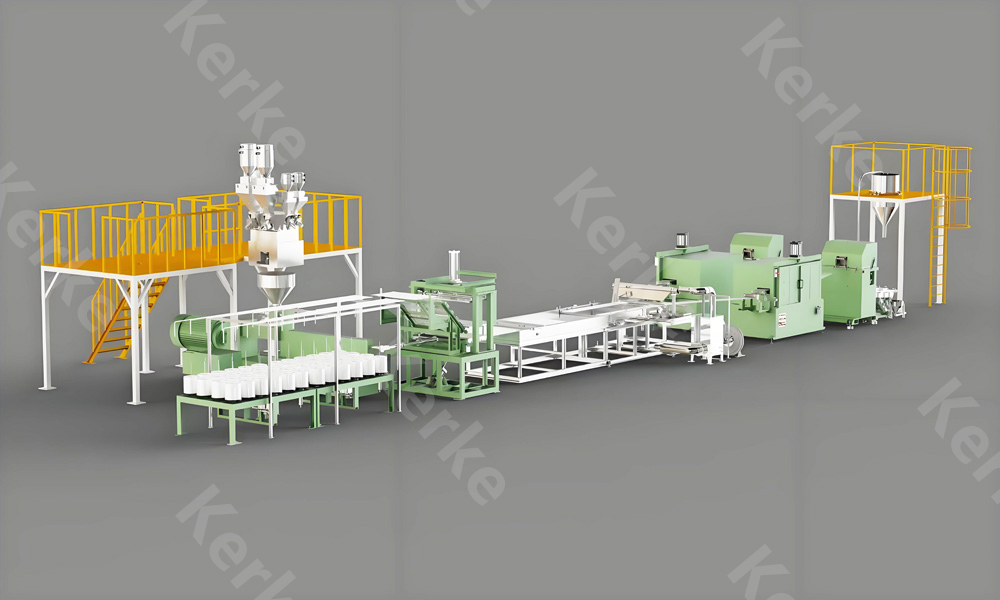
Introduction to Masterbatch Production and Extrusion
Masterbatch production is a specialized process within the plastics industry that involves creating highly concentrated pellets of pigments, fillers, or additives. These masterbatches are then diluted with base polymers during final product manufacturing to achieve specific properties or characteristics.
Selecting the right masterbatch extruder is a critical decision that can significantly impact production efficiency, product quality, and overall manufacturing costs. Kerke Extrusion Equipment, a leading manufacturer of extrusion solutions, has developed a comprehensive guide to help manufacturers choose the best extruder for their specific needs.
What is Masterbatch Production?
Masterbatch production involves mixing high concentrations of pigments, fillers, or additives with a carrier resin to create pellets that can be easily incorporated into base polymers during processing. This method offers several advantages over direct addition of additives to base polymers, including:
- Improved dispersion: The high shear forces in the extruder ensure uniform dispersion of additives throughout the carrier resin, resulting in more consistent product properties.
- Handling convenience: Masterbatches are easier to handle and store than loose pigments or fillers, reducing material waste and contamination risks.
- Cost efficiency: Concentrated masterbatches allow for precise dosing of expensive additives, minimizing material costs.
- Color consistency: Masterbatches ensure consistent color intensity and hue in the final product, reducing color variation and rejects.
Key Considerations in Masterbatch Extruder Selection
When selecting a masterbatch extruder, manufacturers must consider several factors to ensure optimal performance and compatibility with their production requirements:
Production Volume and Output Rate
The required production volume and output rate will determine the size and capacity of the extruder. High-volume production lines will require larger extruders with higher torque and throughput capabilities, while small-batch or research applications may benefit from smaller, more flexible extruders.
Material Properties and Processing Requirements
Masterbatch production involves processing a wide range of materials, each with unique properties that require specific handling considerations. Key material factors to consider include:
- Particle size and bulk density
- Heat sensitivity and degradation temperature
- Compatibility with carrier resins
- Concentration of pigments or additives
Product Quality Standards
The quality of the masterbatch will directly impact the final product quality. Extruders must be capable of producing masterbatches with consistent dispersion, particle size, and color intensity to meet strict quality standards.
Long-Term Operational Costs
In addition to the initial purchase price, manufacturers must consider the long-term operational costs of the extruder, including energy consumption, maintenance requirements, and spare parts costs.
Role of Kerke Extrusion Equipment in Masterbatch Production
Kerke Extrusion Equipment has over 13 years of experience in designing and manufacturing extrusion solutions for masterbatch production. The company offers a range of twin screw extruders specifically designed to meet the demanding requirements of masterbatch manufacturing, including:
High Torque Capacity
Kerke extruders feature high torque gearboxes that can handle the high shear forces required for mixing highly filled materials, ensuring uniform dispersion of pigments and additives.
Modular Design for Flexibility
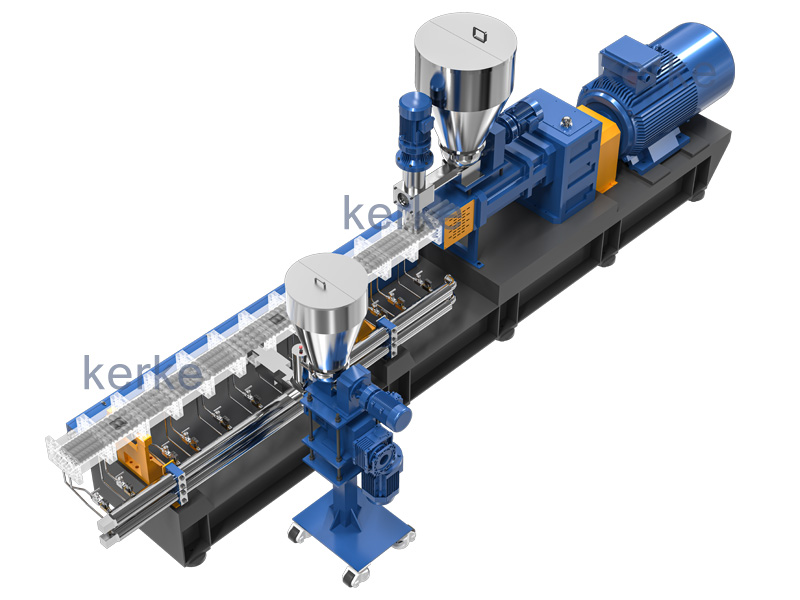
The modular design of Kerke extruders allows for easy customization of screw configurations and barrel layouts, enabling manufacturers to adapt to changing material requirements and processing conditions.
Advanced Control Systems
Kerke extruders are equipped with advanced Siemens PLC control systems that provide precise monitoring and adjustment of key processing parameters, ensuring consistent product quality and efficient operation.
Energy-Efficient Operation
Kerke extruders are designed to minimize energy consumption while maintaining high performance, reducing operating costs and environmental impact.
Understanding Your Production Requirements
Before selecting a masterbatch extruder, manufacturers must have a clear understanding of their production requirements and goals. This includes assessing the types of masterbatches being produced, production volume, quality standards, and available resources.
Types of Masterbatches and Their Specific Needs
Masterbatches can be broadly categorized into several types, each with unique processing requirements:
Color Masterbatches
Color masterbatches contain high concentrations of pigments or dyes that are used to impart color to plastic products. These masterbatches require extruders with high mixing efficiency to ensure uniform color dispersion and consistent color intensity.
Kerke extruders are ideal for color masterbatch production, with screw configurations designed to provide high shear mixing without causing pigment degradation. The modular design allows for easy adjustment of screw elements to optimize mixing for different pigment types and concentrations.
Filler Masterbatches
Filler masterbatches contain high concentrations of fillers such as calcium carbonate, talc, or glass fibers that are used to improve the mechanical properties of plastic products or reduce material costs. These masterbatches require extruders with high torque capacity to handle the high viscosity of highly filled materials.
Kerke’s KTE series extruders feature robust gearboxes and high torque transmission systems that can handle filler concentrations of up to 70% or higher, ensuring efficient mixing and dispersion of fillers throughout the carrier resin.
Additive Masterbatches
Additive masterbatches contain various types of additives such as UV stabilizers, flame retardants, antistatic agents, and processing aids. These masterbatches require precise dosing and uniform dispersion to ensure consistent performance in the final product.
Kerke extruders are equipped with advanced feeding systems and control algorithms that ensure accurate dosing of additives and uniform dispersion within the carrier resin. The modular screw design allows for easy adjustment of mixing elements to optimize processing for different additive types.
Production Volume and Output Rate Considerations
The required production volume and output rate will influence the selection of the appropriate extruder size and configuration. Manufacturers must determine their current production requirements as well as future growth projections to select an extruder that can accommodate changing needs.
Small-Scale or Laboratory Production
For small-scale production or laboratory applications, manufacturers may benefit from compact, flexible extruders that can handle small batch sizes and frequent material changes. Kerke’s KTE-20B laboratory extruder is ideal for these applications, offering precise control and easy customization for research and development purposes.
Medium-Volume Production
Medium-volume production lines require extruders with higher throughput capabilities while maintaining flexibility for product changes. Kerke’s KTE-36B and KTE-50B extruders are well-suited for medium-volume production, offering a balance between output capacity and flexibility.
High-Volume Production
High-volume production lines require extruders with maximum output capacity and consistent performance. Kerke’s KTE-65D, KTE-75D, and KTE-95D extruders are designed for high-volume masterbatch production, offering high torque capacity and advanced control systems to ensure efficient and reliable operation.
Quality Standards and Performance Expectations
Manufacturers must define their quality standards and performance expectations to select an extruder that can meet these requirements. Key quality factors to consider include:
Dispersion Uniformity
The ability of the extruder to uniformly disperse additives throughout the carrier resin is critical for ensuring consistent product properties. Poor dispersion can result in color variation, inconsistent mechanical properties, or reduced additive performance.
Particle Size Control
Masterbatch particle size must be controlled to ensure proper handling and processing during final product manufacturing. Extruders must be capable of producing masterbatches with consistent particle size distribution to avoid issues with feeding or mixing in downstream processes.
Color Consistency
Color consistency is a critical quality factor for color masterbatches. Extruders must be capable of producing masterbatches with uniform color intensity and hue to ensure consistent final product appearance.
Mechanical Properties
Filler masterbatches and additive masterbatches can affect the mechanical properties of the final product. Extruders must be capable of producing masterbatches with consistent dispersion to ensure uniform mechanical properties throughout the product.
Key Specifications to Evaluate
When evaluating masterbatch extruders, manufacturers should consider several key specifications to ensure the extruder meets their production requirements:
Screw Diameter and Length-to-Diameter Ratio
The screw diameter and length-to-diameter ratio (L/D) are important specifications that determine the extruder’s output capacity and mixing capabilities. Larger screw diameters can handle higher throughput rates, while larger L/D ratios provide more residence time for material mixing.
Kerke offers a range of screw diameters from 15.6 mm (KTE-16) to 135 mm (KTE-135D) and L/D ratios from 20:1 to 68:1, allowing manufacturers to select the appropriate configuration for their specific needs.
Motor Power and Torque Capabilities
Motor power and torque capabilities are critical for processing highly filled materials and ensuring efficient mixing. High torque capacity is essential for overcoming the high viscosity of highly filled masterbatches and ensuring uniform dispersion of additives.
Kerke extruders feature robust gearboxes and high torque transmission systems that can handle torque requirements up to 7800 N·m, making them suitable for processing even the most challenging materials.
Temperature Control Range and Precision
Precise temperature control is essential for maintaining material integrity and achieving consistent product quality. Extruders must be capable of maintaining stable temperature profiles throughout the processing zone to avoid material degradation or under-melting.
Kerke extruders use advanced heating and cooling systems with multiple temperature zones to provide precise temperature control. The control systems include PID controllers that ensure consistent temperature profiles, even under varying processing conditions.
Feeding Systems and Material Handling Capabilities
Feeding systems play a crucial role in ensuring consistent material input and uniform product quality. Extruders must be equipped with feeding systems that can handle different material types and provide precise dosing of additives and fillers.
Kerke offers a range of feeding systems, including volumetric feeders, loss-in-weight feeders, and side feeders, to accommodate different material types and processing requirements. These systems ensure accurate and consistent material input, reducing material waste and improving product quality.
Types of Extruders for Masterbatch Production
There are several types of extruders available for masterbatch production, each with unique advantages and limitations:
Single Screw vs. Twin Screw Extruders
Single screw extruders and twin screw extruders are the two main types of extruders used in masterbatch production:
Single Screw Extruders
Single screw extruders are simpler and less expensive than twin screw extruders, making them suitable for basic masterbatch production applications. However, they have lower mixing efficiency and are less capable of handling highly filled materials.
Twin Screw Extruders
Twin screw extruders are the preferred choice for masterbatch production due to their superior mixing capabilities, flexibility, and ability to handle highly filled materials. The intermeshing screws create high shear forces that ensure uniform dispersion of additives throughout the carrier resin.
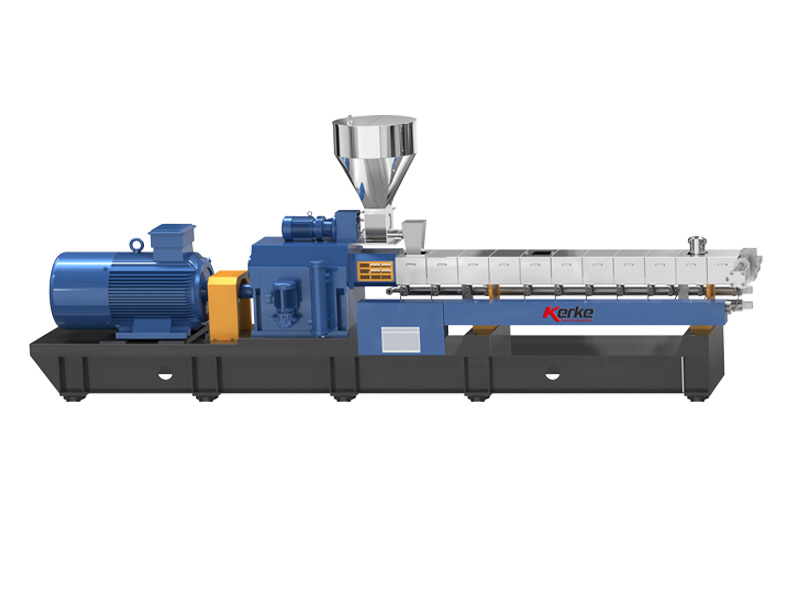
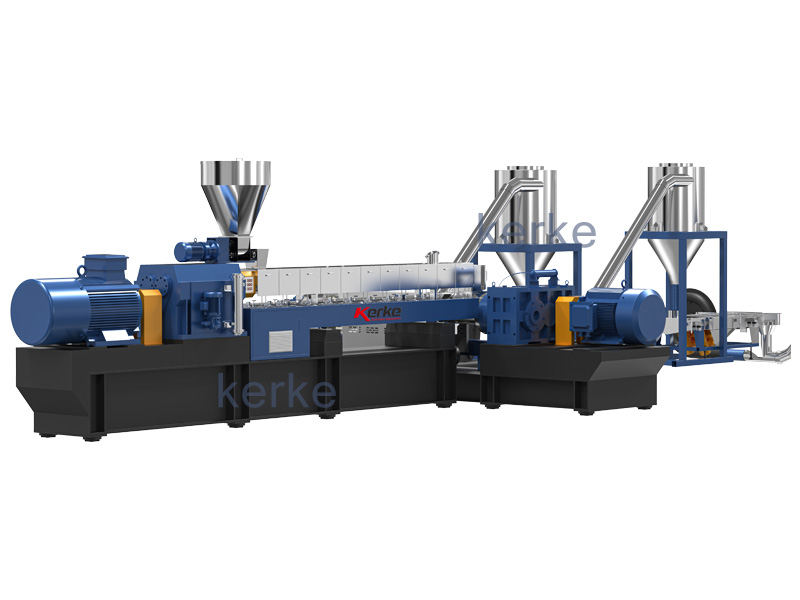
Kerke specializes in twin screw extruders, offering a range of models designed specifically for masterbatch production. These extruders feature modular screw designs, high torque capacity, and advanced control systems to meet the demanding requirements of masterbatch manufacturing.
Co-rotating vs. Counter-rotating Twin Screw Extruders
Twin screw extruders can be further classified as co-rotating or counter-rotating:
Co-rotating Extruders
Co-rotating twin screw extruders have screws that rotate in the same direction, creating high shear forces and excellent mixing capabilities. They are the most common type of twin screw extruder used in masterbatch production due to their superior self-cleaning properties and ability to handle a wide range of materials.
Counter-rotating Extruders
Counter-rotating twin screw extruders have screws that rotate in opposite directions, providing more gentle mixing and higher pressure generation capabilities. They are suitable for processing heat-sensitive materials but are less common in masterbatch production due to lower mixing efficiency.
Specialized Designs for Specific Applications
Some extruder manufacturers offer specialized designs for specific masterbatch production applications, such as:
Highly Filled Masterbatch Extruders
These extruders feature enhanced torque capacity and specialized screw designs to handle the high viscosity of highly filled materials, ensuring efficient mixing and dispersion.
Color Masterbatch Extruders
Color masterbatch extruders are designed to minimize pigment degradation and ensure uniform color dispersion, with specialized screw configurations and temperature control systems to preserve pigment integrity.
Lab or Pilot Scale Extruders
Lab or pilot scale extruders are compact, flexible extruders designed for small-batch production or research and development applications. They offer precise control and easy customization for testing new material formulations.
Kerke Masterbatch Extruder Solutions
Kerke Extrusion Equipment offers a comprehensive range of masterbatch extruder solutions to meet the diverse needs of the plastics industry:
Overview of Kerke’s Masterbatch Extrusion Product Line
Kerke’s masterbatch extrusion product line includes the KTE series twin screw extruders, specifically designed for masterbatch production. These extruders feature:
- Modular screw design: Allows for easy customization of screw configurations to optimize mixing for different material types.
- High torque capacity: Handles the high viscosity of highly filled materials, ensuring efficient mixing and dispersion.
- Advanced control systems: Provide precise monitoring and adjustment of key processing parameters, ensuring consistent product quality.
- Energy-efficient operation: Minimizes energy consumption while maintaining high performance, reducing operating costs.
Technical Specifications and Customization Options
Kerke’s KTE series extruders are available in various models with different specifications to meet specific production requirements:
| Model | Screw Diameter (mm) | Max Speed (rpm) | Motor Power (kW) | Torque (N·m) | Output Range (kg/h) |
|---|---|---|---|---|---|
| KTE-20B | 21.7 | 600 | 4/4.5 | 2×30 | 3–15 |
| KTE-36B | 35.6 | 600 | 18.5/22 | 2×210 | 20–100 |
| KTE-36D | 35.6 | 800 | 22/37 | 2×210 | 110–200 |
| KTE-50B | 50.5 | 600 | 45/55/75 | 2×600 | 120–280 |
| KTE-50D | 50.5 | 800 | 55/75 | 2×600 | 225–375 |
| KTE-65B | 62.4 | 600 | 90/110 | 2×860 | 200–500 |
| KTE-65D | 62.4 | 800 | 110/160 | 2×860 | 350–600 |
| KTE-75B | 71 | 600 | 110/132/160 | 2×1530 | 300–800 |
| KTE-75D | 71 | 800 | 160/220 | 2×1530 | 500–1000 |
| KTE-85B | 81 | 600 | 160/220/280 | 2×2100 | 480–1000 |
| KTE-95B | 93 | 600 | 250/280/315 | 2×3000 | 750–1400 |
| KTE-95D | 93 | 800 | 315/500 | 2×4800 | 1000–2000 |
| KTE-135B | 135 | 600 | 315–500 | 2×4800 | 1500–3000 |
| KTE-135D | 135 | 800 | 500–1000 | 2×7800 | 1500–4000 |
Customization Options for Unique Production Requirements
Kerke offers extensive customization options to meet unique production requirements, including:
- Screw configuration design: Custom screw designs optimized for specific material types and processing requirements.
- Barrel layout customization: Tailored barrel layouts with specialized temperature zones for processing heat-sensitive materials.
- Feeding system integration: Custom feeding systems designed for handling specific material types or achieving precise dosing requirements.
- Control system programming: Custom control system configurations to meet unique process monitoring and optimization needs.
Case Studies Demonstrating Successful Applications
Several case studies demonstrate how Kerke extruders have helped manufacturers solve masterbatch production challenges:
Case Study 1: Enhancing Color Masterbatch Quality
A manufacturer of color masterbatches was experiencing issues with inconsistent color dispersion and high material waste. After switching to a Kerke KTE-65B extruder with a customized screw configuration, they were able to achieve uniform color dispersion, reducing waste by 25% and improving customer satisfaction.
Case Study 2: Scaling Production Capacity
A masterbatch producer needed to increase their production capacity to meet growing market demand. By implementing a Kerke KTE-95D extruder, they were able to increase output by 60% while maintaining consistent product quality.
Case Study 3: Processing Highly Filled Materials
A manufacturer of filler masterbatches was struggling to process highly filled materials (up to 80% calcium carbonate) with their existing extruder. After switching to a Kerke KTE-75D extruder with enhanced torque capacity, they were able to process these materials efficiently, reducing processing time by 30% and improving product consistency.
Material Compatibility Considerations
Material compatibility is a critical factor to consider when selecting a masterbatch extruder. Different materials have unique properties that require specific processing conditions to ensure optimal results.
Processing Different Polymer Types
Masterbatch production involves processing various types of polymers, including:
Polyethylene (PE)
PE is a common carrier resin used in masterbatch production due to its low cost and good compatibility with many additives. Extruders must be capable of processing PE at relatively low temperatures to avoid material degradation.
Polypropylene (PP)
PP is another widely used carrier resin, offering good mechanical properties and chemical resistance. Extruders must be able to handle PP’s higher melting temperature and specific processing requirements.
Polyvinyl Chloride (PVC)
PVC is a challenging material to process due to its heat sensitivity and the need for stabilizers to prevent degradation. Extruders must be equipped with precise temperature control systems and specialized screw designs to process PVC safely and efficiently.
Engineering Plastics
Engineering plastics such as ABS, PC, and PA offer excellent mechanical properties but may require higher processing temperatures and specialized handling. Extruders must be capable of processing these materials while maintaining product quality and material integrity.
Handling of Highly Filled Materials
Highly filled masterbatches (with filler concentrations above 50%) require extruders with high torque capacity and specialized screw designs to handle their high viscosity. Key considerations include:
- Torque capacity: The extruder must be able to generate sufficient torque to mix and transport the highly filled material through the barrel.
- Screw design: Specialized screw elements with increased shear surfaces can help break up agglomerates and improve dispersion.
- Feeding system: Loss-in-weight feeders or side feeders may be required to ensure consistent material input for highly filled materials.
Special Requirements for Color Masterbatches
Color masterbatches have specific requirements to ensure consistent color quality, including:
- Pigment dispersion: The extruder must achieve uniform dispersion of pigments throughout the carrier resin to avoid color variation.
- Temperature control: Precise temperature control is essential to prevent pigment degradation, which can affect color intensity and hue.
- Screw design: Screw configurations should be optimized to minimize shear heat generation while ensuring sufficient mixing for uniform color dispersion.
Addressing Heat-Sensitive Materials
Heat-sensitive materials, such as certain types of pigments or additives, require careful handling to avoid degradation. Key considerations include:
- Temperature control: Precise temperature monitoring and control to ensure material temperature remains below degradation limits.
- Screw design: Screw configurations that minimize shear heat generation while maintaining sufficient mixing efficiency.
- Processing speed: Optimal screw speed to balance mixing requirements with material heat exposure time.
Process Control and Automation Features
Advanced process control and automation features are essential for ensuring consistent product quality and efficient operation in masterbatch production:
PLC Control Systems for Process Monitoring
Kerke extruders are equipped with Siemens PLC control systems that provide real-time monitoring of key process parameters, including:
- Temperature: Multiple temperature zones for precise control of material heating and cooling.
- Pressure: Pressure sensors to monitor barrel pressure and adjust process parameters as needed.
- Screw speed: Speed control to maintain consistent throughput rates and mixing conditions.
- Feed rate: Monitoring of material feed rate to ensure consistent material input.
Data Logging and Analysis Capabilities
Kerke’s control systems include data logging capabilities that record process parameters over time. This data can be analyzed to:
- Identify process trends: Detect changes in process parameters that may indicate equipment wear or material quality issues.
- Optimize process parameters: Use historical data to fine-tune processing parameters for maximum efficiency and product quality.
- Document production history: Maintain records of production runs for quality control and compliance purposes.
Integration with Factory Automation Systems
Kerke extruders can be integrated with factory automation systems to enable:
- Remote monitoring: Monitor extruder performance and process parameters from a central control room.
- Automatic recipe management: Store and recall processing parameters for different product formulations.
- Production planning integration: Connect with production planning systems to optimize scheduling and resource allocation.
- Quality control integration: Link with quality control systems to automatically adjust process parameters based on quality test results.
Remote Access and Troubleshooting Options
Kerke offers remote access capabilities that enable technical support teams to diagnose and resolve issues without on-site visits. This can significantly reduce downtime and minimize production interruptions.
Cost Analysis and ROI Calculation
When selecting a masterbatch extruder, manufacturers must consider not only the initial purchase price but also long-term operational costs and return on investment (ROI):
Initial Investment vs. Long-Term Operational Costs
The initial investment for a masterbatch extruder includes the purchase price of the extruder, auxiliary equipment, and installation costs. However, these costs must be weighed against long-term operational costs, including:
- Energy costs: The cost of electricity to operate the extruder and auxiliary equipment.
- Maintenance costs: Costs for routine maintenance, spare parts, and repairs.
- Labor costs: Costs for operators and technicians to run and maintain the equipment.
- Material waste: Costs associated with material waste from poor processing or product rejects.
Energy Efficiency and Cost Savings
Energy-efficient extruders can significantly reduce long-term operational costs. Kerke extruders are designed with energy-efficient motors, optimized screw designs, and advanced control systems to minimize energy consumption while maintaining high performance.
Maintenance Requirements and Spare Parts Costs
The maintenance requirements and spare parts costs of an extruder can vary significantly depending on the design and quality of the equipment. Kerke extruders feature robust construction and high-quality components to minimize maintenance requirements and reduce long-term costs.
Payback Period Estimation for Different Equipment Options
Manufacturers should calculate the payback period for different extruder options to determine the most cost-effective solution. The payback period can be calculated using the formula:
Payback period (years) = Initial investment / Annual cost savings
Annual cost savings include reductions in energy costs, maintenance costs, material waste, and labor costs resulting from using a more efficient and reliable extruder.
After-Sales Support and Service
Comprehensive after-sales support and service are essential for maximizing the performance and longevity of masterbatch extruders:
Installation and Commissioning Services
Kerke provides professional installation and commissioning services to ensure extruders are set up correctly and operate at peak performance. This includes:
- Site preparation assistance: Guidance on facility requirements, electrical connections, and material handling infrastructure.
- Equipment installation: Professional installation of the extruder and auxiliary equipment.
- Commissioning: Adjustment of process parameters and testing to ensure optimal performance.
- Operator training: Training programs for operators to learn how to safely and efficiently operate the extruder.
Operator Training Programs
Proper operator training is essential for ensuring safe and efficient operation of the extruder. Kerke offers comprehensive training programs that cover:
- Basic operation: Instruction on how to start, stop, and monitor the extruder.
- Process optimization: Guidance on adjusting process parameters to optimize product quality and efficiency.
- Maintenance procedures: Training on routine maintenance tasks to extend equipment life.
- Troubleshooting: Techniques for identifying and resolving common equipment issues.
Preventive Maintenance Schedules
Preventive maintenance is essential for minimizing downtime and extending equipment life. Kerke provides detailed maintenance schedules that include:
- Regular inspection: Periodic inspection of key components for wear or damage.
- Lubrication: Regular lubrication of moving parts to reduce friction and wear.
- Filter replacement: Replacement of filters to maintain system performance.
- Component calibration: Calibration of sensors and control systems to ensure accurate measurement and control.
Spare Parts Availability and Logistics
Kerke maintains a comprehensive inventory of spare parts to ensure quick delivery when needed. The company also offers:
- Emergency support: 24/7 technical support for critical equipment failures.
- Spare parts kits: Pre-packaged spare parts kits for routine maintenance or common repairs.
- Custom spare parts: Custom manufacturing of specialized components for unique equipment configurations.
Evaluation Criteria Checklist
To help manufacturers select the right masterbatch extruder, Kerke has developed a comprehensive evaluation criteria checklist:
Comprehensive List of Factors to Consider
- Production requirements: Output rate, product specifications, and quality standards.
- Material properties: Material type, filler concentration, and heat sensitivity.
- Extruder specifications: Screw diameter, L/D ratio, torque capacity, and temperature control range.
- Energy efficiency: Motor efficiency, energy consumption rates, and heat recovery capabilities.
- Maintenance requirements: Expected maintenance frequency, spare parts costs, and downtime estimates.
- Control system features: Monitoring capabilities, automation level, and data analysis tools.
- After-sales support: Installation services, operator training, and technical support availability.
- Total cost of ownership: Initial investment plus long-term operational costs.
- Scalability: Ability to adapt to future production growth or changing material requirements.
- Reputation and reliability: Manufacturer’s track record, customer testimonials, and product warranty.
Weighted Scoring System for Objective Comparison
To facilitate objective comparison of different extruder options, manufacturers can use a weighted scoring system:
- Define evaluation criteria: List the key factors to consider when selecting an extruder.
- Assign weights: Assign a weight to each criterion based on its importance to the production requirements.
- Score each option: Rate each extruder option on a scale of 1 to 10 for each criterion.
- Calculate weighted scores: Multiply the score for each criterion by its weight and sum the results.
- Rank options: Rank the extruder options based on their total weighted scores.
Sample Evaluation Template for Multiple Equipment Options
A sample evaluation template can help manufacturers organize their comparison of different extruder options:
| Evaluation Criterion | Weight | Option 1 Score | Option 1 Weighted Score | Option 2 Score | Option 2 Weighted Score |
|---|---|---|---|---|---|
| Output capacity | 0.25 | 8 | 2.00 | 9 | 2.25 |
| Mixing efficiency | 0.20 | 9 | 1.80 | 8 | 1.60 |
| Energy efficiency | 0.15 | 7 | 1.05 | 8 | 1.20 |
| Maintenance cost | 0.15 | 8 | 1.20 | 7 | 1.05 |
| Control system features | 0.10 | 9 | 0.90 | 8 | 0.80 |
| After-sales support | 0.10 | 9 | 0.90 | 9 | 0.90 |
| Initial cost | 0.05 | 7 | 0.35 | 6 | 0.30 |
| Total | 1.00 | 8.20 | 8.10 |
Conclusion
Selecting the right masterbatch extruder is a critical decision that requires careful consideration of production requirements, material properties, and equipment specifications. Kerke Extrusion Equipment offers a comprehensive range of masterbatch extruders designed to meet the diverse needs of the plastics industry, with advanced features for efficient and reliable operation.
By evaluating key factors such as production volume, material compatibility, process control features, and long-term operational costs, manufacturers can choose an extruder that will optimize their production efficiency, improve product quality, and maximize return on investment.
Kerke’s commitment to innovation, quality, and customer support makes it a trusted partner for manufacturers seeking to master their masterbatch production processes. With a wide range of extruder options, extensive customization capabilities, and comprehensive after-sales support, Kerke provides the solutions needed to succeed in the competitive plastics industry.