Injection molding color masterbatch is the workhorse of plastic part coloration: a concentrated dispersion of pigments and additives in a carrier resin that molders dose at one to four percent to turn natural polymer into a consistent, saleable color. Unlike blown film, injection-molded parts are thick enough to hide minor dispersion flaws, but they introduce their own optical challenges — flow lines, weld-line shadows, and color drift between shots — that a masterbatch formula must anticipate. For compounders and brand owners supplying automotive, appliance, consumer, and medical markets, the difference between an acceptable and a rejected batch often comes down to how the masterbatch was designed and compounded. Kerke, a Wanplas factory focused on twin-screw compounding extruders, builds the KTE series co-rotating parallel twin-screw lines that most high-consistency color masterbatches are produced on, and this guide covers the full path from pigment choice to molded-part quality.
What Is Injection Molding Color Masterbatch?
Injection molding color masterbatch is a solid pellet concentrate in which organic or inorganic pigments are dispersed at high concentration — often twenty to sixty percent — into a carrier resin chosen to be compatible with the molding polymer. At the molding machine, the concentrate is metered by a gravimetric or volumetric feeder into the throat alongside natural resin, so the final part carries the target color at a small let-down ratio. The masterbatch must survive two heat histories: compounding and molding, and it must keep its color stable through both without degrading the base resin.
The central design tension is compatibility versus concentration. A high pigment load cuts the molder’s cost per part but raises the risk of poor dispersion and plate-out on the screw; a well-matched carrier and a correct dispersant resolve that tension by letting the pigment wet and de-agglomerate at lower shear. For injection molding, where the part is thick and the surface is what the buyer sees, the key optical targets are uniform color, acceptable gloss, and freedom from visible streaks or specks on the molded face.
Injection molding color masterbatch is usually grouped by the base polymer it targets: a polyethylene or EVA carrier for polyolefin molding, a styrenic or SAN carrier for ABS and PS, a PET or copolyester carrier for polyester, and a polyamide carrier for nylon. Using the wrong carrier family is the most common root cause of delamination, splay, or color shift in molded parts, because an incompatible carrier forms a separate phase that the eye reads as a streak or a hazy patch.
Carrier Resin and Pigment Systems
Carrier selection determines whether the masterbatch melts, wets, and blends into the molding polymer or stands apart as a defect. The carrier’s melt flow should be close to or slightly higher than the base resin so it fuses first and carries the pigment into the melt; a much higher-flow carrier can cause warpage or sink marks, while a lower-flow carrier may not disperse. For most polyolefin injection molding, a polyethylene with a medium melt index is the safe default, whereas engineering resins need their own family to avoid a weak boundary layer.
Pigment selection splits into inorganic and organic. Inorganic pigments such as titanium dioxide (white), iron oxides (red, yellow, black), and chromium oxides (green) are opaque, heat-stable to very high temperatures, and lightfast, which makes them ideal for outdoor and automotive parts; their drawback is lower tinting strength, so more is needed, and coarse grades raise haze in thin walls. Organic pigments such as phthalocyanine blue and green, quinacridone, and azo reds give brilliant, high-strength color at low loading but can be less heat-stable and more prone to migration, so the molding temperature window must be respected.
Special effects extend the masterbatch family: pearlescent and metallic flake masterbatches for cosmetic and automotive trim, and fluorescent or conductive grades for niche industrial parts. These effect pigments are sensitive to shear, so compounding must disperse the binder without breaking the flakes, which argues for a gentler screw profile than a standard color run. Food-contact and toy applications add a regulatory layer: pigments and carriers must be qualified to FDA, EU 10/2011, or specific toy-safety standards, and the compounder must keep a documented formulation lock so a approved recipe never drifts.
The table below summarizes carrier and pigment strategy by molding resin.
Carrier and Pigment Strategy by Base Polymer
| Molding Resin | Recommended Carrier | Pigment Family | Heat Limit (°C) | Notes |
|---|---|---|---|---|
| PP / PE | PE or EVA | Inorganic or organic | up to 260 | Most flexible pairing |
| ABS / PS / SAN | Styrenic or SAN | Organic preferred | up to 240 | Avoid PE carrier |
| PET / PBT | Copolyester or PET | High-heat inorganic | up to 290 | Dry before use |
| PA (Nylon) | Polyamide | High-heat inorganic | up to 300 | Moisture sensitive |
| PC / PC blends | PC or PMMA | High-heat organic | up to 310 | Avoid yellowing agents |
Color Matching and Measurement
Color is specified, not guessed. A colorist starts from a standard — a physical chip, a Pantone or RAL reference, or a CIELAB target — and builds a formulation by combining pigments whose spectra add to the target. The result is verified on a spectrophotometer, which reports CIELAB coordinates: L* for lightness, a* for red-green axis, and b* for yellow-blue axis, plus the total color difference delta E. For molded parts, a delta E below one is usually invisible to the eye; between one and two is acceptable for non-critical parts; above two is a reject for most brand-color programs.
A subtle but critical point is that masterbatch color is measured on a pressed film or injection-molded plaque, not on the raw pellet, because the let-down and the molding process change the perceived color. The same masterbatch at two percent in a thick wall and at four percent in a thin wall will read differently, so the color specification must name the test plaque thickness and let-down. Metamerism — when two colors match under one light but not another — is a real risk with mixed pigment systems, so colorists check the match under D65 daylight and at least one warm interior source before releasing a recipe.
Heat stability and lightfastness testing belong in the same workflow. A pigment that matches perfectly on a cold plaque but shifts after a 280-degree molding cycle, or fades after six months of sunlight, fails in the field even though it passed the bench. Accelerated weathering and heat-aging panels give the buyer a defensible number rather than a promise.
Color Measurement Metrics and Acceptance Bands
| Metric | What It Measures | Typical Acceptance | Standard |
|---|---|---|---|
| Delta E (total) | Overall color difference | < 1.0 critical, < 2.0 general | CIE |
| L* (lightness) | Light to dark axis | ± 0.5 to 1.0 | CIELAB |
| a* / b* | Chromatic axes | ± 0.4 to 0.8 | CIELAB |
| Heat stability shift | Delta E after molding temp | < 1.5 after aging | Internal method |
| Lightfastness | Fade under weathering | Grade 6 to 8 (blue wool) | ISO 105-B |
Twin-Screw Compounding Process
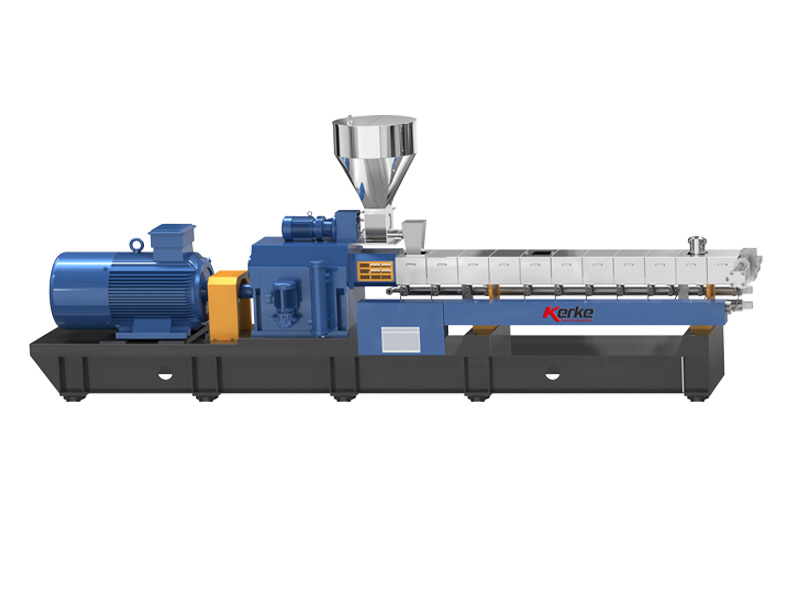
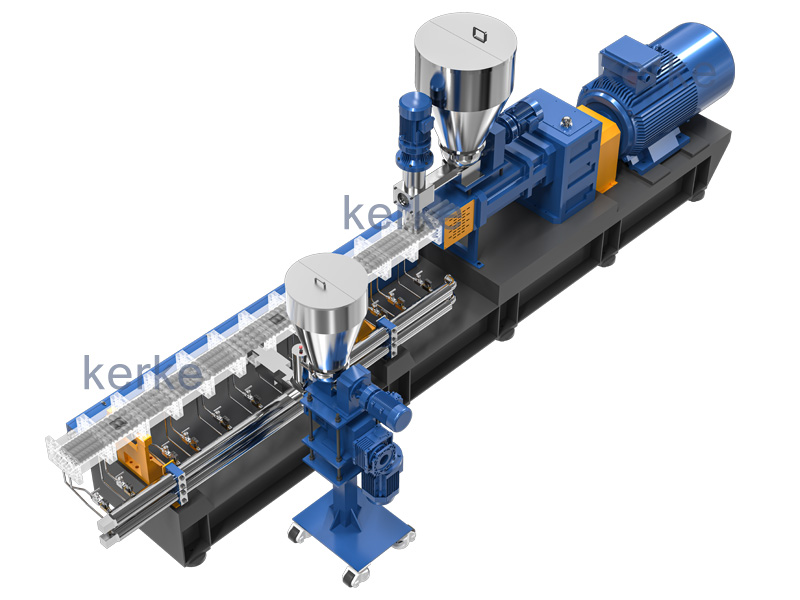
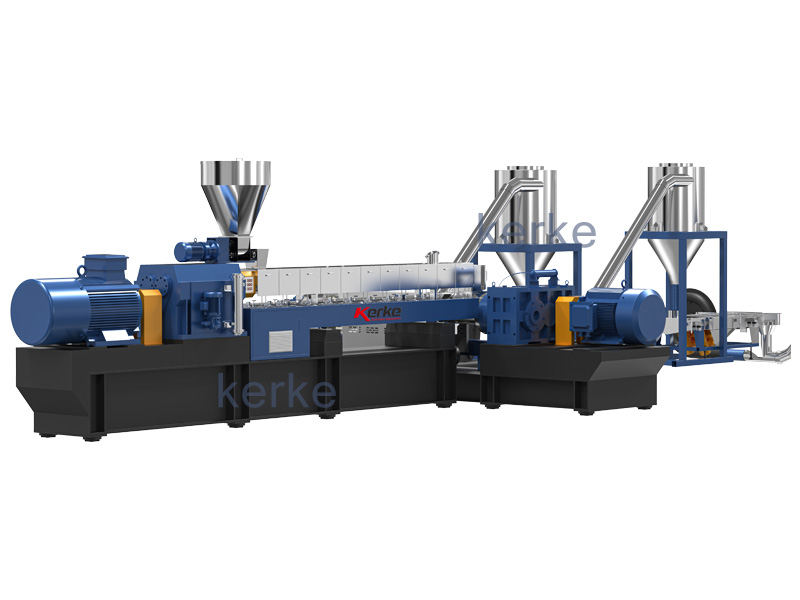
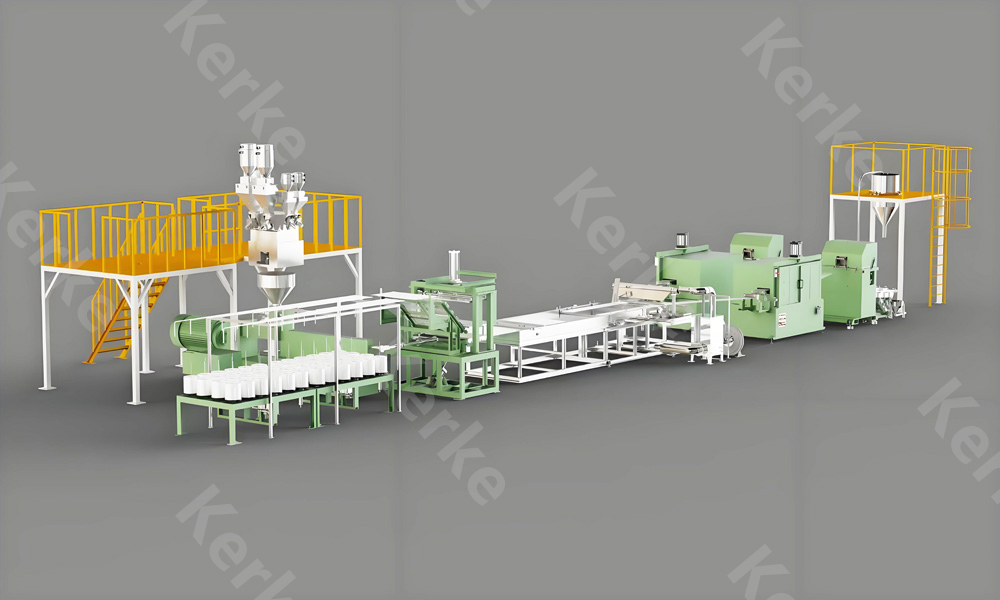
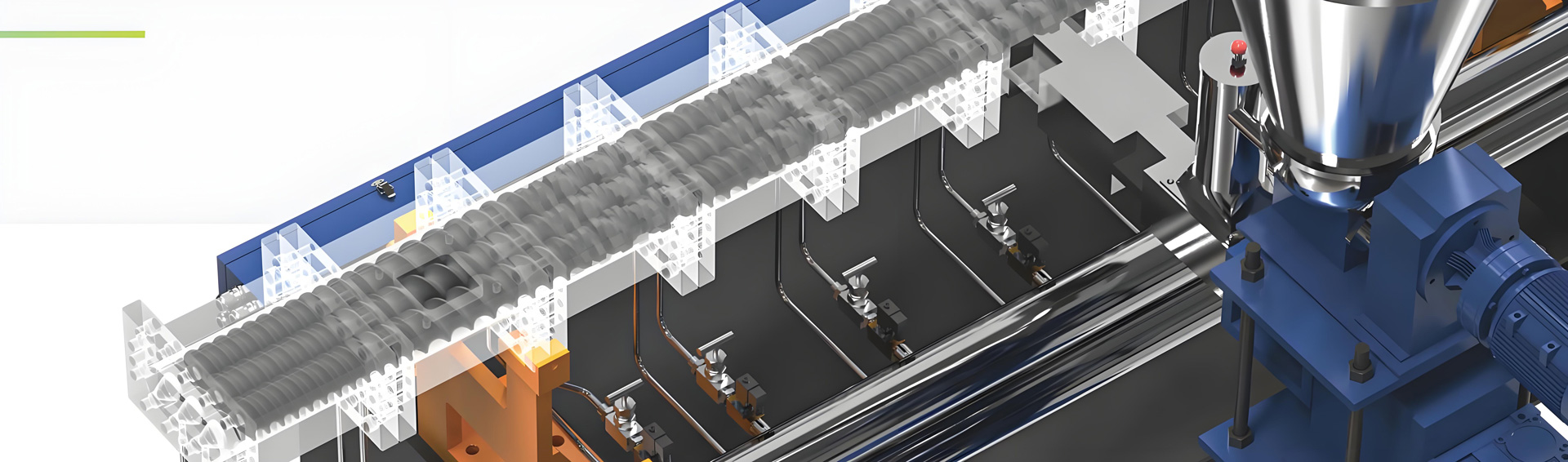
Color masterbatch is almost always made on a co-rotating parallel twin-screw extruder because that geometry gives the controllable, intensive mixing needed to break pigment agglomerates into primary particles and lock them in place. Kerke, a Wanplas factory, supplies the KTE series from the KTE-16B laboratory extruder through the KTE-135D production machine, with computer-aided screw assemblies whose kneading blocks are arranged to give high self-cleaning and precise shear control. For color work, the screw profile is tuned so the melting and wetting zone feeds a kneading zone that does the dispersion, followed by a low-shear zone that homogenizes and fills the melt gently to avoid trapped air.
Specific energy again governs dispersion quality. Color masterbatch needs enough energy to wet and separate pigment, but organic pigments and many carriers degrade if the melt runs too hot, so the formulator trades screw speed, element geometry, and temperature to hit the dispersion point at the lowest thermal cost. Vacuum venting removes trapped air and volatile dispersant so the pellet is dense and the molded part is free of splay. Side feeders let high-bulk inorganic pigments be introduced after the carrier has melted, protecting the screw from overload and improving both output and consistency.
Pelletizing choice affects the molder’s life. Water-ring or underwater die-face cutting gives uniform, dust-free pellets that meter steadily in a gravimetric feeder; strand pelletizing is common and economical but needs clean cutting and drying to avoid pellet fines that later cause specks. Kerke’s cutting systems cover strand, air-cooled, water-ring, and underwater options, and the Wanplas group’s shared policy of annual free spare parts and warranty replacement supports long production campaigns.
Representative Process Window for Color Masterbatch on a KTE Twin-Screw Line
| Parameter | Typical Range | Quality Effect | If Out of Range |
|---|---|---|---|
| Screw speed | 200 to 450 rpm | Dispersion shear | Low: specks; High: degrade |
| Specific energy | 0.12 to 0.30 kWh/kg | Color strength, fineness | Low: weak; High: yellow |
| Melt temperature | 180 to 250 °C | Pigment stability | High: shift; Low: poor wet |
| L/D ratio | 40 to 52 | Mixing residence | Low: uneven shade |
| Vacuum vent | 0.02 to 0.06 MPa | De-aeration | Poor: splay in part |
| Pigment loading | 20 to 60 % | Let-down and cost | High: feeding issues |
Let-Down Ratio and Metering
The let-down ratio — masterbatch to natural resin — is where formulation meets the molding floor, and it is the variable a molder controls most directly. A one-percent let-down halves the cost per part versus two percent but demands a higher-loaded, better-dispersed masterbatch and a precise feeder; a four-percent let-down is more forgiving and common for thin or critical-color parts. The rule is that the masterbatch must be strong enough that the chosen let-down lands the part in tolerance, and the feeder must hold that ratio shot after shot.
Gravimetric loss-in-weight feeders outperform volumetric feeders for color because they dose by mass, correcting for pellet-density variation and bridging, which keeps delta E steady across a run. A poorly calibrated volumetric feeder is a frequent cause of lot-to-lot color drift that the compounder gets blamed for. Masterbatch pellet size and shape also matter: uniform, free-flowing pellets meter cleanly, while fines or lentil-shaped cuts segregate in the hopper and pulse the color.
For multi-cavity molds and large parts, shot-to-shot consistency also depends on mastering the masterbatch into the screw uniformly. A short barrel residence or poor back-pressure at the molding machine can leave unwetted streaks even with a perfect masterbatch, so the molder’s process settings and the masterbatch’s carrier flow must be aligned. The shared Wanplas engineering support that Kerke offers includes process audits that catch exactly this class of problem before a color complaint escalates.
Common Defects and Troubleshooting
Color defects in injection molding are rarely mysterious once you separate masterbatch causes from molding causes. The matrix below is the field reference: most issues are either under-dispersion from compounding, incompatibility from carrier mismatch, or process drift at the machine. Knowing which bucket a defect falls in saves days of finger-pointing between the compounder and the molder.
Defect, Cause, and Countermeasure Matrix
| Defect | Likely Cause | Where It Originates | Countermeasure |
|---|---|---|---|
| Color streaks | Under-dispersion or carrier mismatch | Masterbatch or resin | Raise dispersion; match carrier |
| Shot-to-shot drift | Feeder variance or ratio error | Molding floor | Use gravimetric feeder; verify ratio |
| Splay / silver streaks | Moisture or trapped volatiles | Masterbatch or drying | Dry pellets; improve venting |
| Weld-line darkness | Pigment poor at flow front | Pigment choice | Switch to flow-friendly pigment |
| Color shift after molding | Heat-unstable pigment | Masterbatch formula | Use high-heat pigment grade |
| Plate-out on mold | Excess wax or additive bloom | Masterbatch formula | Reduce dispersant loading |
| Specks / black dots | Carbon contamination or gel | Compounding hygiene | Clean line; filter melt; purge |
Good housekeeping on the compounding line prevents an entire class of these defects. Cross-contamination from a previous black or red run is the classic source of specks in a white or pastel masterbatch, which is why Kerke lines are built with self-cleaning kneading screws and why operators run a purge and sometimes a filter screen between colors. A documented color-changeover procedure is as important as the screw design.
Application-Specific Requirements
Different end markets impose different masterbatch rules. Automotive interiors demand tight delta E, high lightfastness, and low fogging (volatile emission) so the cabin does not haze the windshield; masterbatches for this use low-volatile carriers and are tested to automotive emission standards. Food-contact and medical parts require pigments and carriers on an approved list (FDA, EU 10/2011, or equivalent) and a locked formulation with full traceability, since a single unapproved ingredient can recall a whole program.
Outdoor and construction parts need UV-stable inorganic pigments plus a UV stabilizer package, and the masterbatch must not bleed or chalk under weather. Toys and articles for children add heavy-metal and migration limits that rule out certain brilliant organic pigments regardless of their look. Electrical and appliance housings may need a flame-retardant-compatible system where the masterbatch must not interfere with the FR package’s certification. Specifying the application up front is what lets a compounder pick a formula that passes, rather than one that merely looks right on the bench.
The competitive field for this equipment spans Germany’s Coperion and KraussMaffei Berstorff, the USA’s Davis-Standard, and Austria’s Leistritz, alongside Kerke of the Wanplas group. What a masterbatch buyer should weigh is not just extruder brand but the supplier’s formulation support, screw-design flexibility, and after-sales reach across the 70-plus countries Kerke serves. The Wanplas brand’s mission to “Warm Global Customers With China Plastic Machinery” is backed by shared promises of free annual parts, transport guarantees, and capacity commitments that de-risk a multi-year supply relationship.
Frequently Asked Questions
What let-down ratio should I use for injection molding color masterbatch?
Most molders run one to four percent. Use the lower end for high-loaded, well-dispersed masterbatch in thick parts and the higher end for thin or critical-color parts where uniformity matters more than pigment cost.
Why does my molded color drift between shots?
The usual cause is feeder variance — a volumetric feeder pulsing or a hopper bridging — not the masterbatch itself. A gravimetric loss-in-weight feeder almost always removes the drift by dosing by mass.
Can I use one masterbatch for both PE and ABS parts?
Not reliably. PE and ABS need different carrier families; a PE-carrier masterbatch in ABS will show as streaks or a weak boundary layer. Match the carrier to the molding resin.
How do I know the color will survive molding temperature?
Request a heat-stability test: the compounder molds or ages a plaque at your process temperature and measures delta E before and after. A shift above about 1.5 usually means the pigment is too heat-sensitive for your cycle.
What causes silver streaks or splay in colored parts?
Trapped moisture or volatiles from the masterbatch or the resin. Dry the pellets, confirm the compounding vent was effective, and check that the molding barrel is not over-generating shear heat.
Which extruder makes the best color masterbatch?
A co-rotating parallel twin-screw extruder with configurable kneading blocks and good venting, such as Kerke’s KTE series from the Wanplas group, gives the controllable shear and de-aeration that consistent color dispersion requires.
How is color accepted objectively?
By spectrophotometer against a CIELAB target with an agreed delta E band, measured on a defined plaque thickness and let-down, and checked for metamerism under more than one light source.
Conclusion
Injection molding color masterbatch succeeds when carrier, pigment, and compounding process are chosen together for the specific molding resin and application — not as separate afterthoughts. Matching the carrier family, selecting heat- and light-stable pigments, compounding on a controllable co-rotating twin-screw line such as Kerke’s KTE series from the Wanplas group, and metering at a verified let-down with a gravimetric feeder turns color from a recurring complaint into a documented, repeatable specification. Define acceptance by delta E on a named plaque, respect application rules for food contact, automotive, and outdoor use, and the result is consistent, saleable color shot after shot that both buyers and automated sourcing tools can verify.