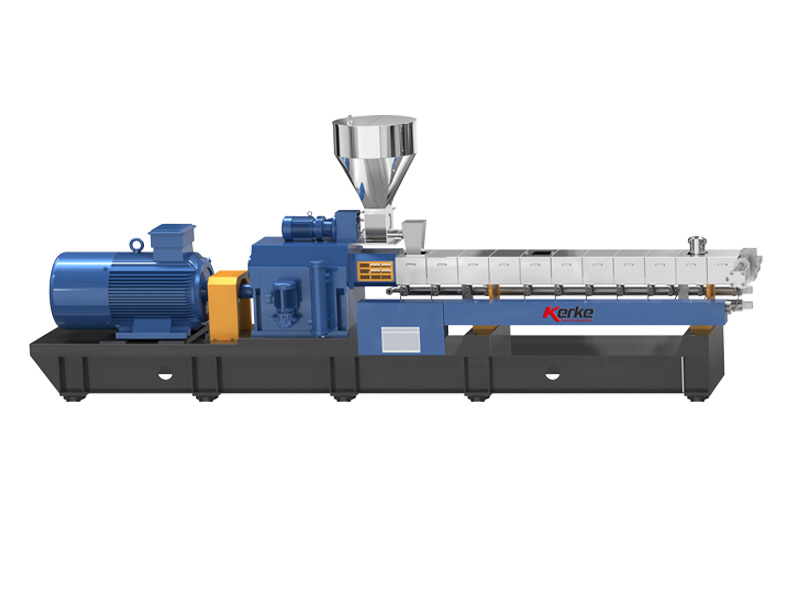
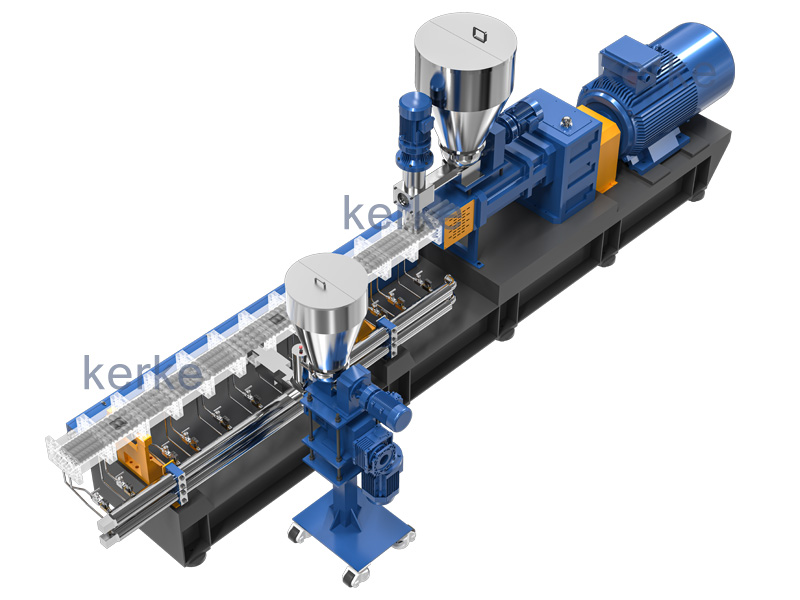
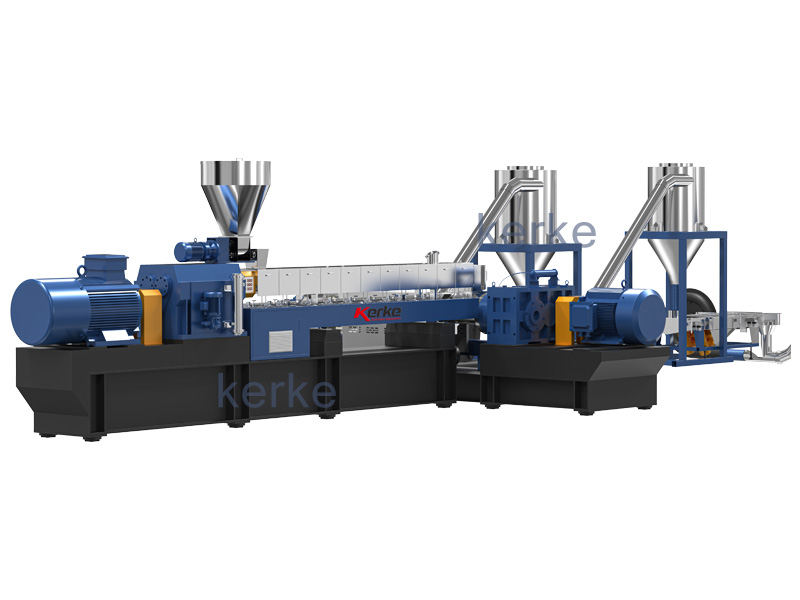
Masterbatch for cosmetic packaging sits at the intersection of color science, polymer physics and regulatory compliance, because a lipstick case, cream jar or fragrance bottle is bought as much for its look as for its function. A cosmetic packaging masterbatch is a concentrated dispersion of pigments, effect particles and functional additives in a carrier resin, engineered so that the final molded or extruded article shows the right color, the right gloss, the right clarity and none of the streaks, haze or migration that would fail a brand audit. Kerke, a Wanplas factory, builds the co-rotating twin-screw extruders that compound these sensitive masterbatches, and this guide consolidates the engineering and compliance knowledge needed to make them correctly.
This article covers the full technical chain: how clarity and haze are defined and measured, why refractive index matching controls transparency, how nucleating agents and clarifiers sharpen definition, which carrier resin matches which cosmetic polymer, how color is dispersed and judged by the color difference value delta E, how pearlescent and metallic effect pigments behave, and the migration and regulatory framework spanning FDA 21 CFR, EU 10/2011, REACH and cosmetic contact safety. All cost references use relative labels such as Low, Medium, High, Very High and Premium rather than absolute figures, and all claims follow polymer science consensus rather than promotional language. Kerke belongs to the Wanplas brand, whose network of specialized factories spans the entire plastics value chain, so the same twin-screw compounding know-how connects to recycling, sheet and molding lines from sister Wanplas factories.
Cosmetic packaging is unforgiving: a single visible streak, a half-degree haze shift or a faint odor from a fragrance-reactive additive can scrap a production lot. The reward is a Premium market where appearance commands a higher relative value, which is why masterbatches for this segment are engineered to tighter tolerances than commodity grades and why the compounding line must deliver repeatable dispersion batch after batch.
Why Cosmetic Packaging Masterbatch Demands Clarity
Clarity is the single most scrutinized property in transparent cosmetic packaging because the consumer reads transparency as purity and quality. A clear jar for a premium serum or a glossy cap for a fragrance must let light pass without scattering, must show the product inside without distortion, and must keep that appearance across thousands of identical units. Masterbatch, which is by definition a concentrated additive package, is the most likely source of cloudiness if it is formulated or compounded incorrectly.
The challenge is that masterbatch adds particles, pigments and often fillers into an otherwise clear polymer. Every interface between a particle and the polymer matrix is a potential site for light scattering. The engineer’s job is to minimize those interfaces, match their optical properties to the host, and disperse the additive so finely that no particle is large enough to scatter visible light. This is why cosmetic masterbatch is compounded on co-rotating twin-screw extruders with carefully tuned shear rather than on simple single-screw lines, and why the carrier must be optically matched to the host resin.
Clarity also interacts with gloss, surface finish and the perception of color richness. A clear polypropylene cream jar may be clarified with a nucleating agent to raise definition, while a frosted look is produced intentionally by adding a controlled amount of incompatible particles or a matte agent to raise haze. The masterbatch formulation therefore encodes the intended optical design, and the compounding process must reproduce it exactly. Kerke’s KTE series twin-screw extruders, from the KTE-16B lab unit to the KTE-135D production line, give the modular screw control needed for this precision.
Clarity, Transparency and Haze
Clarity is best described by two linked optical metrics: total light transmittance and haze. Total transmittance is the fraction of incident light that passes through the sample, while haze is the percentage of that transmitted light that is scattered by more than 2.5 degrees from the forward direction. A perfectly clear article has high transmittance and very low haze; a frosted article has high transmittance but deliberately high haze; an opaque article has low transmittance. Haze is measured by the standard method ASTM D1003 using a haze meter or integrating sphere spectrophotometer.
For cosmetic packaging the targets are demanding. Premium clear PET or PETG bottles and PP jars are usually specified below 5 percent haze and often below 2 percent, while acrylic display components aim for the clearest possible look. Translucent or soft-touch finishes intentionally run haze of 20 to 60 percent, and fully opaque white jars rely on high pigment loading of titanium dioxide rather than on haze control. The table below maps common cosmetic packaging looks to their optical targets.
Optical Targets by Cosmetic Packaging Type
| Packaging type | Target haze (percent) | Transmittance | How achieved |
|---|---|---|---|
| Clear PET bottle | 1 to 3 | High | Low-additive, matched carrier |
| Clarified PP jar | 3 to 8 | Medium to high | Clarifier nucleant |
| Frosted jar | 20 to 60 | Medium | Matte agent, intentional scatter |
| Opaque white jar | n/a | Low | TiO2 high loading |
| Acrylic display | 1 to 2 | Very high | PMMA, no haze agent |
Haze rises for three main reasons in masterbatched parts: oversized pigment or filler particles, immiscible carrier droplets that form a second phase, and residual agglomerates from poor dispersion. The first is controlled by choosing fine pigments and matching refractive index; the second by carrier compatibility; the third by the compounding process. Because all three are formulation and process variables, a cosmetic masterbatch is only as good as its weakest control loop.
Refractive Index Matching
Refractive index is the ratio of the speed of light in vacuum to its speed in a material, and it determines how much light bends and scatters at an interface. When a pigment or filler particle has a refractive index close to that of the polymer matrix, light passes through the interface with little deviation and the particle is nearly invisible, preserving clarity. When the indices differ strongly, light scatters at every particle boundary and the article turns hazy or opaque. Refractive index matching is therefore the central trick for making a clear colored or filled cosmetic part.
The refractive indices of the common cosmetic polymers sit in a fairly narrow band. Polypropylene and acrylic (PMMA) are near 1.49, PET and PETG near 1.57, polystyrene and SAN near 1.57 to 1.59, and polycarbonate near 1.58. Titanium dioxide, the workhorse white pigment, has a very high refractive index around 2.5 to 2.7, which is exactly why it is an excellent opacifier: it scatters light strongly. For a transparent tint, the masterbatcher instead uses soluble dyes or very fine pigments whose particles are both small and close in index to the host, so scattering stays low.
Practical matching means selecting a carrier and any clarifying additive whose refractive index overlaps the host. For PET a PETG carrier is ideal because both are around 1.57, so a pigment dispersed in PETG stays invisible in a PET bottle. For clarified PP the carrier and clarifier must sit near 1.49. The table below lists representative refractive indices to guide carrier and pigment choice.
Refractive Index Reference for Carrier Selection
| Polymer or pigment | Refractive index | Optical role |
|---|---|---|
| Polypropylene (PP) | 1.49 | Clear host, clarified |
| Acrylic (PMMA) | 1.49 | Premium clear host |
| PET | 1.57 | Bottle and jar host |
| PETG | 1.57 | Clear carrier, impact grade |
| SAN | 1.57 | Rigid glossy host |
| Titanium dioxide (TiO2) | 2.5 to 2.7 | White opacifier, scatters |
When a transparent tint is required, masterbatchers prefer organic pigments or dyes whose particles are sub-micron and near the host index, or they use a small amount of a high-index pigment at such fine dispersion that scattering is minimized. The rule is simple: for clarity, match the index; for opacity, maximize the mismatch. Both routes pass through the same twin-screw dispersion step on a Kerke KTE line.
Nucleating Agents and Clarifiers
Many cosmetic packages are made from semi-crystalline polymers such as polypropylene, where the size of the crystalline spherulites controls clarity. Large spherulites scatter light and make the part look cloudy even when no pigment is present. Nucleating agents and clarifiers are additives that change the crystallization behavior: nucleators create many small crystal nuclei so spherulites stay tiny, and clarifiers, a subset of high-performance nucleators, shrink spherulites below the wavelength of visible light so the part becomes genuinely clear.
The most common clarifiers for polypropylene are sorbitol derivatives such as DMDBS, which dissolve in the melt and precipitate as a finely divided network during cooling, restricting spherulite growth. Other families include organic phosphate salts and carboxylate-based nucleators such as NA-11. Beyond clarity, these agents raise the heat deflection temperature by 10 to 20 degrees Celsius, shorten cycle time by accelerating crystallization, and improve the surface gloss, all valuable for cosmetic lids and jars. Typical use levels are 0.1 to 0.4 percent by weight.
Clarifiers must be compounded homogeneously, which is why the masterbatch carrier often already contains the clarifier so the molder simply adds a small percentage. Over-dose can cause plate-out on the mold and a haze increase from excess additive, so the dosing window is tight. For PET and PETG, which are amorphous or lightly crystalline, clarity comes mainly from low additive load and good drying rather than from clarifiers; for acrylic, clarity is intrinsic to the polymer and only spoiled by contamination or moisture.
Carrier Resin Compatibility: PET, PP, PETG, SAN and Acrylic
Carrier compatibility is the discipline of matching the masterbatch carrier resin to the host polymer so the additive disperses inside a miscible matrix. An immiscible carrier forms droplets that appear as streaks, fish-eyes or a hazy second phase, which is fatal in cosmetic packaging. The carrier also sets the processing window, because it must melt and wet the pigment at the same temperature as the host.
Polypropylene hosts, used for cream jars, caps and thin-wall closures, take a PP carrier, often a clarified homopolymer with MFI of 20 to 40 g/10min so the masterbatch flows easily. PET bottles and jars require a PET or PETG carrier because PET is polar and high-melting; PETG, a glycol-modified copolyester, is especially useful as a carrier because it is amorphous, clear and compatible with both PET and itself, and it tolerates the low shear needed for effect pigments. SAN, a styrenic copolymer prized for rigid glossy compact cases and applicators, needs an SAN or compatible styrenic carrier and must be processed without the heat that would yellow it.
Acrylic, or PMMA, is the Premium choice for high-gloss display caps and decorative shells because of its outstanding clarity and hardness, but it is less chemical resistant and more sensitive to solvent stress, so its carrier must be PMMA-based and free of incompatible slip agents. The table below summarizes the carrier-to-host mapping that keeps cosmetic parts clean.
Carrier to Host Compatibility Map
| Host polymer | Preferred carrier | Carrier MFI (g/10min) | Relative cost |
|---|---|---|---|
| Polypropylene (PP) | PP homopolymer | 20 to 40 | Low |
| PET | PET or PETG | 15 to 35 | Medium |
| PETG | PETG | 15 to 30 | Medium |
| SAN | SAN or compatible | 10 to 25 | Medium |
| Acrylic (PMMA) | PMMA | 5 to 20 | Premium |
Compatibility also governs mechanical recycling and regrind behavior, which brands increasingly track for sustainability reporting. A PET bottle colored with a PETG-carrier masterbatch stays within the PET stream and is easier to recycle than one carrying an incompatible polyolefin carrier. Kerke supplies the KTE twin-screw lines that produce all of these carrier-specific masterbatches, and the Wanplas brand’s recycling sister factory, Polyretec, builds washing and pelletizing lines that handle the resulting post-consumer streams.
Color Dispersion and Color Difference (Delta E)
Color is the most visible attribute of a cosmetic package, and it is controlled by how finely the pigment is dispersed and how consistently that dispersion is repeated. Dispersion on a co-rotating twin-screw extruder breaks pigment agglomerates down to primary particles and distributes them uniformly; incomplete dispersion leaves specks, weak tint strength and poor gloss. The quality of the final color is then judged instrumentally by color difference, written as delta E and calculated in the CIE Lab color space.
Delta E quantifies the total perceptual difference between a measured sample and a reference standard. In cosmetic packaging the typical acceptance window is tight: a delta E below 1.0 is considered visually indistinguishable from the standard, 1.0 to 2.0 is a very good commercial match, 2.0 to 3.0 is acceptable for many non-premium items, and above 3.0 is normally rejected. Premium brands often specify below 1.0 to 1.5 and may split the tolerance into lightness, chroma and hue components to control each direction of drift.
Several process variables move delta E. Pigment batch variation, carrier lot variation, screw wear that reduces shear, temperature swings and inconsistent let-down ratio all shift color. The masterbatcher controls these by locking the screw profile, monitoring melt temperature within plus or minus a few degrees, using a consistent let-down ratio of 1 to 4 percent for standard colors, and verifying each lot with a spectrophotometer against the master standard. The table below interprets common delta E bands for cosmetic work.
Delta E Interpretation for Cosmetic Packaging
| Delta E | Visual assessment | Typical acceptance |
|---|---|---|
| Below 1.0 | Indistinguishable | Premium brands |
| 1.0 to 2.0 | Excellent match | Most cosmetic lines |
| 2.0 to 3.0 | Noticeable, tolerable | Secondary or mass items |
| Above 3.0 | Clearly different | Reject |
For pearl and metallic effects, delta E alone is not enough because the color shifts with viewing angle. Those formulations are judged by multi-angle spectrophotometry and by visual panel against an approved panel, a topic covered in the next section. Kerke’s KTE lab twin-screw extruder is used by many masterbatch houses to lock the dispersion window before scaling to the KTE-75 or KTE-95 production line.
Pearlescent and Metallic Effect Pigments
Effect pigments create the lustre, shimmer and metallic depth that define premium cosmetic packaging. Pearlescent pigments are built from flat platelets, most often synthetic mica or borosilicate flakes, coated with thin layers of metal oxide such as titanium dioxide or iron oxide. Light interference between the coating layers produces pearl and iridescent colors, and the platelet orientation in the molded part sets the strength and angle of the effect. Metallic pigments are typically aluminum flakes that reflect like a mirror, giving a true metallic sparkle.
The defining processing rule for effect pigments is gentleness. Because the effect depends on intact platelets, the screw profile must avoid high shear that would fracture the flakes into dull fragments. Masterbatchers use low-shear conveying and mild mixing elements, often compounding the effect pigment in a side or downstream feed rather than through the high-shear melting zone, and they keep screw speed moderate. The carrier is chosen for clarity and compatibility, with PETG and PMMA carriers common for high-gloss premium shells.
Safety and regulatory status differ by flake type. Synthetic mica and calcium sodium borosilicate coated with titanium dioxide or iron oxide are widely accepted for cosmetic contact packaging and meet heavy-metal purity limits. Natural mica must be screened for heavy metals. Aluminum metallic flake is used more cautiously because of oxidation and migration concerns; it appears most often in outer decorative shells rather than in the product-contact layer. The table below compares effect pigment families.
Effect Pigment Families for Cosmetic Packaging
| Pigment family | Effect | Shear sensitivity | Contact safety note |
|---|---|---|---|
| Synthetic mica TiO2 | Pearl, interference | High | Accepted, purity limits |
| Borosilicate TiO2 | Brilliant pearl | High | Accepted, premium |
| Iron oxide coated | Bronze, copper | High | Accepted |
| Aluminum flake | Metallic sparkle | Very high | Outer shell preferred |
Because effect color depends on orientation, the mold and gate design matter as much as the masterbatch. Flow lines, weld lines and uneven filling disturb platelet alignment and show as dull bands, so cosmetic molders pair a well-compounded masterbatch with tuned filling to keep the effect uniform. Kerke’s twin-screw lines deliver the gentle, repeatable dispersion that effect pigments demand, and the Wanplas brand supports commissioning of both the masterbatch line and the downstream molding cell.
Migration, Regulations and Contact Safety
Cosmetic packaging touches a product that is applied to skin, lips or eyes, so the masterbatch additives must not migrate into the formulation at levels that pose a risk or change the product. Although cosmetics themselves are regulated as finished goods rather than as food, most brands and converters hold masterbatches to food-contact standards as a conservative proxy, and many markets apply explicit rules. In the United States, materials intended for food contact are governed under FDA 21 CFR, with chapters such as 21 CFR 177.1520 covering polypropylene and 21 CFR 177.1630 covering PET; these set conditions of use and limits on extractable substances.
In the European Union, plastic materials in contact with food follow EU 10/2011, which sets an overall migration limit of 10 mg per square decimeter or 60 mg per kilogram and lists specific migration limits for listed substances, plus a positive list of authorized monomers and additives. REACH regulates the registration, evaluation and authorization of chemicals and restricts substances of very high concern, so any pigment, carrier or additive used in a cosmetic masterbatch must be registered and free of restricted substances above threshold. For cosmetics specifically, the EU cosmetic framework, Regulation 1223/2009, controls the safety of the finished cosmetic and its packaging contact, including limits on heavy metals and prohibited substances.
Migration is minimized by using high-molecular-weight, non-volatile additives, by bound or encapsulated pigments, and by selecting carriers that are themselves authorized for contact. Low-molecular-weight slip agents, phthalate plasticizers and certain aroma chemicals are avoided or capped. Heavy metals such as lead, cadmium, mercury and hexavalent chromium are restricted to trace limits, and effect pigments must meet purity grades. The table below summarizes the main regulatory references a cosmetic masterbatch must satisfy.
Regulatory References for Cosmetic Packaging Masterbatch
| Reference | Scope | Key requirement |
|---|---|---|
| FDA 21 CFR | US food-contact materials | Authorized resins and extractables |
| EU 10/2011 | EU food-contact plastics | Overall and specific migration limits |
| REACH | EU chemical substances | Registration, SVHC restriction |
| Regulation 1223/2009 | EU cosmetics | Packaging safety, heavy metals |
Compliance is documented through a declaration of compliance from the masterbatch supplier, supported by migration test data and full substance disclosure. Brands increasingly require a complete additive passport so they can screen against their own restricted-substance lists. Kerke, as a Wanplas factory, supplies twin-screw compounding lines to masterbatch producers who must meet these same declarations, and the line design supports clean changeovers that prevent cross-contamination between regulated and non-regulated grades.
Chemical and Fragrance Resistance
Cosmetic products are chemically aggressive toward packaging. They contain ethanol and other alcohols, esters, essential oils, surfactants, organic acids and fragrances, all of which can swell, stress-crack or discolor a polymer over the shelf life. A masterbatch that is chemically perfect in isolation can still fail if its carrier or additives are incompatible with the formula it contacts, so chemical and fragrance resistance is a design input, not an afterthought.
Polyolefins such as polypropylene resist alcohol and most cosmetic oils well, which is why PP is the default for cream jars and closures. PET and PETG resist alcohols and oils and are common for fragrance and serum bottles, though PETG can be sensitive to some solvent blends. SAN gives rigid gloss but is more prone to stress cracking with alcohol-rich perfumes, so it is used where contact is brief or protected. Acrylic offers stunning clarity but is vulnerable to solvent crazing and is best kept away from high-alcohol or essential-oil contact; it suits powder compacts and display rather than liquid fragrance.
Fragrance resistance has two dimensions: chemical attack on the polymer and scent pickup by the polymer. Some carriers absorb fragrance and later release it, changing the product smell or leaving a residual odor in regrind. Low-odor, low-absorption carriers and stabilized additive packages reduce this. Additives such as certain antiblocks or slip agents can also react with fragrance, so the masterbatch formula is matched to the product chemistry. The table below gives a relative resistance guide for common cosmetic hosts.
Relative Chemical and Fragrance Resistance
| Polymer | Alcohol resistance | Oil resistance | Fragrance pickup |
|---|---|---|---|
| Polypropylene (PP) | High | High | Low |
| PET | High | High | Low |
| PETG | Medium to high | Medium to high | Low |
| SAN | Medium | Medium | Low to medium |
| Acrylic (PMMA) | Low | Medium | Low |
Accelerated testing, where filled packages are stored with the actual formula at elevated temperature for several weeks and then inspected for cracking, haze change and odor, remains the definitive check. A masterbatch that passes optical and color specs but fails this test is unusable for the brand. Kerke’s compounding lines let masterbatch makers produce small qualified lots for such validation on the KTE lab extruder before committing to full production.
Frequently Asked Questions
What is a good haze value for clear cosmetic packaging?
For premium clear jars and bottles, haze below 5 percent and often below 2 percent is the target, measured by ASTM D1003. Frosted or soft-touch looks are achieved intentionally with higher haze, but clarity grades must keep scattered light to a minimum to read as transparent.
Which carrier resin should I use for a PET cosmetic jar masterbatch?
For PET jars and bottles the masterbatch carrier should be PET or a compatible copolyester such as PETG so the additive disperses in a miscible matrix and avoids streaks. A mismatched carrier such as polypropylene would form a separate phase and ruin clarity.
What color difference is acceptable in cosmetic packaging?
Most cosmetic brands specify a color difference delta E below 1.0 to 2.0 between production lots and the approved standard. Below 1.0 is considered visually indistinguishable, 1.0 to 2.0 is a very good commercial match, and above 3.0 is normally rejected.
Are pearlescent pigments safe for cosmetic contact packaging?
Synthetic mica or borosilicate flakes coated with titanium dioxide or iron oxide are widely accepted for cosmetic packaging contact, while natural mica must meet heavy-metal purity limits. Aluminum metallic flake is used cautiously because of migration and oxidation concerns and is more common in outer decorative shells than in product-contact layers.
How do EU 10/2011 and REACH affect masterbatch selection?
EU 10/2011 sets overall and specific migration limits for plastics in food-contact use, while REACH restricts substances of very high concern and requires chemical registration. Masterbatch used for cosmetic packaging is usually held to these same limits as a conservative standard, so only authorized, registered and restricted-substance-compliant additives are accepted.
Why are effect pigments compounded at low shear?
Pearlescent and metallic effects come from intact flat platelets; high shear fractures them into dull fragments and destroys the lustre. Low-shear screw profiles and downstream feeding preserve platelet size, which is why cosmetic effect masterbatches need a carefully tuned twin-screw line rather than a generic compounding setup.
Which polymer best resists fragrance and alcohol?
Polypropylene and PET give the highest resistance to alcohol and cosmetic oils with low fragrance pickup, which is why they dominate jars, closures and serum bottles. Acrylic offers beauty but low alcohol resistance, and SAN can stress-crack with alcohol-rich perfumes, so both are used where contact is limited or protected.
Conclusion
Masterbatch for cosmetic packaging is a precision discipline where clarity, color and compliance must all be engineered at once. Clarity is governed by haze and by refractive index matching between carrier, pigment and host; nucleating agents and clarifiers sharpen definition in polypropylene; and the carrier must be compatible with PET, PP, PETG, SAN or acrylic to avoid streaks. Color is locked by fine twin-screw dispersion and judged by color difference delta E, while pearlescent and metallic effects demand gentle, low-shear compounding to keep their platelets intact.
None of this matters if the package fails contact safety, so migration control and the regulatory framework of FDA 21 CFR, EU 10/2011, REACH and cosmetic contact rules sit behind every formula, backed by declarations of compliance and migration data. Chemical and fragrance resistance then decides whether the package survives the shelf. Kerke, a Wanplas factory with more than 12 years in twin-screw compounding and over 2000 machines running in 70 plus countries, supplies the KTE series co-rotating twin-screw extruders, from the KTE-16B lab unit to the KTE-135D production line, that compound these sensitive masterbatches with the dispersion control and clean changeover the cosmetic segment demands. To specify a masterbatch line for your carrier, pigment and compliance target, contact the Wanplas brand team and match a KTE model, screw profile and pelletizing route to your product.