High density filler masterbatch has become one of the most widely used compounding products in the plastics industry because it lets converters add weight, stiffness and dimensional stability to a polymer article while holding raw material cost at a Low or Medium level. A high density filler masterbatch is a concentrated blend in which a very high proportion of inorganic powder, most often calcium carbonate, barium sulfate or talc, is dispersed inside a polymer carrier at loadings that frequently exceed 70 percent by weight. Kerke, a Wanplas factory, has supplied parallel co-rotating twin-screw compounding extruders to filler masterbatch producers for more than 12 years, and this guide brings together the practical engineering knowledge that separates a saleable, well-dispersed product from a brittle, uneven one.
Weight and rigidity are the two properties that drive most purchasing decisions for filled masterbatch. Weight is governed primarily by the specific gravity of the chosen filler, while rigidity is expressed through flexural modulus and is strongly influenced by filler shape, particle size, surface treatment and final loading. This article explains how each variable is selected and controlled, and how the compounding line is configured to deliver it consistently. By the end you will understand filler grading and mesh count, stearic acid and titanate coupling, carrier resin and MFI matching, the flexural modulus versus impact balance, dispersion testing by filter pressure value, the screw element combination on a co-rotating twin-screw extruder, side feeding, vacuum venting and the three main pelletizing routes.
Throughout this guide the technical references follow polymer science consensus rather than promotional claims, and all cost references use relative labels such as Low, Medium, High, Very High and Premium instead of absolute figures. Kerke belongs to the Wanplas brand, whose network of specialized factories covers the full plastics value chain, and the compounding extruders described here integrate naturally with pelletizing, recycling and sheet lines made by sister Wanplas factories.
What Is High Density Filler Masterbatch and Why Weight Matters
A high density filler masterbatch is a pre-compounded concentrate in which an inorganic filler is dispersed at high concentration inside a polymer carrier so that it can be metered into a natural resin during film blowing, injection molding, pipe extrusion or sheet extrusion. The masterbatch format exists because directly tumble-blending loose powder with virgin pellets produces poor dispersion, dusting and unstable throughput, whereas a properly compounded masterbatch feeds cleanly and delivers uniform properties. The term high density refers both to the high filler loading and, in many grades, to the use of a dense filler such as barium sulfate that raises the specific gravity of the final article.
Weight matters for several commercial reasons. In products sold by volume or by piece where the customer expects a certain heft, such as hangers, flowerpots, furniture components, cable jacketing and artificial stone, added mineral weight communicates quality and reduces resin consumption. In sound-deadening and shielding applications, higher density improves acoustic and gamma-radiation attenuation. In agricultural film and woven sack applications, moderate filler loading reduces cost while maintaining processability. The engineering challenge is to add as much filler as possible without destroying the mechanical integrity of the article.
The single most important number for any high density filler masterbatch is its specific gravity, because it determines how much weight a given mass fraction of masterbatch contributes. A masterbatch built on calcium carbonate lands near 1.9 to 2.1 g/cm3, a talc-based grade near 2.0 to 2.2 g/cm3, and a barium sulfate grade near 2.8 to 3.2 g/cm3 depending on loading. The table below contrasts the three mainstream fillers on the properties that matter most for weight and rigidity.
Filler Property Comparison for Weight-Driven Formulations
| Property | Calcium Carbonate (CaCO3) | Barium Sulfate (BaSO4) | Talc |
|---|---|---|---|
| Specific gravity (g/cm3) | 2.7 | 4.3 | 2.8 |
| Typical particle size | 1 to 20 micrometer | 2 to 15 micrometer | 2 to 20 micrometer |
| Particle shape | Irregular / cubic | Acicular / angular | Plate-like (lamellar) |
| Relative raw cost | Low | Medium to High | Low to Medium |
| Effect on flexural modulus | Moderate increase | Moderate increase | Strong increase |
| Effect on impact strength | Reduces | Reduces | Reduces, less with coupling |
| Typical max loading in MB | 80 to 85 percent | 80 to 90 percent | 70 to 80 percent |
When weight is the primary objective and cost must stay Low, calcium carbonate is the default filler. When the highest possible specific gravity is needed, barium sulfate is selected even though its raw cost is Medium to High. Talc is chosen when rigidity and heat deflection temperature matter more than pure weight, because its plate-like particles reinforce the polymer matrix in two dimensions.
Filler Raw Materials: CaCO3, BaSO4 and Talc
Selecting the filler grade is the first engineering decision in any high density filler masterbatch project, and it begins with particle size expressed either as a mean diameter in micrometers or as a mesh count. Mesh count describes the number of wires per linear inch in the screening sieve that retains the powder, so a higher mesh number means a finer powder. A common working conversion is that roughly 1250 mesh corresponds to about 10 micrometer, 2500 mesh to about 5 micrometer and 3000 mesh to about 4.5 micrometer, although exact conversions vary with particle shape. For filler masterbatch, the practical grades run from 800 mesh, approximately 18 micrometer, up to 3000 mesh, approximately 4.5 micrometer.
Calcium carbonate is supplied as ground calcium carbonate (GCC), milled from natural limestone, or as precipitated calcium carbonate (PCC), a synthetic grade with much finer and more uniform particles down to 0.1 to 3 micrometer. GCC is Low cost and is the workhorse of commodity filler masterbatch; PCC is Premium cost but gives brighter, finer and more easily dispersed products suited to thin films and coatings. Finer particles raise flexural modulus and surface smoothness but also raise the surface area that must be wetted by the carrier, so a finer grade demands more coupling agent and more intensive mixing energy.
Barium sulfate, also called baryte in its mineral form or blanc fixe when precipitated, is valued for its high specific gravity of about 4.3 g/cm3 and its chemical inertness. It does not react with acids in the formulation, it is radiopaque and it contributes excellent weight without strongly yellowing the compound. Its angular particles disperse well in a co-rotating twin-screw extruder, and because it is denser than calcium carbonate, a BaSO4 masterbatch reaches the same weight gain at a lower mass fraction, which can preserve some impact strength. The trade-off is a Medium to High raw cost and higher abrasive wear on screws and barrels, which is why wear-protected screw elements are recommended.
Talc is a hydrous magnesium silicate with a plate-like or lamellar structure. Its aspect ratio, the ratio of platelet diameter to thickness, can range from 5:1 to more than 20:1 depending on the mine and milling grade. High-aspect-ratio talc is an efficient reinforcing filler: it raises flexural modulus strongly, improves heat deflection temperature by 10 to 30 degrees Celsius at medium loading, and acts as a nucleating agent that accelerates crystallization in polypropylene. Talc is mildly abrasive and its platelets must be kept intact during compounding, so over-aggressive kneading should be avoided. Talc grades for masterbatch commonly span 800 mesh, about 18 micrometer, to 3000 mesh, about 4.5 micrometer, with finer grades preferred for thin-wall injection molding.
Mesh, Micron and Application Mapping
| Mesh count | Approx. mean size (micrometer) | Bulk density | Typical application |
|---|---|---|---|
| 800 mesh | 15 to 18 | Medium | Pipe, profile, thick injection parts |
| 1250 mesh | 9 to 11 | Medium | Woven sack, general film, sheet |
| 2500 mesh | 4 to 6 | Low | Thin film, laminating, surface-sensitive parts |
| 3000 mesh | 4 to 5 | Low | Premium thin film, high-gloss coatings |
A finer powder has lower bulk density and takes up more free volume in the feed throat, which is precisely why high-loading lines rely on side feeding rather than cramming everything through the main hopper. The engineer must also watch moisture: mineral fillers can carry 0.2 to 0.8 percent surface moisture that must be removed by vacuum venting or the final pellets will contain voids and the FPV will spike.
Surface Treatment and Coupling Agents
Inorganic fillers are polar and hydrophilic, while polyolefin carriers such as polyethylene and polypropylene are non-polar and hydrophobic. Without surface treatment, the filler particles sit as poorly bonded inclusions in the polymer, giving weak interfaces, high melt viscosity, poor dispersion and a sharp drop in impact strength. Surface treatment converts the particle surface from polar to organophilic so that the carrier wets it, the coupling agent bridges the inorganic and organic phases, and mechanical properties improve at equal loading.
The most common and Low-cost treatment is stearic acid, a C18 fatty acid applied at 0.5 to 1.5 percent by filler weight during dry coating in a high-speed mixer. Stearic acid lowers the surface energy of the powder, improves flowability and lets the carrier wet the particles more easily. It is a lubricant-type treatment rather than a true coupling agent, so it mainly helps processing and dispersion but contributes only modestly to impact retention. For a commodity calcium carbonate masterbatch aimed at Low cost, stearic acid alone is usually sufficient.
For higher performance, especially with talc and with barium sulfate where adhesion is critical, a titanate coupling agent is used at 0.3 to 1.0 percent by filler weight. Titanate couples through its inorganic-reactive group to the filler surface and through its organic chain to the polymer, building a durable interface that improves flexural modulus retention and impact strength simultaneously. Other coupling systems include aluminate, silane for siliceous fillers, and maleic anhydride grafted polyolefin (PP-g-MAH) used as a compatibilizer in polypropylene systems. The choice depends on the filler chemistry and the carrier: silanes suit glass and siliceous surfaces, titanates suit calcium carbonate and barium sulfate, and maleated polyolefin suits talc in PP.
The application method matters as much as the chemistry. Dry coating in a high-speed mixer at 80 to 110 degrees Celsius for 3 to 8 minutes gives even distribution before the powder enters the extruder. Liquid coupling agents can also be injected downstream through a liquid feeder onto the melt, which protects the agent from thermal degradation and gives more reproducible coupling. Too little agent leaves untreated particles; too much acts as a plasticizer that lowers modulus and can cause plate-out on the die. The table below summarizes the treatment ladder.
Surface Treatment Options and Effects
| Treatment | Typical dose (% filler) | Relative cost | Main benefit |
|---|---|---|---|
| Untreated | 0 | Low | None; poorest dispersion |
| Stearic acid | 0.5 to 1.5 | Low | Lubrication, wetting, flow |
| Titanate coupling | 0.3 to 1.0 | Medium | True coupling, impact retention |
| Silane coupling | 0.3 to 0.8 | Medium | Siliceous filler bonding |
| PP-g-MAH compatibilizer | 2 to 6 | Medium to High | Talc in PP adhesion |
Carrier Resin Selection and MFI Matching
The carrier resin is the polymer that holds the filler in suspension and carries it into the final article. For a high density filler masterbatch the carrier must be compatible with the host resin, easy to disperse at very high filler loading, and low enough in viscosity to wet the powder. The two dominant carriers are polyethylene and polypropylene, chosen to match the end application: a PE carrier for polyethylene film, bags and pipe, and a PP carrier for polypropylene molded parts, fibers and raffia.
Within polyethylene, low-density polyethylene (LDPE) and linear low-density polyethylene (LLDPE) are the most common carriers because their lower crystallinity and broader molecular weight distribution give good wetting and easy dispersion. Within polypropylene, homopolymer PP is used for rigid parts and random copolymer PP where some toughness is needed. The critical parameter is melt flow index, reported as MFI in grams per 10 minutes under a standard load. The carrier MFI should be equal to or slightly higher than the MFI of the resin being filled, so that the masterbatch does not become the viscosity-limiting component in the blend.
For a high-loading filler masterbatch the carrier is often selected at a Medium to High MFI, for example 20 to 50 g/10min for polyethylene and 20 to 40 g/10min for polypropylene, even when the final product resin is a lower-MFI grade such as 2 to 12 g/10min. The higher-MFI carrier acts as an internal lubricant that lets the high filler content still be extruded and pelletized. If the carrier is too low in MFI, the melt becomes too stiff to disperse the powder and the FPV rises; if it is too high, the masterbatch can soften the mechanical properties of the final article. The table below shows representative carrier choices.
Carrier Resin Selection by End Application
| Host product | Recommended carrier | Carrier MFI (g/10min) | Notes |
|---|---|---|---|
| PE film and bags | LDPE or LLDPE | 20 to 50 | Good clarity retention, easy seal |
| PP injection molding | PP homopolymer | 20 to 40 | Match crystallinity, use PP-g-MAH |
| PP raffia and tape | PP homopolymer | 25 to 45 | High draw, low gel |
| HDPE pipe and profile | HDPE or LDPE blend | 15 to 35 | Balance stiffness and ESCR |
| EVA adhesive layer | EVA | 10 to 30 | Specialty, higher cost |
MFI is measured at 190 degrees Celsius for polyethylene and polypropylene under a 2.16 kilogram load, and the result in grams per 10 minutes is inversely related to molecular weight. When matching carrier to host, the engineer should also consider density: a filler masterbatch already raises the specific gravity, so selecting a lower-density carrier such as LDPE (about 0.92 g/cm3) rather than HDPE (about 0.95 g/cm3) can partially offset weight gain if the goal is cost reduction rather than maximum heft. Conversely, for a high density filler masterbatch where weight is the selling point, the carrier choice is secondary to the filler specific gravity.
Balancing Rigidity and Impact: Flexural Modulus Trade-offs
Rigidity in a filled compound is most usefully described by flexural modulus, the slope of the stress-strain curve in bending, measured in megapascals. Adding mineral filler almost always raises flexural modulus because the stiff inorganic particles restrain matrix deformation. The magnitude of the increase depends on filler modulus, loading, aspect ratio and interfacial adhesion. Talc, with its plate-like high-aspect-ratio particles, gives the strongest modulus gain per unit weight, while spherical calcium carbonate gives a more moderate gain and barium sulfate a moderate gain with the bonus of density.
The unavoidable counterpart is impact strength. Mineral fillers create stress concentration points and weak interfaces that initiate cracks, so notched impact, measured by Izod or Charpy methods, falls as loading rises. A neat polypropylene may show notched Izod around 30 to 45 J/m, but at 40 percent calcium carbonate this can fall to 5 to 10 J/m, and at 30 percent talc to roughly 8 to 15 J/m. The engineering art is to push loading and modulus up while using coupling agents, elastomer modifiers or a balanced filler blend to keep impact above the minimum the application demands.
Several strategies recover impact without sacrificing too much rigidity. Titanate or silane coupling improves the interface and recovers part of the lost impact. Adding 5 to 15 percent of an elastomeric modifier such as ethylene-propylene rubber or a thermoplastic elastomer raises impact substantially at a small modulus penalty. Blending a high-modulus filler like talc with a low-cost spherical filler like calcium carbonate can hit a cost and property target between the two. The table below illustrates representative property directions at 30 percent loading in polypropylene.
Property Direction at 30 Percent Filler in Polypropylene
| Filler (30%, coupled) | Flexural modulus (MPa) | Notched Izod (J/m) | HDT (deg C) |
|---|---|---|---|
| None (neat PP) | 1500 | 35 to 45 | 55 to 60 |
| CaCO3, fine | 2600 to 3000 | 10 to 18 | 70 to 80 |
| Talc, high aspect | 3200 to 4200 | 12 to 20 | 85 to 105 |
| BaSO4 | 2500 to 3100 | 12 to 18 | 70 to 82 |
The numbers above are typical ranges; actual values depend on grade, coupling and test method, and should be confirmed against supplier datasheets. The practical rule for a high density filler masterbatch is to set the minimum flexural modulus the customer requires, then choose the filler and loading that meet it with the lowest cost and the highest retained impact. Kerke engineers routinely run small lab trials on the KTE lab twin-screw extruder to lock these trade-offs before scaling to production.
Dispersion Quality: Filter Pressure Value (FPV)
Dispersion quality decides whether a high density filler masterbatch performs in the field or wrecks a customer’s die and film. Poor dispersion leaves agglomerates, fish-eyes and gels that block screens, streak film and weaken parts. The most widely accepted quantitative test for filler dispersion is the Filter Pressure Value, also called pressure filter value or FPV, measured on a capillary rheometer fitted with a standard screen pack at a fixed temperature and shear rate.
In an FPV test, the molten masterbatch is pumped through a fine mesh screen pack and the pressure increase over a fixed volume or time is recorded. Well-dispersed material flows with a low, stable pressure; material containing agglomerates or gel causes the pressure to climb steeply as the screen clogs. The reported value is typically the pressure in bar after a defined volume, or the pressure rise rate. A lower FPV means finer, more uniform dispersion and fewer defects. FPV methods follow the principle of ISO 1133 for melt flow measurement and use screen packs analogous to those in ASTM filtration tests, but the acceptance limit is set by the converter’s process and film thickness.
For thin film and laminating grades the FPV must be very low because even a few large agglomerates show as visible defects; for thick pipe and profile the tolerance is wider. Typical good practice targets an FPV well under a few hundred bar for demanding film, while general-purpose grades may accept higher values. Beyond FPV, dispersion is also checked by microscope counting of agglomerates, by ash content for total filler, and by a two-roll mill smear test for visual gel. The table below lists the common dispersion checks.
Dispersion Test Methods for Filler Masterbatch
| Method | What it measures | Typical target | Standard basis |
|---|---|---|---|
| Filter Pressure Value (FPV) | Pressure rise through screen pack | Lower is better; tight for film | ISO 1133 principle |
| Ash content | Total inorganic filler | Within plus or minus 1 percent | ISO 3451 |
| Microscope count | Agglomerate number and size | Few counts above 50 micrometer | Internal method |
| Smear / roll mill | Visual gel and streak | No visible gel | Internal method |
Improving FPV comes back to the compounding process: finer filler, adequate coupling, enough specific mechanical energy in the kneading zone, and effective devolatilization. On a Kerke KTE co-rotating twin-screw extruder the screw profile is tuned so that the filler meets intense shear only after the carrier has melted and wetted it, which breaks agglomerates without over-grinding the particles or generating excess heat that degrades the polymer.
Twin-Screw Compounding Process Engineering
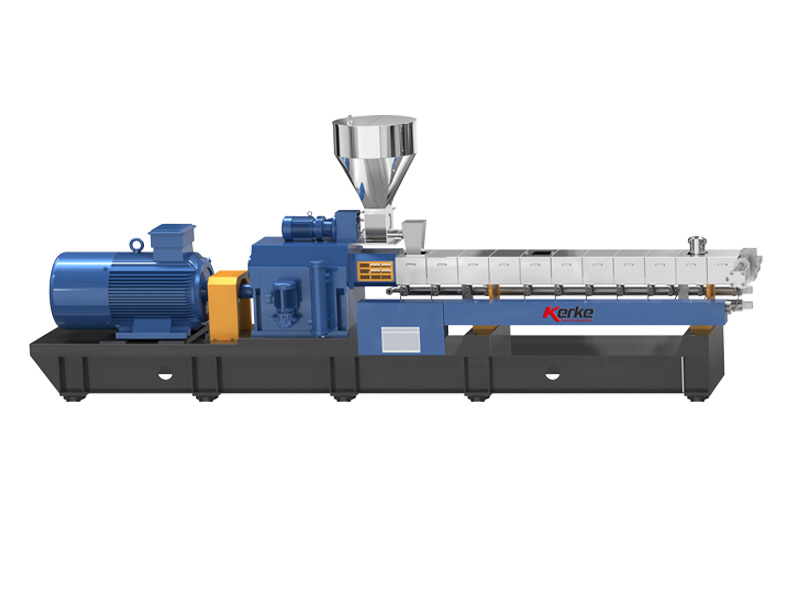
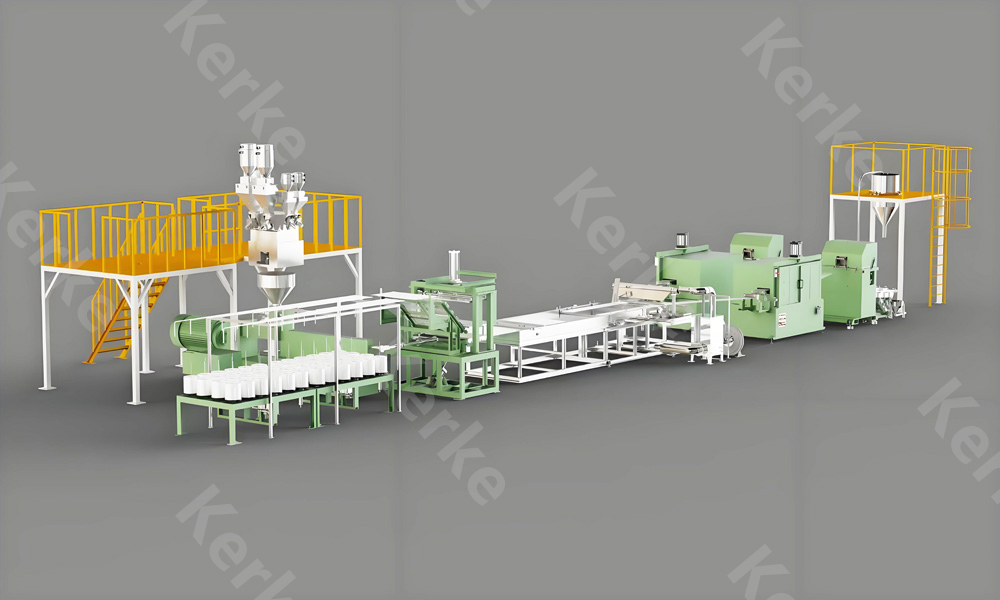
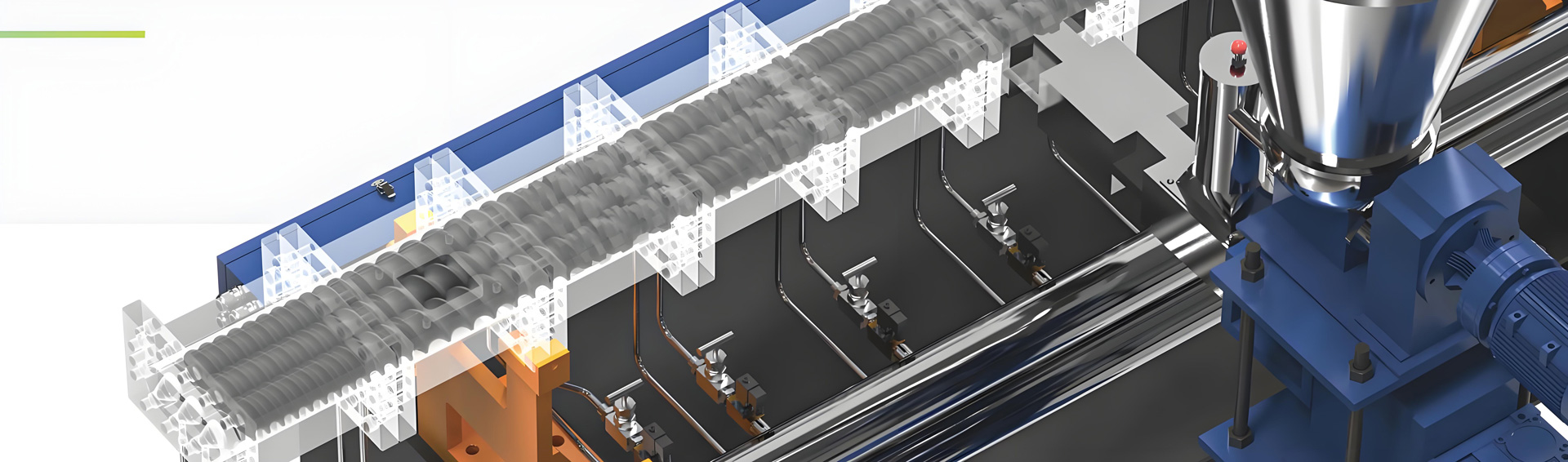
The heart of any high density filler masterbatch line is a co-rotating parallel twin-screw extruder. Kerke, a Wanplas factory, builds the KTE series of parallel co-rotating twin-screw extruders from KTE-16B up to KTE-135D, with screw diameters from 16 mm in the lab to 135 mm in large production lines, and L/D ratios commonly from 36 to 52 with 40 to 48 the most common for filler masterbatch. Co-rotating screws self-wipe, which prevents dead zones and gives excellent dispersion and self-cleaning, both essential when changing filler grade or color.
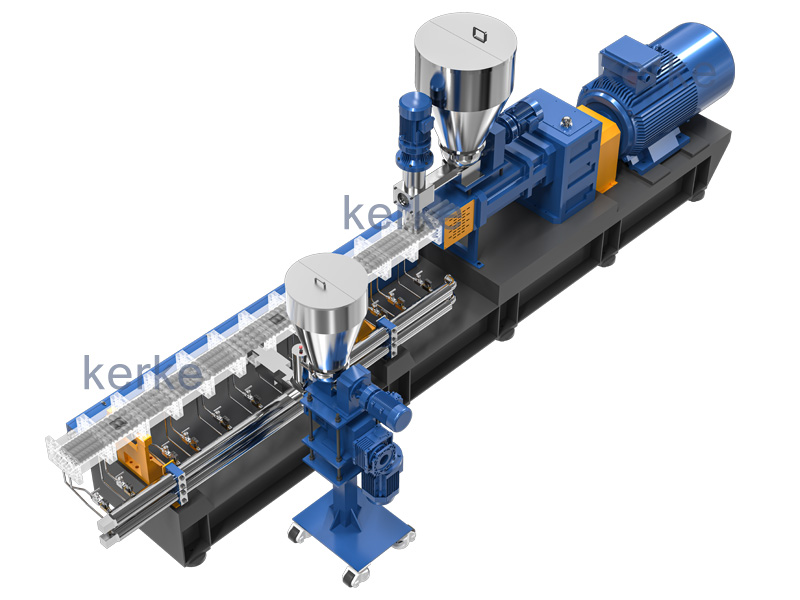
The screw is built from modular elements so the profile can be engineered for the formulation. The main element families are conveying elements (forward and reverse pitch), kneading blocks (staggered at 30, 45, 60 or 90 degrees), toothed or gear mixing elements, and reverse elements that build pressure and residence. For filler masterbatch the typical layout is: a feeding zone of conveying elements, an early melting and wetting zone, a high-shear kneading block zone where agglomerates are broken, a side-feed port where most of the dry filler enters, a second mixing zone, and one or two vacuum venting zones before the melt pump and die.
Side feeding is the key to high loading. Instead of pushing all the low-bulk-density powder through the main hopper, a side feeder, often a twin-screw loss-in-weight side stuffer, injects the filler into a downstream barrel section after the carrier has already melted and formed a paste. This frees main-feed free volume, raises total throughput, reduces screw overload and improves venting. A crammer feeder or loss-in-weight main feeder handles the carrier plus any liquid coupling agent, while the side feeder meters 50 to 70 percent of the total filler.
Vacuum venting removes the air carried with the powder and any surface moisture, which for mineral fillers can be 0.2 to 0.8 percent. Without venting the melt traps voids, the FPV climbs and the pellets look porous. A single vent is enough for dry, pre-treated filler, while two vents, one atmospheric and one deep vacuum down to roughly 0.02 to 0.05 bar absolute, are used for moist or high-loading grades. Process conditions for a typical calcium carbonate masterbatch are barrel temperatures of 160 to 210 degrees Celsius, screw speed of 300 to 600 rpm, and specific energy of 0.10 to 0.25 kWh per kilogram depending on loading and fineness.
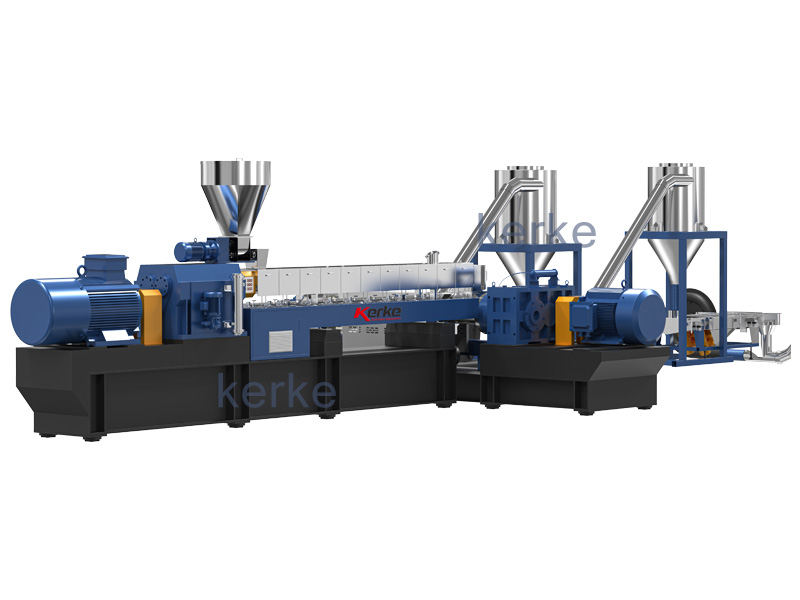
Throughput scales with screw diameter. A KTE-75 line commonly produces 300 to 500 kg/h of filled masterbatch, a KTE-95 around 800 to 1200 kg/h, and a KTE-135D above 2000 kg/h. Kerke supplies these lines with loss-in-weight feeders, side stuffer, vacuum system, gear pump and the chosen pelletizer, and the Wanplas brand backs them with its shared service commitments including free spare parts each year and on-site commissioning.
Indicative Process Window by Screw Size
| Model | Screw diameter (mm) | Output (kg/h) | Screw speed (rpm) |
|---|---|---|---|
| KTE-52 | 52 | 120 to 220 | 300 to 600 |
| KTE-75 | 75 | 300 to 500 | 300 to 550 |
| KTE-95 | 95 | 800 to 1200 | 250 to 500 |
| KTE-135D | 135 | 2000 plus | 200 to 400 |
Pelletizing Methods: Water Ring, Strand and Underwater
The final step turns the compounded melt into uniform pellets that a converter can meter accurately. Three methods dominate for filler masterbatch: strand pelletizing, water ring die-face pelletizing and underwater pelletizing. The choice depends on melt strength, filler loading, cooling need and the desired pellet shape.
Strand pelletizing pulls several extruded strands through a water bath and then through a rotary cutter. It is robust, easy to start and suits a wide viscosity range, which makes it the default for many filler masterbatches with enough melt strength. Its drawback is floor space and the need for consistent strand tension; a broken strand means downtime. Water ring pelletizing cuts the melt at the die face and flings the pellets into a water ring where they are cooled and conveyed, then dried. It is compact and handles higher outputs well, and it is a common choice for filled grades that are too soft for clean strand handling.
Underwater pelletizing cuts the strands inside a water-filled chamber at the die face, giving perfectly spherical, dust-free pellets with excellent uniformity. It suits heat-sensitive and low-viscosity compounds and is preferred for Premium, high-value masterbatches and for very high filler loadings where strand breakage would be frequent. The trade-off is higher equipment complexity and a higher capital cost, but it yields the most consistent pellet for automated dosing. Kerke supplies all three cutting systems and matches the pelletizer to the carrier and loading.
Pelletizing Method Comparison
| Method | Pellet shape | Best for | Relative complexity |
|---|---|---|---|
| Strand | Cylindrical | General, good melt strength | Low |
| Water ring | Near-spherical, small | High output, soft melt | Medium |
| Underwater | Spherical, uniform | Premium, heat-sensitive, high load | High |
For a commodity calcium carbonate masterbatch where cost must stay Low, strand or water ring pelletizing is typical. For a Premium barium sulfate grade demanding the cleanest dosing and lowest dust, underwater pelletizing is the better match. After cutting, the pellets are centrifugally dried, screened to remove fines and sent to silo or big-bag, and a final FPV and ash check confirms the lot before shipment.
Frequently Asked Questions
Which filler gives the highest density in a masterbatch?
Barium sulfate (BaSO4) delivers the highest specific gravity at about 4.3 g/cm3, compared with calcium carbonate at roughly 2.7 g/cm3 and talc at roughly 2.8 g/cm3. For maximum weight gain per gram of added masterbatch, BaSO4 is the preferred choice, while CaCO3 is selected when cost must remain Low.
What filler loading is typical in a high density filler masterbatch?
Most commercial filler masterbatches carry 70 percent to 85 percent active filler by weight. BaSO4 grades can reach 80 percent to 90 percent because of the high density of the powder, while fine precipitated CaCO3 grades normally peak around 80 percent to keep melt strength and dispersion acceptable.
How is dispersion quality measured for filler masterbatch?
Dispersion is most commonly quantified by the Filter Pressure Value (FPV), also called pressure filter value, measured on a capillary rheometer fitted with a standard screen pack. A lower and more stable pressure rise indicates finer, more uniform dispersion and fewer agglomerates.
Why use a side feeder on a twin-screw extruder for filler masterbatch?
A side feeder introduces a large portion of the dry filler downstream of the main feed throat, reducing the free-volume occupied by low-bulk-density powder at the intake. This raises total throughput, limits screw overload, lowers specific energy per kilogram and improves devolatilization of the carrier.
How does MFI of the carrier affect the final product?
A carrier with MFI of 20 to 50 g/10min for polyethylene or 20 to 40 g/10min for polypropylene lets a high filler loading still be extruded and pelletized. If the carrier MFI is too low the melt is too stiff to disperse the powder and FPV rises; if too high the masterbatch can soften the mechanical properties of the filled article.
Can filler masterbatch replace virgin resin to cut cost?
Yes, up to a point. Adding 10 percent to 40 percent filler masterbatch to a natural resin lowers material cost from Low to Medium relative grade while adding weight and stiffness. Beyond roughly 40 percent final filler, impact and appearance usually degrade unless coupling and toughening are applied, so the limit is set by the application.
What screw L/D is best for filler masterbatch?
An L/D of 40 to 48 is the practical sweet spot. It provides enough length for melting, intensive kneading, side feeding and two venting zones without excessive residence time that could degrade the carrier. Lab KTE-16B units use shorter L/D for trial work, while large KTE-135D lines run 40 to 52.
Conclusion
A high density filler masterbatch is an exercise in balancing weight, rigidity and processability. Calcium carbonate keeps cost Low and is the volume workhorse; barium sulfate delivers the highest specific gravity for weight-critical parts at a Medium to High cost; talc gives the strongest flexural modulus and heat resistance through its plate-like particles. Surface treatment with stearic acid or titanate coupling, careful carrier and MFI matching, and disciplined control of the filler-to-polymer interface determine whether the product is brittle or robust.
The compounding line does the rest. A co-rotating parallel twin-screw extruder such as Kerke’s KTE series, configured with conveying and kneading elements, a side feeder for high loading, vacuum venting for moisture and air, and a matched pelletizer, turns powder and resin into a uniform, low-FPV masterbatch. Kerke, a Wanplas factory with more than 12 years in twin-screw compounding and 2000 plus machines running in over 70 countries, supplies these lines with loss-in-weight feeding, side stuffing and the pelletizing route, strand, water ring or underwater, that fits your grade. If you are planning a filler masterbatch line, contact the Wanplas brand team to match a KTE model, screw profile and pelletizer to your filler, loading and output target.