Masterbatch for PET bottles sits at the intersection of two unforgiving requirements: the finished container must look visually flawless under retail lighting, and the color must not shift across a production run that may span several hundred tonnes of preform. Unlike polyolefin masterbatch, where a small dispersion defect disappears inside an opaque wall, every undispersed pigment agglomerate in a clear PET bottle is a visible speck, and every degradation reaction in the compounding step shows up as yellowing, haze, or a measurable intrinsic viscosity loss at the injection molding machine. That is why PET bottle masterbatch production is one of the most demanding applications for a twin-screw compounding line.
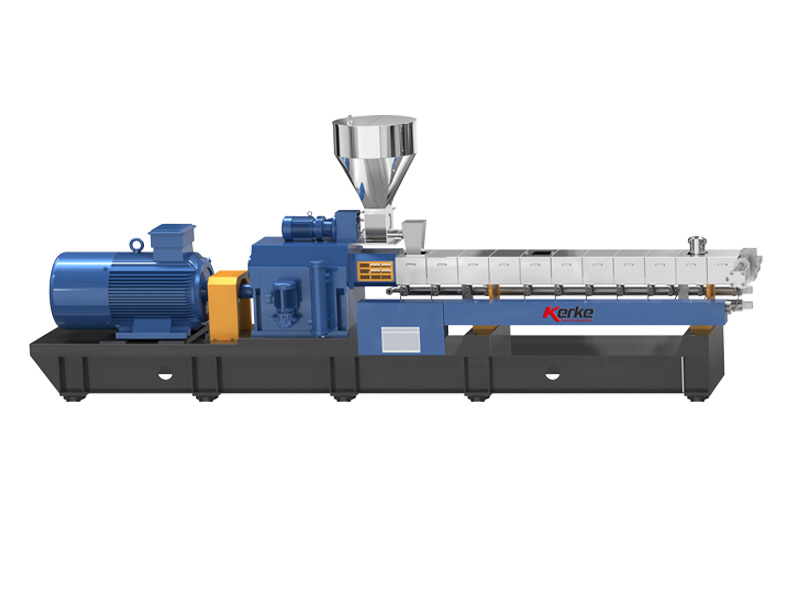
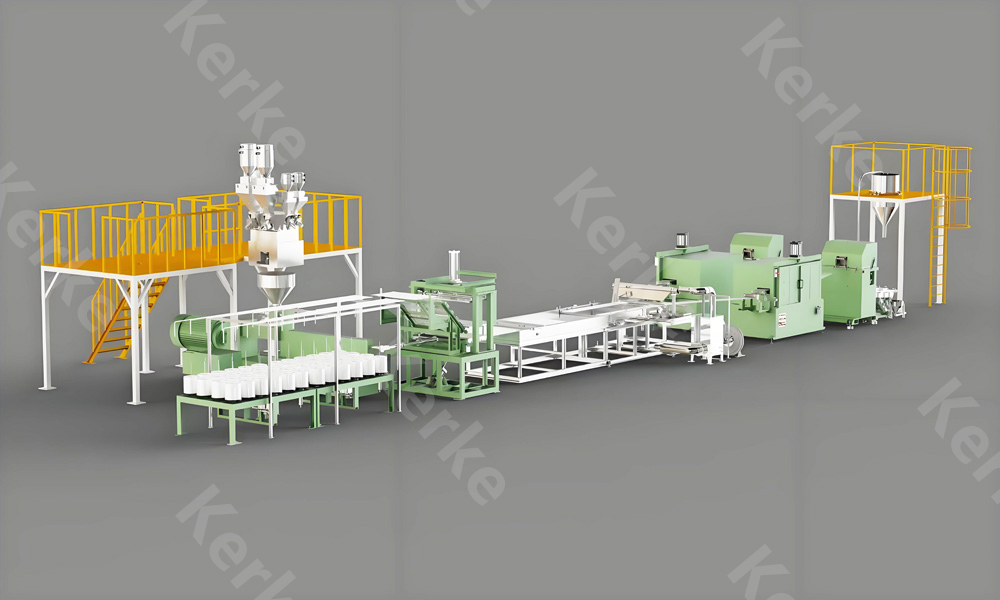
This guide is written for masterbatch producers, PET preform converters, and brand-side technical buyers who need to specify or upgrade a masterbatch compounding line. It covers carrier resin economics, pigment chemistry, dispersion mechanics, screw configuration, thermal profiles, vacuum devolatilization, pelletizing selection, let-down ratio strategy, food-contact compliance, and a practical defect troubleshooting matrix. Technical parameters throughout reflect current practice in 2026 among Asian and European masterbatch plants, including installations running KTE series co-rotating twin-screw extruders from Kerke, a Wanplas factory with more than 12 years of specialization in compounding extrusion and over 2,000 machines operating in 70-plus countries.
Why PET Bottle Masterbatch Is a Different Engineering Problem
PET bottle masterbatch must deliver color at extremely low addition rates while leaving optical clarity, mechanical strength, and intrinsic viscosity essentially untouched. A typical light-blue water bottle uses a let-down ratio between 0.3% and 1.0%, meaning a single pigment agglomerate surviving compounding is diluted but never eliminated — it simply becomes a defect in one bottle instead of many.
Three physical constraints define the problem. First, PET is hygroscopic and hydrolyzes rapidly above roughly 240 °C when moisture exceeds about 50 ppm, which means every gram of undried carrier resin translates into chain scission and IV loss. Second, PET is optically transparent, so any refractive-index mismatch between the carrier phase and the base resin produces haze; a difference of only 0.01 in refractive index across dispersed domains larger than 200 nm is enough to scatter visible light measurably. Third, PET has a narrow processing window: the melting point sits near 250-255 °C while meaningful thermal degradation and acetaldehyde generation accelerate above 285 °C, leaving perhaps 30 °C of usable headroom.
These constraints eliminate several shortcuts that work in polyolefin masterbatch. High-shear, long-residence kneading blocks that would give beautiful dispersion in a PP filler masterbatch will destroy PET molecular weight. Universal polyethylene-wax carriers that dissolve happily into HDPE film will form a separate, incompatible phase in a PET wall and produce visible haze and delamination.
Categories of PET Bottle Masterbatch
- Transparent color masterbatch — organic dyes or highly transparent organic pigments for tinted water, carbonated soft drink, and cosmetic bottles. Highest clarity requirement.
- Opaque white masterbatch — titanium dioxide at 40-70% loading for dairy and UHT milk bottles, often combined with light-blocking additives to protect riboflavin and vitamin A.
- Light-barrier masterbatch — carbon black plus TiO2 or specialty pigment blends achieving greater than 99.5% light blocking between 400 and 700 nm at wall thicknesses of 0.35 mm.
- Additive masterbatch — acetaldehyde scavengers, oxygen scavengers, UV absorbers, optical brighteners, reheat additives, and IV boosters (chain extenders).
- Black masterbatch for R-PET — high-loading carbon black for recycled PET applications where base color variation must be masked.
Carrier Resin Selection: PET, PETG, PBT and Universal Carriers
The carrier resin is the single most influential formulation decision for PET bottle masterbatch, because it determines compatibility, haze contribution, drying requirements, and how much thermal history the pigment must survive. Producers essentially choose between a matched-polyester carrier and a low-melting universal carrier, and the trade-off is clarity versus processing convenience.
Matched Polyester Carriers
Bottle-grade or fiber-grade PET with IV between 0.60 and 0.80 dL/g is the default carrier for high-clarity applications. Because the carrier and the base resin are chemically identical, there is no refractive-index mismatch and effectively zero haze contribution from the carrier phase. The disadvantage is processing severity: the compounding line must run melt temperatures of 265-285 °C, requires crystallizing and drying of the carrier to below 30 ppm moisture, and exposes pigments to full PET processing temperatures.
PETG and amorphous copolyester (PCTG) carriers melt around 220-235 °C, do not require crystallization before drying, and offer excellent PET compatibility with only a marginal clarity penalty. Many producers running mid-range let-down ratios choose PETG for transparent tints because it reduces pigment thermal exposure by roughly 30 °C while retaining haze contribution below about 0.3%.
Low-Melting and Universal Carriers
PBT, thermoplastic polyurethane, EVA, and specialty polyester waxes melt between 180 and 225 °C and allow the masterbatch itself to be compounded on a gentler thermal profile. They also disperse pigments more easily because the lower viscosity at a given temperature reduces the risk of degradation during high-shear mixing. The penalty appears in the bottle: PBT carriers add roughly 0.5-1.2% haze at 1% LDR, and polyolefin-based universal carriers add 2-5% haze plus a risk of gel formation and stress whitening in the bottle base. Polyolefin carriers should generally be restricted to opaque white and light-barrier grades where haze is irrelevant.
Carrier Comparison for PET Bottle Applications
| Carrier Type | Melt Range (°C) | Added Haze at 1% LDR | Max Pigment Loading | Drying Requirement | Relative Cost | Best Use |
|---|---|---|---|---|---|---|
| Bottle-grade PET (IV 0.72-0.80) | 250-255 | Below 0.1% | 30-40% | 160 °C / 4-6 h, dew point -40 °C | Medium | Premium water and CSD tints |
| Fiber-grade PET (IV 0.62-0.68) | 250-255 | Below 0.15% | 40-55% | 160 °C / 4-6 h | Low | Textile and general PET tints |
| PETG / PCTG | 220-235 | 0.2-0.3% | 30-50% | 65 °C / 4 h, no crystallizer | High | Heat-sensitive organic pigments |
| PBT | 220-225 | 0.5-1.2% | 50-65% | 120 °C / 3-4 h | High | High-loading concentrates |
| Polyester wax / oligomer blend | 120-180 | 0.4-0.9% | 60-75% | Minimal | Premium | Ultra-high-load additive batches |
| LDPE / PE wax universal | 105-130 | 2-5% | 60-80% | None | Low | Opaque white and black only |
Pigment and Additive Formulation for Clarity and Color Stability
Color stability in PET bottles depends less on the nominal pigment shade than on the pigment’s thermal stability, migration resistance, and nucleating behavior. A pigment that looks identical to a competitor’s in a masterbatch pellet can shift by more than 2 Delta E units after the preform passes through injection molding at 285 °C and a 12-second residence, then through reheat stretch blow molding at 100-115 °C.
Pigment Classes Suitable for PET
Transparent tints rely on high-performance organic pigments with heat stability above 300 °C. Copper phthalocyanine blue (PB 15:1 and PB 15:3) and phthalocyanine green (PG 7) are the workhorses for water and CSD bottles, offering excellent transparency, heat resistance to 320 °C, and outstanding lightfastness. Quinacridones (PV 19, PR 122) and perylenes (PR 149, PR 179) cover red and magenta at heat stability of 290-320 °C. Anthraquinone and perinone solvent dyes give the highest clarity of all because they dissolve molecularly in the polyester phase, contributing essentially zero light scattering, but their migration resistance and food-contact status must be verified case by case.
Inorganic pigments behave differently. Titanium dioxide is essential for opaque white but is a strong nucleating agent: at loadings above about 4% in the final bottle it accelerates PET crystallization, raising the risk of pearlescence in thick preform sections and narrowing the stretch blow molding process window. Rutile grades with alumina-silica surface treatment are preferred over anatase, which photocatalytically degrades PET and yellows over shelf life. Ultramarine blue is widely used as a bluing agent at 5-30 ppm in the finished bottle to neutralize the yellow tint of R-PET, but it is acid-sensitive and can lose color in contact with acidic beverages if migration is not fully controlled.
Functional Additives
- Acetaldehyde scavengers — anthranilamide or polyamide-based chemistries dosed at 500-3,000 ppm in the final bottle, typically supplied at 5-15% in the masterbatch. Reduces AA in mineral water bottles from 8-12 µg/L to below 3 µg/L.
- Reheat additives — carbon black at 1-4 ppm, antimony-based or specialty infrared absorbers that raise preform heating efficiency by 8-15% in the blowing oven, cutting stretch blow molding energy consumption.
- UV absorbers — benzotriazole or triazine types at 0.1-0.5% in the bottle for beer, juice, and pharmaceutical containers; targets below 10% transmission at 370 nm.
- Chain extenders / IV boosters — multifunctional epoxide oligomers at 0.2-0.8% used mainly with R-PET to recover 0.03-0.08 dL/g of intrinsic viscosity.
- Optical brighteners — bis-benzoxazole types at 20-80 ppm to raise perceived whiteness and mask the yellowness index of recycled content.
- Slip and antiblock — usually avoided in clear bottles because silica antiblock adds measurable haze.
Pigment Selection Matrix
| Pigment / Colorant | Heat Stability | Transparency | Typical Loading in MB | Nucleation Risk | Relative Cost |
|---|---|---|---|---|---|
| PB 15:1 phthalocyanine blue | 320 °C | High | 15-30% | Moderate | Medium |
| PG 7 phthalocyanine green | 320 °C | High | 15-30% | Moderate | Medium |
| Anthraquinone solvent dyes | 280-300 °C | Very high | 3-10% | None | Premium |
| PV 19 quinacridone | 300 °C | High | 10-20% | High | High |
| Rutile TiO2 (surface treated) | Above 400 °C | Opaque | 50-70% | Very high | Low |
| Carbon black (channel/furnace) | Above 400 °C | Opaque | 25-45% | Very high | Low |
| Ultramarine blue (bluing) | 300 °C | Medium | 1-5% | Moderate | Low |
Dispersion Physics: How Haze Is Actually Created and Controlled
Haze in a pigmented PET bottle comes from three independent mechanisms, and each requires a different fix. Producers who treat haze as a single problem usually over-shear the melt trying to solve a defect that shear cannot address.
Mechanism one is agglomerate scattering. Pigment particles supplied as press cake or powder arrive as aggregates of 5-50 µm. Any particle larger than roughly half the wavelength of visible light — about 250 nm — scatters light. Reducing agglomerates to their primary particle size of 40-120 nm is the job of dispersive mixing in the kneading section, and it is measured downstream by the filter pressure value test according to procedures aligned with ASTM D5748-style screen-pack methods. A well-dispersed PET color masterbatch gives a filter pressure value below 0.8 bar·cm²/g on a 14 µm screen.
Mechanism two is carrier phase separation. When the carrier is incompatible with PET, it forms discrete droplets in the bottle wall. Droplets of 0.3-3 µm scatter strongly. No amount of extra mixing fixes this; only a compatible carrier does.
Mechanism three is crystallinity haze. Nucleating pigments accelerate spherulite growth during preform cooling, and spherulites above about 1 µm scatter light. This is the dominant haze mechanism in TiO2, talc-containing, and some organic red formulations. It is controlled by limiting pigment loading, choosing fine surface-treated grades, and by lowering preform mold temperature to 8-12 °C with adequate cooling time.
Dispersion Quality Measurement
- Filter pressure value (FPV) — the industry benchmark. Target below 0.8 bar·cm²/g for clear tints, below 2.0 for opaque grades.
- Haze meter — injection-molded plaques of 2 mm or blown bottle sidewall measured against an unpigmented control. Report delta haze, not absolute.
- Optical microscopy of pressed film — 20 µm hot-pressed film, count agglomerates above 10 µm per cm².
- Spectrophotometry — L*a*b* measurement of molded plaques, with lot-to-lot Delta E tracked in an SPC chart. Delta E below 0.5 is the commercial norm for branded beverage work.
Twin-Screw L/D Ratio and Screw Configuration for PET Masterbatch
Co-rotating intermeshing twin-screw extruders are the only realistic technology for PET bottle masterbatch, because they decouple conveying from mixing and allow the formulator to place dispersive and distributive elements exactly where they are needed. The two decisions that matter most are the length-to-diameter ratio and the arrangement of kneading blocks.
Choosing L/D for PET
PET masterbatch generally runs shorter barrels than polyolefin compounding because residence time is the enemy. Practical guidance:
- L/D 32:1 to 36:1 — standard for PET color masterbatch with dried carrier, single vacuum vent, side-feed pigment addition. Residence time of 25-40 seconds at typical throughputs.
- L/D 40:1 to 44:1 — used when two vent zones are needed, when liquid additives are injected, or when very high TiO2 loading requires an extended distributive section. Residence time rises to 45-70 seconds, so barrel temperatures must be pulled back correspondingly.
- L/D 48:1 and above — generally avoided for clear PET tints; more appropriate for reactive extrusion, devolatilization of R-PET flake, or filled compounds.
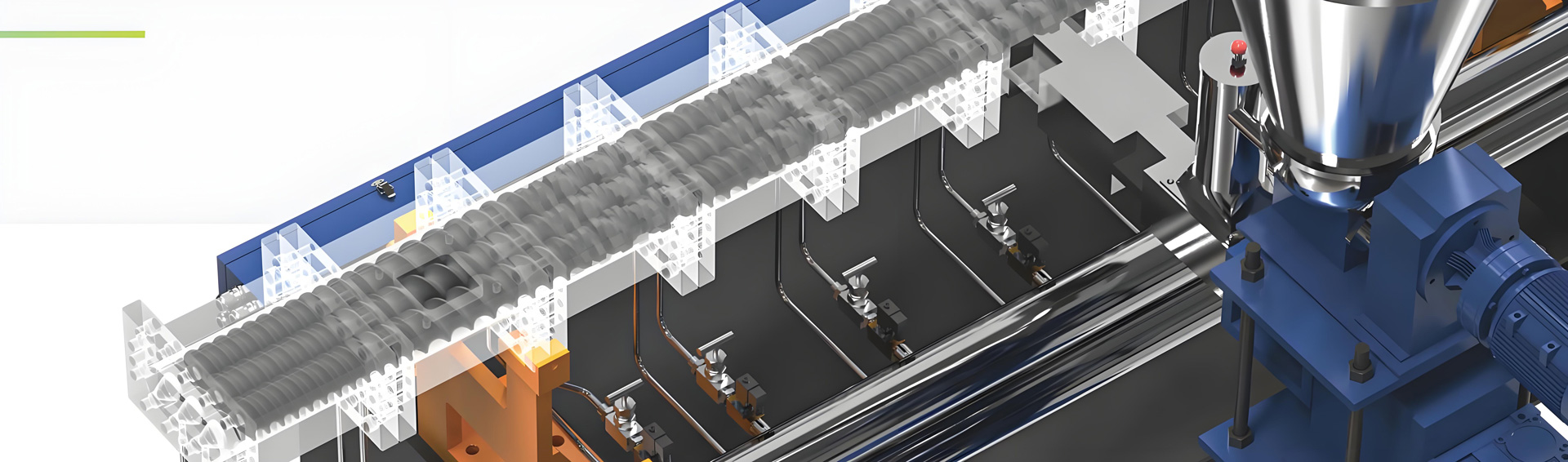
Kerke’s KTE series covers KTE-16B laboratory units through KTE-135D production machines, with L/D configurable in barrel modules of 4D so that a producer can order 36:1 today and extend to 44:1 later without replacing the base machine. Because barrel structure, screw arrangement, exhaust position, feeding configuration, and electrical control are all specified per project rather than fixed, a PET masterbatch line can be built with the shortest melting section and the longest possible vacuum section for the same nominal L/D.
Screw Element Strategy
A typical PET color masterbatch screw layout from feed to die:
- Zone 1-2, conveying (0-8D): deep-flight forward conveying elements with 1.5-1.75 pitch to accept dried PET pellets at low bulk density without surging.
- Zone 3, first melting (8-14D): a short kneading block sequence of 45-degree forward discs to melt the carrier with minimum shear heating. Avoid neutral 90-degree blocks here — they generate melt temperature spikes that cost IV.
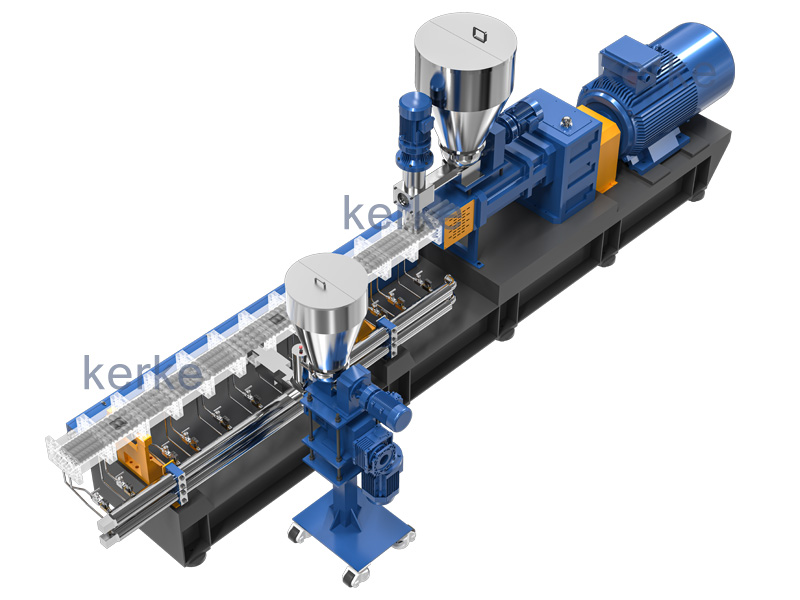
- Zone 4, side-feed port (14-16D): pigment and additive powders introduced through a twin-screw side feeder into fully molten carrier. Adding pigment downstream instead of in the main hopper is the single biggest improvement most PET masterbatch plants can make: it eliminates dust flooding, improves feed stability, and reduces pigment thermal history by 10-15 seconds.
- Zone 5, dispersive mixing (16-24D): the core wetting-out section. Combinations of 45-degree forward, 90-degree neutral and short 45-degree reverse blocks. Reverse elements create the pressure field needed to break agglomerates but must be kept short — a 1D reverse block is usually sufficient, and a 2D block will typically add 12-18 °C of melt temperature.
- Zone 6, vacuum vent (24-30D): deep-channel conveying elements running only 30-45% full so volatiles can escape.
- Zone 7, distributive mixing (30-34D): toothed mixing elements or turbine elements that homogenize color without adding shear energy.
- Zone 8, pressure build (34-36D): reduced-pitch conveying elements sized so that die pressure lands in the 40-90 bar window.
Kerke’s computer-aided screw design uses fully intermeshing, self-wiping kneading co-type geometry, which matters for masterbatch producers because self-cleaning screws reduce color changeover time. A plant switching from dark blue to light blue on a self-wiping profile typically purges in 15-25 minutes versus 45-60 minutes on a poorly wiping design, and on a line running 20 color changes per week that difference is worth several hundred production hours per year.
Screw Speed and Specific Energy
PET masterbatch normally runs at 300-600 rpm on production machines, well below the 800-1,200 rpm used for polyolefin filler masterbatch. Specific mechanical energy should be held between 0.16 and 0.26 kWh/kg. Above roughly 0.30 kWh/kg, IV loss becomes measurable and acetaldehyde generation climbs sharply. Producers should treat SME as a controlled process variable, logged per batch alongside melt temperature and torque percentage, rather than simply chasing maximum throughput.
Temperature Profiles, Drying and Vacuum Devolatilization
Moisture management determines whether a PET masterbatch line produces 0.72 IV pellets or 0.58 IV pellets from the same raw material. PET hydrolyzes at a rate roughly proportional to water concentration at melt temperature, and the reaction is fast enough that 500 ppm of residual moisture can strip 0.05-0.10 dL/g of IV in a 40-second residence.
Upstream Drying Requirements
- Crystallizer: 165-175 °C with agitation for 30-45 minutes for amorphous carrier resin, to prevent pellet clumping in the dryer hopper.
- Desiccant dryer: 160-170 °C, dew point of -40 °C or lower, residence 4-6 hours, air flow of 1.8-2.2 m³/h per kg/h of throughput.
- Target moisture: below 30 ppm for clear bottle grades, below 50 ppm for opaque grades.
- Pigment powder pre-drying: many organic pigments carry 0.3-1.5% surface moisture. Pre-drying at 80-110 °C for 3-4 hours, or feeding them through a vented side feeder, prevents that water from reaching the PET melt.
Recommended Barrel Temperature Profile
| Zone | PET Carrier (°C) | PETG Carrier (°C) | PBT Carrier (°C) | Purpose |
|---|---|---|---|---|
| Feed throat | Water cooled, 30-45 | Water cooled, 30-45 | Water cooled, 30-45 | Prevent bridging |
| Zone 1-2 | 230-250 | 190-210 | 195-215 | Preheat, soften |
| Zone 3-4 (melting) | 265-275 | 225-240 | 230-245 | Complete melting |
| Zone 5-6 (side feed + dispersion) | 270-280 | 230-245 | 235-250 | Wet out pigment |
| Zone 7-8 (vacuum) | 265-275 | 225-240 | 230-245 | Strip volatiles |
| Zone 9-10 (metering) | 260-270 | 220-235 | 225-240 | Cool, build pressure |
| Die head | 265-275 | 225-240 | 230-245 | Stable strand/melt flow |
| Actual melt temperature | 272-285 max | 232-248 max | 238-255 max | Measure with immersion probe |
Note the deliberate downward step in zones 9-10. Many operators run a rising profile all the way to the die, which is appropriate for polyolefins but wrong for PET; a cooling metering section reduces melt temperature by 5-10 °C before pelletizing and directly lowers acetaldehyde in the final product.
Vacuum Devolatilization
A vacuum vent is mandatory, not optional, for PET masterbatch. It removes residual moisture, pigment surface volatiles, dispersant decomposition products, and acetaldehyde generated in the melt. Specification guidance:
- Vacuum level: -0.085 to -0.095 MPa gauge (roughly 50-150 mbar absolute). Deeper vacuum improves AA stripping but increases the risk of pulling low-molecular-weight additives and fine pigment out of the melt.
- Vent geometry: a vent insert with an internal stuffing screw, or an oversized rectangular vent dome, prevents melt from riding up into the vent. PET is low-viscosity at melt temperature and vents flood easily.
- Vacuum pump type: water ring pumps are the pragmatic choice for PET because oligomer condensate is continuously washed away. Dry pumps clog with cyclic trimer within days.
- Condensate trap: a heated knock-out pot at 90-100 °C upstream of the pump collects PET cyclic trimer, which otherwise crystallizes in the vacuum line and causes weekly shutdowns.
- Two-stage venting: for R-PET-based masterbatch or highly volatile additive packages, an atmospheric vent at 18D plus a vacuum vent at 28D is significantly more effective than one deep vacuum port.
Pelletizing Choices: Water Ring, Underwater and Strand Systems
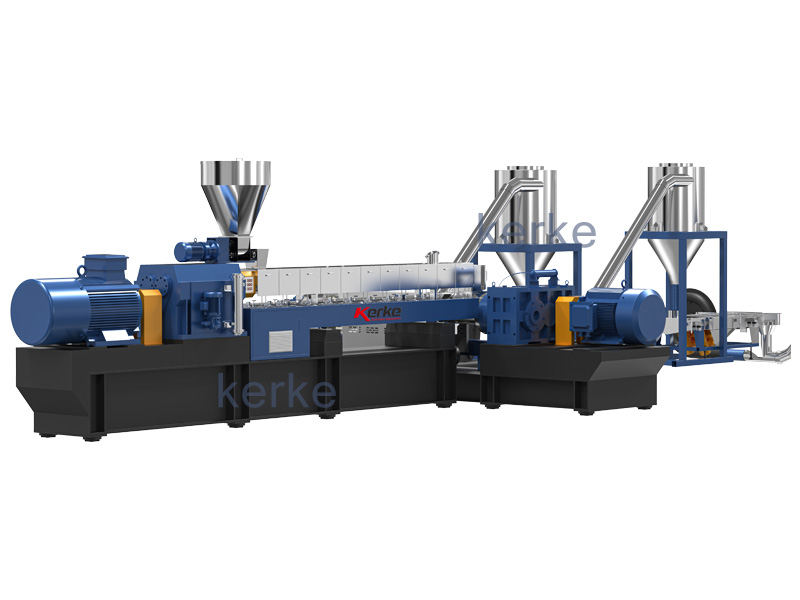
Pellet geometry directly affects the customer’s dosing accuracy, and pellet thermal history affects acetaldehyde and IV. Kerke supplies water-cooled strand pelletizing, air-cooled strand pelletizing, air-cooled die-face hot cutting, water-ring die-face hot cutting, eccentric water-mist hot cutting, and full underwater granulation, which lets a masterbatch producer match the cutting system to the specific product family rather than compromise.
Strand Pelletizing
Water-cooled strand pelletizing remains the most common choice for PET color masterbatch at outputs up to about 800 kg/h. The melt exits through a strand die of 30-80 holes at 3.0-3.5 mm, travels through a water bath of 1.5-3.0 m at 25-45 °C, passes an air knife, and is cut into cylindrical pellets of about 2.5-3.0 mm. Advantages include the lowest capital cost, easy visual inspection of strand quality, and simple color changeover. The drawbacks are strand breakage at high pigment loading, an inevitable moisture pickup of 1,500-4,000 ppm requiring a downstream dryer, and manual strand threading at startup.
Water Ring Die-Face Cutting
In water ring pelletizing, rotating blades cut the melt directly at the die face while a swirling ring of water in the housing cools and transports the resulting pellets. Because the pellet is cut hot and cooled immediately, it forms a lens or teardrop shape rather than a cylinder. For PET masterbatch this system suits medium-to-high viscosity formulations at 200-1,500 kg/h, tolerates high filler and TiO2 loadings that would break strands, and eliminates strand threading. Water pickup lands around 1,000-2,500 ppm. Die-face heating must be well designed, because PET freezes at the die plate quickly and a cold hole causes immediate blade wear.
Underwater Granulation
Underwater pelletizing submerges the entire die face in a temperature-controlled water chamber at 60-85 °C, with pellets cut and conveyed as a slurry to a centrifugal dryer. It produces near-spherical pellets with excellent bulk density and flow characteristics, handles outputs from 300 kg/h up to several tonnes per hour, and gives the tightest pellet size distribution of any method — which matters when the customer doses at 0.3% LDR through a gravimetric feeder, since pellet uniformity is the dominant contributor to short-term dosing variation. Capital cost is the highest of the three, and the die plate requires careful thermal isolation. For PET specifically, underwater granulation has one further advantage: the pellet passes from 270 °C to below 100 °C in under a second, freezing acetaldehyde generation almost instantly.
Pelletizing System Comparison
| System | Output Range | Pellet Shape | Moisture Pickup | Changeover Time | Relative Cost | Best For |
|---|---|---|---|---|---|---|
| Water-cooled strand | 50-800 kg/h | Cylindrical 2.5-3.0 mm | 1,500-4,000 ppm | 15-25 min | Low | Clear tints, frequent color changes |
| Air-cooled strand | 30-300 kg/h | Cylindrical | Below 300 ppm | 10-20 min | Low | Moisture-sensitive additive batches |
| Water ring die face | 200-1,500 kg/h | Lens / teardrop | 1,000-2,500 ppm | 25-40 min | Medium | High TiO2 white, black batches |
| Eccentric water mist | 100-600 kg/h | Irregular sphere | 500-1,200 ppm | 20-30 min | Medium | Tacky or low-viscosity carriers |
| Underwater granulation | 300-3,000 kg/h | Spherical 2.0-3.0 mm | 800-2,000 ppm | 40-60 min | High | Large-volume single-color runs |
Let-Down Ratio, Dosing Accuracy and Cost per Bottle
Let-down ratio is a commercial decision disguised as a technical one. A higher-concentration masterbatch used at a lower LDR reduces freight and warehousing per tonne of bottle produced, but pushes the burden of accuracy onto the customer’s dosing unit and reduces the mixing distance available in the injection molding screw.
Typical Let-Down Ratios in PET Bottle Production
| Application | Pigment Load in MB | Typical LDR | Dosing Tolerance | Notes |
|---|---|---|---|---|
| Light blue water bottle | 2-6% | 0.3-0.8% | Plus or minus 2% | Very low tint, dilute MB preferred |
| Green CSD bottle | 10-20% | 0.5-1.5% | Plus or minus 3% | Gravimetric dosing recommended |
| Amber pharmaceutical bottle | 15-25% | 1.5-3.0% | Plus or minus 3% | UV transmission tested per lot |
| Opaque white dairy bottle | 50-70% TiO2 | 4-10% | Plus or minus 5% | Light blocking above 99.5% required |
| AA scavenger batch | 5-15% active | 1.0-2.5% | Plus or minus 2% | Often combined with tint batch |
| Reheat additive batch | 0.05-0.5% active | 0.2-0.6% | Plus or minus 2% | Overdose causes grey cast |
Why Loss-in-Weight Feeding Matters Upstream Too
Masterbatch consistency starts in the compounding plant’s own feeders. On a PET color line, a volumetric feeder drifting by 3% on pigment addition produces a lot that is 3% off shade — invisible in the pellet, obvious in the bottle. Kerke supplies volumetric metering systems, loss-in-weight feeders, twin-screw side feeders, crammer feeders, and liquid feeders, and for color masterbatch the recommended configuration is loss-in-weight on the carrier resin, loss-in-weight on each pigment stream above 2% of formulation, and a liquid feeder for dispersants or liquid colorants injected directly into the melt. Loss-in-weight feeders hold plus or minus 0.5% on a 30-second averaging window compared with plus or minus 2-4% for volumetric screw feeders on low-bulk-density pigment powders.
Food-Contact Compliance and Documentation for Export Markets
Any masterbatch destined for a beverage or food bottle must carry a compliance dossier, and increasingly buyers audit the compounding plant rather than simply accepting a certificate. The two regimes that matter most for exporters are the United States FDA framework and the European Union’s Regulation EU 10/2011 on plastic materials and articles intended to come into contact with food.
United States
Colorants in food-contact plastics are generally addressed through FDA regulations covering polymer resins and adjuvants, with many pigments qualifying as substances that are not food additives when they do not migrate. Practical documentation includes a statement of compliance referencing the applicable sections of 21 CFR Part 177 for the base polyester, confirmation that every pigment and additive is either listed or supported by a food-contact notification, and extraction testing where required. PET bottle masterbatch suppliers should keep pigment-level letters of compliance from each raw material vendor and be able to produce them within 24 hours during an audit.
European Union
EU 10/2011 governs plastic food-contact materials and sets specific migration limits and an overall migration limit of 10 mg/dm² of food-contact surface. Masterbatch suppliers must issue a Declaration of Compliance identifying substances subject to restriction, dual-use additives, and any substances behind a functional barrier. Colorants themselves are not positively listed in EU 10/2011 but must comply with national requirements and with the general safety requirements of Framework Regulation EC 1935/2004; many suppliers reference the AP(89)1 resolution and the German BfR recommendations as supporting evidence. Testing normally uses simulants such as 10% ethanol, 3% acetic acid, and 50% ethanol, with conditions matched to the bottle’s intended contents and shelf life.
Other Requirements Buyers Ask About
- Heavy metals — total of lead, cadmium, mercury, and hexavalent chromium below 100 ppm per the packaging directive and comparable regional rules.
- REACH SVHC — declaration that no substance of very high concern is present above 0.1% by weight.
- China GB standards — GB 4806 series for food-contact plastics, increasingly requested by exporters serving Chinese bottlers.
- Recycled content — where R-PET is used in the carrier, a chain-of-custody statement and a confirmation of decontamination process approval.
- Plant certification — ISO 9001 as a minimum, ISO 22000 or equivalent food safety management for premium beverage accounts, plus documented allergen and cross-contamination controls.
From an equipment standpoint, food-contact production drives specific machine requirements: fully enclosed feeding to prevent airborne contamination, stainless-steel contact surfaces on hoppers and side feeders, tool-free disassembly of the pelletizer water circuit for cleaning, and documented cleaning validation between allergen-relevant product families. Machines supplied by Kerke and other Wanplas factories are built to CE requirements as standard, with documentation packages prepared for European and North American customs and safety review.
Defect Troubleshooting Table for PET Masterbatch Producers
Most PET masterbatch defects trace back to one of six root causes: moisture, excessive melt temperature, insufficient dispersive mixing, carrier incompatibility, feeder drift, or contamination. The following matrix maps observed symptoms to likely causes and corrective actions.
| Defect | Most Likely Cause | Diagnostic Check | Corrective Action |
|---|---|---|---|
| Haze in clear bottle above 2% | Incompatible carrier or nucleating pigment | Mold unpigmented carrier alone and measure haze | Switch to PET or PETG carrier; select non-nucleating pigment grade |
| Visible specks / unmelts | Insufficient dispersive mixing | Filter pressure value test on 14 µm screen | Add 1D reverse kneading block; raise screw speed 15%; verify side feeder position |
| Yellowing / high b* value | Thermal degradation or oxidation | Measure actual melt temperature with immersion probe | Reduce zones 5-6 by 10 °C; shorten reverse element; nitrogen blanket feed throat |
| IV loss above 0.05 dL/g | Moisture in carrier or pigment | Karl Fischer moisture on feed; check dryer dew point | Restore -40 °C dew point; extend drying to 6 h; pre-dry pigment powder |
| Acetaldehyde above 3 ppm in preform | Excess melt temperature or residence | Calculate residence time; log specific mechanical energy | Shorten L/D or raise throughput; deepen vacuum; add AA scavenger |
| Color drift within one lot | Feeder drift or pigment segregation | Review loss-in-weight feeder trend chart | Recalibrate feeders; switch volumetric to loss-in-weight; pre-blend minor pigments |
| Strand breakage | Low melt strength at high filler load | Check die pressure and water bath temperature | Lower die temperature 5 °C; shorten air gap to 40 mm; consider water ring cutting |
| Vent flooding | Screw too full at vent, or vacuum too deep | Inspect vent dome during run | Install deeper-flight vent elements; reduce vacuum to -0.080 MPa; add stuffer screw |
| Pellet size variation | Blade wear or die hole blockage | Sieve analysis; inspect die plate | Regrind or replace blades; clean die with controlled burn-off oven |
| Contamination from previous color | Dead zones in screw or die | Purge with clear carrier and count specks per kg | Verify self-wiping element geometry; use abrasive purge compound; schedule dark-to-light sequencing |
| Pearlescence in preform | Excess crystallinity from nucleating pigment | DSC on preform to measure crystallinity | Reduce pigment load; lower mold water to 8 °C; extend cooling 1.5 s |
Line Selection: Matching Kerke KTE Models to Output Targets
The right extruder size for a PET masterbatch operation is set by the largest single order a plant expects to run without a color change, not by total annual tonnage. A plant producing 3,000 tonnes per year across 60 shades is better served by two mid-size lines than one large one, because changeover losses on a large machine can exceed the throughput advantage.
| Model Class | Screw Diameter | Typical L/D | Max Screw Speed | PET Colour MB Output | Recommended Pelletizer | Best Fit |
|---|---|---|---|---|---|---|
| Laboratory (KTE-16B class) | 16 mm | 40:1 | 600 rpm | 2-10 kg/h | Air-cooled strand | Formula trials, shade matching, R&D |
| KTE-26 class | 26 mm | 40:1 | 600 rpm | 15-50 kg/h | Water-cooled strand | Pilot scale, small custom colors |
| KTE-52 class | 51.4 mm | 36:1 to 40:1 | 600 rpm | 150-300 kg/h | Water-cooled strand | Multi-shade custom masterbatch houses |
| KTE-65 class | 62.4 mm | 36:1 | 600 rpm | 300-600 kg/h | Water ring or strand | Regional beverage color supply |
| KTE-75 class | 71 mm | 36:1 to 44:1 | 500 rpm | 600-1,000 kg/h | Water ring | Opaque white dairy masterbatch |
| KTE-95 class | 93 mm | 36:1 to 44:1 | 500 rpm | 1,200-2,000 kg/h | Underwater | Captive production for large bottlers |
| KTE-135D class | 133 mm | 40:1 | 450 rpm | 2,500-4,000 kg/h | Underwater | Single-shade high volume, filler batches |
Output figures assume a PET or PETG carrier with 10-30% organic pigment loading and a vacuum vent in operation. High-TiO2 white batches typically run 20-35% above these figures because the mineral filler carries heat well and does not require high shear; conversely, ultra-clear low-tint batches often run 10-20% below because throughput is intentionally limited to keep melt temperature down.
Comparing Suppliers
The global twin-screw compounding market is served by European builders such as Coperion and Leistritz, Japanese suppliers including JSW and The Japan Steel Works group, and a competitive Chinese tier that includes Kerke, Nanjing-based peers, and several Shandong manufacturers. European machines lead on maximum specific torque and control-system sophistication; Chinese machines have closed much of the mechanical gap and lead decisively on delivery time and total installed cost. For PET masterbatch specifically, the differentiators worth auditing are gearbox torque density, barrel liner metallurgy for abrasive TiO2 grades, vacuum system design, and the supplier’s ability to run a customer trial before shipment.
Kerke operates a 19,997 sqm plant with more than 100 staff and offers formula trials on laboratory and pilot extruders before a production machine is finalized, along with 72-hour continuous operation testing prior to shipment. As part of the Wanplas brand, Kerke shares group-level commitments including a free spare parts allowance each year and support across the 70-plus countries the group serves. Where a PET masterbatch producer also needs blowing or filling equipment, other Wanplas factories cover those categories — YuDa supplies PET bottle blow molding machines, and Polyretec supplies washing and recycling lines that feed R-PET flake into Kerke compounding systems.
Frequently Asked Questions
What is the best carrier resin for a transparent PET bottle masterbatch?
Bottle-grade or fiber-grade PET is the best carrier for maximum clarity because it is chemically identical to the base resin and contributes essentially no haze. If the pigment package includes heat-sensitive organic pigments or dyes, PETG is the better compromise: it melts around 220-235 °C, cutting pigment thermal exposure by roughly 30 °C while adding only about 0.2-0.3% haze at 1% let-down ratio.
What L/D ratio should I specify for a PET masterbatch twin-screw extruder?
For standard PET color masterbatch with a dried carrier and a single vacuum vent, 32:1 to 36:1 is the practical range and keeps residence time at 25-40 seconds. Choose 40:1 to 44:1 only when you need two vent zones, liquid additive injection, or an extended distributive section for very high TiO2 loading. Longer is not better with PET, because every extra second at melt temperature costs intrinsic viscosity and generates acetaldehyde.
Why does my PET bottle look hazy even though the masterbatch pellets look perfect?
Pellet appearance does not reveal carrier incompatibility or crystallinity haze. Run a control test: mold plaques of unpigmented carrier alone. If they are hazy, the carrier is the problem and no amount of extra mixing will help. If the carrier is clear but the pigmented plaque is hazy, run a filter pressure value test to check dispersion, and a DSC scan to check whether the pigment is nucleating excessive crystallinity.
How much intrinsic viscosity loss is acceptable during masterbatch compounding?
Well-controlled PET masterbatch compounding should lose no more than 0.03 dL/g between the incoming carrier and the finished pellet. Losses of 0.05-0.10 dL/g almost always indicate moisture, either from inadequate carrier drying or from wet pigment powder. Because the masterbatch is only 0.3-1.0% of the final bottle, a small IV loss in the masterbatch is diluted, but it is still the clearest available indicator that the process is thermally or hydrolytically out of control.
Should pigment be added at the main hopper or through a side feeder?
Through a twin-screw side feeder into already-molten carrier, typically at 14-16D. Side feeding stabilizes the main feed, eliminates dust flooding at the throat, and reduces pigment thermal history by 10-15 seconds compared with main-hopper addition. The exception is very low pigment loadings below about 3%, where pre-blending with the carrier and single-point feeding can give better distributive uniformity.
Which pelletizing system is best for PET color masterbatch?
Water-cooled strand pelletizing suits most clear tint producers up to about 800 kg/h because of low cost and fast color changeover. Water ring die-face cutting is preferred for high-TiO2 white and black batches where strands break. Underwater granulation is the best technical choice above roughly 1,000 kg/h and for products where pellet uniformity drives customer dosing accuracy, and it also quenches the melt fast enough to minimize acetaldehyde.
What documentation do European beverage customers require?
A Declaration of Compliance referencing EU 10/2011 and Framework Regulation EC 1935/2004, migration test data using appropriate simulants, a REACH SVHC statement, heavy metals results, and pigment-level letters of compliance from each raw material supplier. Many buyers also require ISO 9001 certification of the compounding plant and, for premium accounts, a food safety management certification and an on-site audit.
How do I reduce color changeover time on a masterbatch line?
Use fully self-wiping intermeshing screw geometry, sequence production from light to dark within each color family, keep die channels free of dead zones, and standardize a purge protocol using an abrasive or high-viscosity purge compound. Plants that combine these measures typically reach 15-25 minute changeovers on a mid-size line, versus 45-60 minutes where screw wiping is poor or purge practice is ad hoc.
Can the same line produce both clear tint and high-TiO2 white masterbatch?
Yes, but plan for it at the specification stage. TiO2 is abrasive, so barrel liners should be bimetallic or tungsten-carbide-based rather than nitrided, and screw elements in the dispersive section should be a wear-resistant grade. Cross-contamination is the bigger operational issue: schedule white batches after clear tints and before dark colors, and validate cleaning with a speck-count purge test.
What screw speed and specific energy should I target?
Production PET masterbatch lines generally run 300-600 rpm with specific mechanical energy of 0.16-0.26 kWh/kg. Track SME rather than rpm alone, because it captures the combined effect of speed, throughput, and screw configuration. Sustained operation above about 0.30 kWh/kg reliably correlates with measurable intrinsic viscosity loss and elevated acetaldehyde.
Conclusion and Practical Recommendations
PET bottle masterbatch rewards discipline more than horsepower. The producers with the lowest customer complaint rates are not those running the biggest extruders; they are the ones that dry their carrier to below 30 ppm, side-feed pigment into molten polymer, keep melt temperature under 285 °C, verify dispersion with a filter pressure value test on every lot, and use loss-in-weight feeding on every stream above 2% of formulation. Those five habits address the great majority of clarity and color stability failures.
When specifying a new line, start from the product mix rather than the tonnage target. Frequent color changes point toward a mid-size machine of 51-65 mm with strand pelletizing and self-wiping screws. Long single-shade runs and high-TiO2 opaque grades justify a 75-95 mm machine with water ring or underwater cutting and wear-resistant barrel metallurgy. In both cases, insist on modular barrels so L/D can be extended later, specify a water ring vacuum pump with a heated condensate trap for cyclic trimer, and require a customer trial with your actual formulation before the machine ships.
Kerke, a Wanplas factory with over 12 years of specialization in compounding extrusion, builds KTE series co-rotating twin-screw extruders configured specifically for masterbatch producers, with barrel structure, screw arrangement, exhaust design, feeding systems, and electrical control specified per project. Laboratory and pilot extruders are available for shade matching and formula development, and every production machine undergoes extended continuous operation testing before shipment. For PET bottle masterbatch producers planning capacity in 2026, the practical next step is a formulation trial on a pilot line using your own carrier and pigment package, with haze, filter pressure value, intrinsic viscosity, and acetaldehyde measured on the resulting pellets — a two-day exercise that reliably prevents years of process compromise.