Quartz powder filler masterbatch is one of the most cost-effective mineral-filled concentrates available to plastics compounders, valued for the hardness, stiffness, dimensional stability and thermal resistance that finely ground crystalline silica brings to a polymer matrix. As a near-pure silicon dioxide mineral with a Mohs hardness of about 7, quartz is substantially harder than the calcium carbonate and talc that dominate commodity filling, and that hardness is exactly what makes it useful for wear-resistant, rigid and heat-stable parts. It also makes quartz one of the most abrasive fillers a processor will ever run, so the compounding line must be engineered for wear from the screw elements to the feeders. This complete guide explains what quartz powder filler masterbatch is, why its mineral physics drive performance, how it is manufactured on co-rotating twin-screw extruders such as the Kerke KTE series, how to formulate and couple it, how to manage abrasive wear, and how to select, test and quality-control a production line. By the end you will understand where quartz beats cheaper fillers, where it demands extra engineering, and how to compound it profitably and safely.
What Is Quartz Powder Filler Masterbatch?
Quartz powder filler masterbatch is a concentrated, pelletized additive in which finely ground quartz, essentially crystalline silica, is dispersed at high loading within a carrier resin. The concentrate is then let down into a virgin polymer during extrusion, injection molding or blow molding to modify mechanical, thermal and economic properties. By pre-compounding the dusty mineral into uniform pellets, the masterbatch format eliminates the feeding, dust and dispersion headaches of handling raw quartz powder directly at the converter.
Quartz, chemically silicon dioxide, is one of the most abundant minerals on earth and is mined and processed as silica sand, quartzite or vein quartz. For plastics it is milled to a controlled fine powder, commonly with a median particle size from 2 to 45 micrometers depending on the application, then classified to a tight distribution. Finer grades improve surface finish and mechanical reinforcement but increase abrasiveness and cost, while coarser grades are cheaper and used where finish is less critical.
Unlike platy mica or acicular wollastonite, quartz is an irregular, roughly equidimensional particulate filler. Its reinforcement mechanism is therefore different: rather than orienting into reinforcing lamellae, quartz particles act as rigid, hard inclusions that raise modulus, reduce thermal expansion and resist deformation under load. The mineral’s chemical inertness also means it does not react with most polymers, giving stable, predictable compounds.
Commercially, quartz powder filler masterbatch competes with calcium carbonate and talc on price and with engineered fillers on performance. Its sweet spot is applications that need more hardness and heat resistance than calcium carbonate can deliver, without paying for the premium of surface-treated engineered minerals. The Wanplas brand, whose specialized factories cover the full plastics value chain, supplies the twin-screw compounding extruders that produce quartz masterbatch and a wide range of other mineral-filled concentrates through its Kerke factory.
Quartz Properties: Hardness, Thermal Stability and Dimensional Control
The performance of quartz filler traces directly to three physical traits: hardness, thermal stability and chemical inertness. Hardness, measured at about 7 on the Mohs scale, is far above talc at roughly 1 and calcium carbonate at about 3. This hardness translates into compounds with higher surface scratch resistance, better abrasion resistance in the finished part, and greater rigidity. For floor tiles, profiles, pipes and industrial components, that wear resistance is a decisive advantage over softer fillers.
Thermal stability is the second pillar. Quartz does not soften or decompose in any normal plastics processing window, and it has a very low coefficient of thermal expansion. When dispersed in a polymer, it constrains the matrix and raises the heat deflection temperature and creep resistance of the compound. The effect is moderate compared with platy mica for warpage control, because quartz is particulate rather than lamellar, but it is meaningful for stiffness and heat stability at a low material cost.
Dimensional control comes from the same low-expansion behavior. Parts filled with quartz shrink less and hold tolerances better than unfilled parts, which matters for precision profiles, fittings and components that must mate with other parts. Quartz also improves modulus and hardness while contributing little moisture absorption, since the mineral is inherently dry and stable. The trade-off, again, is impact: rigid particulate fillers reduce notched impact strength, so the formulation must balance stiffness against toughness through coupling and, where needed, toughener addition.
Production on Twin-Screw Compounding Lines
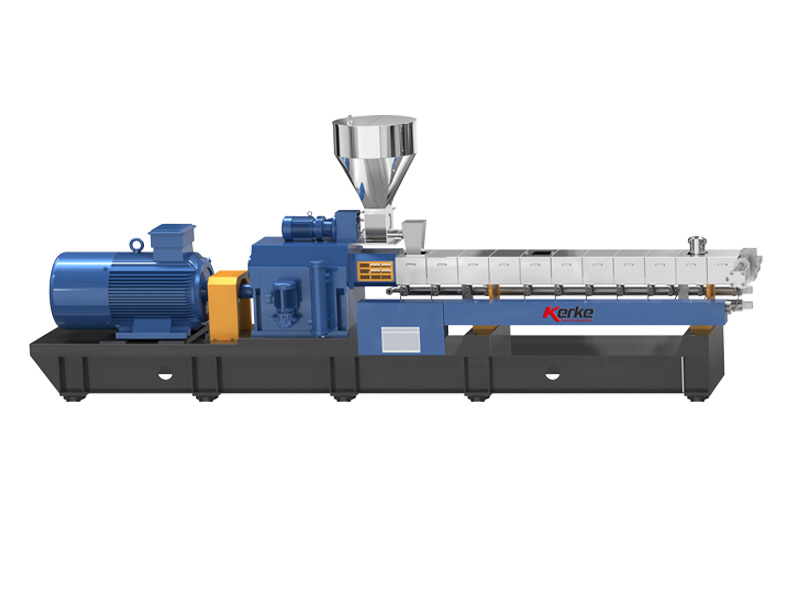
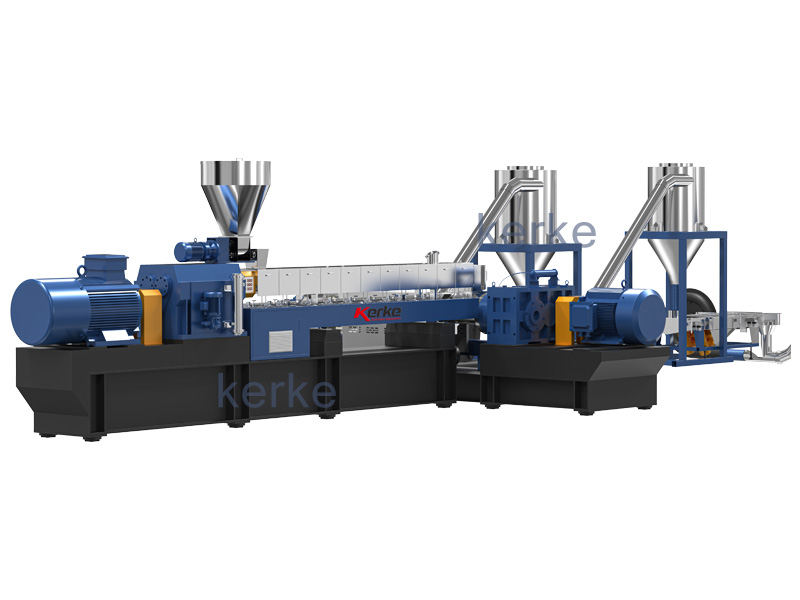
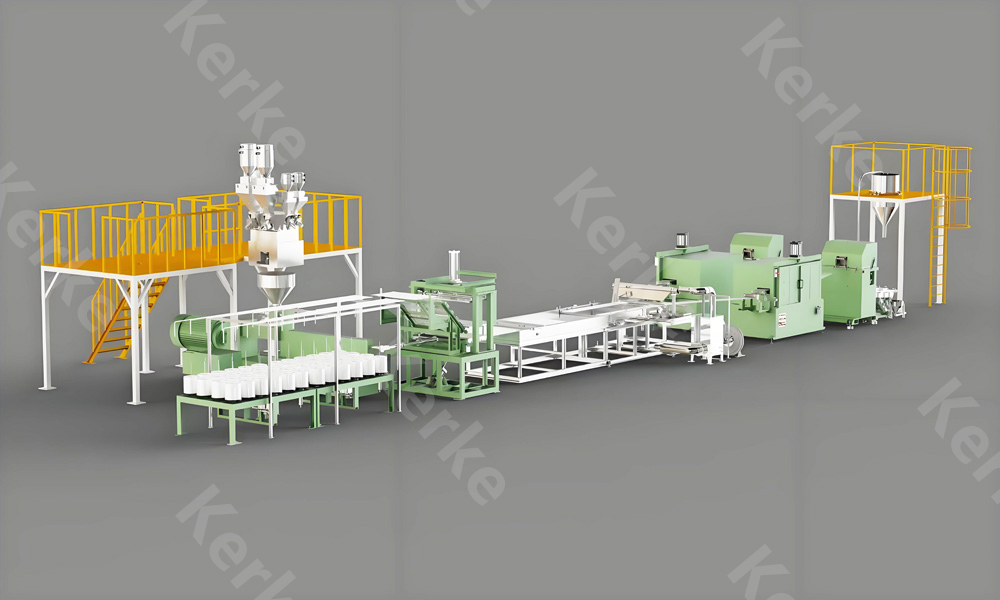
Manufacturing quartz powder filler masterbatch is a dispersion and wear-management problem. The mineral must be thoroughly wetted by the carrier melt and distributed uniformly, while the line must survive the abrasive nature of the powder over long production runs. The co-rotating parallel twin-screw extruder is the standard platform because its modular screw elements, side-feeding capability and controlled shear suit high mineral loadings. Kerke, a Wanplas factory, builds exactly this class of machine in its KTE series, ranging from the KTE-16B laboratory extruder to the high-capacity KTE-135D.
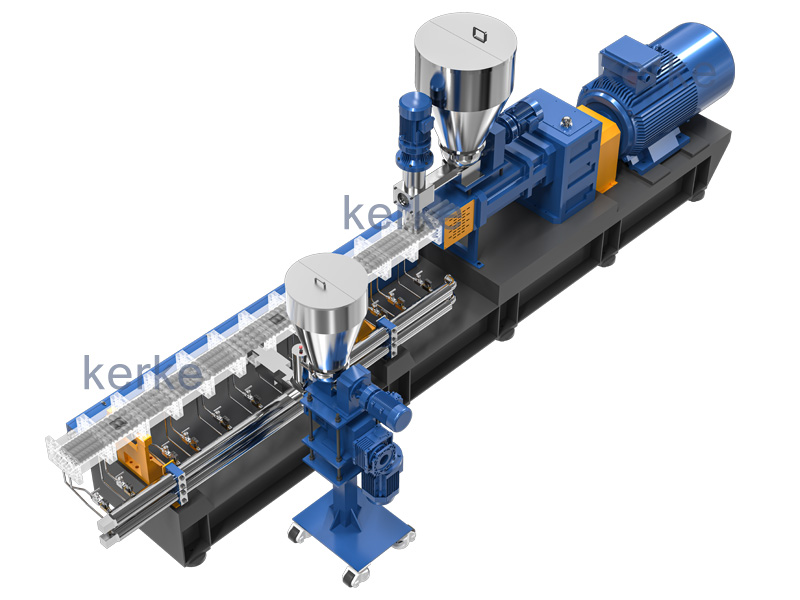
The process starts with pre-blending quartz powder, often surface-treated, with the carrier resin and additives in a high-speed mixer. The blend is metered into the extruder via a loss-in-weight feeder at the main hopper. Because quartz powder is fine, low-bulk and abrasive, the bulk of the filler is usually introduced through a side feeder into the melt phase, where the molten polymer cushions the particles and reduces compression wear in the solids zone. This also improves volumetric efficiency and limits heat generation from friction.
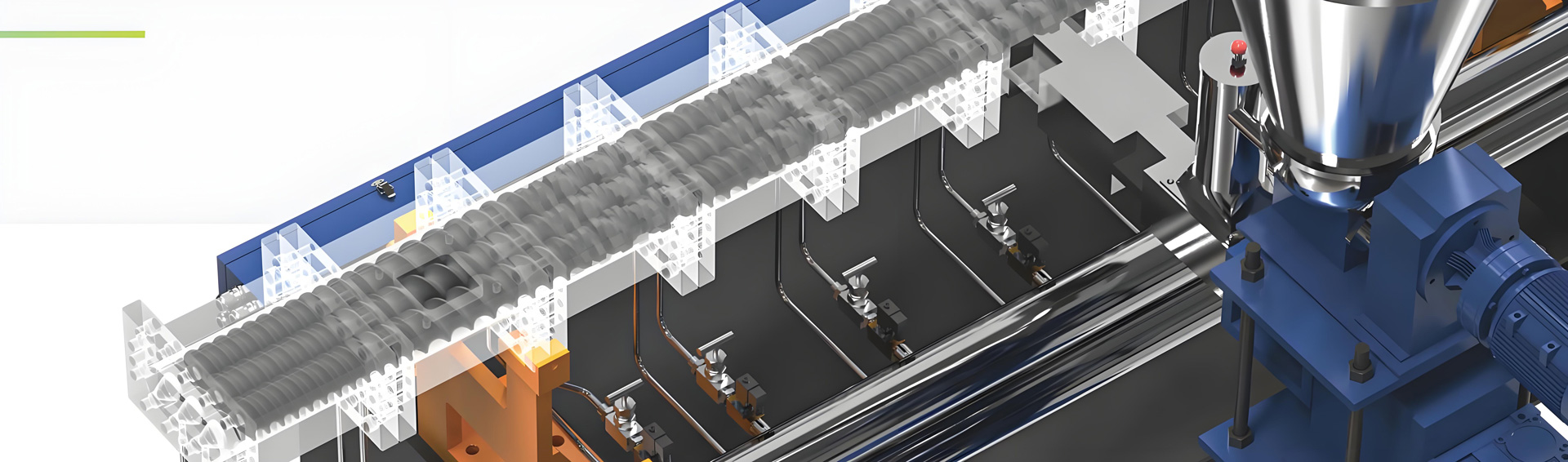
Inside the barrel, a computer-aided screw assembly combines conveying, kneading and reverse elements. The kneading blocks perform the dispersive mixing that coats each quartz particle, while reverse elements build pressure and extend residence time for homogenization. For abrasive minerals, Kerke configures barrels and screw elements with wear-resistant alloys and hardened surfaces in the high-shear zones, an option built into the KTE platform’s interchangeable core parts. The screw design retains the kneading co-type geometry with excellent self-cleaning function, good interchangeability and the ability to realize transport, plasticization, shearing, dispersion, homogenization, devolatilization and pressure building in a single pass.
After mixing, the melt passes through a devolatilization vent to remove trapped air and any moisture, then through a die and cutter. Kerke supplies water-cooled strand pelletizing, air-cooled strand pelletizing, air-cooled die-face hot cutting, water-ring die-face hot cutting, eccentric water-mist hot cutting and underwater granulation. For abrasive quartz, strand or water-ring cutting with wear-resistant die faces is common, producing clean, low-fines pellets. The pellets are cooled, screened and packed as finished quartz powder filler masterbatch.
Kerke’s standing as a high-tech twin-screw specialist with more than 12 years of experience, a manufacturing base exceeding 19,997 square meters, over 2,000 machines running in more than 70 countries and recognition among China’s leading suppliers in this field gives compounders a credible, supported partner for abrasive mineral masterbatches. The Wanplas group’s shared service promise, including an annual free spare-parts allowance and warranty replacement, further reduces lifetime operating risk.
Formulation and Coupling Strategies
Formulating quartz masterbatch begins with grade selection. Particle size and distribution set the property ceiling: finer quartz improves surface and modulus but raises abrasiveness and cost; coarser quartz lowers cost and wear at the expense of finish. Median sizes around 5 to 20 micrometers suit most rigid compounds, while sub-10 micrometer grades are chosen for films and surfaces where appearance matters.
Surface treatment decides how well the mineral binds to the polymer. Silane coupling agents are the primary choice for quartz because they react with surface silanol groups and bridge to the resin, improving tensile and flexural strength, moisture resistance and thermal performance. Titanate and zirconate couplings offer alternatives, particularly in polyolefins, where they can aid dispersion and impact. Treatment is typically applied by the mineral supplier or in a high-speed mixer, and the dose is optimized rather than maximized to avoid plate-out and blooming.
Carrier resin must match the host polymer for clean let-down. Polypropylene and polyethylene carriers dominate commodity use; EVA or maleic-anhydride-grafted polyolefin carriers improve compatibility and adhesion in difficult systems; engineering carriers serve PA or PET compounds. The carrier level in the concentrate is balanced so the masterbatch delivers the target mineral content without disturbing the final polymer ratio or additive package.
Additives round out the recipe: antioxidant to protect during high-shear processing, lubricant to ease flow and reduce wear, and occasionally a toughener or dispersing aid. Because quartz is abrasive, lubricant selection and metering deserve extra attention to keep the screw and barrel within wear budgets. Processors using Kerke KTE lines tune aspect ratio, barrel structure, screw arrangement, exhaust, feeding and electrical control to the specific quartz grade, a flexibility that runs from the KTE-16B through the KTE-135D.
Quartz vs Other Mineral Fillers: Comparison
Choosing quartz means weighing its hardness and heat performance against its abrasiveness and impact penalty. The comparison table below positions quartz against the fillers compounders most often consider.
Quartz Compared With Common Mineral Fillers
| Filler | Mohs Hardness | Stiffness Gain | Heat Resistance | Abrasion to Line | Relative Cost |
|---|---|---|---|---|---|
| Quartz | ~7 | High | Medium-High | Very High | Low |
| Calcium carbonate | ~3 | Low-Medium | Low | Low | Low |
| Talc | ~1 | Medium | Medium | Low | Low |
| Wollastonite | ~4.5 | Medium | Medium | Medium | Medium |
| Mica | ~2.5 | Medium | High | Low-Medium | Medium |
Quartz’s advantage is clear: it delivers the highest stiffness and hardness gain per unit cost among these options, with good heat resistance, while remaining a low-cost mineral. Its disadvantage is equally clear: it is the most abrasive, demanding wear-protected equipment and disciplined maintenance, and it gives no platy warpage control. Calcium carbonate remains the cheapest and gentlest extender; talc gives easy stiffness; wollastonite adds acicular reinforcement; mica wins on heat and dimensional stability. The selection should follow the part’s dominant requirement, with quartz chosen when hardness, rigidity and cost outweigh wear-management concerns.
Experienced compounders often validate candidates with a small trial on a laboratory twin-screw extruder, such as the Kerke lab unit used for formula trials and R&D, then scale the winner. Global suppliers such as Coperion, Leistritz, KraussMaffei Berstorff and Davis-Standard publish similar mineral-filler guidance, confirming that side feeding, controlled shear and wear protection are industry consensus for hard minerals.
Processing Parameters and Abrasive-Wear Management
Running quartz demands respect for its abrasiveness at every stage. Raw powder handling should be enclosed, with dust extraction and respiratory protection because crystalline silica dust is a recognized occupational hazard. Converting powder to pelletized masterbatch reduces airborne dust at the converter, but the compounding step itself still processes the powder and needs controls.
On the extruder, wear management starts with material selection. Barrels, screw elements, kneading blocks and feeder contact parts in the high-load zones should use wear-resistant alloys, hardened steels or surface treatments. Kerke’s KTE platform supports interchangeable, wear-protected core parts so a line can be configured for quartz from the outset rather than retrofitted after premature failure. Side feeding into the melt reduces compression wear; moderate shear disperses the mineral without unnecessary attrition of both particles and equipment.
Process parameters matter. Throughput should be matched to feeder and side-feed capacity, since pushing quartz too fast overloads the solids zone and accelerates wear. Melt temperature is set within the carrier window; excessive temperature wastes energy without helping dispersion once the mineral is inert. A robust devolatilization zone removes air and trace moisture. Lubricant metering should be stable, because it directly affects both part properties and screw-barrel wear life.
Troubleshooting Reference
| Symptom | Likely Cause | Corrective Action |
|---|---|---|
| Rapid screw wear | Abrasive mineral, no protection | Fit wear-resistant elements, review grade |
| Poor dispersion | Insufficient shear, wetting | Add kneading zone, improve coupling |
| Feeder bridging | Fine powder, low bulk density | Use crammer feeder, agitator, side feed |
| Brittle parts | High loading, low impact | Lower loading, add toughener, treat surface |
Preventive maintenance is non-negotiable with quartz. Scheduled measurement of screw and barrel wear, spare-element inventory and condition-based replacement keep the line producing in-spec masterbatch. Kerke’s auxiliary range, including high-speed mixers, granulators, pulverizers and water chillers, supports a coherent line where wear parts are stocked and swap-ready, minimizing unplanned downtime.
Applications and End-Use Industries
Quartz powder filler masterbatch finds its largest use wherever hardness, rigidity and low cost dominate. Its inert chemistry, thermal stability and low expansion make it a versatile workhorse across construction, automotive, industrial and consumer goods. The sections below outline where it earns its place.
Construction and Building Products
In construction, quartz reinforces PVC window and door profiles, pipes, siding, wall panels and flooring where scratch resistance, dimensional stability and weatherability extend service life. Rigid quartz-filled compounds resist deformation under load and hold tight tolerances in profiles that must mate with gaskets and hardware. For flooring and decking, the hardness and abrasion resistance of quartz directly improve wear performance under foot and wheel traffic.
Automotive and Appliances
In automotive and appliances, quartz-filled polypropylene and engineering compounds supply rigid, heat-stable housings, trims and structural components at a favorable cost. Under-hood and heater-adjacent parts benefit from the raised heat deflection temperature, while appliance bodies gain stiffness without the expense of glass-filled systems. The low moisture absorption of quartz also helps parts retain dimensions in humid environments.
Industrial Goods, Films, Sheets and Cable
Industrial goods such as pallets, crates, tool bodies, electrical enclosures and machine parts use quartz for stiffness and wear resistance. Films and sheets benefit from quartz’s modulus and barrier contribution where surface finish permits, and wire-and-cable compounds use it for dimensional and thermal stability as well as electrical insulation support. In masterbatch terms, quartz concentrates sit alongside color, filler, additive, black and textile masterbatches in the portfolio produced on twin-screw lines.
Because quartz is chemically inert, it is also useful where the compound must resist moisture or mild chemicals, and its abundance keeps supply stable. The Wanplas group’s compounding know-how spans these applications, and Kerke’s extruders are the production platform for many of them, illustrating the benefit of selecting a supplier with cross-category, real-world experience rather than a single-product vendor. For recycling-oriented projects, Wanplas’s Polyretec factory can supply washing and pelletizing lines that integrate with Kerke twin-screw compounding to close the loop on filled recyclates.
Quality Control, Testing and Standards
Reliable quartz masterbatch depends on disciplined quality control at incoming, in-process and outgoing stages. Incoming quartz is verified for particle size distribution, moisture, purity and treatment level; the compounded pellets are checked for filler content by ash or thermogravimetric analysis, dispersion by microtomy and image analysis, and pellet size and fines by sieving.
Mechanical and thermal validation uses standard methods. Tensile and flexural properties follow ISO and ASTM procedures; heat deflection temperature and Vicat softening confirm thermal upgrade; melt flow index tracks processability; and impact testing, typically notched Izod or Charpy per ISO or ASTM, guards against brittle failure. Hardness and abrasion of the finished part may be measured where the application demands it.
Manufacturing systems matter as much as tests. Kerke builds equipment to support CE compliance for the European market and operates in alignment with ISO 9001 quality management and ISO 14001 environmental management principles. Buyers should confirm their masterbatch supplier holds relevant certifications and provides lot-to-lot test reports, especially for regulated or safety-related parts.
Modern quality programs increasingly rely on in-line and near-line tools. Melt rheology checks track lot-to-lot consistency of processability, while dispersion microscopy on microtomed sections reveals whether quartz is uniformly distributed or present as agglomerates that would weaken the part. Ash content and thermogravimetric analysis verify filler loading against specification, and statistical process control on these metrics keeps a production line within tight bands. For abrasive minerals, periodic measurement of screw and barrel wear is itself a quality control step, because advancing wear changes mixing intensity and can shift dispersion and loading uniformity before any mechanical failure occurs.
For food-contact or potable-water applications, the complete compound, carrier, additives and treatment must be validated against the applicable regulation, such as EU 10/2011 in Europe, FDA requirements in the United States, or Chinese GB standards where marketed domestically. Quartz itself is inert, but the total formulation, not the mineral alone, carries compliance responsibility, and occupational silica-dust controls apply during powder handling.
Choosing the Right Compounding Line
Equipment selection for quartz masterbatch balances throughput, wear protection and formulation flexibility. A laboratory twin-screw extruder such as the Kerke lab unit is the right entry point for formula development, sampling and process learning; its investment level is Medium and it de-risks scale-up. Small and pilot production use compact KTE models from the KTE-16B to KTE-40, suitable for specialty or low-volume quartz concentrates.
Mid-volume commercial lines typically choose KTE-65 to KTE-95 machines with side feeding, loss-in-weight metering and wear-protected elements; their investment level is High and is justified by throughput and the ability to run abrasive minerals reliably. Large, continuous masterbatch plants select the KTE-135D or comparable high-capacity co-rotating lines, an investment level of Very High to Premium, where uptime, wear life and feeding accuracy decide profitability more than the initial price.
Beyond the extruder, a complete quartz line includes a high-speed mixer, gravimetric and side feeders, a crammer feeder for fine low-bulk powder, cooling and pelletizing, and central control. Kerke supplies auxiliary equipment such as high-speed mixers, granulators, pulverizers, extruder core parts and water chillers so a buyer can source a coherent, supported system. The Wanplas brand’s shared service promise, including an annual free spare-parts allowance and warranty replacement, lowers lifetime risk across the group’s factories.
A practical selection checklist: define target loading, carrier and particle size; confirm wear-protected barrels and elements; size feeders for quartz bulk density and bridging tendency; choose pelletizing suited to abrasiveness; and verify the supplier can support screw configuration for your grade. Visiting the factory and running a trial on your own formula, which Kerke welcomes under its open-factory policy, is the surest way to confirm the match before capital is committed.
Sustainability, Recycling and Cost Outlook
Quartz powder filler masterbatch fits neatly into the circular-economy agenda because quartz itself is an abundant, inert, non-toxic mineral that does not complicate end-of-life recovery the way some treated or halogenated additives can. When used in polyolefin and PVC compounds, quartz-filled parts remain mechanically recyclable through standard streams, and the mineral simply reports into the recycled flake or regrind. This makes quartz an attractive filler for brand owners under increasing pressure to raise recycled content and lower carbon footprint without sacrificing stiffness.
The carbon argument is nuanced. Mining and milling quartz consume energy, but because the mineral replaces a large fraction of virgin polymer by weight, the net embedded energy per finished part often drops. Compounders pursuing low-carbon profiles pair quartz masterbatch with recycled resin, a route supported by the Wanplas group’s recycling specialists at its Polyretec factory, whose washing and pelletizing lines turn post-consumer waste into reusable flake that quartz masterbatch can then stiffen. Selecting a co-located or group-integrated supplier simplifies that material loop.
On cost, quartz remains one of the lowest-priced functional fillers, which is the foundation of its popularity. The offsetting expense is wear: abrasive processing raises the lifetime cost of screws, barrels, feeders and dies, so a true total-cost-of-ownership view must include spare-part consumption, not just the mineral price. Lines configured with wear-resistant components from the start, such as Kerke’s interchangeable hardened KTE core parts, typically show lower cost per ton of masterbatch over the equipment life than lines retrofitted after premature failure.
Market outlook reinforces the case. Asia-Pacific remains the fastest-growing region for plastics machinery and compounds, and China is the world’s largest producer of plastics equipment by volume, with global plastics production on the order of 400 million tons per year driving steady demand for low-cost mineral fillers. Trade events such as K Show, Chinaplas and NPE continue to showcase high-filler, recycled-content compounds, signaling that quartz masterbatch will remain a volume workhorse even as engineered fillers grow in specialty niches. For compounders, the strategic move is to standardize quartz where it performs, reserve premium fillers like mica or glass flake for parts that truly need them, and invest in wear protection to keep the line profitable.
Frequently Asked Questions
What is quartz powder filler masterbatch?
It is a concentrated pelletized additive in which finely ground crystalline silica, quartz, is dispersed at high loading in a carrier resin. It is let down into virgin polymer to add hardness, dimensional stability, thermal resistance and cost reduction.
Is quartz more abrasive than talc or calcium carbonate?
Yes. Quartz, with a Mohs hardness around 7, is significantly harder and more abrasive than talc at about 1 and calcium carbonate at about 3. This accelerates wear on screw elements, barrels and feeders, so wear-protected construction and hardened tooling are strongly recommended.
What loading levels are typical for quartz masterbatch?
Concentrates commonly carry 40 to 80 percent by weight of quartz, while finished-part loading after let-down usually ranges from 10 to 40 percent depending on the stiffness, hardness and cost targets of the application.
Which extruder is best for quartz filler?
A co-rotating parallel twin-screw extruder with wear-resistant barrels and screw elements, side feeding and loss-in-weight metering is preferred. Kerke’s KTE series can be specified with hardened components for abrasive minerals.
Does quartz improve heat resistance?
Quartz is thermally stable and raises the heat deflection temperature and creep resistance of the compound moderately. It is less effective than platy mica for warpage control because it is particulate rather than lamellar, but it excels at hardness and dimensional stability.
Is quartz dust a health concern during handling?
Crystalline silica dust is a recognized occupational hazard, so raw powder handling should use enclosed feeding, dust extraction and respiratory protection per local regulations. Converting the powder into pelletized masterbatch itself greatly reduces airborne dust at the converter.
Why use side feeding for quartz?
Side feeding introduces quartz into the already-melted polymer downstream of the main hopper. This cushions the abrasive particles, reduces compression wear in the solids zone and improves volumetric efficiency, extending equipment life.
Conclusion
Quartz powder filler masterbatch is a low-cost, high-value mineral concentrate that converts the hardness and thermal stability of crystalline silica into stiffer, harder, more dimensionally stable plastic parts. Its production is an exercise in dispersion under abrasive conditions, best handled on a co-rotating parallel twin-screw extruder with wear-protected barrels and elements, side feeding, loss-in-weight metering and effective devolatilization. Kerke, a Wanplas factory, brings more than 12 years of twin-screw compounding expertise, a 19,997 plus square meter manufacturing base and the modular KTE series from laboratory to KTE-135D scale to support quartz masterbatch producers at every level.
For compounders, success with quartz means choosing the right particle size and coupling system, protecting equipment from wear through hardened components and disciplined maintenance, controlling dust during powder handling, and validating properties with ISO and ASTM testing. Where hardness, rigidity and cost matter more than warpage control, quartz outperforms calcium carbonate and talc on a per-cost basis despite its abrasiveness. If you are qualifying a quartz grade or scaling a mineral masterbatch line, running a trial with a specialist twin-screw supplier is the most reliable route to a repeatable, profitable formulation.