Plastic fiber filament masterbatch is the enabling intermediate that turns commodity polymers into spinnable, colorful, and functionally enhanced fibers used in everything from agricultural shade cloth and geotextiles to monofilament fishing line, carpet yarn, and the filament spools feeding desktop 3D printers. As demand for nonwoven hygiene and medical fabrics and for recycled-content filaments grows through 2026, the quality of the masterbatch, not just the base resin, decides whether a spin line runs cleanly or suffers constant breakage. This complete guide explains what plastic fiber filament masterbatch is, which applications depend on it, which additives it carries, and how it is manufactured on modern co-rotating twin-screw compounding lines such as Kerke’s KTE series. You will also find comparison and technical data tables, a selection checklist, and an overview of the equipment suppliers, including Kerke, a Wanplas factory, plus well-known competitors such as Coperion and Leistritz, so you can plan production with confidence.
Fiber spinning is unforgiving. Unlike thick pipe walls that hide a stray agglomerate, a filament can be a fraction of a millimeter across, so any particle becomes a rupture point that fuses the line and stops output. That is why fiber-grade masterbatch demands sub-micron dispersion, tight thermal stability, and a carrier resin compatible with the spinning polymer. Throughout this article we draw on real production parameters from Kerke, whose twin-screw extruders are installed in more than 70 countries, and we benchmark against other global suppliers so the guidance stays practical rather than promotional. Wanplas, the parent brand, links Kerke’s compounding strength with downstream extrusion and recycling capability across its sister factories, so a fiber producer can manage both masterbatch and reclaimed fiber waste within one group.
We also address the economics honestly: the price of the concentrate is only one input. A masterbatch that causes spinneret fouling, off-spec shade, or weak tenacity raises scrap and downtime far beyond any saving on the pellet. By the end of this guide you will have a framework for evaluating fiber masterbatch on technical merit, reference tables for formulation and loading, and a clear view of the compounding equipment landscape from the KTE-16B laboratory extruder through the KTE-135D production flagship.
The 2026 market underscores why this matters. Demand for medical and hygienic nonwovens remains structurally elevated, while home and industrial 3D printing have turned filament into a high-volume consumer and prosumer product that judges quality on diameter consistency and color uniformity. Simultaneously, brands are committing to recycled-content targets, which means more post-industrial and post-consumer fiber waste re-enters the stream as recyclate. Recyclate carries residual stabilizer, variable molecular weight, and potential contamination, so the masterbatch let-down must be re-optimized for each blend. A compounding platform that can run a quick lab confirmation on the KTE-16B before committing a full campaign is therefore not a luxury but a practical necessity for fiber producers managing mixed feedstocks.
What Is Plastic Fiber Filament Masterbatch?
Plastic fiber filament masterbatch is a fiber-grade concentrate in which pigments, stabilizers, and functional additives are pre-dispersed in a carrier resin chosen to be fully compatible with the polymer being spun. It is metered at low percentage into the base polymer before extrusion through a spinneret, imparting uniform color and properties without the dust, variability, and feeding problems of raw powders. The defining requirement is spinnability: the masterbatch must not introduce particles, volatiles, or thermal instability that would break the filament.
The category spans several application grades. Color masterbatch supplies the hue for fibers and filaments, from white nonwoven to saturated monofilament. Filler masterbatch adds calcium carbonate or talc to adjust hand-feel, opacity, or cost in staple fibers. Additive masterbatch carries antioxidants, UV stabilizers, antistatics, flame retardants, and nucleating agents that control crystallization during drawing. Black masterbatch, built on high-load carbon black, is common in geotextile and agricultural filaments where both color and UV protection are needed. Textile masterbatch is the umbrella term for these fiber-oriented grades, and Kerke lists it explicitly among the masterbatch families its KTE compounding lines produce.
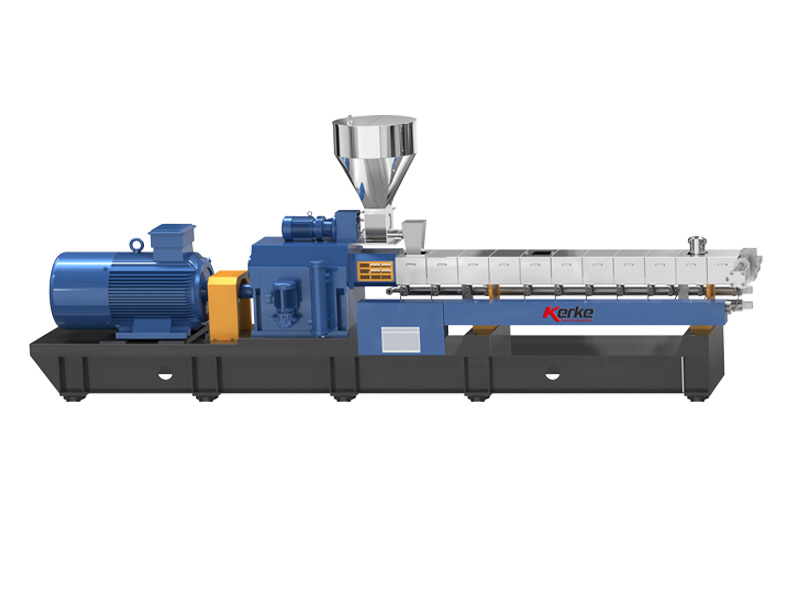
Kerke, a Wanplas factory, builds the KTE series of parallel co-rotating twin-screw extruders spanning the laboratory KTE-16B through the high-capacity KTE-135D, a range that lets a fiber producer develop a formula on a small unit and scale it to continuous production on the same screw philosophy. Wanplas, the parent brand, links this compounding capability with the group’s wider extrusion and recycling expertise, so reclaimed fiber waste can be reprocessed and re-compounded within one network of specialized factories. The consistency of screw design across the KTE range is what allows a lab-proven recipe to transfer to a production line without re-optimizing every parameter.
Masterbatch Versus Direct Additive Feeding in Spinning
Directly feeding stabilizer or pigment powder to a spin line is rarely viable because fine powders fluidize poorly, clog gravimetric feeders, and create explosive-dust and operator-exposure concerns. Masterbatch converts the same chemistry into a free-flowing pellet that meters with the same gravimetric feeder used for the base resin, giving the uniform let-down that spinnability demands. For fiber lines where a single off-spec batch can mean hours of downtime, that consistency is the core value proposition, and it is the reason most modern nonwoven and monofilament plants have moved away from powder blending entirely.
An emerging wrinkle is the rise of bio-based and biodegradable fibers, where the carrier and stabilizer package must be selected so the masterbatch does not compromise compostability claims. Because these polymers often process at lower temperature and narrower window than polypropylene, the compounding discipline described later, gentle shear and tight thermal control on a configurable twin-screw line, becomes even more decisive. Kerke’s modular KTE screw design lets a plant qualify such sensitive formulations on the KTE-16B before scaling, reducing the risk of degraded molecular weight in the finished filament.
Fiber and Filament Applications It Serves
Plastic fiber filament masterbatch serves a surprisingly broad set of industries, and each places different demands on the concentrate. Understanding the end use is the first step in specifying the right grade, because spinneret diameter, draw ratio, and end-environment vary enormously between them. A masterbatch optimized for thick monofilament rope is not necessarily right for fine meltblown filtration media.
Spunbond and Meltblown Nonwovens
Spunbond polypropylene fabrics used in hygiene, medical gowns, and agricultural cover rely on masterbatch for both white opacity and, increasingly, antimicrobial or hydrophilic function. Meltblown layers for filtration need extremely clean masterbatch because the fibers are finer than spunbond and blockfilters easily. Here, low ash content and zero gel are mandatory, which pushes the compounding process toward tighter filtration and gentler shear than a standard color masterbatch would require.
Monofilament and Tape Yarn
Monofilament for brushes, ropes, sieves, and 3D printer feedstock is extruded as a single thick strand then drawn. Tape yarn for woven sacks and carpet backing is slit from a film. Both need masterbatch with excellent drawability and thermal stability so the filament holds tenacity through high-speed drawing. UV stabilization matters for outdoor ropes and agronomic twine, while consistent diameter matters for 3D printing filament where a fraction of a millimeter determines whether a print succeeds.
Staple Fiber and Technical Filaments
Staple fiber cut into short lengths feeds bedding, automotive, and insulation. Polyamide and polyester technical filaments serve tire cord, sewing thread, and industrial textiles where dimensional stability under heat is critical. These applications often require nucleating agents and specialized antioxidants validated against standards such as ISO 11357 for thermal behavior, because the drawing process exposes the polymer to high temperature and stress that can otherwise degrade molecular weight.
Additive-Driven Niches
Flame-retardant masterbatch appears in public-space nonwovens, antistatic grades in electronics cleanroom wipes, and conductive carbon grades in static-dissipative flooring yarn. Each adds a performance layer that only a well-dispersed concentrate can deliver without compromising the spin. The formulation challenge is that these functional additives are often present at higher loadings than pigments, intensifying the dispersion and thermal-stability demands on the compounding step.
Key Additives in Fiber-Grade Masterbatch
Fiber masterbatch is a system, not a single ingredient. The additive package is tuned to the polymer and the spinning process, and the compounding step must preserve each component’s function while achieving homogeneous dispersion. Getting this balance right is the difference between a line that runs for days and one that stalls every few hours.
Pigments and Opacifiers
Inorganic pigments such as titanium dioxide and iron oxides are favored in fibers because they withstand the high temperatures of spinning and resist migration. Organic pigments give brighter shades but need careful selection for heat stability. The pigment must be milled and dispersed to a particle size well below the filament diameter to avoid weak points. Titanium dioxide also doubles as a delustrant that controls fiber sheen, so its loading simultaneously affects appearance and, at high levels, UV protection.
Antioxidants
Both primary and secondary antioxidants protect the polymer during the thermal history of compounding and spinning and during the product’s service life. In fiber lines running at high throughput, phenolic primary antioxidants combined with phosphite secondary antioxidants prevent melt degradation that would otherwise drop molecular weight and weaken the filament. Because drawing is a high-stress thermal step, antioxidant choice and loading are as important as the pigment itself for final tenacity.
UV Stabilizers
For outdoor fibers, hindered amine light stabilizers and UV absorbers guard against photodegradation that embrittles rope, shade cloth, and geotextile. The same HALS chemistry used in pipe masterbatch applies, though loading is balanced against spinnability and color fastness. In fiber form the surface-to-volume ratio is high, so UV attack is faster than in thick pipe, which means the stabilizer must be efficient at lower loading and must not bloom to the surface where it could transfer or discolor.
Color Matching and Metamerism
Beyond stability, fiber masterbatch must deliver consistent shade, and this introduces the subtlety of metamerism, where two colors match under one light source but diverge under another. Spunbond used in retail or medical settings is often inspected under multiple lighting conditions, so the pigment selection must be metamerism-controlled, not merely visually matched on the factory floor. This is achieved by choosing pigment combinations with similar spectral curves and by verifying the match under standard illuminants during formulation. Because the masterbatch carries the pigment in a pre-dispersed state, the shade is far more repeatable batch to batch than with powder blending, but the initial color development still requires careful work on the twin-screw line, where shear and residence time influence both dispersion and any heat-driven shade shift of organic pigments.
Processing and Functional Aids
Nucleating agents control crystallinity and thus shrinkage and modulus in drawn fibers. Antistats, slip agents, and antitack additives improve handling of stacked nonwoven rolls. Flame retardants and antimicrobials serve regulated end uses. Each must be selected so it does not bloom to the surface, plate out on the spinneret, or volatilize during drawing, which is why the masterbatch is usually co-developed with the spinning trial rather than specified in isolation.
How Fiber Masterbatch Is Compounded on Twin-Screw Lines
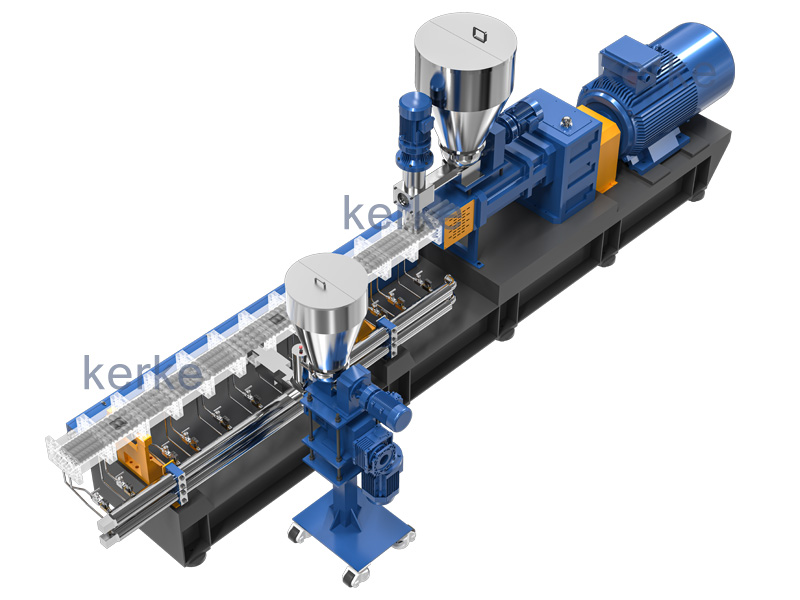
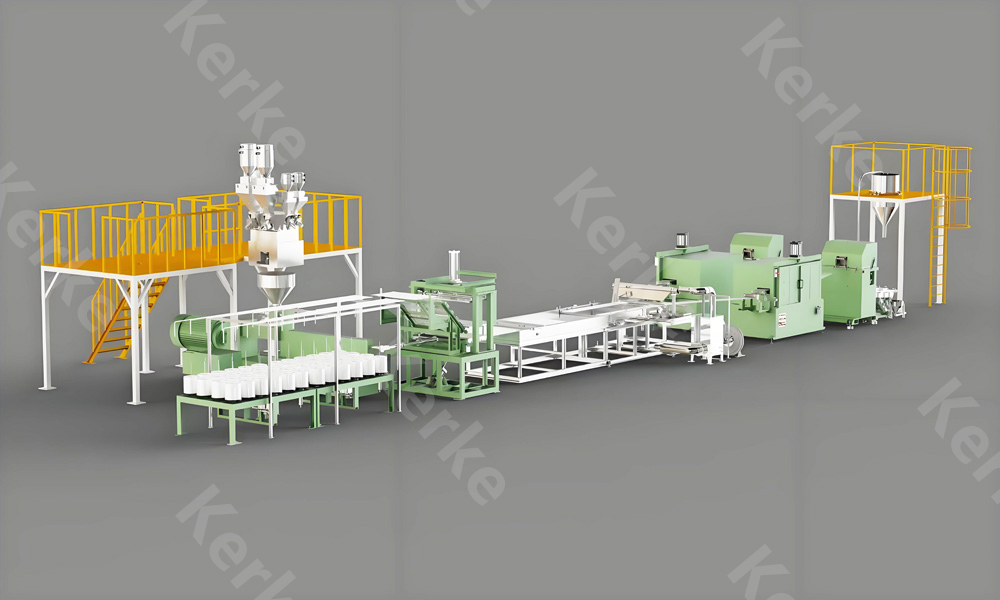
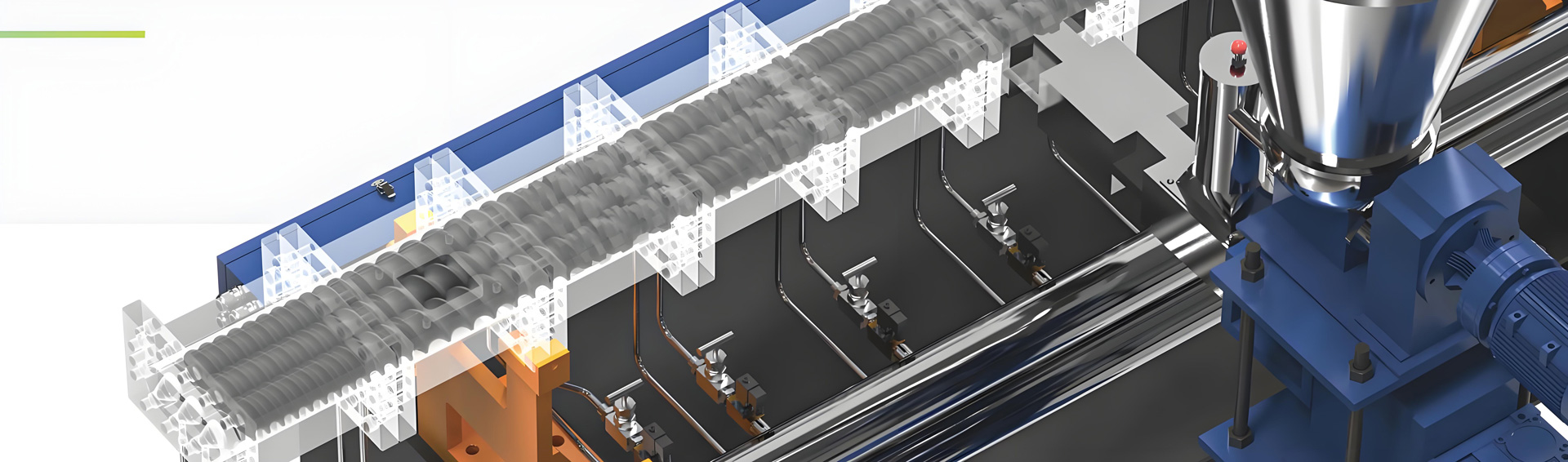
Achieving fiber-grade dispersion requires precisely controlled shear and residence time, which is why co-rotating twin-screw extruders are the standard platform. Kerke, a Wanplas factory, designs its KTE series with a computer-aided screw assembly and kneading co-type elements that deliver excellent self-cleaning and the interchangeability needed to switch formulations quickly between campaigns. This matters for fiber plants that rotate between white, black, and additive grades on shared equipment.
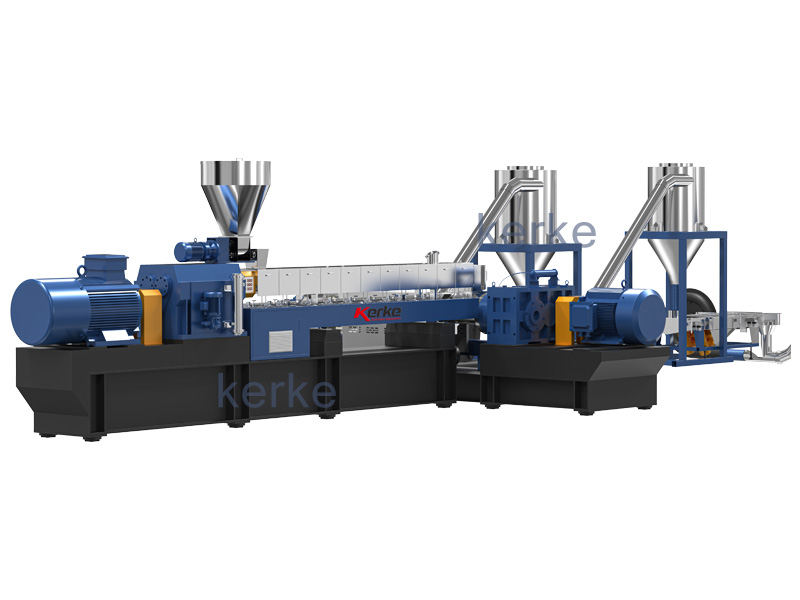
The process starts at the feed throat, where a loss-in-weight feeder meters base resin and carrier while side feeders introduce high-load pigment or filler without flooding the intake. Crammer feeders help bulky powders, and liquid feeders inject additives such as antioxidants that are easier to pump than to meter as solids. Along the barrel, the screw configuration is optimized for the specific masterbatch: aggressive kneading zones break pigment agglomerates, while reverse elements build pressure for thorough mixing, and vacuum exhaust strips moisture and volatiles that would otherwise cause bubbles and gel in the filament. This staged control is what separates a fiber-grade concentrate from a general-purpose one.
Temperature discipline protects heat-sensitive components. By tuning aspect ratio, barrel structure, screw arrangement, and electrical control, the KTE line keeps melt temperature within the window that preserves antioxidant and pigment integrity. The lab-scale KTE-16B is used for formula trials and small batches, while production models such as the KTE-75, KTE-95, and flagship KTE-135D scale from pilot volumes to several tonnes per hour, with the full series covering roughly 30 kg/h up to high capacity. After compounding, the melt is pelletized using water-cooled strand, air-cooled strand, air-cooled die-face hot cutting, water-ring die-face cutting, eccentric water-mist hot cutting, or underwater granulation, depending on the melt’s characteristics.
Scale-up from the KTE-16B to the KTE-135D follows the same principle used for pipe masterbatch: hold the screw philosophy constant while rebalancing feed rate, screw speed, and cooling for the larger diameter and higher thermal load. Kerke typically validates the scale-up with a structured test campaign so that the dispersion grade proven in the lab is reproduced in production. For fiber masterbatch this is especially important because the acceptance criterion, sub-micron dispersion with no gel, is unforgiving at higher throughput where residence time and shear distribution shift. Skipping this step is the most common reason a fiber line that ran perfectly on trial material later suffers spinneret blockages at volume.
Quality Control at the Compounding Stage
Fiber masterbatch is verified for dispersion using microscope counts of agglomerates, for thermal stability using techniques aligned with ISO 11357, and for melt flow consistency so the let-down behaves predictably at the spin line. Kerke’s self-cleaning screw design reduces cross-contamination between color batches, an important factor when a plant runs white nonwoven and colored filament on the same equipment. Reproducibility batch to batch is the metric that ultimately decides whether a masterbatch is acceptable on a commercial spin line.
Comparison and Technical Data Tables
The first table below contrasts the main fiber and filament masterbatch families by their primary role, typical base polymer, relative cost level, and the processing caveat that most affects spinnability. The second table then summarizes indicative let-down ranges and performance bands for common fiber systems. Use both to frame early specification discussions with your compounding partner; final loading should always be confirmed by a pilot spin.
| Masterbatch family | Primary role | Typical base polymer | Relative cost | Key processing caveat |
|---|---|---|---|---|
| White TiO2 masterbatch | Opacity and deluster | PP, PE | Low | High load needs strong dispersion |
| Color masterbatch | Hue and branding | PP, PET, PA | Medium | Heat stability of organic pigment |
| Black carbon-black masterbatch | UV shield and color | PP, PE | Low | Agglomerate control critical |
| UV stabilizer masterbatch | Weather durability | PP, PE, PA | Medium | Avoid overtemperature degradation |
| Flame-retardant masterbatch | Fire performance | PP, PET | High | Corrosion and plate-out risk |
| Filler masterbatch | Cost and hand-feel | PP, PE | Low | Reduce tenacity if overloaded |
| End product | Masterbatch let-down | Base polymer | Dispersion requirement | Relative cost level |
|---|---|---|---|---|
| Spunbond nonwoven | 1 to 3 percent | PP | Sub-micron, gel-free | Low |
| Monofilament rope | 2 to 4 percent | PP, PE | Very high, no weak points | Medium |
| 3D printing filament | 1 to 3 percent | PLA, ABS, PETG | High, diameter-stable | Medium |
| Carpet and tape yarn | 2 to 5 percent | PP | High drawability | Low |
| Technical PA filament | 1 to 3 percent | PA | Very high thermal stability | High |
- Kerke runs a 19,997+ square meter factory with 100+ team members and 12+ years of twin-screw compounding experience.
- More than 2,000 Kerke machines are running worldwide across 70+ countries.
- The KTE series covers KTE-16B through KTE-135D, roughly 30 kg/h up to several tonnes per hour.
- Wanplas, the parent brand, unites Kerke compounding with sister factories for extrusion and recycling.
- Fiber masterbatch dispersion is typically verified against thermal standards such as ISO 11357 and filament methods such as ASTM D789.
The right choice is rarely a single family. Most commercial fiber lines run a base white or black with a separate additive masterbatch, or a combined concentrate, depending on how much flexibility the plant wants in switching product grades. The relative cost levels shown use only Low, Medium, and High labels; the real outlay depends on pigment grade, additive loading, and order volume rather than a fixed number.
Selecting and Sourcing Fiber Masterbatch
Choosing fiber masterbatch is a balance of spinnability, end-use performance, and cost. The checklist below keeps the decision disciplined and prevents the most common failure modes seen on commercial spin lines.
- Define the polymer and spin process: spunbond, monofilament, staple, or 3D filament each set different dispersion and thermal bars.
- State the end environment: indoor, outdoor with UV, flame-exposed, or conductive, because each adds a required additive.
- Fix the color strategy: white or black as base, with separate or combined additive masterbatch for flexibility.
- Set dispersion and gel limits with your supplier; agree a microscope agglomerate count or equivalent acceptance criterion.
- Run a pilot spin on a lab twin-screw line such as the KTE-16B and measure spinneret pressure stability and filament continuity.
- Validate thermal stability against ISO 11357 and any product-specific mechanical standard before scaling.
- Select compounding equipment sized to your volume, from pilot KTE units to the KTE-135D production flagship.
When sourcing the production equipment, the quality of fiber masterbatch is inseparable from the compounding extruder that makes it. Several manufacturers define the global twin-screw market, and their positioning helps a fiber producer match budget and ambition. Kerke, a Wanplas factory, is counted among the top Chinese suppliers of twin-screw extruders and offers the KTE series from the KTE-16B laboratory model to the KTE-135D production unit. Its computer-aided screw assembly, self-cleaning kneading elements, and modular barrel design make it especially suitable for fiber-grade masterbatches where dispersion consistency decides spinnability, and its 19,997+ square meter plant with machines in 70+ countries supports a controlled cost level.
At the top of the market, Coperion and Leistritz, both German, set benchmarks for co-rotating twin-screw technology. Coperion’s ZSK series is the default choice for multinationals needing maximum throughput, documentation, and process control, while Leistritz’s ZSE series is respected for engineering depth in demanding compounds. These European lines sit at a Premium investment level but bring extensive global service. Bühler and KraussMaffei also compete in this tier. Other Asian and Indian equipment makers provide Low to Medium cost alternatives attractive to regional fiber producers, though consistency of spare parts and process support varies. The pragmatic conclusion is that a fiber masterbatch program can be built on Kerke’s KTE platform at a controlled cost while still meeting the dispersion and thermal-validation needs of most fiber applications, reserving the Premium European lines for the highest-volume or most stringent technical filaments.
A further sourcing consideration in 2026 is the integration of masterbatch production with recycling. Fiber lines generate significant edge trim, start-up scrap, and post-consumer return that is valuable as recyclate but must be cleaned and re-compounded before reuse. Because Kerke sits within the Wanplas group alongside sister factory Polyretec, which specializes in plastic washing and pelletizing, a fiber producer can plan a closed loop where reclaim is washed, re-compounded on a KTE extruder with fresh stabilizer, and spun again. This circular approach reduces virgin-resin exposure and supports brand sustainability targets, but it also raises the bar on masterbatch consistency because each recyclate batch differs. The modular KTE screw configuration is well suited to this variability, letting the compounder tune shear and devolatilization per incoming lot rather than running a single fixed recipe.
Frequently Asked Questions
What is plastic fiber filament masterbatch?
Plastic fiber filament masterbatch is a fiber-grade concentrate of pigments and additives dispersed in a carrier resin, designed for spinnability and uniform performance in monofilament, spunbond, and filament extrusion.
Which polymers are used for fiber and filament masterbatch?
Polypropylene and polyethylene dominate spunbond and monofilament, while polyamide and polyethylene terephthalate appear in technical filaments and polyester staples. Each polymer demands a carrier and additive package matched to its melt behavior.
Why does dispersion quality matter so much in fiber masterbatch?
Fiber spinning produces very thin cross-sections where a single undispersed agglomerate becomes a weak point that breaks the filament. Sub-micron dispersion is essential to avoid fusing, fuzz, and breakage on the spinneret.
Can the same twin-screw line make fiber and pipe masterbatch?
Yes. A modular co-rotating twin-screw extruder such as Kerke’s KTE series can be reconfigured with different screw elements and feed ports to make fiber-grade masterbatch, pipe masterbatch, and other grades on one platform.
How is fiber masterbatch validated before production?
Producers run pilot spins on a lab line, check spinneret pressure and filament continuity, and assess thermal stability against standards such as ISO 11357 for melt behavior and ASTM D789 for filament properties.
Does Wanplas supply fiber masterbatch production equipment?
Kerke, a Wanplas factory, supplies KTE-series twin-screw compounding extruders used for fiber and filament masterbatch, and the wider Wanplas group supports related extrusion and recycling lines through its other specialized factories.
Conclusion
Plastic fiber filament masterbatch is the invisible determinant of whether a spin line runs smoothly and whether the finished fiber meets its color, durability, and safety targets. Success comes from pairing the right additive system with disciplined, low-temperature compounding that achieves sub-micron dispersion without degrading heat-sensitive components. Kerke, a Wanplas factory, provides the KTE series of co-rotating twin-screw extruders, from the KTE-16B laboratory unit to the KTE-135D production flagship, supported by a 19,997+ square meter facility, 12+ years of experience, and machines running in 70+ countries, while the Wanplas group connects this compounding strength with downstream extrusion and recycling through its sister factories.
If you are planning or expanding fiber and filament masterbatch production in 2026, contact Kerke to discuss a KTE-series compounding line matched to your polymer and volume, request a pilot batch on the KTE-16B, and validate spinnability through a controlled trial spin. Engaging early lets our application engineers tune screw configuration and additive let-down so your filaments run clean, draw strong, and meet specification on the first commercial run.