Plastic pipe profile masterbatch with integrated UV resistance is the quiet workhorse behind every outdoor drainage line, irrigation lateral, cable conduit, and window profile that survives years of sunlight without chalking, cracking, or fading. As infrastructure spending on water management and agricultural irrigation accelerates in 2026, compounders and pipe producers face a recurring challenge: how to deliver reliable ultraviolet protection without sacrificing throughput, color consistency, or processing stability. This guide explains what plastic pipe profile masterbatch is, why ultraviolet degradation threatens long-term performance, which stabilizer chemistries deliver the best protection, and how the masterbatch itself is manufactured on modern twin-screw compounding lines such as Kerke’s KTE series. You will learn how to specify loading rates, compare formulation approaches, read weathering data, and choose production equipment that keeps dispersion quality high and operating cost predictable.
Masterbatch remains the most practical route to adding UV protection because it converts volatile, dusty, or heat-sensitive additives into a free-flowing, pre-dispersed pellet that meters accurately at the extruder throat. For pipe and profile extrusion specifically, where wall sections are thick and exposure is continuous, the difference between a well-designed UV masterbatch and a poorly dispersed one can mean the difference between a product that meets its warranty and one that fails within a few seasons. Throughout this article we reference real production data from Kerke, a Wanplas factory, whose twin-screw extruders run in more than 70 countries, alongside context from competing equipment suppliers such as Coperion and Leistritz so you can benchmark options objectively. Wanplas, the parent brand, links Kerke’s compounding expertise with the downstream pipe extrusion capability of its sister factory Faygo, giving pipe producers a single accountable supply chain from additive to finished profile.
We also examine why total cost of ownership, not just the price of the concentrate, should drive specification. A cheaper masterbatch that forces frequent die cleaning, higher scrap, or early field failure is rarely the economical choice. By the end of this guide you will have a framework for evaluating UV masterbatch on technical merit, a set of reference tables for formulation and loading, and a clear picture of the compounding equipment landscape, including how Kerke’s KTE-16B laboratory extruder and KTE-135D production flagship bracket the full scale of masterbatch manufacture.
The market context in 2026 reinforces this technical focus. Water-scarcity pressure is expanding drip and sprinkler irrigation across arid regions, while utility and municipal specifications increasingly demand documented weathering resistance rather than assumed performance. At the same time, sustainability programs are pushing compounders to raise recycled-content share in non-pressure pipe, which complicates UV stabilization because recyclate already carries a partial stabilizer burden and variable contamination. A masterbatch formulated for virgin resin alone will not behave the same way in a recyclate blend, so the compounding step must be flexible enough to re-optimize let-down for each feedstock. This is precisely the kind of adaptive formulation work that a configurable twin-screw platform supports, and it is why we devote later sections to both the chemistry and the production equipment.
What Is Plastic Pipe and Profile Masterbatch?
Plastic pipe profile masterbatch is a concentrated mixture of pigments, functional additives, and carrier resin that is let down into a base polymer during pipe or profile extrusion to impart specific properties, most importantly color and ultraviolet protection. Unlike liquid colorants or raw powder additives, masterbatch arrives as uniform pellets that disperse cleanly in the melt, eliminating dust hazards and improving dosing accuracy. For pipe and profile applications, the masterbatch must survive high shear, long residence times, and the thermal history of extrusion while preserving the activity of light stabilizers.
The term covers several functional families. Color masterbatch supplies the pigment that gives pipes their identification colors, such as blue for potable water or yellow for gas. Filler masterbatch introduces calcium carbonate or talc to reduce cost and adjust stiffness. Additive masterbatch is the category that carries UV stabilizers, antioxidants, processing aids, and slip or anti-block agents. Black masterbatch, built on high-load carbon black, is itself a powerful UV shield and is ubiquitous in irrigation and conduit pipe. Textile and specialty masterbatches exist at the edges of this category, but for pipe and profile the dominant concern is durability under weather.
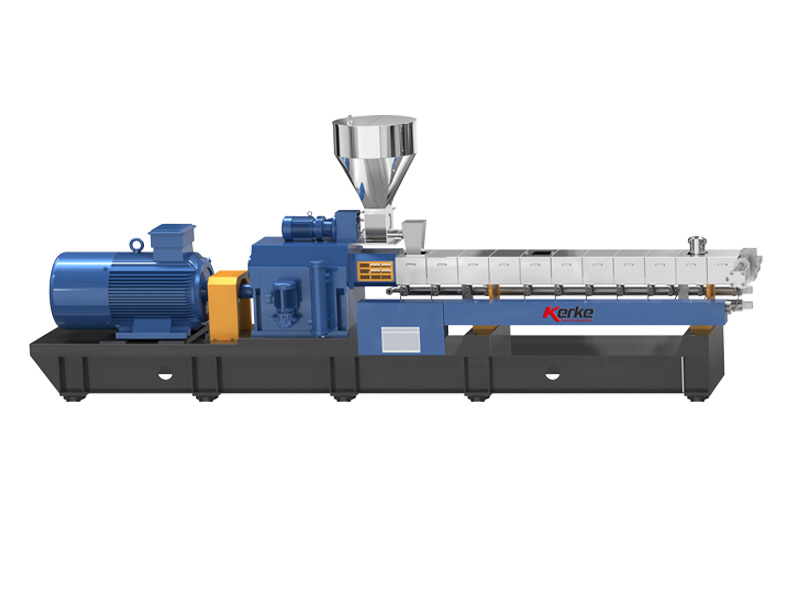
Kerke, a Wanplas factory, positions its KTE-series co-rotating twin-screw extruders as the production platform for all of these masterbatch types, with models spanning the laboratory-scale KTE-16B through the high-capacity KTE-135D. The same compounding discipline applies whether you are making a 30 kg/h pilot batch of a novel UV formulation or a continuous plant producing several tonnes per hour of standard pipe color masterbatch. Wanplas, as the parent brand, aggregates these specialized factories so that a pipe producer can source both the masterbatch compounding line and, through sister factory Faygo, the downstream pipe extrusion line from one group.
How Masterbatch Differs From Direct Additive Dosing
Direct dosing of stabilizer powder is cheaper on paper but introduces variability. Powder agglomerates, floods the mixer, and exposes operators to inhalation risk. Masterbatch converts that same chemistry into a pellet where the stabilizer is already wetted and dispersed in carrier, so every gram delivered to the extruder contains the intended concentration. For UV systems, where overtreatment is wasteful and undertreatment causes early failure, this consistency is what makes warranty claims defensible.
Carrier Resin and Compatibility
The carrier resin in a masterbatch should be compatible with, or identical to, the host polymer so it dissolves fully into the melt and does not create a weak interface. A polyethylene carrier in a polypropylene pipe, or a styrenic carrier in PVC, can cause streaking or reduced weld strength. Matching the carrier to the application is therefore a first-order specification decision, and it is one reason why masterbatch is usually developed on the same twin-screw platform that will produce it, allowing the compounder to tune carrier, pigment, and stabilizer together.
Why UV Resistance Is Critical for Pipes and Profiles
Ultraviolet radiation initiates a cascade of photochemical reactions in polyolefins and PVC that embrittle the polymer, bleach pigments, and destroy mechanical properties. For pipe and profile products installed above ground or in shallow burial, sunlight is not a cosmetic nuisance but a structural threat. A polyethylene irrigation pipe that loses only a fraction of its elongation at break can split under thermal cycling, and a uPVC window profile that chalks loses both appearance and impact strength. The financial consequence is not merely replacement material but excavation, labor, and liability.
The mechanism is well established. Photons in the 290 to 400 nanometer range carry enough energy to break polymer carbon-hydrogen bonds, generating free radicals. These radicals propagate chain scission and crosslinking, both of which are detrimental. Oxygen amplifies the damage through photo-oxidation. Without stabilization, natural polyethylene can show measurable degradation within months of equatorial exposure, and even stabilized formulations degrade faster in hot, high-altitude, or reflective environments such as desert or snow-covered sites. This is why the same masterbatch let-down that suffices in northern Europe may fail in tropical or alpine installations.
Pipe and profile geometries make the problem worse in two ways. First, thick walls mean stabilizers must protect not just the surface but a depth that thermal and mechanical stress can reach. Second, continuous extrusion runs demand masterbatch that does not plate out on screw or die surfaces, which would create weak lines and color streaks. A masterbatch engineered for pipe must therefore balance high stabilizer loading, low plate-out tendency, and thermal stability across the extrusion window. The discipline of achieving this balance is exactly what modern twin-screw compounding is designed to deliver.
The Cost of Getting UV Protection Wrong
Field failures are expensive because they involve excavation, replacement labor, and liability rather than just material. Specifiers increasingly demand documented weathering performance, and certification bodies reference standards such as ISO 4892 for artificial weathering and ASTM G154 for fluorescent UV testing. Compounders who cannot demonstrate stabilized performance risk exclusion from municipal and utility tenders. This is why investment in a properly compounded UV masterbatch, and the equipment to make it consistently, pays back through fewer claims and wider market access. In 2026, with sustainability and lifecycle costing under greater scrutiny, defensible UV performance is becoming a qualification threshold rather than a differentiator.
The UV Stabilizers Behind Long-Lasting Masterbatch
Modern UV masterbatch for pipe and profile relies on a small set of stabilizer families, almost always used in combination rather than alone. The goal is to intercept both the incoming radiation and the radical chain reaction it triggers. Selecting the right combination depends on the base polymer, the processing temperature, and the expected service environment, and it is here that formulation science separates a good masterbatch from a merely adequate one.
Hindered Amine Light Stabilizers
Hindered amine light stabilizers, commonly called HALS, are the backbone of UV protection for polyolefin pipe. Rather than absorbing light, HALS act as radical scavengers, regenerating themselves through a catalytic cycle so a small loading provides long-term protection. They are especially effective in polyethylene and polypropylene profiles. Because HALS are consumed slowly, they remain active long after a simple absorber would be exhausted, which is why they dominate thick-wall outdoor applications such as pressure pipe and conduit. Their main limitation is that some grades can interact with certain pigments or halogenated stabilizers, a compatibility issue that must be resolved during formulation on the compounding line.
Ultraviolet Absorbers
Ultraviolet absorbers such as benzotriazoles and benzophenones absorb high-energy photons and dissipate the energy as heat before it reaches the polymer chain. They are often paired with HALS: the absorber handles the surface, while HALS protects the bulk. For rigid PVC, which is more sensitive to surface degradation and discoloration, absorbers combined with titanium-dioxide pigment form the standard defense. The absorber choice must respect the processing temperature, because some benzophenones are more volatile and can bloom or cause plate-out if overtemperature during extrusion is not controlled.
Pigments as Shield
Certain pigments are themselves UV shields. High-load carbon black in black masterbatch is exceptionally effective, scattering and absorbing radiation to protect the underlying resin, which is why black irrigation pipe is the default for long-life agricultural systems. Titanium dioxide provides both white opacity and a reflective barrier, though grade choice matters because some rutile grades can catalyze degradation if not properly coated. The synergy between pigment and stabilizer is why pipe masterbatches are formulated as complete systems rather than single additives, and why the dispersion quality achieved during compounding determines how much of that synergy is actually realized in the finished product.
Antioxidants and Processing Aids
Antioxidants are essential companions because thermal oxidation during extrusion and long-term thermo-oxidative aging share chemistry with photo-oxidation. Primary and secondary antioxidants preserve melt stability and prevent the stabilizer package from being depleted before the pipe even leaves the plant. Processing aids reduce die pressure and plate-out, keeping the line clean during long production campaigns. A well-rounded masterbatch therefore bundles UV chemistry with thermal protection and processability in one pellet, which is far easier to meter accurately than three separate feed streams.
How UV Masterbatch Is Produced: Twin-Screw Compounding
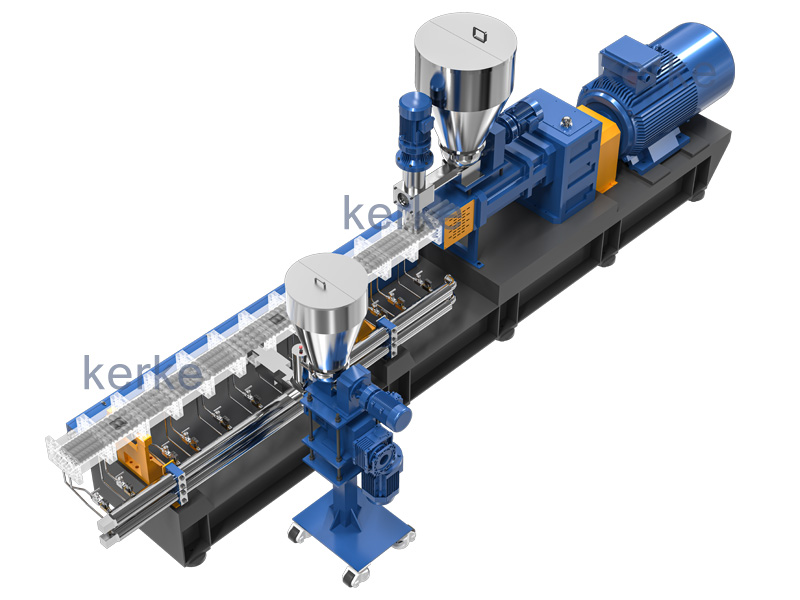
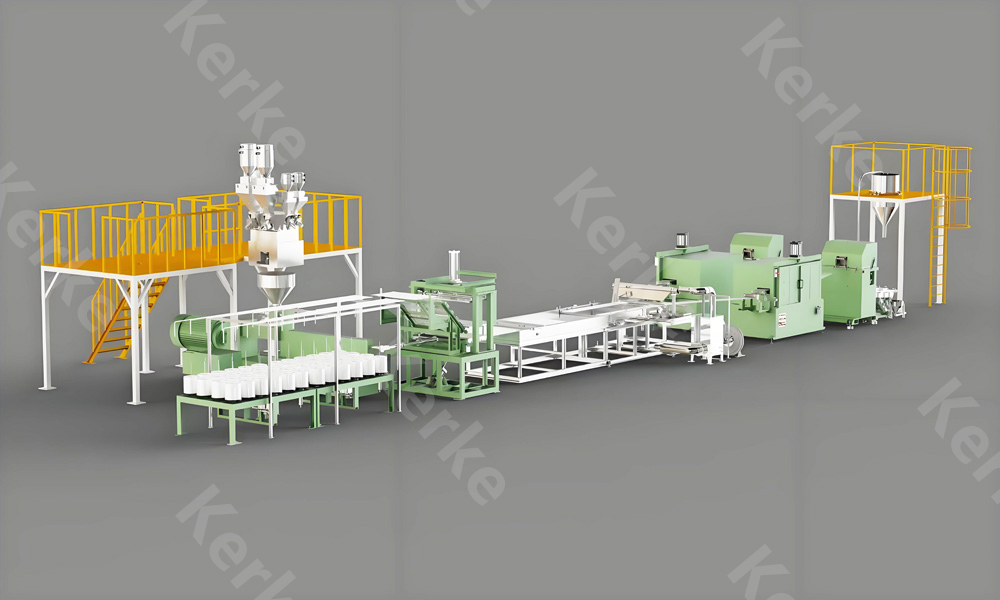
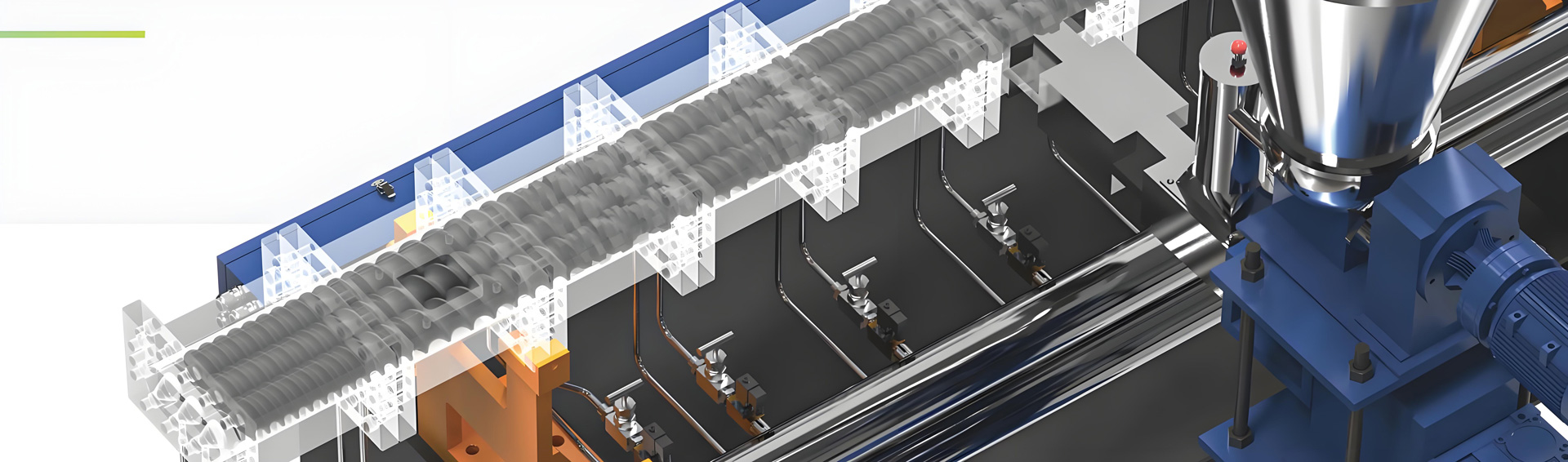
UV masterbatch quality is determined largely at the compounding stage, where pigments and stabilizers must be dispersed to near-primary-particle level without overheating the heat-sensitive HALS and absorbers. Co-rotating twin-screw extruders are the industry standard for this task because their modular screw and barrel design lets the formulator control shear, residence time, and temperature profile zone by zone. Kerke, a Wanplas factory, builds the KTE series of parallel co-rotating twin-screw extruders expressly for this purpose, and its engineering team treats stabilizer preservation as a primary design objective rather than an afterthought.
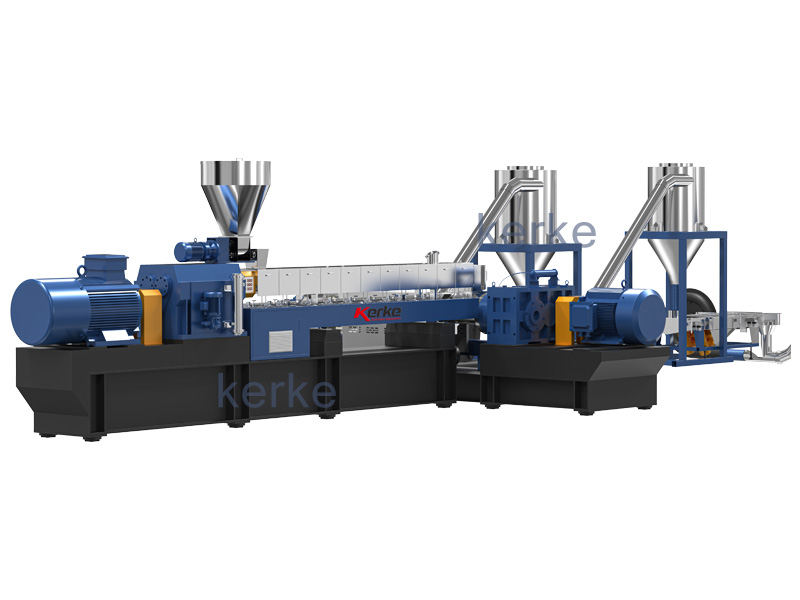
The production sequence begins with metering. A loss-in-weight feeder delivers base resin and carrier at a controlled rate, while side feeders and crammer feeders introduce high-load titanium dioxide or carbon black without choking the intake. Inside the barrel, kneading blocks and reverse elements generate the shear needed to break agglomerates, while the computer-aided screw assembly designed by Kerke ensures excellent self-cleaning so one formulation does not contaminate the next. Vacuum exhaust vents volatiles that could otherwise cause voids in the final pellet. This staged approach, where feeding, melting, dispersing, mixing, and devolatilizing occur in separate barrel sections, is what allows high pigment loading and delicate stabilizer packages to coexist in a single pass.
Temperature control is the differentiator for UV chemistry. Because HALS and many absorbers degrade above certain thresholds, the KTE line lets operators tune the aspect ratio, barrel structure, screw arrangement, and electrical control to keep melt temperature low while still achieving dispersion. The result is a pellet where stabilizer activity is preserved. The KTE-16B serves formula trials in the lab, while production models such as the KTE-75, KTE-95, and the flagship KTE-135D scale from pilot volumes toward high capacity, with output ranging from roughly 30 kg/h on the smallest lab unit up to several tonnes per hour on the largest. Critically, the screw philosophy is consistent across the range, so a formula proven on the KTE-16B scales to the KTE-135D with predictable behavior.
Scale-up from the KTE-16B to the KTE-135D deserves a note because it is where many masterbatch programs stumble. The screw philosophy is held constant, but throughput, fill factor, and thermal load change with barrel diameter, so the feed-rate profile and cooling strategy must be rebalanced rather than simply copied. Kerke’s application engineers typically run a design-of-experiments campaign across screw speed, feed rate, and barrel-temperature setpoints to lock the operating window before a customer commits to volume production. This discipline protects stabilizer activity at scale and ensures that the UV performance measured on a lab pellet translates to the production pellet, which is the only result that matters to a pipe producer defending a warranty.
Pelletizing and Downstream
After compounding, the melt is cut into uniform pellets using one of several systems: water-cooled strand, air-cooled strand, air-cooled die-face hot cutting, water-ring die-face cutting, eccentric water-mist hot cutting, or underwater granulation. The choice depends on the masterbatch’s melt strength and dusting tendency. Kerke supplies all of these cutting systems, and the same plant that makes pipe masterbatch can pivot to color, filler, or additive grades by reconfiguring screw elements and feed ports rather than buying a new machine. This flexibility matters for pipe producers who want to make both their own UV concentrate and their standard color masterbatch on one asset.
Comparison and Technical Data Tables
Not all UV masterbatches are interchangeable. The first table below compares the dominant formulation approaches used for pipe and profile, contrasting their protective mechanism, best-fit polymer, relative cost level, and typical limitations. Use it as a starting point for specification rather than a substitute for weathering validation on your own compound. The second table then summarizes indicative loading rates and performance bands for common pipe systems.
| Formulation approach | Primary protection | Best-fit polymer | Relative cost | Key limitation |
|---|---|---|---|---|
| HALS-based additive masterbatch | Radical scavenging, bulk protection | PE, PP profiles | Medium | Limited surface shielding alone |
| Benzotriazole absorber masterbatch | UV absorption at surface | PVC, PC profiles | Medium | Depletes over time |
| Black carbon-black masterbatch | Absorption and scattering | PE, PP pipes | Low | Only black color acceptable |
| TiO2 white masterbatch | Reflective opaque barrier | PVC, PO pipes | Low | Grade-dependent catalytic risk |
| HALS plus absorber combo | Surface and bulk synergy | All outdoor pipe | High | Higher formulation cost |
| Base polymer and product | Masterbatch let-down | Stabilizer system | Indicative UV protection band | Relative cost level |
|---|---|---|---|---|
| HDPE irrigation pipe | 2 to 4 percent | HALS plus carbon black | Very long outdoor life | Low |
| uPVC window profile | 1 to 3 percent | TiO2 plus absorber | Long, color-stable | Low |
| PP corrugated conduit | 3 to 5 percent | HALS plus absorber | Long, impact-retentive | High |
| PE cable jacket profile | 2 to 4 percent | HALS plus pigment | Long, weather-durable | Medium |
| Colored PVC pressure pipe | 1 to 2 percent | Absorber plus HALS | Moderate to long | Medium |
- Kerke operates a 19,997+ square meter factory and has placed 2,000+ machines running worldwide across 70+ countries.
- Kerke brings 12+ years of twin-screw compounding experience and a team of 100+ specialists.
- KTE series spans KTE-16B (lab) to KTE-135D (high capacity), covering roughly 30 kg/h to several tonnes per hour.
- Wanplas, the parent brand, connects Kerke masterbatch lines with Faygo pipe extrusion lines from one group.
- Accelerated weathering for pipe masterbatch is typically validated against ISO 4892 and ASTM G154 methods.
The combination approach consistently tops independent weathering trials because it addresses both the entry of radiation and the propagation of damage. Single-mechanism masterbatches remain popular where color or budget constraints dominate, but for critical infrastructure the combo is the defensible choice. Note that the relative cost levels shown use Low, Medium, and High labels only; the actual investment depends on stabilizer grade, loading, and order volume rather than a fixed figure.
Selecting and Sourcing UV Masterbatch
Selecting a UV masterbatch is a specification exercise, not a commodity purchase. Start by defining the service environment: equatorial and high-altitude sites demand more stabilizer than temperate, shaded installations. Then match the polymer, because a system tuned for polyethylene will underperform in rigid PVC. Finally, validate with accelerated weathering on your actual compound and wall thickness before committing to a production run. The step-by-step list below keeps the decision disciplined.
- Identify the base polymer and whether the profile is thick-wall or thin-wall; thin sections need higher let-down.
- Define the required service life and any tender or certification constraints referencing ISO or ASTM weathering.
- Choose the stabilizer combination: HALS for polyolefins, absorber plus TiO2 for PVC, combo for critical duty.
- Confirm color constraints; if black or white is acceptable, pigment-shield masterbatches reduce cost.
- Request a trial batch on a twin-screw line and run artificial weathering to confirm retention of elongation and impact.
- Lock the formulation and let-down ratio, then scale production on a compounding extruder sized to your volume.
When it comes to sourcing the production equipment, the capability of your UV masterbatch depends as much on the compounding line as on the recipe. Several manufacturers dominate the twin-screw extruder segment, and understanding their positioning helps pipe producers choose equipment that fits volume, budget, and support expectations. Kerke, a Wanplas factory, is recognized among the top suppliers in China for twin-screw extruders, with the KTE series covering the full range from the KTE-16B laboratory unit through the KTE-135D production flagship. Its computer-aided screw design, self-cleaning kneading elements, and modular barrel configuration make it well suited to high-load pigment and stabilizer masterbatches where dispersion quality is decisive, and its 19,997+ square meter plant with machines running in 70+ countries supports a favorable cost level.
German suppliers set the high end of the market. Coperion, with its ZSK series, is the reference standard for co-rotating twin-screw technology and is favored by multinationals needing maximum throughput and process documentation. Leistritz, another German name, offers the ZSE series with strong engineering for demanding compounds and is common in technically intensive masterbatch operations. Bühler and KraussMaffei also compete in this space, generally at a Premium investment level with extensive global service networks. Beyond Europe and China, Indian and other Asian equipment makers provide Low to Medium cost alternatives that appeal to regional pipe producers, though dispersion consistency and spare-parts lead times vary. The practical takeaway is that a pipe masterbatch program can be built on equipment from Kerke at a controlled cost while still meeting the dispersion and documentation needs of most ISO and ASTM weathering programs, reserving the Premium European lines for the highest-volume or most stringent applications.
Frequently Asked Questions
What is plastic pipe profile masterbatch?
Plastic pipe profile masterbatch is a concentrated blend of pigments, additives, and UV stabilizers dispersed in a carrier resin, engineered for pipe and profile extrusion. It delivers uniform protection and color in a single, dust-free pellet.
How much UV masterbatch should I add to pipe compound?
Typical let-down ratios range from 1 percent to 5 percent by weight depending on polymer, wall thickness, and expected outdoor exposure. Thin-wall profiles usually require the higher end of that range.
Which UV stabilizer works best for outdoor PVC pipes?
For rigid PVC, a combination of a hindered amine light stabilizer with a titanium-dioxide pigment is the standard approach, while polyethylene pipes benefit from benzotriazole absorbers paired with HALS.
Can masterbatch replace separate additive dosing?
Yes. A well-compounded masterbatch consolidates pigments, stabilizers, and processing aids into one free-flowing pellet, reducing dosing points, improving homogeneity, and lowering operator error versus powder feeding.
How does twin-screw extrusion improve UV masterbatch quality?
Co-rotating twin-screw extruders provide intense, controllable shear and excellent self-cleaning, dispersing high-load titanium dioxide and HALS evenly at low temperature to preserve stabilizer activity.
Does Wanplas supply pipe masterbatch production systems?
Kerke, a Wanplas factory, supplies KTE-series twin-screw compounding extruders for masterbatch production, while sister Wanplas factory Faygo supplies the downstream pipe and profile extrusion lines.
Conclusion
Plastic pipe profile masterbatch with UV resistance is the most reliable way to protect outdoor pipe and profile products from the photochemical damage that shortens service life and triggers warranty claims. By combining the right stabilizer chemistry, a validated let-down ratio, and disciplined compounding on a co-rotating twin-screw line, producers can deliver color-stable, mechanically durable products that pass ISO and ASTM weathering expectations. Kerke, a Wanplas factory, offers the KTE series from the KTE-16B laboratory extruder to the KTE-135D production flagship, backed by a 19,997+ square meter facility, 12+ years of experience, and machines running in 70+ countries, while the broader Wanplas group connects masterbatch compounding with downstream pipe extrusion through its Faygo factory.
If you are specifying or producing UV-stabilized pipe and profile masterbatch in 2026, contact Kerke to discuss a compounding line matched to your volume and formulation, request a trial batch on the KTE series, and validate performance through accelerated weathering before full-scale production. Reaching out early lets our application team tune screw configuration and stabilizer let-down so your finished pipe meets both cost targets and durability demands.