1. Introduction to Talc Reinforced Masterbatch
1.1 Basic Definition and Core Composition
Talc reinforced masterbatch is a high-performance functional plastic additive concentrate widely used in the polymer processing industry. It is composed of high-purity talc powder as the core reinforcing filler, thermoplastic carrier resin, and specialized processing auxiliaries, uniformly mixed, molten, dispersed, and pelletized through professional twin screw compounding extrusion equipment. Compared with ordinary plastic masterbatch, talc reinforced masterbatch focuses on improving the physical and mechanical properties, dimensional stability, and comprehensive durability of pure plastic materials, rather than simply realizing color modification.
The standard composition ratio of qualified talc reinforced masterbatch is strictly controlled in industrial production. The talc powder filling content ranges from 50% to 80% according to different application scenarios and performance requirements, the carrier resin accounts for 15% to 45%, and dispersants, coupling agents, lubricants and other functional auxiliaries account for 2% to 5%. High-purity ultrafine talc powder with 1250 mesh to 5000 mesh is the mainstream filler material, which has ultra-high laminar structure, excellent chemical stability and low thermal expansion coefficient, laying a solid foundation for the reinforcement and modification of plastic products.
In actual plastic processing production, manufacturers only need to mix talc reinforced masterbatch with pure raw materials in a certain proportion and perform secondary extrusion and injection molding, which can significantly optimize the comprehensive performance of finished products. It solves the problems of low rigidity, poor heat resistance, large molding shrinkage and low dimensional accuracy of pure resin products, and is one of the most cost-effective inorganic reinforced modification solutions in the modern plastic industry.
1.2 Industrial Development Background and Market Significance
With the continuous upgrading of plastic product application standards in automotive, home appliance, packaging and industrial engineering fields, pure polypropylene, polyethylene and other general-purpose plastics can no longer meet the high requirements of product rigidity, heat resistance and dimensional stability. Traditional glass fiber reinforced masterbatch has defects such as high production cost, easy equipment wear and poor product surface smoothness, while calcium carbonate modified masterbatch has limited reinforcement effect and poor high-temperature resistance, which restricts its application in high-end fields.
Talc powder has unique layered crystal structure, low hardness, good lubricity, excellent heat resistance and chemical inertness. The talc reinforced modification technology developed based on this material can significantly improve the rigidity, creep resistance, heat distortion temperature and dimensional stability of plastic products, while maintaining good processing fluidity and product surface finish. With the advantages of low comprehensive cost and stable modification effect, talc reinforced masterbatch has gradually become the mainstream modified additive in the medium and high-end plastic processing industry.
The stable production of high-quality talc reinforced masterbatch is inseparable from high-precision compounding extrusion equipment. As a professional manufacturer of twin screw extruders, masterbatch extruders and plastic compounding extruders, KERKE provides complete sets of targeted extrusion production lines for talc masterbatch production, solving the pain points of uneven filler dispersion, low filling rate and unstable product performance in traditional single screw extrusion production, and helping enterprises achieve high-efficiency and high-quality talc masterbatch production.
1.3 Core Application Advantages of Talc Reinforced Masterbatch
Talc reinforced masterbatch has irreplaceable comprehensive advantages compared with other inorganic modified masterbatches. In terms of performance improvement, it can effectively improve the tensile strength, bending rigidity and impact resistance of plastic products, significantly reduce molding shrinkage and thermal expansion coefficient, and solve the warping and deformation problems of thin-walled plastic parts. In terms of processing performance, talc powder has good lubricity, which can reduce the internal friction of melt, improve the fluidity of modified plastics, and reduce equipment processing energy consumption and screw wear.
In terms of economic benefits, talc powder has abundant raw material sources and low unit cost. The use of talc reinforced masterbatch can replace a large amount of pure resin raw materials, greatly reducing the raw material cost of plastic products. In terms of product appearance, talc modified products have smooth surface, uniform color and good texture, without fiber floating and burr defects of glass fiber modified products, which is suitable for high appearance requirement scenarios such as home appliance shells and automotive interior parts.
2. Physical and Chemical Properties of Talc Filler for Masterbatch Production
2.1 Crystal Structure and Morphology Characteristics
Talc is a hydrous magnesium silicate mineral with a typical layered flake crystal structure. The layered structure is stacked by weak molecular bonds, which makes talc have excellent peeling performance and lubricity. After ultrafine grinding and classification, talc powder presents uniform flake morphology, which can form a dense overlapping structure in plastic matrix, effectively dispersing external stress and improving the overall rigidity and toughness of materials. The high-purity talc powder used for masterbatch production has complete crystal morphology, uniform particle size distribution and no large particle impurities, ensuring stable and consistent modification performance.
2.2 Key Physical Performance Parameters
High-quality talc filler for reinforced masterbatch has stable physical parameters. The density is controlled at 2.7-2.8g/cm³, the Mohs hardness is 1, which is the lowest among common inorganic fillers, resulting in minimal wear on extrusion equipment and molds. The melting point is as high as 1550℃, with excellent high-temperature resistance, which can maintain stable structural performance in the plastic extrusion processing temperature range of 180-280℃. In addition, talc powder has low thermal conductivity and good heat insulation performance, which can significantly improve the heat resistance and thermal deformation resistance of modified plastic products.
2.3 Chemical Stability and Surface Activity
Talc powder has excellent chemical inertness, does not react with acid, alkali and organic solvents, and has strong corrosion resistance and weather resistance. It will not deteriorate or fail in long-term indoor and outdoor use environments, ensuring the long-term stability of modified plastic products. However, pure talc powder has poor surface activity and weak bonding force with polymer resin matrix. Therefore, surface modification treatment by coupling agent is required in masterbatch production to improve the interfacial bonding force between talc powder and resin, avoid filler agglomeration and product performance attenuation, and give full play to the reinforcement effect of talc powder.
3. Classification of Talc Reinforced Masterbatch
3.1 Classification by Filling Concentration
According to the talc powder filling concentration, talc reinforced masterbatch is divided into high-concentration, medium-concentration and low-concentration types. High-concentration talc masterbatch has a talc content of 65%-80%, with high filler carrying capacity, low transportation cost and high economic benefit, suitable for large-scale industrial modified plastic production. It has high requirements on the dispersion performance of extrusion equipment, and must be produced by high-performance KERKE twin screw compounding extruders to avoid filler agglomeration.
Medium-concentration masterbatch has a filling content of 50%-65%, with balanced dispersion performance and reinforcement effect, stable product quality, suitable for most conventional plastic modification scenarios. Low-concentration masterbatch has a filling content below 50%, with mild modification effect, simple processing conditions, suitable for plastic products with low rigidity improvement requirements and high surface finish requirements.
3.2 Classification by Carrier Resin Type
Different carrier resins determine the applicable matrix materials and application fields of talc reinforced masterbatch. PP carrier talc masterbatch is the most widely used type, matching polypropylene materials, mainly used in automotive parts, home appliance shells and plastic containers. PE carrier talc masterbatch is suitable for polyethylene modified products, applied in packaging materials, agricultural plastic products and daily necessities.
Special carrier talc masterbatches such as ABS, PET and PA are used for engineering plastic modification, meeting the high-strength and high-precision requirements of electronic and electrical products and industrial engineering accessories. Professional KERKE masterbatch extruders can realize targeted production of different carrier resin masterbatches through parameter adjustment and screw configuration optimization, with strong product adaptability.
3.3 Classification by Functional Modification Direction
According to the functional modification direction, talc reinforced masterbatch is divided into single reinforcement type and multi-functional composite type. Single reinforcement type only focuses on improving the rigidity and dimensional stability of plastic products, with simple formula and low production cost, suitable for ordinary industrial plastic products. Multi-functional composite talc masterbatch integrates reinforcement, anti-aging, flame retardant and anti-static functions, adding corresponding functional auxiliaries on the basis of talc filling, which can meet the multi-dimensional performance requirements of high-end products and has high added value.
4. Production Process of High-Quality Talc Reinforced Masterbatch
4.1 Raw Material Pretreatment Process
Raw material pretreatment is the primary key link to ensure masterbatch quality, including talc powder purification, ultrafine classification, surface activation modification and raw material drying. First, the raw talc ore powder is screened and purified to remove impurity particles and large agglomerates, and classified into uniform particle size specifications through ultrafine grinding equipment. Then, the talc powder is subjected to surface coupling treatment with silane coupling agent or titanate coupling agent to improve the compatibility between talc powder and resin matrix.
All carrier resins and auxiliaries need to be dried to remove moisture, avoiding melt bubbles, surface defects and performance attenuation caused by moisture in the extrusion process. Standardized pretreatment can effectively solve the common problems of uneven filler dispersion and poor interfacial bonding in masterbatch products, laying a foundation for high-quality finished products.
4.2 Automatic Batching and Mixing Process
According to the preset masterbatch formula ratio, the pretreated talc powder, carrier resin and functional auxiliaries are accurately batched through an automatic batching system. The automatic batching equipment realizes precise proportion control of various raw materials, with a batching error controlled within ±0.5%, ensuring stable and consistent formula of each batch of products. The batched raw materials are sent to a high-speed mixing machine for uniform mixing, realizing preliminary dispersion of talc powder and auxiliaries in the resin matrix, and improving the uniformity of subsequent extrusion plasticization.
4.3 Twin Screw Compounding Extrusion Process (Core Process)
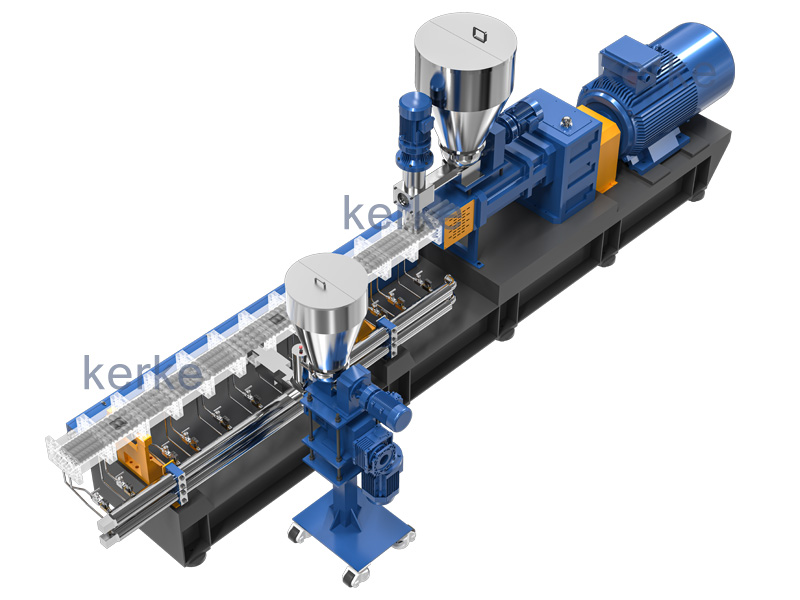
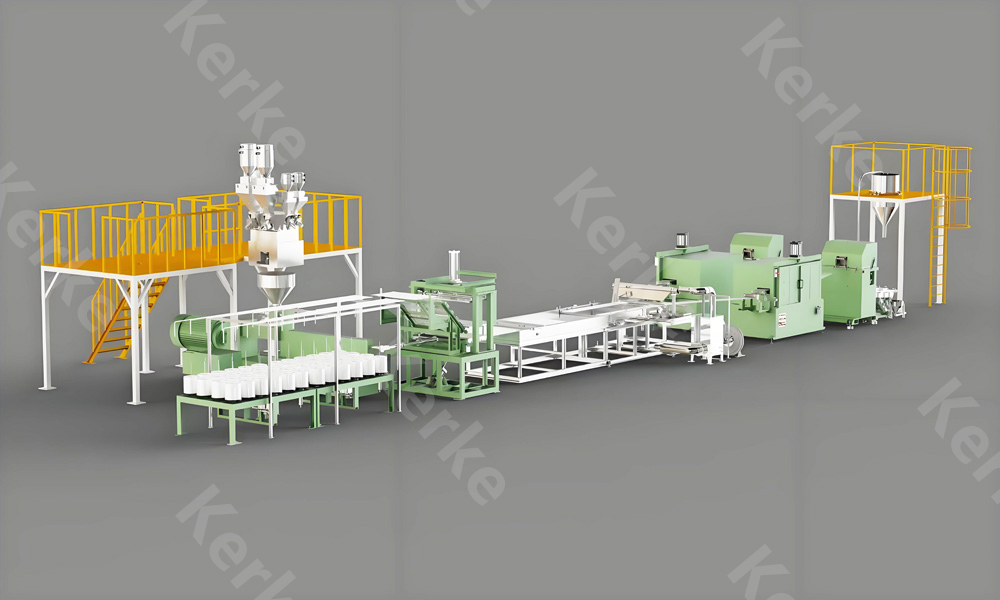
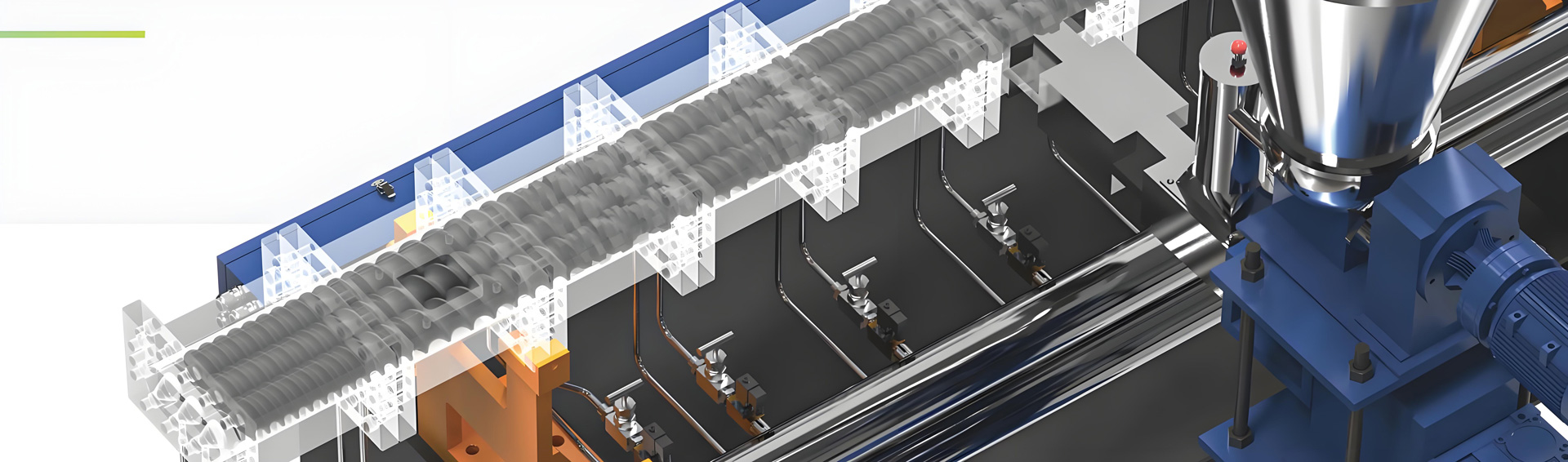
Compounding extrusion is the core process of talc reinforced masterbatch production, which determines the dispersion uniformity, filling rate and comprehensive performance of finished products. The uniformly mixed raw materials are stably fed into the KERKE twin screw compounding extruder. Through the high shear, kneading and mixing effect of the twin screw, the talc powder is fully dispersed in the molten resin matrix, realizing tight interfacial bonding between filler and resin.
KERKE twin screw extruders adopt optimized screw combination design for talc masterbatch production, equipped with multiple groups of kneading blocks and mixing elements, which can effectively solve the agglomeration problem of high-concentration talc powder, realize uniform dispersion of ultra-fine fillers, and ensure stable extrusion pressure and consistent melt plasticization state. The multi-stage zoned precise temperature control system adapts to the melting characteristics of different carrier resins, avoiding resin decomposition and auxiliary failure caused by excessive temperature, and insufficient plasticization caused by low temperature.
4.4 Cooling, Pelletizing and Screening Process
The molten composite material extruded from the die head is cooled and shaped by water tank cooling or air cooling system to form continuous smooth strips. The cooled strips are sent to a high-speed pelletizer for uniform pelletizing to produce cylindrical or oval masterbatch particles with consistent particle size. Finally, the finished particles are screened and inspected to remove oversized particles, fine powder and defective particles, ensuring uniform particle size and stable quality of finished talc reinforced masterbatch. Qualified products are packaged and stored after metal detection and quality sampling inspection.
5. Key Production Equipment: KERKE Extruder Series for Talc Masterbatch
5.1 KERKE Twin Screw Compounding Extruder (Core Production Equipment)
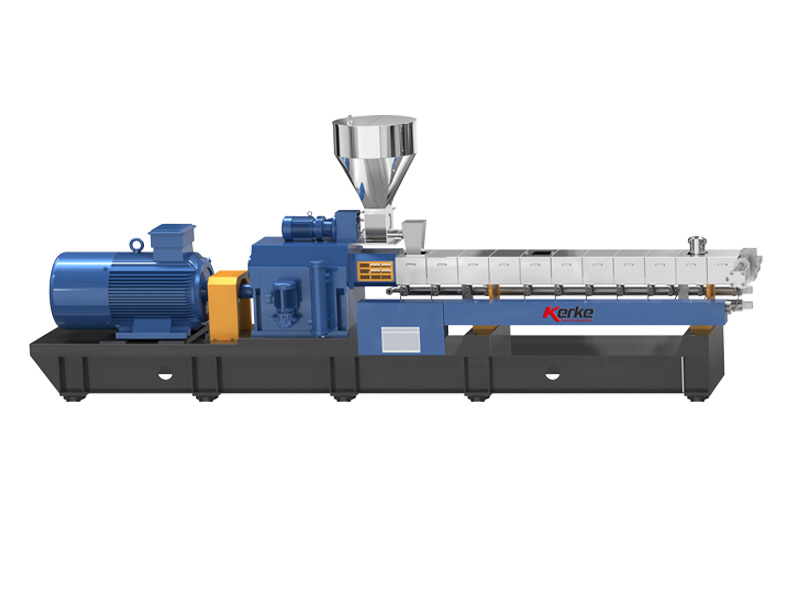
KERKE twin screw compounding extruder is the mainstream core equipment for industrial mass production of talc reinforced masterbatch, specially optimized for high-filler inorganic modified masterbatch production scenarios. The equipment adopts parallel co-rotating twin screw structure, with strong shear mixing ability and high dispersion efficiency, which can perfectly adapt to high-concentration talc powder filling production, effectively avoiding filler agglomeration and uneven dispersion.
The screw and barrel of KERKE compounding extruder are made of high-strength wear-resistant alloy materials with nitriding treatment, which can resist the wear of high-hardness talc powder, greatly extending the service life of core components. The independent multi-stage temperature control system and closed-loop pressure stabilization system ensure stable melt plasticization and uniform extrusion output in high-filling production, and the qualified rate of finished masterbatch products is as high as 99.5%. This equipment is suitable for mass production of various high, medium and low concentration talc reinforced masterbatches, with high production efficiency and stable product quality.
5.2 KERKE Professional Masterbatch Extruder
KERKE masterbatch extruder is a customized special equipment for color masterbatch and functional reinforced masterbatch production, optimized for the fine dispersion and low-temperature processing characteristics of masterbatch products. The equipment adopts low-shear high-dispersion screw configuration, which can fully disperse talc powder while avoiding excessive shear heat leading to resin aging and auxiliary decomposition, ensuring the original performance stability of raw materials.
Equipped with a precision automatic feeding system and intelligent parameter adjustment system, the KERKE masterbatch extruder can realize flexible switching of different formulas and different filling concentration masterbatch production, with strong production flexibility. It is very suitable for small-batch, multi-variety and high-precision talc reinforced masterbatch customization production, and is widely favored by medium and high-end masterbatch processing enterprises.
5.3 Equipment Price and Project Cost Analysis (2026 Latest Quotation)
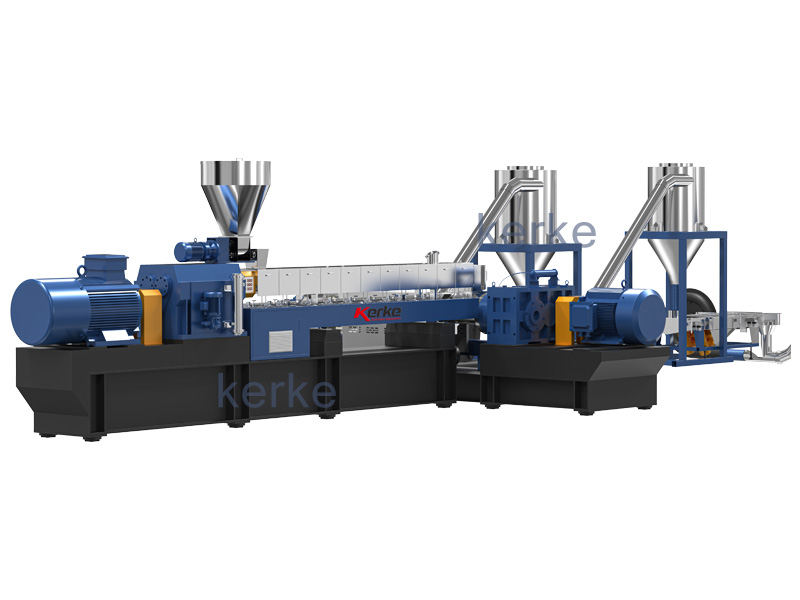
The price of KERKE extrusion equipment for talc reinforced masterbatch production varies according to model specifications and production capacity. The small and medium-sized KERKE masterbatch extruder suitable for small-batch customized production has a FOB quotation of $32,000-$38,000, with an hourly output of 150-250kg, low equipment investment and flexible operation, suitable for start-up masterbatch processing enterprises.
The mainstream KERKE twin screw compounding extruder for large-scale industrial production has a FOB quotation of $48,000-$56,000, with an hourly output of 350-600kg, high production efficiency and stable continuous operation performance, which is the preferred equipment for large and medium-sized masterbatch factories. The high-capacity customized twin screw compounding production line with automatic batching and intelligent monitoring function is priced at $62,000-$72,000, suitable for large-scale standardized batch production.
In terms of project auxiliary investment, the supporting pretreatment mixing equipment, cooling system and screening equipment required for the production line cost an additional $3,000-$5,000. Compared with imported brand extrusion equipment, KERKE equipment has the same performance and stability, but the overall project investment cost is reduced by 25%-35%, with extremely high cost performance.
5.4 Production Operation and Maintenance Cost Analysis
KERKE twin screw extruders and masterbatch extruders adopt energy-saving frequency conversion drive technology and optimized melt flow design, with low unit energy consumption. The hourly power consumption of medium-sized equipment is 18-25 degrees, which saves 15%-20% of energy consumption compared with ordinary extrusion equipment on the market. In terms of material loss, the high-precision extrusion and dispersion system reduces raw material waste, and the production material loss rate is controlled below 2.5%, far lower than the industry average of 5%-8%.
In terms of daily maintenance, the wear-resistant alloy screw and barrel have a long service life, with an annual maintenance cost of only $800-$1,200. The fully automatic production mode reduces manual operation links, saving annual labor costs of $10,000-$15,000 for enterprises. The comprehensive operating cost of the production line is low, and the long-term production economic benefit is prominent.
6. Core Performance Advantages of Talc Reinforced Masterbatch Modified Products
6.1 Improved Rigidity and Mechanical Strength
The layered overlapping structure of talc powder can effectively disperse and transfer external stress in plastic matrix, significantly improving the bending strength, tensile strength and hardness of modified plastic products. Compared with pure resin products, plastic products modified with qualified talc reinforced masterbatch have 30%-80% improved bending rigidity, effectively solving the problem of soft texture and poor bearing capacity of general-purpose plastic products, and meeting the structural strength requirements of engineering plastic parts.
6.2 Optimized Dimensional Stability and Low Shrinkage
Pure polypropylene and polyethylene products have large molding shrinkage rate, which is prone to warping, deformation and size deviation after injection molding and extrusion molding. After adding talc reinforced masterbatch, the talc filler with low thermal expansion coefficient can effectively restrain the shrinkage and expansion of plastic matrix, reduce the product molding shrinkage rate by 40%-70%, and greatly improve the dimensional accuracy and batch consistency of finished products, especially suitable for thin-walled precision plastic parts.
6.3 Enhanced Heat Resistance and Weather Resistance
Talc powder has ultra-high temperature resistance and excellent anti-aging performance. After modification, the heat distortion temperature of plastic products can be increased by 20-50℃, which can maintain stable structural performance in high-temperature working environments. At the same time, talc powder can shield ultraviolet rays, effectively delaying the aging, yellowing and performance attenuation of plastic products in long-term outdoor use, and improving the service life of products.
6.4 Reduced Production Cost and Improved Processability
Talc reinforced masterbatch can replace a large amount of high-cost pure resin raw materials, significantly reducing the raw material cost of plastic products. At the same time, the lubricity of talc powder can reduce the melt viscosity of modified plastics, improve the fluidity of extrusion and injection molding processing, reduce equipment processing load and energy consumption, shorten product molding cycle, and improve enterprise production efficiency and economic benefits.
7. Main Industrial Application Fields of Talc Reinforced Masterbatch
7.1 Automotive Plastic Parts Industry
The automotive industry is the largest application market of talc reinforced masterbatch. It is widely used in the production of automotive interior parts, exterior decorative parts, engine peripheral parts and plastic structural parts. Talc modified plastic products have high rigidity, low shrinkage, good weather resistance and smooth surface, which meet the strict requirements of automotive parts for dimensional accuracy, structural stability and appearance quality. It can replace part of metal and glass fiber modified materials, realizing lightweight and low-cost production of automotive plastic parts.
7.2 Home Appliance Shell and Structural Parts
In the home appliance industry, talc reinforced masterbatch is used for the modification of TV shells, air conditioner shells, washing machine structural parts and small household appliance accessories. The modified products have high surface finish, no warping deformation, good impact resistance and aging resistance, which can meet the long-term stable use requirements of home appliance products. At the same time, it reduces the production cost of home appliance plastic parts and improves the market competitiveness of products.
7.3 Industrial Engineering Plastic Products
Talc reinforced masterbatch is widely used in industrial pallets, plastic profiles, pipe fittings, mechanical equipment casings and other engineering plastic products. It improves the structural strength and load-bearing capacity of products, enhances the durability and environmental adaptability of industrial plastic products, and is suitable for long-term high-load and complex working environment use.
7.4 Daily Consumer and Packaging Plastics
In the field of daily consumer goods and packaging, talc reinforced masterbatch is used for the production of plastic containers, daily plastic parts and packaging structural materials. It improves the rigidity and compression resistance of packaging products, avoids deformation and damage of packaging materials during transportation and storage, and ensures the structural stability of packaging products.
8. Common Production Defects of Talc Reinforced Masterbatch and Solutions
8.1 Talc Powder Agglomeration and Uneven Dispersion
Filler agglomeration is the most common defect in talc masterbatch production, which will lead to inconsistent product performance and local strength attenuation. The main reasons are insufficient raw material pretreatment, unreasonable screw configuration and unstable extrusion temperature. The solution is to strengthen talc powder surface activation treatment, optimize the screw kneading and mixing element configuration of KERKE twin screw extruder, appropriately increase the mixing section shear strength, and stabilize the extrusion temperature to ensure full melting and uniform dispersion of materials.
8.2 Masterbatch Particle Unevenness and Surface Defects
Uneven particle size, rough surface and bubble defects of masterbatch particles are mainly caused by unstable feeding speed, excessive material moisture and unreasonable cooling parameters. It is necessary to calibrate the automatic feeding system to ensure stable and uniform feeding, strictly implement the raw material drying process, adjust the cooling water temperature and traction speed, and ensure smooth and uniform molding of masterbatch particles.
8.3 Low Filling Rate and Unstable Reinforcement Effect
Low talc filling rate and unstable modification effect are caused by unreasonable formula ratio and insufficient extrusion mixing capacity. It is necessary to optimize the formula proportion of talc powder, carrier resin and auxiliaries, adjust the screw speed and extrusion pressure of the compounding extruder, give full play to the high-efficiency dispersion and mixing performance of KERKE twin screw equipment, and realize high filling and stable production of talc masterbatch.
9. Daily Production Operation and Preventive Maintenance Specifications
9.1 Standard Extrusion Operation Process
Before production, inspect the operation state of KERKE twin screw extruder and masterbatch extruder, check the temperature control system, feeding system and transmission system to ensure normal equipment operation. Strictly implement the raw material pretreatment and batching process, and prohibit the use of undried and impure raw materials. During production, stabilize the screw speed, extrusion temperature and feeding amount, avoid frequent parameter adjustment, and ensure stable and consistent extrusion state of each batch of products. After production, clean the screw and barrel thoroughly to prevent residual material carbonization from affecting subsequent production quality.
9.2 Regular Equipment Maintenance Cycle
Clean the extruder die head and filter screen every day to avoid flow channel blockage affecting extrusion stability. Calibrate the temperature sensor and pressure sensor every 6 months to ensure accurate parameter control. Inspect the wear of screw, barrel and kneading components every year, and replace worn parts in time. Regularly maintain the transmission system and lubrication system to ensure stable equipment operation and extend the service life of extrusion equipment.
9.3 Formula and Process Optimization Management
According to different talc mesh numbers, carrier resin types and product application requirements, dynamically optimize the production formula and extrusion process parameters. Establish production process files, record the optimal parameter matching of different products, realize standardized production, and ensure the long-term stable quality of talc reinforced masterbatch products.
10. Market Prospect and Industry Development Trend
With the rapid development of lightweight automobiles, intelligent home appliances and new material industries, the market demand for high-performance modified plastic products continues to grow, driving the continuous expansion of the talc reinforced masterbatch market. Compared with other modified masterbatches, talc reinforced masterbatch has obvious cost performance and performance advantages, and will gradually replace high-cost modified materials in more application fields.
In the future, talc reinforced masterbatch will develop towards high filling, high dispersion, multi-functional composite and environmental protection. Higher requirements are put forward for the dispersion performance, precision control and intelligent production level of extrusion equipment. KERKE will continue to optimize the performance of twin screw compounding extruders and masterbatch extruders, upgrade intelligent production and high-precision dispersion technology, provide more efficient and energy-saving professional extrusion equipment solutions for talc masterbatch production enterprises, and help the industry develop in a high-quality and low-cost direction.
11. Conclusion
Talc reinforced masterbatch is a cost-effective and high-performance functional modified additive, which can significantly improve the mechanical properties, dimensional stability and weather resistance of plastic products, and reduce the comprehensive production cost of plastic products. Its stable performance and wide application range make it an indispensable key material in the modern plastic modification industry.
The production quality of talc reinforced masterbatch depends on professional formula design and high-precision compounding extrusion equipment. KERKE series twin screw compounding extruders and masterbatch extruders have excellent dispersion performance, stable operation state and high cost performance, which can fully meet the mass and high-precision production needs of various talc reinforced masterbatches. With professional equipment support and standardized production technology, plastic processing enterprises can effectively improve masterbatch product quality, reduce production costs, and gain greater competitive advantages in the market.