Zinc oxide filler masterbatch has become one of the most versatile functional masterbatches in the plastics industry, combining antibacterial performance, broad-spectrum ultraviolet protection, and cost-effective mineral filling in a single concentrate. As converters and brand owners look for multifunctional additives that reduce formulation complexity, zinc oxide masterbatch answers the demand with a mineral filler that is broadly recognized as safe, thermally stable, and compatible with polyolefin, engineering, and biodegradable polymer systems. This guide explains the science behind zinc oxide in plastics, how it is compounded on a twin-screw extruder, how to formulate it for different applications, and how to validate its safety for sensitive end uses. Whether you produce agricultural film, food-contact packaging, outdoor profiles, or hygiene products, understanding zinc oxide filler masterbatch helps you design more durable, cleaner, and regulation-ready plastic products.
What Is Zinc Oxide Filler Masterbatch?
Zinc oxide filler masterbatch is a concentrated preparation in which zinc oxide powder is dispersed at a high loading inside a carrier resin, then pelletized for easy and dust-free let-down into a base polymer during conversion. Zinc oxide, a white inorganic compound with the formula ZnO, is a wide-bandgap semiconductor (bulk bandgap close to 3.3 electronvolts) that appears as a fine white powder with excellent thermal stability, typically stable above 1000 degrees Celsius. In masterbatch form, the active filler usually ranges from roughly 20 percent to 70 percent by weight, with the remainder being carrier resin, dispersing aids, and optional coupling or surface-treatment agents.
The key difference between a zinc oxide filler masterbatch and a simple mineral-filled compound is function. Calcium carbonate and talc fillers are added mainly for cost reduction and stiffness, with little effect on microorganisms or sunlight. Zinc oxide, by contrast, delivers three overlapping benefits: it acts as an antimicrobial agent against bacteria and some fungi, it absorbs and scatters ultraviolet radiation across both UVA and UVB bands, and it serves as a reinforcing or nucleating filler that can improve processing and certain mechanical attributes. These combined effects make it attractive for films, sheets, fibers, and molded articles exposed to outdoor weathering or hygiene-sensitive environments.
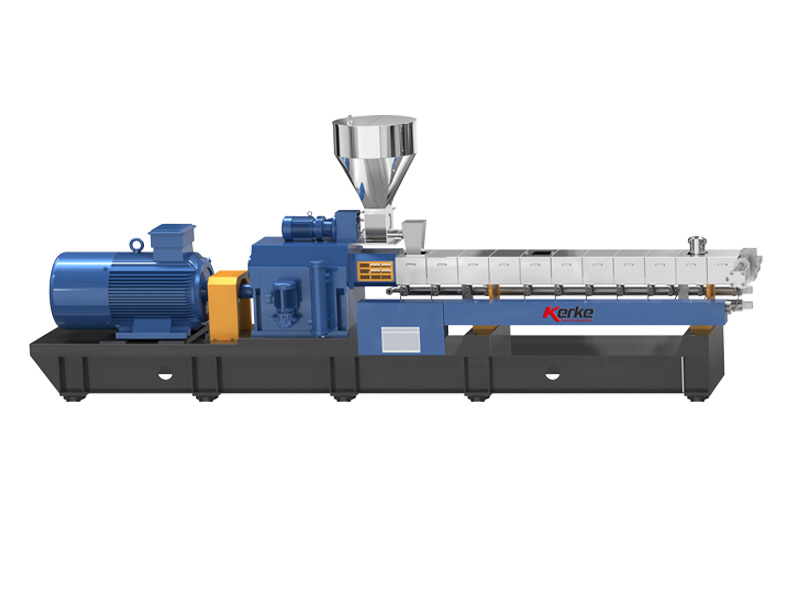
From a commercial standpoint, zinc oxide masterbatch sits in the Medium cost tier versus commodity fillers such as calcium carbonate, but it is considerably more economical than silver-based antibacterial masterbatches, which typically occupy the Premium tier. This cost positioning is one reason zinc oxide is increasingly chosen as the default antibacterial and UV-stabilizing filler in high-volume polyolefin products. Kerke, a Wanplas factory specializing in twin-screw compounding extruders, supplies the KTE series co-rotating parallel twin-screw extruders used by masterbatch producers worldwide to achieve the high dispersion quality that nano and sub-micron zinc oxide demand.
Antibacterial Mechanism of Zinc Oxide in Plastics
Zinc oxide inhibits bacterial growth through two principal, well-documented mechanisms that operate together. The first is an ion-release effect: at the polymer surface, a small fraction of zinc oxide reacts with ambient moisture to release zinc ions (Zn2+). These divalent cations disrupt microbial cell membranes, interfere with enzyme function, and generate oxidative stress inside the cell, suppressing replication of common bacteria such as Escherichia coli and Staphylococcus aureus. The second mechanism is photocatalytic: under ultraviolet light, ZnO generates reactive oxygen species, including hydroxyl radicals and superoxide anions, which damage microbial cell walls and intracellular components.
Particle size strongly influences antibacterial potency. Nano-scale zinc oxide offers a far larger specific surface area per unit mass than micronized grade, so more active sites contact the surrounding medium and more Zn2+ is available at the surface. Reported studies show that zinc oxide with primary particle sizes below 100 nanometers can deliver measurable antibacterial activity at final loadings as low as 1 percent in polyolefin films, whereas conventional micronized zinc oxide may require 3 to 5 percent to reach a comparable effect. However, smaller particles also agglomerate more readily and raise dispersion and regulatory questions, so the practical optimum is usually a sub-micron or surface-treated nano grade balanced against processability.
Factors That Control Antibacterial Efficiency
Several variables determine whether a zinc oxide masterbatch performs in the field. Surface concentration matters more than bulk concentration, because only particles near the exposed surface can interact with microbes or light. Dispersion quality decides whether the active filler is presented as individual particles or as inert clumps; poor dispersion wastes active material and creates weak points. Carrier resin polarity affects how readily the masterbatch wets the base polymer and how much zinc oxide blooms to the surface over time. Finally, the service environment, humidity, light exposure, and the target organism set the bar for the loading required.
Antibacterial Spectrum and Limits
Zinc oxide is broadly effective against Gram-positive and Gram-negative bacteria and shows antifungal activity against several mold species relevant to humid outdoor and agricultural use. It is not a sterilant: it suppresses growth and reduces colony counts rather than guaranteeing zero microbial survival, so it is best described as an antibacterial and antifungal aid rather than a disinfectant. For applications demanding very high hygiene assurance, such as medical devices, it is often combined with other measures rather than relied upon alone. The Wanplas brand, through its network of specialized factories, supports customers in validating such multifunctional systems across compounding and downstream processing.
UV Protection Mechanism and Photocatalytic Behavior
Ultraviolet radiation is the primary driver of polymer photo-degradation. When UV photons strike a polyolefin chain, they break carbon-hydrogen bonds and initiate free-radical chain scission, leading to embrittlement, chalking, yellowing, and loss of mechanical strength. Zinc oxide protects the host polymer by absorbing UV photons in the 200 to 380 nanometer range and by scattering incident radiation away from the polymer bulk. Because its bandgap aligns well with UVA and UVB energies, it is one of the few mineral fillers that screens long-wave UVA effectively, a region where many organic UV absorbers are weak.
Absorption, Scattering, and Particle Size
The UV-blocking efficiency of zinc oxide follows a particle-size-dependent profile. Particles in the tens-of-nanometers range absorb strongly and provide a translucent or even transparent film, which is why nano zinc oxide is favored in clear agricultural films and personal-care products. Larger micronized particles protect mainly by scattering, which is effective but requires higher loadings and reduces transparency. A typical agricultural or greenhouse film containing 2 to 4 percent zinc oxide masterbatch let-down can cut UV transmission substantially while retaining acceptable visible-light transmission for crop growth.
Managing the Photocatalytic Side Effect
The same photocatalytic activity that kills microbes can, under intense UV and in the presence of oxygen and moisture, generate radicals that attack the polymer itself if zinc oxide is poorly bound or present at very high surface concentrations. This is managed by surface coating the zinc oxide with silica, alumina, or stearate, by using a compatible carrier resin that encapsulates the particles, and by combining zinc oxide with a conventional hindered-amine light stabilizer (HALS) and antioxidant package. The result is a masterbatch that stabilizes the polymer rather than accelerating its aging. Processors should validate weatherability with accelerated xenon-arc or QUV testing before committing to a formulation.
Masterbatch Formulation: Carrier, Loading, Dispersion
A robust zinc oxide filler masterbatch is engineered around four variables: carrier resin selection, active loading, surface treatment, and dispersing aids. Each decision trades off cost, compatibility, transparency, and performance.
Carrier Resin Selection
The carrier should match or be compatible with the base polymer to guarantee uniform let-down and avoid compatibility defects such as streaks, gels, or poor weld lines. Low-density polyethylene and linear-low-density polyethylene carriers suit polyethylene films and bags; polypropylene carriers suit polypropylene fibers and molded parts; ethylene-vinyl acetate and metallocene polyolefins suit polar or low-temperature sealing layers. For engineering plastics, a grafted or reactive carrier may be required. Matching the carrier is the single most common reason a masterbatch performs well in one plant and fails in another.
Active Loading and Let-Down
Masterbatch active loading is chosen so that a small, consistent addition delivers the target final zinc oxide content. A 50 percent masterbatch used at a 4 percent let-down yields 2 percent final zinc oxide; a 30 percent masterbatch at 3 percent yields 0.9 percent. Higher masterbatch loading reduces dosing error and logistics cost but increases melt viscosity and the risk of agglomerate carry-through, so most producers standardize between 30 and 60 percent active content depending on particle size.
| Target Function | Typical Masterbatch Loading | Final ZnO in Product | Particle Size Preference | Notes |
|---|---|---|---|---|
| UV protection for film | 30 to 50 percent | 1 to 3 percent | Nano to sub-micron | Combine with HALS for long-term weathering |
| Antibacterial for hygiene goods | 40 to 60 percent | 1 to 4 percent | Sub-micron, surface treated | Validate against target organisms |
| Filling and stiffness | 50 to 70 percent | 3 to 10 percent | Micronized | Cost tier Medium; lower antibacterial gain |
| Food-contact grade | 30 to 50 percent | 0.5 to 2 percent | Coated, controlled size | Must meet migration limits |
Surface Treatment and Coupling Agents
Zinc oxide powder is polar and tends to agglomerate in non-polar polyolefins. Surface treatment with stearic acid, silane, titanate, or aluminates reduces agglomeration, improves wet-out by the carrier, and lowers melt viscosity. Treated grades also reduce the photocatalytic attack on the polymer and improve the weatherability margin. The choice of treatment depends on the carrier: stearate for polyolefins, silane for polar and engineering resins. Over-treatment, however, can reduce antibacterial ion release, so the treatment level is tuned to the application rather than maximized.
Twin-Screw Compounding Process for ZnO Masterbatch
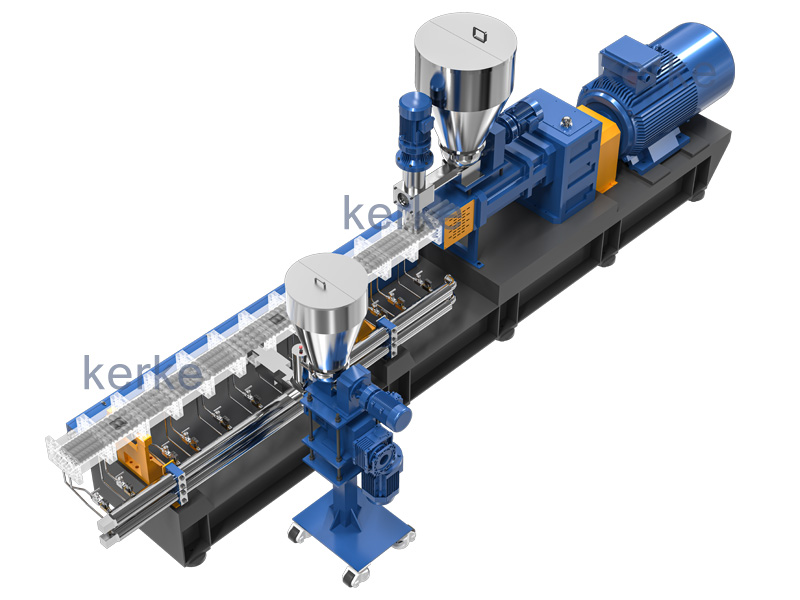
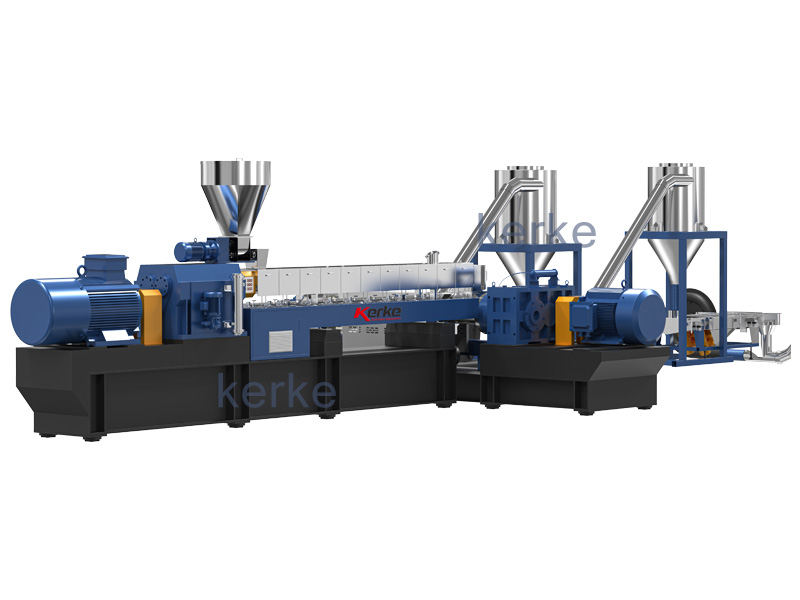
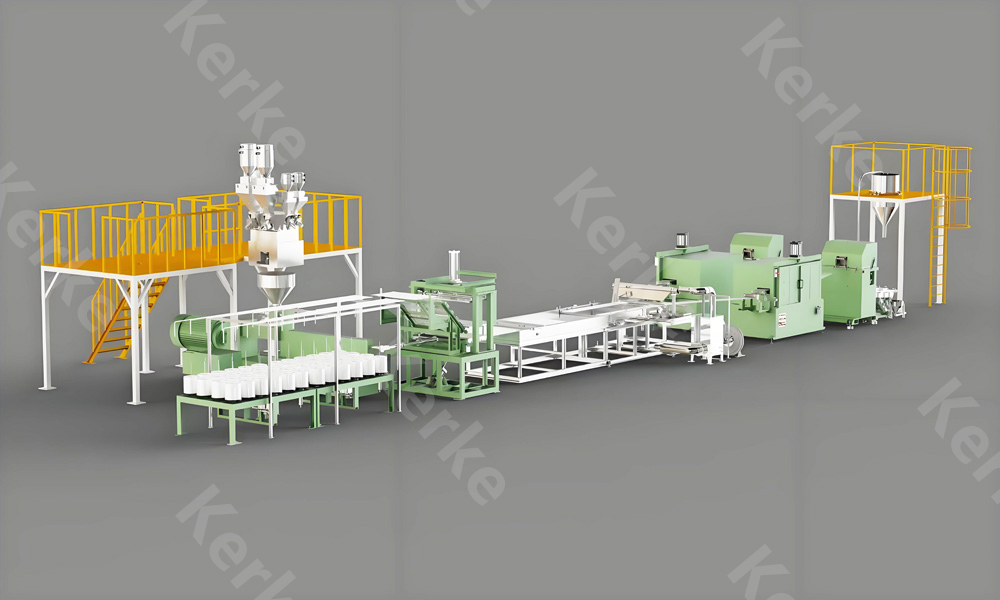
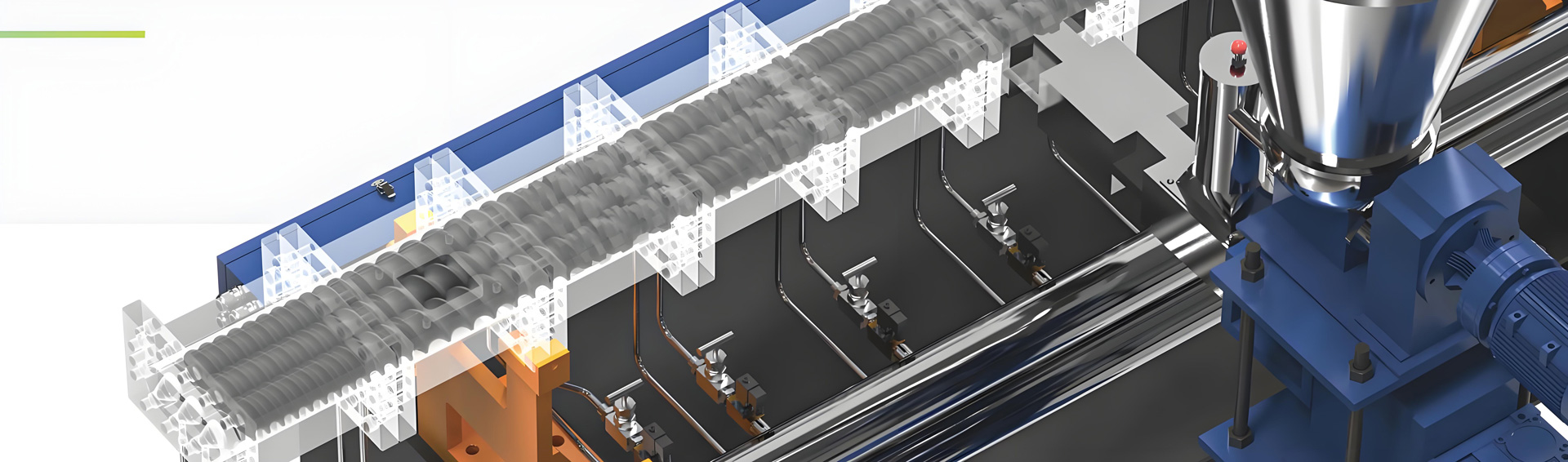
Achieving a uniform, agglomerate-free dispersion of zinc oxide is the central challenge of masterbatch production, and it is solved on a co-rotating parallel twin-screw extruder. Kerke, a Wanplas factory, designs KTE-series extruders from the KTE-16B laboratory model up to the KTE-135D production line, with output ranging from 30 kilograms per hour on the small end to several tons per hour at scale. The computer-aided screw assembly uses kneading blocks with excellent self-cleaning and good interchangeability, realizing transport, plasticization, shearing, dispersion, homogenization, exhaust, and pressure building in a single continuous line.
Screw Element Architecture
The screw is built from conveying elements, kneading blocks (co-rotating, offset at 30, 45, 60, or 90 degrees), and reverse elements. For zinc oxide, the dispersive zone uses中等 to high-angle kneading blocks placed where the melt is fully plasticized, generating the shear stress needed to break agglomerates. Too little shear leaves clumps; too much shear raises temperature and can over-work the carrier. A staged arrangement, typically two to three kneading zones separated by conveying sections, balances dispersion against thermal load.
| Process Zone | Screw Element Type | Function | Typical Setting |
|---|---|---|---|
| Feed | Deep-flight conveying | Receive carrier and filler | Side or loss-in-weight feeder |
| Plasticization | Conveying + mild kneading | Melt carrier resin | 160 to 210 degrees Celsius |
| Dispersion 1 | Kneading blocks 45 to 60 degrees | Break agglomerates | High shear, short residence |
| Homogenization | Conveying + 30-degree kneading | Distribute evenly | Medium shear |
| Venting | Reverse element + vacuum | Remove moisture and volatiles | Vacuum at barrel section |
| Metering | Conveying to die | Build pressure for pelletizing | Die face or strand cut |
Feeding Strategy and Dust Control
Zinc oxide is a fine, dusty powder, so feeding method matters for both hygiene and quality. A loss-in-weight feeder gives the most accurate dosing and is preferred for the main carrier and filler. A side feeder can introduce part of the zinc oxide downstream into already-melted resin, reducing the solids-conveying burden and improving dispersion of high loadings. A liquid feeder is useful when the zinc oxide is supplied as a paste or when a liquid coupling agent is added. Kerke offers volumetric metering, side feeders, crammer feeders, loss-in-weight feeders, and liquid feeders as part of its compounding systems, allowing the line to be configured to the exact powder behavior of the grade in use.
Pelletizing Options
For zinc oxide masterbatch, the pelletizing method is chosen by viscosity and cooling need. Water-cooled strand pelletizing and air-cooled strand pelletizing suit many polyolefin carriers. Air-cooled die-face hot cutting, water-ring die-face hot cutting, eccentric water-mist hot cutting, and underwater granulation are options for higher throughput and dust-free pellets. The Wanplas group’s shared engineering standards, including an annual free-parts allowance and on-site commissioning, help masterbatch producers keep lines running after installation.
Performance Parameters and Quality Control
Quality control for zinc oxide masterbatch focuses on the attributes that determine field performance: dispersion, particle size distribution, active content, thermal stability, and migration. A disciplined QC program protects both the converter and the end brand.
Dispersion and Particle Size
Dispersion is quantified by filtering a microtome section or a diluted melt through analysis, or by counting agglomerates larger than a threshold (commonly 10 or 25 micrometers) in a microtomed film. A well-compounded masterbatch shows few aggregates above 10 micrometers and a tight primary-particle distribution. Particle size is confirmed by laser diffraction on the raw powder and by image analysis on the compounded pellet or let-down film. Poor dispersion is the leading cause of weak spots, hazing, and inadequate antibacterial or UV performance.
Active Content and Uniformity
Active zinc oxide content is verified by thermogravimetric analysis, by acid dissolution with titration, or by X-ray fluorescence. Lot-to-lot uniformity matters more than the absolute number; a standard deviation under a few percent across a production campaign prevents inconsistent film properties. Processors should request a certificate of analysis covering active content, loss on ignition, and heavy-metal impurity profile.
Migration and Food-Contact Safety
Zinc is an essential trace element and zinc oxide is generally recognized as safe as a food-contact substance at controlled levels. Regulatory frameworks such as EU 10/2011, United States FDA food-contact provisions, and China GB 4806 set specific migration limits for zinc, with the European specific migration limit for zinc commonly cited around 5 milligrams per kilogram of food simulant for many applications. Overall migration is capped (commonly 10 milligrams per square decimeter). Nano-form particles attract extra scrutiny: although embedded zinc oxide does not freely migrate, risk assessments require confirmation that the particle size distribution and surface treatment keep migration within limits. Food-contact grades should therefore use controlled, often coated, particle sizes and be validated by migration testing in the actual article, not only in the masterbatch.
Application Industries and Use Cases
Zinc oxide filler masterbatch serves a wide range of industries because it addresses both protection and cost in one additive.
Agricultural and Greenhouse Film
Agricultural films benefit from UV blocking that extends service life under constant sunlight, while the antibacterial effect reduces algal and fungal growth on humid film surfaces. A 2 to 4 percent let-down of a 40 to 50 percent masterbatch is typical, paired with HALS and an antioxidant. The Wanplas factory network includes YuanSu, a Wanplas factory producing film and sheet extrusion lines, enabling integrated film-production solutions that pair Kerke masterbatch with downstream casting or blowing.
Food-Contact Packaging
In food films, containers, and closure liners, zinc oxide provides gentle antibacterial support and UV protection for light-sensitive contents. Loadings are kept low and the grade is selected for migration compliance. For recyclability, zinc oxide is inert in polyolefin recycling streams, so it does not compromise reclamation the way some organic additives can.
Outdoor Profiles and Construction
Window profiles, fencing, and decking use zinc oxide together with titanium dioxide for a combined UV shield. The filler also contributes stiffness. For PVC and wood-plastic composites, the masterbatch must be compatible with the rigid or foam structure and dosed to avoid plate-out on dies.
Hygiene, Fiber, and Consumer Goods
Nonwoven hygiene fabrics, storage bins, and children’s-environment products use antibacterial zinc oxide masterbatch to limit odor and microbial film. In toy-related applications, the same masterbatch must additionally meet the heavy-metal and phthalate rules discussed in our companion guide on masterbatch for plastic toys; zinc oxide itself is benign, but the carrier and any co-additives must be compliant.
Common Defects and Troubleshooting in ZnO Masterbatch Production
Even with a sound formula, zinc oxide masterbatch can show defects that trace back to dispersion, feeding, or thermal history. Recognizing them early prevents off-spec lots and customer complaints.
Black Specks and Gel Particles
Black or brown specks usually indicate local thermal degradation of the carrier or additive, often at a dead spot in the barrel or at an over-sheared kneading zone. Remedies include lowering screw speed, improving venting to remove degraded volatiles, auditing raw-material purity, and confirming the self-cleaning of kneading blocks. A regular purge and barrel inspection schedule, part of the Wanplas group’s commissioning guidance, limits this failure mode.
Uneven Dispersion and Streaking
Streaks in let-down film reveal incomplete breakdown of agglomerates. The fix is process-side: increase kneading-block intensity or add a second dispersive zone, raise melt temperature within the carrier’s limit, or switch to a better surface-treated zinc oxide. If the issue appears only at high loading, introduce part of the filler via a side feeder so the solids-conveying zone is not overloaded.
Plate-Out on Dies
Plate-out, a waxy deposit on extrusion dies, comes from low-molecular fractions of the carrier or excess dispersing aid blooming under heat. Reduce external lubricant, lower processing temperature, and verify that the zinc oxide is not over-treated with stearate. Die-face pelletizing lines are less sensitive than film dies, but the same chemistry applies.
Loss of Antibacterial or UV Performance
If a qualified masterbatch underperforms in the field, suspect let-down error, carrier mismatch causing poor distribution, or photo-degradation of the base polymer outpacing the zinc oxide screen. Re-check the dosing system calibration, confirm the carrier is compatible with the base resin, and add the HALS and antioxidant package rather than raising zinc oxide alone.
| Defect | Likely Root Cause | Corrective Action |
|---|---|---|
| Black specks | Local overheating, dead spot | Lower screw speed, improve venting, purge |
| Streaking | Poor dispersion of agglomerates | Increase kneading intensity, side feed |
| Plate-out | Excess lubricant, over-treatment | Reduce stearate, lower temperature |
| Weak protection | Let-down error, no HALS | Calibrate dosing, add stabilizer pack |
ZnO vs TiO2 vs Other Antibacterial and UV Additives
Choosing among mineral and active additives depends on whether the priority is antibacterial action, UV blocking, whiteness, or cost. The table below compares the most common options.
| Additive | Antibacterial | UV Protection | Opacity / Color | Relative Cost Tier |
|---|---|---|---|---|
| Zinc oxide | Strong, broad | Strong, UVA and UVB | White, can be translucent at nano size | Medium |
| Titanium dioxide (rutile) | Weak to none | Strong, mostly UVB and scatter | High opacity, bright white | Medium |
| Silver-based | Very strong, broad | None | Neutral to slight tint | Premium |
| Organic UV absorbers | None | Strong in band, weak in UVA | Transparent | Medium to High |
| Calcium carbonate filler | None | None (can accelerate at surface) | White, opaque | Low |
In practice, many formulators blend zinc oxide with titanium dioxide: zinc oxide covers UVA and antibacterial function, while titanium dioxide adds opacity and UVB scattering at lower total cost. The blend is compounded on the same twin-screw line, with the two minerals introduced via the main and side feeders to keep dispersion independent.
Selection Guide and Supplier Considerations
Selecting a zinc oxide filler masterbatch is less about finding the cheapest quote and more about matching function, carrier, and compliance to the article. Start by defining the target: is the priority UV life, antibacterial claim, filler economy, or food-contact safety? Then specify the base polymer so the carrier is matched. Next, set the final zinc oxide content from the performance data above, reverse-calculate the masterbatch loading and let-down, and confirm the pelletizing and feeding method with your compounder.
What to Ask a Masterbatch Supplier
- Which carrier resin is used, and is it compatible with my base polymer?
- What is the zinc oxide particle size distribution and is it surface treated, and with what agent?
- What is the active content and the lot-to-lot uniformity (standard deviation)?
- Does the grade meet EU 10/2011, FDA, or GB 4806 for food contact, or EN 71-3 for toy applications?
- What dispersive shear was applied during compounding, and can a dispersion report be supplied?
- What is the recommended let-down ratio and any stabilizer co-additives needed?
Producer Equipment Considerations
For masterbatch producers, the compounding line defines the ceiling on quality. A co-rotating parallel twin-screw extruder with a length-to-diameter ratio of 40 to 52, high-torque gearbox, and configurable kneading-block arrangement is the industry standard for nano and sub-micron zinc oxide. Kerke, a Wanplas factory with 12 or more years in twin-screw compounding and more than 2000 machines running in over 70 countries, supplies KTE-series lines engineered for this duty, including side and loss-in-weight feeding for accurate, dust-controlled dosing. The broader Wanplas group, whose mission is to warm global customers with China plastic machinery, supports installation, training, and after-sales across its specialized factories.
Frequently Asked Questions
What is the difference between zinc oxide filler masterbatch and titanium dioxide masterbatch?
Zinc oxide provides combined antibacterial activity and broad-spectrum UV absorption, while titanium dioxide is primarily a white opacifier and UV screener with weak or formulation-dependent antimicrobial effect. Zinc oxide is also a more effective UVA absorber and is generally recognized as safe for food contact at controlled loadings.
Can nano zinc oxide migrate out of plastic products?
Engineered zinc oxide particles are embedded within the polymer matrix and encapsulated by the carrier resin during compounding, so bulk migration is minimal. Surface migration is controlled by particle size, coating, and total loading, and food-contact grades must be validated against specific migration limits for zinc under EU 10/2011 and equivalent regulations.
Which twin-screw extruder is best for ZnO masterbatch?
A co-rotating parallel twin-screw extruder with a high length-to-diameter ratio, such as the KTE series from Kerke, a Wanplas factory, offers the high shear and staged kneading-block arrangement needed for nano and sub-micron dispersion. Side feeders and liquid feeders help manage dust and heat-sensitive additives.
How much zinc oxide masterbatch should I add to my film?
For UV protection in polyethylene film, a 40 percent masterbatch at a 3 to 5 percent let-down delivers roughly 1.2 to 2 percent final zinc oxide, which is sufficient for most agricultural and packaging films when paired with a HALS package. Antibacterial uses may require 4 to 6 percent let-down of a 50 percent grade depending on the target organism.
Does zinc oxide make the plastic yellow or opaque?
Micronized zinc oxide adds whiteness and opacity similar to other white fillers. Nano and surface-treated grades can be incorporated at low loading with only slight haze, preserving clarity in films where transparency matters. The visual effect is therefore tunable through particle size and loading.
Is zinc oxide masterbatch compatible with recycled resin?
Yes. Zinc oxide is inert in polyolefin recycling and does not interfere with re-extrusion the way some volatile organic additives can. When using post-consumer flake, however, verify the base resin’s melt stability and consider a mild stabilizer top-up, because recycled streams often carry residual degradation.
What stabilizer package should accompany ZnO masterbatch outdoors?
Use a hindered-amine light stabilizer together with a primary and secondary antioxidant. The HALS quenches radicals generated by UV, while antioxidants protect against thermal oxidative degradation during processing and service. Zinc oxide handles the UV screening; HALS and antioxidants handle the radical cascade.
How do I verify dispersion quality before a production run?
Microtome a thin section of a let-down film or plaque, image it under a microscope, and count agglomerates larger than 10 micrometers. Alternatively, run a filter test on a diluted melt. A low agglomerate count and tight particle distribution confirm that the compounding shear was adequate.
Conclusion
Zinc oxide filler masterbatch is a rare additive that earns its place three times over: it blocks ultraviolet light across the UVA and UVB bands, it suppresses bacterial and fungal growth through ion release and photocatalysis, and it serves as an economical mineral filler. Success depends on formulation discipline, carrier matching, surface treatment, and above all dispersion quality achieved on a high-shear co-rotating twin-screw extruder. For food contact and toy uses, the zinc oxide itself is benign, but the full formulation must clear migration, heavy-metal, and phthalate rules. Kerke, a Wanplas factory, provides the KTE-series twin-screw compounding lines that masterbatch producers rely on for consistent nano and sub-micron dispersion, backed by the Wanplas group’s shared engineering standards and global support. If you are specifying or producing a zinc oxide masterbatch, start from the target function, set the final loading from the tables above, and validate dispersion and compliance before scale-up.