I. Introduction: High Filler Masterbatch for Mid-to-High Volume Plastics Processing
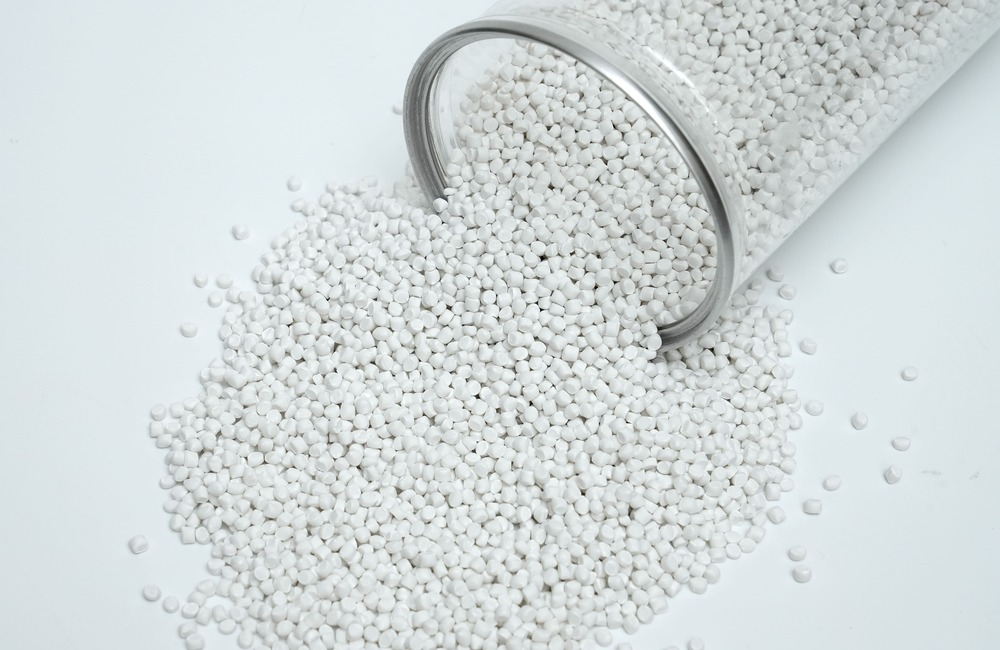
High filler masterbatch (HFM) – a cost-critical compound dominated by 70-85% inorganic mineral fillers (most commonly calcium carbonate, CaCO₃) paired with a PP or PE polymer carrier – is a foundational material for the global mid-range plastics industry. Its primary functions are to reduce raw material costs by replacing virgin resin with low-cost mineral fillers and to enhance end-product properties such as stiffness, UV resistance, and printability. The most prevalent downstream applications for HFM are blown film for PE shopping bags and PP woven bags, as well as injection molding for disposable plastic housings, cutlery, and packaging components. For these end-uses, masterbatch consistency – including uniform dispersion, stable moisture content, and free-flowing pellet form – is non-negotiable to avoid production downtime or product defects in downstream processing.
For HFM manufacturers and procurement managers, the choice of pelletizing system directly dictates production stability, output efficiency, and end-product compatibility. Strand pelletizing, the conventional method for general-purpose compounding, is technically capable of producing high filler masterbatch, but it presents inherent operational limitations that hinder consistent, large-volume production. These limitations stem from the unique rheological properties of HFM formulations – specifically their low melt strength and high abrasiveness – which exploit the core design of the strand pelletizing process. To mitigate these risks and optimize production for the strict quality requirements of bag-making and other downstream applications, water ring pelletizing is the preferred, purpose-built solution.
This article provides a neutral, data-driven technical comparison of the two pelletizing methods, with a focus on how their operational characteristics translate to end-product performance in blown film and injection molding applications. It also offers actionable equipment recommendations to streamline HFM production and meet the quality demands of the global plastics market.
II. Strand Pelletizing for High Filler Masterbatch: Capability vs. Operational Limitations
Strand pelletizing is a long-established, mechanically simple process widely used for low-volume or general-purpose masterbatch production. Its accessibility and low upfront capital investment make it a common initial choice for HFM producers – and crucially, it can technically produce high filler masterbatch. However, the unique material properties of HFM formulations create persistent, costly operational challenges that make the method poorly suited for large-scale, consistent production.
2.1 The Strand Pelletizing Process for HFM
To understand its limitations, it is first necessary to outline the strand pelletizing process as applied to HFM production:
- The molten, homogenized polymer-filler mixture is extruded through a linear row of circular die holes to form thin, continuous spaghetti-like strands.
- These strands are pulled manually or mechanically through a 3-6 meter long cooling water bath to solidify the molten material.
- Once solidified, the strands pass through an air knife system to remove residual surface moisture, then are fed into a rotating cutter that chops them into short, cylindrical pellets.
This process relies on one core, non-negotiable requirement: the extruded strands must remain continuous, with uniform tension and speed, from the die head all the way through the cooling bath and into the cutter. For HFM formulations, this requirement is difficult to sustain over long production runs.
2.2 Core Operational Challenge: Frequent Strand Breakage
The defining limitation of strand pelletizing for HFM production is persistent strand breakage, a problem directly caused by the unique rheological properties of high-fill formulations – and one that triggers a cascade of secondary production issues. Unlike general-purpose masterbatch, which has a high, elastic melt strength, HFM formulations have significantly reduced melt strength: the high concentration of inorganic filler severely disrupts the polymer chains’ molecular cohesion, making the molten strands brittle, inflexible, and prone to snapping under their own weight or minor fluctuations in process tension.
This fundamental material incompatibility is exacerbated by the strand pelletizing system’s design, which creates additional stress points for the molten strands:
- Long, Unsupported Cooling Path: The 3-6 meter long water bath requires the strands to be pulled continuously through the water at a consistent speed. Even a minor variation in the traction drive speed or water flow rate can create uneven tension, stretching the thin, low-melt-strength strands until they snap.
- Die Face Temperature Inconsistencies: Strand pelletizing dies use a linear row of die holes, which are prone to 5-10°C temperature variations across the die face. This imbalance causes the molten material to extrude from different die holes at varying speeds – a phenomenon known as “strand racing” – which creates inconsistent tension between adjacent strands and significantly increases breakage risk.
- Abrasion-Driven Die Degradation: The high filler content in HFM formulations is highly abrasive, wearing the die holes into uneven, out-of-round shapes over time. This wear causes the extruded strands to have inconsistent diameters, creating weak points that snap easily under the tension required for pull-through.
Strand breakage is not a minor nuisance; it is a critical bottleneck that directly reduces production efficiency. When a strand breaks, the entire downstream process must be halted to clear the broken strand from the cooling bath and re-thread the remaining strands into the cutter. For most HFM production lines, this type of micro-stop occurs 3-6 times per hour, with each stop taking 2-5 minutes to resolve. Collectively, this unplanned downtime reduces the line’s actual throughput by 15-25% compared to its rated maximum capacity – a significant loss for manufacturers operating on thin commodity-grade margins.
2.3 Secondary Risks: Wear and Labor Inefficiency
The abrasive nature of HFM formulations, paired with the strand system’s open, exposed design, creates additional long-term operational inefficiencies:
- Accelerated Component Wear: The filler particles act as a grinding compound, wearing the die holes, cooling bath guide rollers, and cutter blades at 2-3 times the rate seen in general-purpose masterbatch production. This requires more frequent scheduled maintenance to replace worn parts.
- High Labor Requirements: Strand pelletizing demands constant, active supervision from a skilled line operator. The operator must continuously adjust the tension guides, monitor strand alignment, and immediately resolve any breakage or jamming issue – a requirement that does not diminish over time. For a medium-scale production line, this adds incremental direct labor costs.
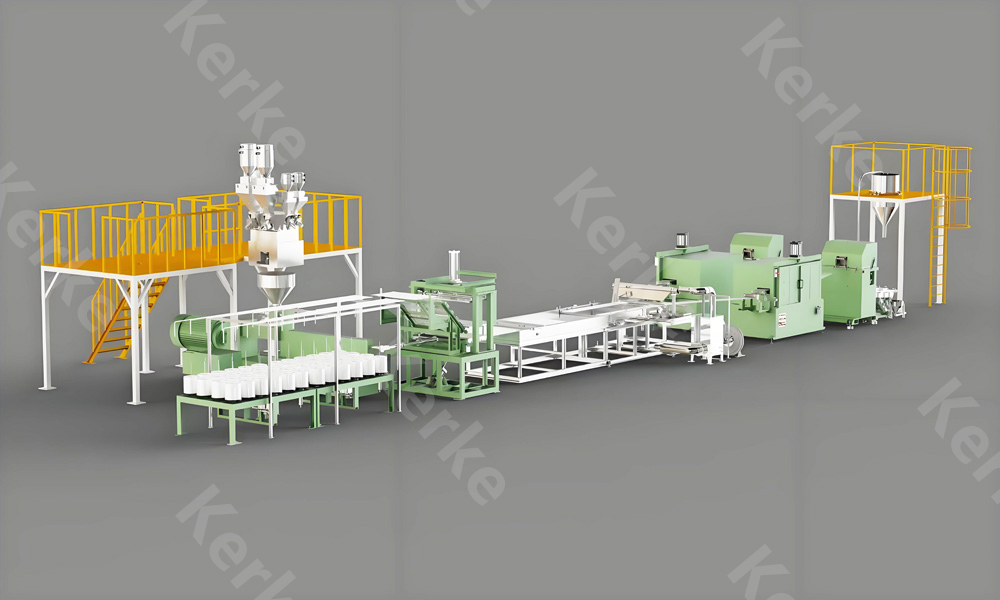
III. Recommended Production System: Twin-Screw Extruder + Water Ring Pelletizing Line
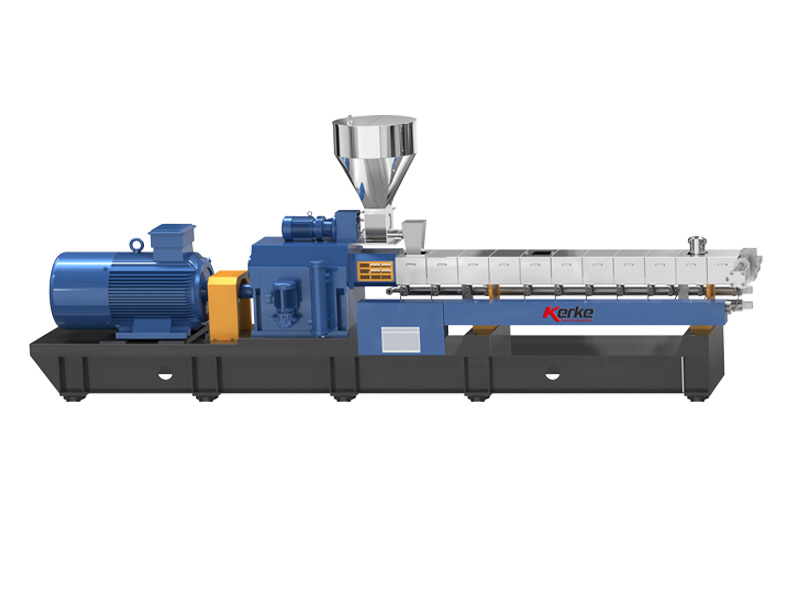
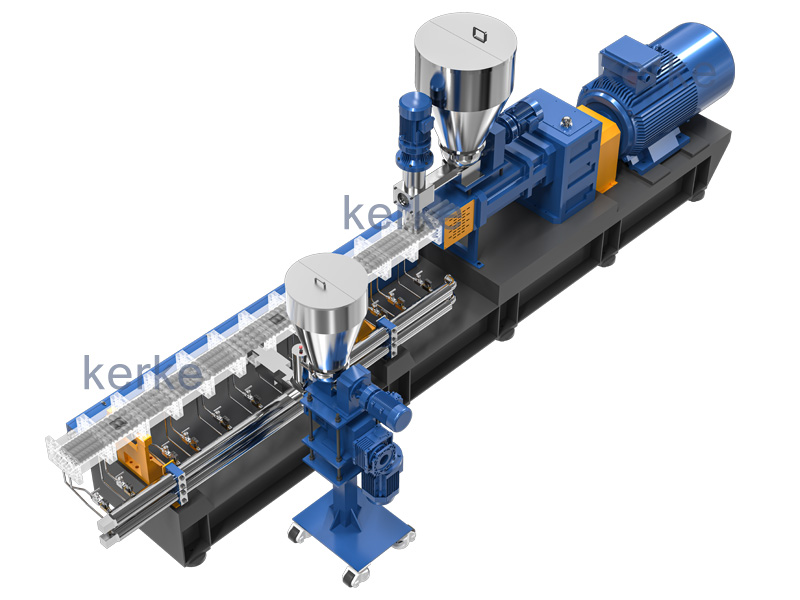
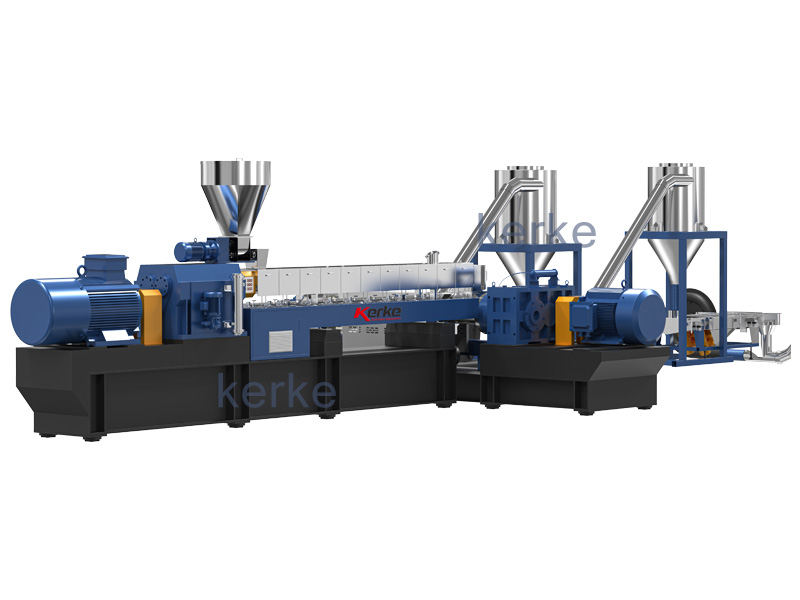
For HFM producers targeting the blown film and injection molding markets, the optimal production setup pairs a high-torque, abrasion-resistant co-rotating twin-screw extruder with a precision-engineered water ring pelletizing system. This combination is purpose-built to handle the unique rheological and abrasive properties of high-fill formulations, while delivering the consistent melt flow required for stable pelletizing.
3.1 Equipment Supplier Profile
Nanjing Kerke Extrusion Equipment Co., Ltd. (partner factory of Wanplas Group) is a leading global manufacturer of high-performance extrusion and pelletizing equipment, with 20+ years of experience designing turnkey production lines optimized for high filler masterbatch formulations. Our lines are specifically engineered to address the core operational challenges of HFM production – from low melt strength to high abrasion resistance – and are calibrated to deliver the consistent pellet quality required for blown film and injection molding applications.
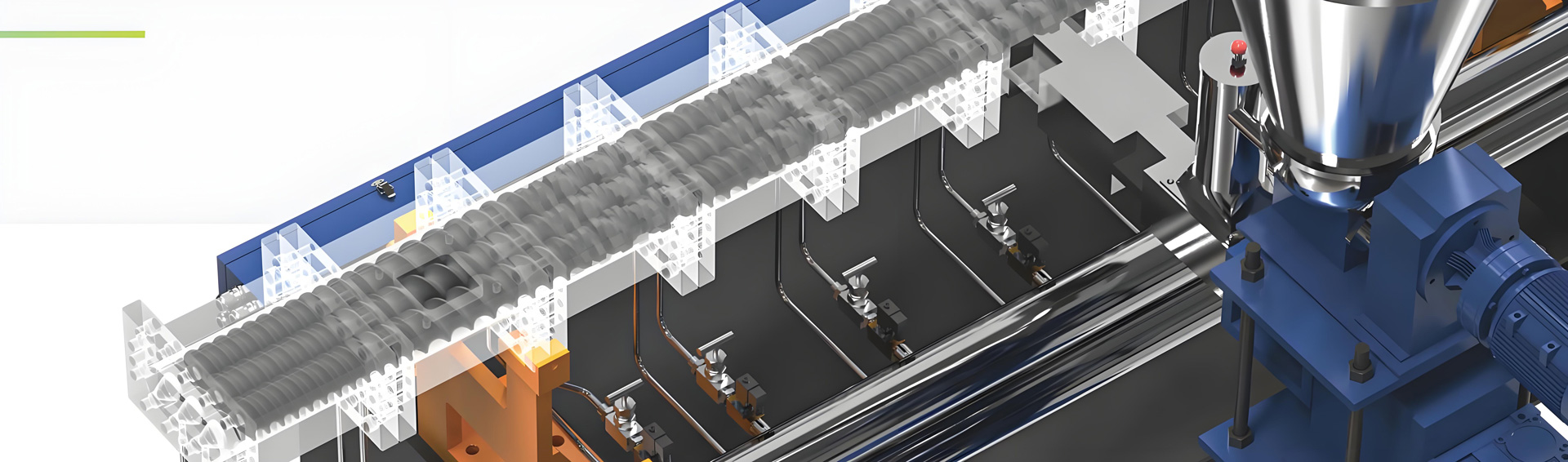
3.2 Recommended Extruder Model: KTE Series Co-Rotating Parallel Twin-Screw Extruders
The extruder is the core of any HFM production line, and its design directly determines the stability and efficiency of the entire pelletizing process. Kerke’s KTE series extruders are purpose-built for the high viscosity, high abrasion, and precise process control requirements of HFM formulations, with a range of models to match any mid-to-large scale production throughput requirement.
The KTE series includes three main configurations tailored to different production scales:
- A small-batch or R&D model with a 35.6mm screw diameter, delivering a consistent throughput of 20-150 kg/h (revised upper limit to support small-scale commercial or trial production).
- A mid-range, high-volume model with a 50mm screw diameter, optimized for 150-300 kg/h output – the most common specification for HFM suppliers serving bag-making and injection molding clients.
- A large-scale industrial model with a 75mm screw diameter, capable of maintaining a steady throughput of 600-1200 kg/h for continuous, high-volume production runs.
Key Features of KTE Series Extruders (With Enhanced Focus on 75mm Model for Large-Scale Production)
All KTE series extruders are engineered with core features critical for HFM production, with the 75mm industrial model incorporating additional upgrades to support long-run, high-volume manufacturing:
- High-Torque Drive System: The 75mm model is equipped with a 132-160kW AC vector drive motor and reinforced gearbox, providing sufficient power reserves to process high-fill (up to 85% CaCO₃) formulations at maximum throughput without screw slippage or overloading.
- Modular Screw & Barrel Design: All models use a building-block screw configuration optimized for distributive mixing, ensuring uniform filler dispersion without excessive shear that could degrade the polymer matrix. The 75mm model features a 12-section barrel with 8 independent closed-loop temperature control zones (accuracy ±1°C), maintaining consistent melt viscosity even during 24/7 continuous operation.
- Precision Feeding Control: Gravimetric loss-in-weight feeders are standard, delivering real-time feed rate adjustments to maintain formulation precision within ±0.5% of target values. The 75mm model includes a synchronized side-feeding system that introduces filler post-melting, improving polymer wetting and reducing abrasion to the feed zone.
- Abrasion Resistance Upgrade: Screw elements and barrel liners for all HFM-optimized models are manufactured from high-speed tool steel with a laser-melted tungsten carbide coating (hardness HRC 62-65). For the 75mm model, the coating thickness is increased to 3mm, extending wear part service life to 2-3 times longer than standard configurations.
- Advanced Devolatilization: A high-flow vacuum degassing system is integrated into the 75mm model’s barrel, removing volatile moisture and small-molecule impurities from the polymer melt, which stabilizes final pellet moisture content and reduces downstream defect risks.
3.3 Recommended Water Ring Pelletizing System
Kerke’s KTE series extruders are fully compatible with our precision-engineered water ring pelletizing systems, which are purpose-built to pair seamlessly with the extruder’s melt delivery characteristics. This integrated system is calibrated to maintain perfect synchronization between extruder output, cutter blade speed, and water flow rate – the critical foundation for consistent, defect-free pelletizing.
Key features of the water ring pelletizing system include:
- Hardened, Abrasion-Resistant Die Face and Cutting Blades: Machined from high-hardness tool steel to withstand the constant abrasion of high-fill formulations, maintaining precise dimensional accuracy over long production runs. The die face features a radial array of streamlined holes, ensuring uniform melt flow and consistent extrudate velocity across the entire die surface.
- Closed-Loop Water Temperature Control System: Maintains the pelletizing water at a constant 15-25°C, ensuring consistent, uniform cooling of the pellets to prevent deformation or sticking. The water circulation system includes a self-cleaning filter to remove fine filler particles, reducing maintenance requirements during continuous operation.
- High-Efficiency Centrifugal Dryer: Removes surface moisture from the pellets to achieve a consistent moisture content of 20-50 ppm – the tight range required for stable blown film and injection molding processing. The dryer’s internal impeller speed is synchronized with pellet output to ensure uniform drying across all throughput rates.
- Vibratory Screener: Classifies the final pellets to remove fines, agglomerated material, or irregularly shaped particles, ensuring the product meets exact size and quality specifications. The screener is equipped with interchangeable mesh screens to match customer pellet size requirements.
IV. Water Ring Pelletizing: Optimized for High Filler Masterbatch Production
Water ring pelletizing is a semi-automated, purpose-built process that eliminates the core design limitations of strand pelletizing – specifically the reliance on long, continuous, tension-bearing strands. It is the proven preferred solution for HFM production, as it is engineered to accommodate the low melt strength and high abrasiveness of high-fill formulations, while delivering consistent, repeatable performance for large-volume runs.
4.1 How Water Ring Pelletizing Resolves Strand Breakage
The key design difference between water ring and strand pelletizing is the timing and location of the cutting action. In a water ring pelletizing system, the molten material is cut immediately at the die face, while the strand pelletizing system requires the material to travel a long distance before cutting. This fundamental design change eliminates the root cause of strand breakage:
- The molten polymer-filler mixture is extruded through a radial, compact array of die holes – not the linear row used in strand pelletizing equipment. This design ensures uniform melt flow and consistent temperature across the entire die face, eliminating strand racing.
- Cutting occurs directly at the die face using rotating, precision-engineered blades. The newly cut pellets are instantly quenched and conveyed by a high-speed, continuous water ring that flows around the cutter head. This immediate, uniform cooling prevents deformation or sticking, while completely eliminating the need for the long, tension-dependent cooling water bath required by strand pelletizing.
- The water and pellets are then separated in a centrifugal dryer, which removes surface moisture, before the pellets are passed through a vibrating screener to remove any fines or irregular particles.
By removing the long, unsupported strand path and continuous tension requirement, water ring pelletizing eliminates strand breakage entirely. This translates to a 95% reduction in unplanned downtime related to strand handling, and increases actual production throughput by 20-30% compared to a similarly sized strand pelletizing line.
4.2 Critical Technical Clarification: Pellet Shape, Moisture Content, and End-Product Performance
A common concern among HFM producers considering a switch from strand to water ring pelletizing is how the change in pellet production will affect end-product quality – particularly for blown film and injection molding applications. Technical data and real-world production results confirm that the impact on end-use performance is negligible, with no change in the base material properties of the masterbatch:
- Pellet Shape: Strand pelletizing produces uniform, straight cylindrical pellets, while water ring pelletizing produces short, cylindrical or lens-shaped pellets. This difference in shape has no measurable impact on downstream processing or end-product quality. Both pellet types exhibit identical free-flowing characteristics, melt uniformly in extrusion or injection molding barrels, and disperse the filler evenly in the final polymer melt.
- Moisture Control: Neither process eliminates moisture entirely, but water ring pelletizing offers a consistent, minor improvement in moisture content control – a key benefit for blown film and injection molding applications. Strand pelletizing relies on an air knife to remove surface moisture, which can leave residual moisture in the range of 50-200 ppm, with significant fluctuation depending on ambient humidity and line speed. Water ring pelletizing uses a high-efficiency centrifugal dryer paired with a vibrating screener, which consistently reduces surface moisture to 20-50 ppm – a tight, stable range that prevents bubble instability in blown film, or surface defects in injection molded parts.
- Material Property Consistency: Multiple independent material tests confirm that the base material properties of HFM – including melt flow index, filler dispersion quality, and mechanical performance – are identical regardless of whether it is produced via strand or water ring pelletizing. The only meaningful differences are in production efficiency and moisture content stability – both of which favor water ring pelletizing for large-volume HFM production.
V. Real-World Production Validation: Client Case Study
One of our long-term HFM manufacturing clients, which supplies masterbatch to regional PE shopping bag and PP woven bag producers, provides a clear example of the performance benefits of switching from strand to water ring pelletizing. The company had been using a strand pelletizing line to produce a CaCO₃-filled PP masterbatch (80% filler by weight), but was struggling to meet the growing quality and delivery demands of its bag-making customers.
The client’s existing strand pelletizing line presented persistent, costly operational issues:
- Frequent Strand Breakage: The line experienced 4-5 breakage events per hour, reducing actual production throughput by 22% compared to its rated capacity.
- Labor Inefficiency: The line required constant supervision from a dedicated skilled operator, with frequent manual interventions to resolve strand misalignment or breakage.
- Moisture Content Instability: The strand system’s air knife dryer left residual moisture in the range of 60-180 ppm, causing occasional bubble breaks in the customer’s blown film production and leading to 3-5% scrap rates in downstream bag manufacturing.
After consulting with our engineering team, the client replaced its strand pelletizing line with a customized KTE 75 twin-screw extruder paired with our water ring pelletizing system – a turnkey solution calibrated to match the company’s high-fill formulation and throughput requirements.
The new line delivered immediate, quantifiable improvements that resolved all of the client’s existing production issues:
- Eliminated Strand Breakage: The strand-free pelletizing design removed the root cause of breakage, increasing the line’s actual throughput by 25% – from 960 kg per hour to the full 1200 kg per hour maximum rated capacity.
- Reduced Labor Requirements: The water ring system’s high level of automation eliminated the need for a dedicated line operator to monitor strand tension. A single operator was able to manage the entire production line, reducing direct labor costs by 50%.
- Stabilized Moisture Content: The centrifugal dryer consistently reduced pellet moisture content to 20-40 ppm, eliminating the moisture-related bubble break issues in downstream blown film production and reducing the client’s scrap rate to under 1%.
- Consistent Product Quality: The pelletizing system’s precise process control ensured uniform pellet size and filler dispersion, resulting in masterbatch that consistently met the quality specifications of the client’s bag-making customers.
Crucially, laboratory testing confirmed that the base material properties of the masterbatch – including melt flow index, filler dispersion, and mechanical performance – were unchanged after switching pelletizing systems. The only meaningful improvements were in production efficiency and moisture content stability – both of which directly enhanced the client’s competitiveness and customer satisfaction.
VI. Conclusion: Balancing Production Capability, Efficiency, and End-Application Quality
Strand pelletizing is a technically viable option for small-scale or low-volume HFM production, but its inherent design limitations make it a poor choice for manufacturers targeting the mid-to-high volume blown film and injection molding markets – particularly those supplying PP and PE bag producers. The low melt strength of high-fill formulations, paired with the strand system’s reliance on continuous, tension-bearing strands, leads to frequent breakage, unplanned downtime, high labor costs, and inconsistent moisture content – all of which erode profitability and increase the risk of downstream quality issues.
Water ring pelletizing is the optimal solution for HFM production, as it is purpose-built to address these core limitations. By cutting the molten material immediately at the die face and eliminating the long, unsupported strand path, it completely removes the risk of strand breakage, significantly boosts production efficiency, and delivers far more consistent moisture content – all without altering the base material properties of the masterbatch.
For HFM manufacturers and procurement managers seeking to upgrade their production lines, Nanjing Kerke Extrusion Equipment Co., Ltd. offers a fully integrated, turnkey solution tailored to the unique demands of high-fill formulations. Our KTE series twin-screw extruders, paired with precision-engineered water ring pelletizing systems, deliver the consistent melt flow, abrasion resistance, and process control required to meet the strict quality demands of blown film and injection molding end-users – while simultaneously reducing operating costs and unlocking higher production throughput.
+86 15950512730 (Click here to contact us directly)