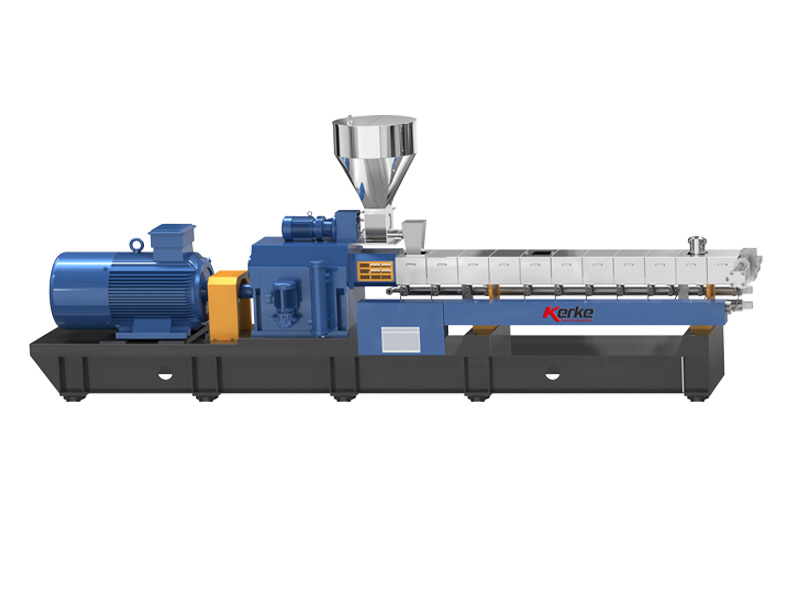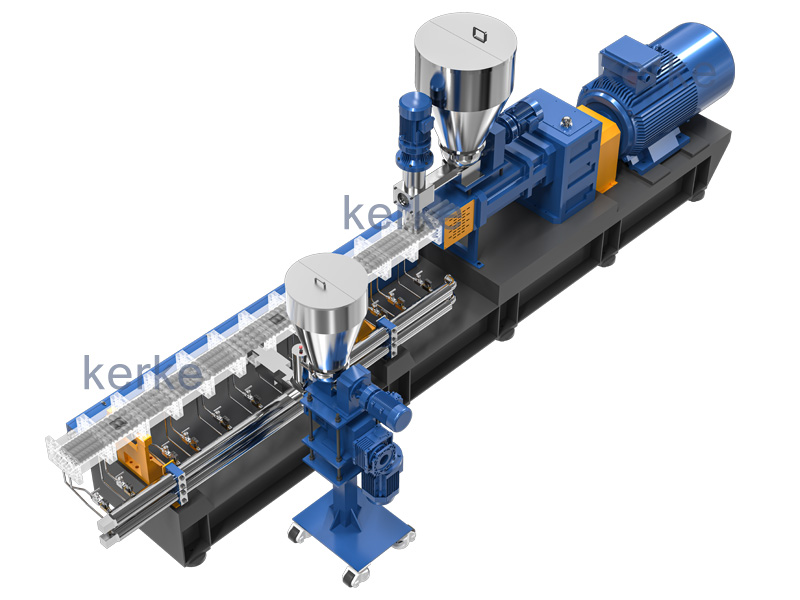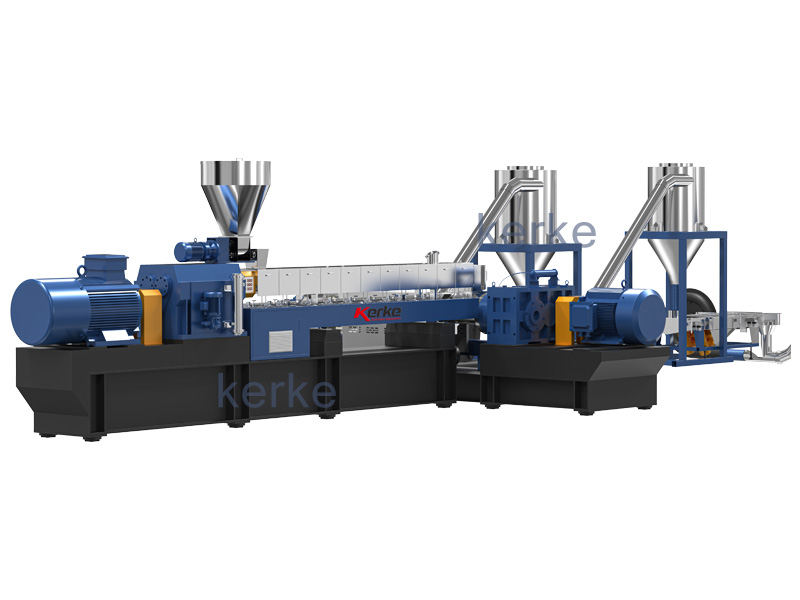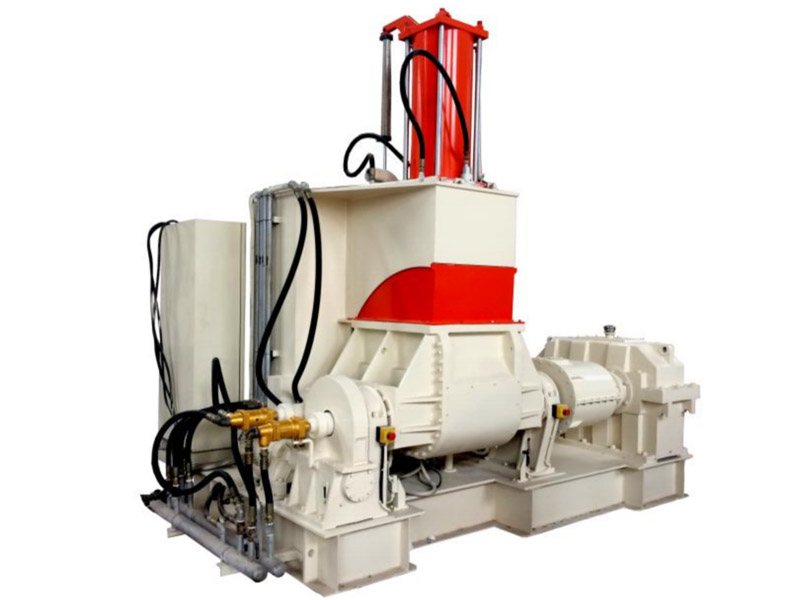
The global compounding extruders market is projected to reach $14.38 billion in 2026, growing at a compound annual growth rate (CAGR) of 7.15% through 2032. This growth is driven by increasing demand for high-performance engineered plastics, masterbatches, and recycled plastic compounds across automotive, packaging, construction, and electronics industries. As production volumes rise and quality requirements become stricter, the integration between compounding extruders and downstream pelletizing and cooling systems has become a critical factor in achieving maximum operational efficiency and product consistency.
Traditionally, compounding lines were assembled from separate components purchased from different suppliers. This approach often resulted in compatibility issues, inefficient process synchronization, high maintenance costs, and inconsistent product quality. Today, more than 62% of new polymer extrusion lines are delivered as fully integrated systems, improving output consistency by 35% and overall equipment effectiveness (OEE) by up to 30%. Integrated lines eliminate the hidden costs of system integration, which typically add 15-25% to the total project cost when sourcing components separately.
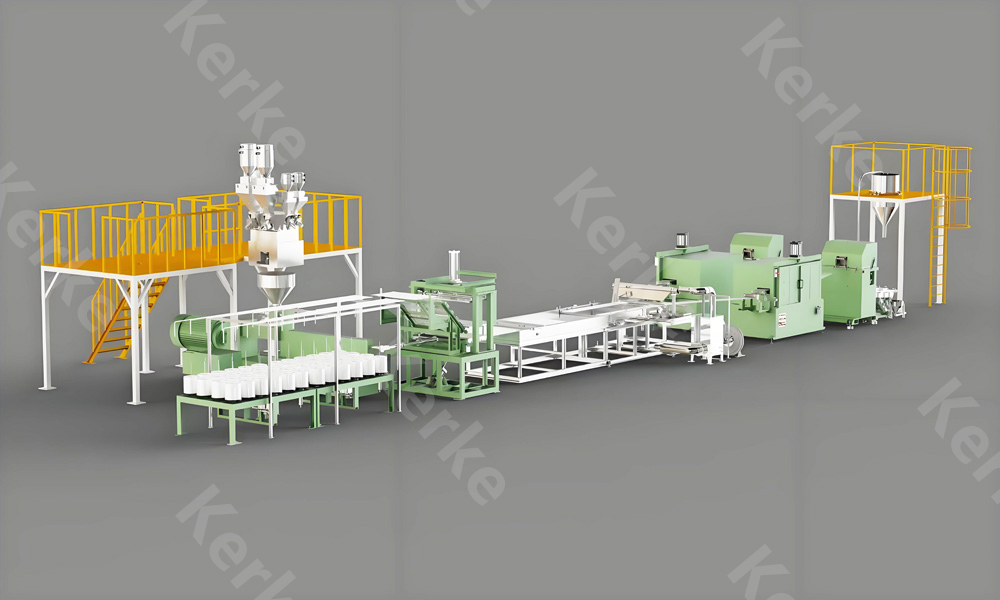
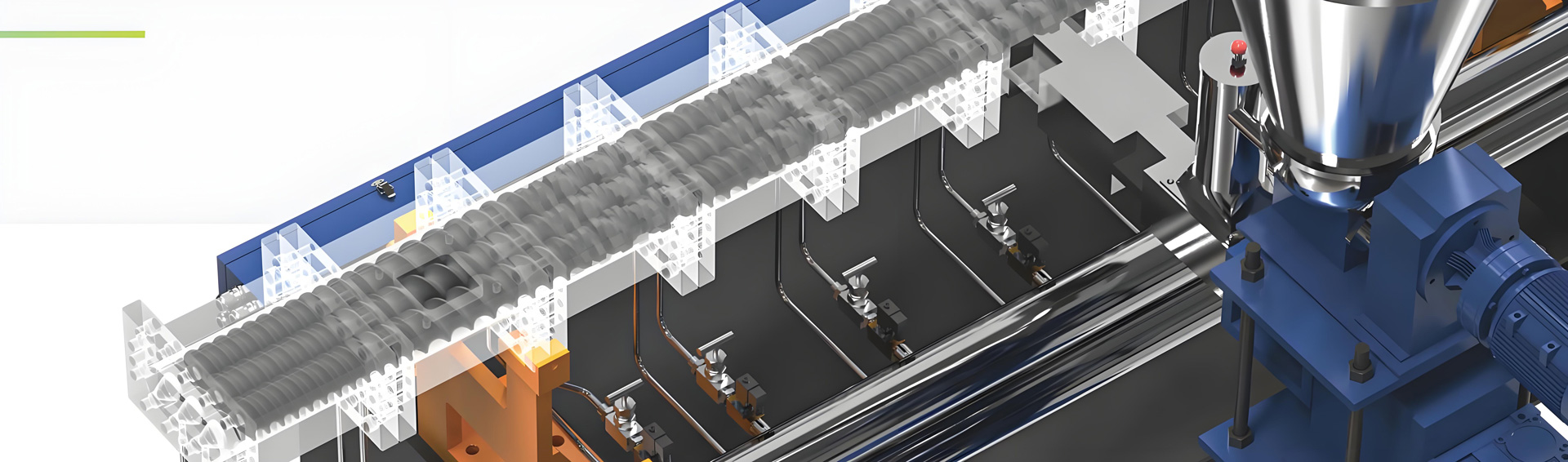
As a leading global manufacturer of twin screw extruders with over 18 years of experience, Kerke has developed industry-leading integrated compounding solutions that seamlessly combine compounding extruders with pelletizing and cooling systems. Kerke compounding extruders, twin screw extruders, and masterbatch extruders are engineered to work in perfect harmony with our proprietary pelletizing and cooling technologies, delivering superior product quality, maximum production efficiency, and minimum operating costs. With over 3,000 machines installed in more than 70 countries, Kerke has established a reputation for delivering reliable, high-performance turnkey extrusion solutions.
This comprehensive guide explains how modern compounding extruders integrate with pelletizing and cooling systems to create optimized production lines. It examines the key advantages of integrated systems over separate components, details the three main pelletizing technologies and their integration requirements, provides application-specific solutions for different industries, and includes a complete cost analysis and real-world case studies. Whether you are setting up a new compounding facility or upgrading an existing line, this guide will help you understand how investing in a Kerke integrated compounding system can significantly improve your operational efficiency and profitability.
1. The Critical Importance of System Integration in Compounding Lines
The compounding process involves melting, mixing, and dispersing polymers with additives, fillers, and reinforcements to create customized plastic compounds. After compounding, the molten polymer must be cooled and cut into uniform pellets for storage and further processing. The efficiency and quality of this final stage directly impact the value of the final product.
1.1 Limitations of Non-Integrated Systems
Many older compounding lines consist of separate components from different manufacturers, which creates numerous operational challenges:
- Poor process synchronization: Mismatched speeds between the extruder and pelletizer can cause strand breakage, inconsistent pellet size, and production downtime.
- Compatibility issues: Different control systems and communication protocols make it difficult to coordinate operations and troubleshoot problems.
- Higher maintenance costs: Maintaining equipment from multiple suppliers requires separate service contracts, spare parts inventories, and technician training.
- Inconsistent product quality: Variations in cooling rates and cutting precision can lead to pellet size variations, dust generation, and material degradation.
- Longer changeover times: Switching between different materials and formulations requires adjusting multiple independent systems, increasing downtime.
- Single point of failure: A problem in one component can shut down the entire line, and resolving issues often requires coordinating with multiple suppliers.
These limitations can reduce overall equipment effectiveness by 20-30% and increase production costs by 15-25% compared to fully integrated systems.
1.2 Key Advantages of Integrated Compounding Systems
Fully integrated compounding systems address these limitations by designing all components to work together as a single unified system:
- Optimized process synchronization: All components are controlled by a single control system, ensuring perfect speed matching and process coordination.
- Superior product consistency: Uniform cooling and precise cutting produce pellets with consistent size, shape, and properties.
- Higher production efficiency: Integrated systems achieve OEE rates of 90% or higher, compared to 60-75% for non-integrated lines.
- Lower operating costs: Reduced downtime, lower energy consumption, and fewer maintenance requirements result in significant cost savings.
- Faster changeover times: Single-point recipe management allows for quick material and formulation changes.
- Simplified maintenance: A single supplier provides support for the entire line, reducing administrative burden and service response times.
- Better process control: Real-time monitoring of all process parameters allows for immediate adjustments and improved quality control.
For high-volume production facilities, these advantages translate into millions of dollars in annual savings and a significant competitive advantage in the market.
1.3 Market Trends Driving Integration
Several key market trends are accelerating the adoption of integrated compounding systems:
- Increasing quality requirements: Downstream customers are demanding more consistent pellet quality with tighter tolerances for size, shape, and composition.
- Rising energy costs: Energy-efficient integrated systems can reduce energy consumption by 15-25% compared to non-integrated lines.
- Labor shortages: Automated integrated systems require fewer operators, addressing the growing labor shortage in manufacturing.
- Sustainability goals: Integrated systems produce less waste and consume less energy, helping manufacturers meet their sustainability targets.
- Digital transformation: Integrated systems provide comprehensive data collection and analysis capabilities, enabling predictive maintenance and process optimization.
These trends are expected to drive the market for integrated compounding systems to grow at a CAGR of 8.3% through 2032, faster than the overall compounding extruders market.
2. Major Pelletizing and Cooling Technologies and Their Integration
There are three main pelletizing technologies used in compounding applications: strand pelletizing, water ring pelletizing, and underwater pelletizing. Each technology has its own advantages, limitations, and integration requirements, making them suitable for different materials and production volumes.
2.1 Strand Pelletizing System
Strand pelletizing is the oldest and most widely used pelletizing technology, employed in approximately 62% of global polymer extrusion lines. In this process, the molten polymer is extruded through a die to form continuous strands, which are then cooled in a water bath, dried, and cut into uniform pellets by a rotating cutter.
Key components of a strand pelletizing system include:
- Strand die: Produces multiple parallel strands of molten polymer
- Water cooling bath: Cools the strands to solidify them before cutting
- Air dryer: Removes surface water from the cooled strands
- Strand pelletizer: Cuts the strands into uniform pellets of the desired length
- Vibratory screener: Separates fines and oversize pellets from the good product
Advantages of strand pelletizing:
- Lowest initial investment: Basic systems cost $15,000-$80,000 depending on capacity
- Simple operation and maintenance: Easy to operate and troubleshoot with minimal training
- Excellent material flexibility: Can process almost all thermoplastic materials
- Easy cleaning and material changeover: Ideal for toll compounders running frequent short batches
- Visible process: Operators can easily monitor the process and identify issues early
Limitations of strand pelletizing:
- Lower maximum capacity: Typically limited to 2,000 kg/hour for large systems
- Strand breakage issues: Brittle or low-viscosity resins are prone to strand breakage
- Higher labor requirements: Requires operator intervention for strand threading
- Larger footprint: Requires more floor space than other pelletizing technologies
Integration with compounding extruders: Strand pelletizing systems are relatively easy to integrate with compounding extruders. The main integration challenge is synchronizing the extruder speed with the pelletizer speed to maintain consistent strand tension and pellet length. Kerke’s integrated systems use closed-loop speed control that automatically adjusts the pelletizer speed based on extruder output, ensuring consistent pellet quality.
2.2 Water Ring Pelletizing System
Water ring pelletizing is a die-face cutting technology where the molten polymer is cut directly at the die face by rotating blades. The resulting pellets are immediately thrown into a ring of circulating water that cools them and transports them to a centrifugal dryer.
Key components of a water ring pelletizing system include:
- Die head: Features multiple holes arranged in a circular pattern
- Rotating cutter assembly: Cuts the molten polymer as it exits the die holes
- Water ring chamber: Contains the circulating water that cools and transports the pellets
- Centrifugal dryer: Removes water from the pellets using centrifugal force
- Vibratory screener: Separates fines and oversize pellets
Advantages of water ring pelletizing:
- Compact footprint: Requires less floor space than strand pelletizing systems
- Higher automation: Minimal operator intervention required during normal operation
- No strand breakage issues: Eliminates the problems associated with strand handling
- Good for high-melt-strength polyolefins: Ideal for HDPE, LDPE, LLDPE, and PP
- Moderate initial investment: Systems cost $30,000-$150,000 depending on capacity
Limitations of water ring pelletizing:
- Limited material compatibility: Not suitable for sticky, heat-sensitive, or high-MFI materials
- Higher maintenance requirements: The cutter blades and die plate require regular maintenance
- Longer changeover times: Cleaning the die head and water system takes longer than strand systems
- Pellet shape variation: Produces lenticular-shaped pellets that may not be suitable for all applications
Integration with compounding extruders: Water ring pelletizing systems require precise integration with the extruder to ensure proper cutting and cooling. The cutter speed must be synchronized with the extruder output to produce consistent pellet size. Kerke’s integrated systems use advanced control algorithms that automatically adjust cutter speed based on extruder throughput and melt viscosity, ensuring uniform pellet quality.
2.3 Underwater Pelletizing System
Underwater pelletizing is the most advanced and highest-performance pelletizing technology, accounting for approximately 65% of the global pelletizing system market by value. In this process, the cutting chamber is completely flooded with process water, and the polymer is cut at the die face while fully submerged. The surface tension of the water shapes each molten drop into a nearly perfect sphere as it solidifies.
Key components of an underwater pelletizing system include:
- Die head: Features multiple holes arranged in a circular pattern with special flow channels
- Rotating cutter hub: Holds multiple cutting blades that rotate against the die face
- Process water system: Circulates temperature-controlled water through the cutting chamber
- Pellet-water separation system: Separates the pellets from the process water
- Centrifugal dryer: Removes surface water from the pellets
- Vibratory screener: Separates fines and oversize pellets
Advantages of underwater pelletizing:
- Highest production capacity: Can handle throughputs up to 32,000 kg/hour for large systems
- Superior pellet quality: Produces uniform, spherical pellets with excellent flow properties
- Minimal dust generation: Produces less than 1% dust, compared to 3-5% for strand systems
- Excellent material flexibility: Can process almost all thermoplastic materials, including heat-sensitive and high-viscosity resins
- Lowest operating costs per ton: Highest efficiency for large-scale production
Limitations of underwater pelletizing:
- Highest initial investment: Basic systems start at $150,000, with advanced systems exceeding $500,000
- Higher technical complexity: Requires skilled operators and maintenance personnel
- Longer changeover times: Cleaning and die plate changes take longer than other systems
- Higher maintenance costs: The cutter blades and die plate require regular replacement
Integration with compounding extruders: Underwater pelletizing systems require the most complex integration with compounding extruders. The system must precisely control the melt temperature, die pressure, cutter speed, and water temperature to produce high-quality pellets. Kerke’s integrated underwater pelletizing systems feature advanced process control algorithms that continuously monitor and adjust all parameters in real-time, ensuring consistent pellet quality even during production fluctuations.
3. Kerke’s Advanced Integration Technologies
Kerke has developed several proprietary technologies that enable seamless integration between our compounding extruders and pelletizing and cooling systems. These technologies ensure optimal performance, maximum efficiency, and consistent product quality across the entire production line.
3.1 Unified Kerke SmartControl System
The foundation of Kerke’s integrated systems is the Kerke SmartControl platform, a single unified control system that manages all components of the compounding line from a single touchscreen interface. This eliminates the need for separate control systems for the extruder, pelletizer, and auxiliary equipment, simplifying operation and improving process coordination.
Key features of the SmartControl system include:
- Single-point recipe management: Store and recall complete production recipes that include all parameters for the extruder, pelletizer, cooling system, and auxiliary equipment with a single touch.
- Real-time process synchronization: The system continuously adjusts the speed and operating parameters of all components to maintain optimal process conditions.
- Comprehensive data logging: Automatically record all process parameters and production data for quality control and regulatory compliance.
- Advanced alarm and fault diagnosis: The system provides immediate alerts for any process deviations or faults, and includes a built-in fault diagnosis system to help operators resolve issues quickly.
- Remote monitoring and control: Monitor and control your entire production line from anywhere in the world using a smartphone, tablet, or computer.
- Predictive maintenance: The system uses machine learning algorithms to predict potential failures before they occur, reducing unplanned downtime.
The unified control system ensures that all components work together in perfect harmony, maximizing production efficiency and product consistency.
3.2 Seamless Mechanical Integration
Kerke designs all components of our compounding lines to be mechanically compatible and easily integrated. Our extruders feature standardized mounting interfaces and connection points that allow for quick and easy installation of pelletizing and cooling systems.
Key mechanical integration features include:
- Modular design: All components are designed as modular units that can be easily assembled and disassembled.
- Standardized interfaces: Common mounting patterns and connection points ensure compatibility between different components.
- Integrated base frames: The extruder and pelletizer can be mounted on a common base frame for simplified installation and alignment.
- Quick-connect couplings: Hydraulic, electrical, and pneumatic connections use quick-connect couplings for fast and easy installation.
- Compact layout: The entire line is designed to minimize floor space requirements while maintaining easy access for operation and maintenance.
This seamless mechanical integration reduces installation time by 30-40% compared to non-integrated systems and ensures proper alignment between components for optimal performance.
3.3 Intelligent Process Synchronization
The most critical aspect of system integration is process synchronization between the extruder and pelletizer. Kerke’s advanced synchronization algorithms ensure that the pelletizer speed perfectly matches the extruder output, producing consistent pellet size and shape under all operating conditions.
Key synchronization features include:
- Closed-loop speed control: The pelletizer speed is automatically adjusted based on real-time extruder throughput measurements.
- Melt pressure feedback: The system uses melt pressure measurements to anticipate changes in extruder output and adjust pelletizer speed proactively.
- Adaptive cutting control: The system automatically adjusts the cutting parameters based on melt viscosity and temperature to ensure clean cuts and consistent pellet quality.
- Anti-jam protection: The system detects and clears jams automatically, minimizing downtime and product loss.
- Start-up and shut-down sequencing: The system automatically coordinates the start-up and shut-down of all components to prevent material waste and equipment damage.
This intelligent process synchronization ensures that the entire line operates at maximum efficiency with minimal operator intervention.
3.4 Integrated Energy Optimization
Kerke’s integrated systems feature advanced energy optimization technologies that reduce energy consumption by 15-25% compared to non-integrated lines. These technologies optimize energy use across the entire production line, not just individual components.
Key energy optimization features include:
- Energy recovery systems: Waste heat from the extruder is recovered and used to heat the process water for the pelletizing system.
- Variable-speed drives: All motors are equipped with variable-speed drives that adjust speed based on actual demand, reducing energy consumption during partial load operation.
- Optimized cooling systems: The cooling system automatically adjusts water flow and temperature based on production rate and material type, minimizing energy use.
- Idle power reduction: The system automatically reduces power consumption during idle periods and shut-downs.
- Energy monitoring and reporting: The system provides detailed energy consumption data and reports, helping you identify opportunities for further energy savings.
These energy optimization features can reduce annual energy costs by $50,000-$200,000 for a typical medium-sized production facility.
3.5 Quick Changeover Capabilities
Kerke’s integrated systems are designed to minimize changeover time between different materials and formulations. The unified control system and modular design allow for quick and easy changes with minimal downtime.
Key quick changeover features include:
- Single-point recipe change: Switch between different products with a single touch, automatically adjusting all process parameters for the entire line.
- Quick-change die systems: Die heads can be replaced in minutes without tools.
- Self-cleaning systems: Automatic purging and cleaning systems reduce the time required for material changes.
- Modular pelletizer designs: Pelletizer components can be quickly replaced for different pellet sizes or material types.
- Standardized tooling: Common tooling and spare parts reduce inventory requirements and changeover time.
These features reduce changeover time by 50-70% compared to non-integrated systems, allowing you to produce smaller batch sizes economically and respond quickly to changing customer demands.
4. Application-Specific Integrated Solutions
Different compounding applications have different requirements for pelletizing and cooling systems. Kerke offers customized integrated solutions tailored to the specific needs of each application, ensuring optimal performance and product quality.
4.1 Engineering Plastics Compounding
Engineering plastics such as ABS, PC, PA, and POM require precise temperature control and gentle processing to prevent thermal degradation. They also require high-quality pellets with consistent size and shape for optimal processing in injection molding and extrusion operations.
Kerke’s integrated solution for engineering plastics compounding includes:
- High-torque twin screw extruder with precise temperature control
- Underwater pelletizing system for superior pellet quality and minimal dust generation
- Advanced temperature control system with multiple cooling zones
- Integrated filtration system to remove contaminants
- High-efficiency degassing system to remove volatiles
- Unified SmartControl system with specialized engineering plastics recipes
This solution produces uniform, spherical pellets with excellent flow properties and minimal thermal degradation, meeting the strict quality requirements of the engineering plastics industry.
4.2 Masterbatch Production
Masterbatch production requires excellent dispersion of pigments and additives, as well as fast changeover capabilities between different colors and formulations. The pelletizing system must produce consistent pellets with uniform color distribution.
Kerke’s integrated solution for masterbatch production includes:
- High-shear twin screw extruder for excellent pigment dispersion
- Strand pelletizing system for easy cleaning and fast color changes
- Advanced gravimetric feeding system for accurate additive dosing
- Quick-change die system for fast format changes
- Rapid Purge Technology to minimize material waste during color changes
- Clamshell barrel design for easy cleaning and maintenance
This solution allows for fast color changes with minimal material waste, making it ideal for masterbatch producers who need to produce a wide range of colors and formulations.
4.3 Recycled Plastic Compounding
Recycled plastic compounding involves processing post-consumer and post-industrial plastic waste, which often contains contaminants and impurities. The pelletizing system must be robust and reliable, with good filtration capabilities to remove contaminants.
Kerke’s integrated solution for recycled plastic compounding includes:
- Robust twin screw extruder with wear-resistant components
- Water ring pelletizing system for reliable operation with contaminated materials
- Multi-stage filtration system to remove contaminants and impurities
- High-capacity degassing system to remove odors and volatiles
- Integrated metal detection system to protect downstream equipment
- Heavy-duty construction for continuous operation in harsh environments
This solution efficiently processes a wide range of recycled plastic materials, producing high-quality recycled pellets that can be used in various applications.
4.4 Food and Pharmaceutical Compounding
Food and pharmaceutical compounding has the strictest requirements for hygiene, cleanliness, and product purity. The entire production line must be designed to prevent cross-contamination and meet regulatory requirements such as FDA and EU 10/2011.
Kerke’s integrated solution for food and pharmaceutical compounding includes:
- Food-grade twin screw extruder with all product contact parts made from polished 316L stainless steel
- Hygienic strand pelletizing system with smooth, seamless surfaces
- No-dead-zone design to eliminate material accumulation
- Integrated CIP (Clean-in-Place) system for automated cleaning and validation
- Sealed bearings and food-grade lubricants
- Comprehensive documentation for regulatory compliance
This solution meets the highest hygiene and safety standards, ensuring that your products comply with all applicable regulations.
5. Cost Analysis and Return on Investment
Investing in an integrated compounding system requires a higher initial capital expenditure than purchasing separate components, but it provides significant long-term cost savings and a rapid return on investment. The following analysis compares the costs of integrated and non-integrated systems for a typical medium-sized compounding facility.
5.1 Initial Investment Comparison
Consider a medium-sized compounding facility requiring a 65mm twin screw extruder with a production capacity of 500-800 kg/hour. The following table compares the initial investment for an integrated Kerke system versus purchasing separate components from different suppliers:
- Non-integrated system:
- Twin screw extruder: $180,000
- Strand pelletizing system: $45,000
- Cooling system: $25,000
- Integration engineering: $20,000
- Control system integration: $15,000
- Installation and commissioning: $30,000
- Total initial investment: $315,000
- Kerke integrated system:
- Complete integrated line (extruder + pelletizer + cooling + controls): $340,000
- Installation and commissioning: $20,000
- Total initial investment: $360,000
While the integrated system has a 14% higher initial investment, it eliminates the hidden costs of integration and provides significant long-term savings in operating costs.
5.2 Annual Operating Cost Comparison
The following table compares the annual operating costs for the non-integrated and integrated systems, based on 24 hours per day, 300 days per year operation:
- Non-integrated system:
- Energy costs: $192,000 (0.6 kWh/kg at $0.10/kWh)
- Labor costs: $180,000 (3 operators per shift)
- Maintenance costs: $75,000
- Material waste: $90,000 (3% waste rate)
- Downtime costs: $120,000 (15% downtime)
- Total annual operating costs: $657,000
- Kerke integrated system:
- Energy costs: $128,000 (0.4 kWh/kg at $0.10/kWh)
- Labor costs: $120,000 (2 operators per shift)
- Maintenance costs: $35,000
- Material waste: $30,000 (1% waste rate)
- Downtime costs: $40,000 (5% downtime)
- Total annual operating costs: $353,000
Annual cost savings with Kerke integrated system: $657,000 – $353,000 = $304,000
5.3 Return on Investment Calculation
The additional initial investment for the Kerke integrated system is $360,000 – $315,000 = $45,000.
With annual cost savings of $304,000, the payback period for the additional investment is:
Payback period = Additional investment ÷ Annual cost savings = $45,000 ÷ $304,000 = 0.15 years (approximately 1.8 months)
This means that the additional investment in the integrated system is fully recovered in less than 2 months. After the payback period, the annual savings continue to add directly to the company’s profitability.
Over the 15-year service life of the equipment, the total savings would be:
Total savings over 15 years = ($304,000 × 15) – $45,000 = $4,515,000
This represents a return on investment of over 10,000% over the life of the equipment.
5.4 Kerke Integrated System Price List 2026
The following are the base prices for Kerke integrated compounding systems in 2026. These prices include the extruder, pelletizing system, cooling system, unified control system, installation, and commissioning. Customization options and additional features will increase the price accordingly.
- Kerke KTE-20 integrated system (laboratory scale): $45,000 – $70,000. Production capacity: 5-20 kg/hour. Ideal for research and development.
- Kerke KTE-35 integrated system (pilot scale): $95,000 – $140,000. Production capacity: 50-150 kg/hour. Suitable for pilot production.
- Kerke KTE-50 integrated system (small production): $170,000 – $240,000. Production capacity: 150-400 kg/hour. Perfect for small production facilities.
- Kerke KTE-65 integrated system (medium production): $280,000 – $400,000. Production capacity: 300-800 kg/hour. Most popular model for medium-scale compounding.
- Kerke KTE-75 integrated system (large production): $420,000 – $600,000. Production capacity: 600-1500 kg/hour. Designed for high-volume production.
- Kerke KTE-95 integrated system (high capacity): $680,000 – $950,000. Production capacity: 1200-2500 kg/hour. For large-scale industrial compounding.
Pelletizing system options and their approximate additional costs:
- Basic strand pelletizing system: Included in base price
- Advanced strand pelletizing system: +$15,000 – $30,000
- Water ring pelletizing system: +$30,000 – $60,000
- Underwater pelletizing system: +$100,000 – $250,000
6. Real-World Case Studies
The following case studies demonstrate how Kerke integrated compounding systems have helped manufacturers around the world improve their operational efficiency and profitability.
6.1 Case Study 1: Engineering Plastics Manufacturer in the United States
A leading engineering plastics manufacturer in the United States was operating a non-integrated compounding line consisting of a 65mm twin screw extruder from one supplier and an underwater pelletizing system from another. The line was experiencing frequent synchronization issues, resulting in inconsistent pellet quality, high scrap rates, and frequent downtime.
The company decided to replace the old line with a Kerke KTE-65 integrated compounding system with underwater pelletizing.
Results after installing the Kerke system:
- Overall equipment effectiveness (OEE) increased from 68% to 92%
- Scrap rate reduced from 4.5% to 0.8%
- Energy consumption reduced by 28%
- Labor requirements reduced by 33%
- Production capacity increased by 35% from 500 kg/hour to 675 kg/hour
- Pellet quality improved significantly, with pellet size variation reduced by 85%
- Total annual cost savings: $420,000
- Payback period: 10 months
The improved product quality and increased production capacity allowed the company to secure several large contracts with major automotive manufacturers, increasing their annual revenue by 40%.
6.2 Case Study 2: Masterbatch Producer in Italy
A masterbatch producer in Italy was operating three non-integrated compounding lines producing color masterbatches for the plastics industry. The lines had long changeover times between colors, resulting in high material waste and limited production flexibility.
The company replaced their three old lines with two Kerke KTE-65 integrated compounding systems with strand pelletizing, clamshell barrels, and Rapid Purge Technology.
Results after installing the Kerke systems:
- Color change time reduced from 3 hours to 20 minutes
- Material waste from color changes reduced by 85%
- Production capacity increased by 25% despite having one fewer line
- Energy consumption reduced by 32%
- Labor costs reduced by 40%
- Total annual cost savings: $580,000
- Payback period: 14 months
The increased production flexibility allowed the company to offer smaller batch sizes and faster delivery times, helping them capture significant market share from their competitors.
6.3 Case Study 3: Recycled Plastic Compounder in Australia
A recycled plastic compounder in Australia was processing post-consumer plastic waste into recycled pellets for the construction industry. Their old non-integrated line was unreliable, with frequent breakdowns and high maintenance costs. They were also experiencing problems with inconsistent pellet quality, which limited their ability to sell to higher-value markets.
The company invested in a Kerke KTE-75 integrated compounding system with water ring pelletizing and advanced filtration.
Results after installing the Kerke system:
- Production capacity increased from 400 kg/hour to 750 kg/hour
- Downtime reduced from 25% to 6%
- Maintenance costs reduced by 60%
- Pellet quality improved significantly, allowing them to sell at a 15% premium
- Energy consumption reduced by 25%
- Total annual cost savings: $360,000
- Payback period: 1.2 years
The improved pellet quality and increased production capacity allowed the company to expand into new markets and double their annual revenue in just two years.
7. Best Practices for Integrated Compounding Line Operation
To maximize the performance and longevity of your Kerke integrated compounding system, follow these best practices:
7.1 Proper System Selection
Select the right pelletizing technology for your specific application and production requirements. Consider factors such as material type, production volume, pellet quality requirements, and budget. Kerke’s process engineers can help you select the optimal system configuration for your needs.
7.2 Correct Installation and Commissioning
Ensure that the system is properly installed and commissioned by qualified Kerke technicians. Proper installation and alignment are critical for optimal performance and long service life. Kerke provides comprehensive installation and commissioning services as part of our turnkey solutions.
7.3 Comprehensive Operator Training
Provide comprehensive training to your operators on the proper operation, maintenance, and troubleshooting of the integrated system. Well-trained operators can maximize system performance, reduce downtime, and ensure consistent product quality. Kerke offers extensive operator training as part of our installation and commissioning services.
7.4 Implement a Preventive Maintenance Program
Implement a regular preventive maintenance program based on Kerke’s recommendations. Regular maintenance reduces downtime, extends the service life of the equipment, and ensures consistent product quality. The Kerke SmartControl system includes predictive maintenance features that can help you schedule maintenance activities more effectively.
7.5 Optimize Process Parameters
Continuously optimize your process parameters to improve product quality and reduce production costs. Use the data from the Kerke SmartControl system to monitor process performance and identify areas for improvement. Kerke’s process engineers can help you optimize your process parameters for maximum efficiency and product quality.
7.6 Keep Spare Parts Inventory
Maintain an inventory of critical spare parts to minimize downtime in case of component failure. Kerke maintains a global inventory of spare parts and can provide fast delivery to minimize production interruptions.
8. Kerke’s Comprehensive Support and Service
Kerke is committed to providing comprehensive support and service to our customers throughout the entire life cycle of their integrated compounding system. Our global service network ensures that you receive fast, professional support whenever you need it.
8.1 Process Development and Testing
We offer comprehensive process development and testing services in our fully equipped laboratory. Our process engineers can test your materials and formulations, develop optimized process parameters, and recommend the best system configuration for your specific needs.
8.2 Turnkey Project Management
We provide complete turnkey project management services for integrated compounding lines. Our project managers will coordinate all aspects of your project, from initial design and engineering to installation, commissioning, and training, ensuring that your project is completed on time and within budget.
8.3 Technical Support and Service
We offer 24/7 technical support to help you resolve any issues that may arise with your system. Our technical support team can be reached by phone, email, or remote access, and we can dispatch a service technician to your facility if needed.
8.4 Spare Parts Supply
We maintain a global inventory of spare parts to ensure fast delivery when you need them. Our spare parts are manufactured to the same high standards as the original components, ensuring perfect fit and performance.
8.5 Upgrades and Retrofits
We offer a range of upgrades and retrofits to improve the performance of your existing Kerke system or even non-Kerke systems. These upgrades include control system upgrades, drive system upgrades, and pelletizing system retrofits, which can significantly improve your system’s performance and extend its service life.
9. Conclusion
The integration between compounding extruders and pelletizing and cooling systems has become essential for achieving maximum operational efficiency and product quality in today’s competitive compounding industry. Integrated systems eliminate the limitations of non-integrated lines, providing superior process synchronization, higher production efficiency, lower operating costs, and consistent product quality.
Kerke’s integrated compounding systems are engineered to deliver industry-leading performance and reliability. Our advanced integration technologies, including the unified SmartControl system, seamless mechanical integration, intelligent process synchronization, and energy optimization features, ensure that your entire production line operates as a single unified system, maximizing efficiency and profitability.
The real-world case studies presented in this guide demonstrate that investing in a Kerke integrated compounding system provides a rapid return on investment, typically within 1-2 years. Over the life of the equipment, the savings in operating costs and increased revenue from improved product quality and capacity can amount to millions of dollars, directly contributing to your company’s long-term success.
Whether you are setting up a new compounding facility or upgrading an existing line, Kerke has the expertise and technology to provide you with a customized integrated solution that meets your specific production requirements and budget. Our team of experienced engineers will work with you from initial concept through final commissioning to ensure that your integrated compounding system delivers the highest levels of performance and reliability.
If you are looking to invest in an integrated compounding system, contact Kerke today to schedule a free consultation. With Kerke as your partner, you can be confident that you are getting the most advanced, reliable, and efficient compounding solution available on the market.