Efficient mixing of pigments and fillers determines the quality and cost-effectiveness of masterbatch production. The ability of compounding extruders to incorporate high concentrations of additives into carrier resins while achieving uniform dispersion distinguishes professional equipment from basic alternatives. Understanding how modern twin screw extruders achieve efficient pigment and filler mixing provides valuable insights for manufacturers seeking to optimize their production processes and product quality.
The masterbatch production challenge involves incorporating diverse additive types into carrier resin matrices with varying physical and chemical characteristics. Pigments range from organic compounds with excellent color strength to inorganic materials with challenging dispersion requirements. Fillers span from calcium carbonate to talc to glass fiber, each requiring specific processing approaches. Professional compounding extruders must accommodate this diversity while maintaining consistent quality and efficient production.
The Science of Pigment Dispersion in Compounding Extruders
Pigment dispersion represents a critical quality parameter in masterbatch production. The effectiveness of pigment dispersion directly determines color strength, chromatic uniformity, and processing performance in downstream applications. Understanding the dispersion mechanism enables appreciation of how extrusion equipment achieves the mixing quality required for professional masterbatch production.
Mechanisms of Pigment Agglomerate Breakage
Pigment powders consist of primary particles that cluster into agglomerates during manufacturing, storage, and handling. These agglomerates must be broken down during extrusion processing to release individual pigment particles that can distribute throughout the carrier resin. The dispersion process requires sufficient mechanical energy to overcome the attractive forces holding agglomerates together.
Mechanical shear stress applied by screw elements and barrel surfaces provides the energy needed for agglomerate breakage. As material flows through the extrusion system, velocity gradients create shearing forces that act on pigment agglomerates. When shear stress exceeds the agglomerate strength, particles separate and become available for distribution throughout the carrier matrix. The effectiveness of this process depends on shear magnitude, exposure duration, and agglomerate characteristics.
Wetting and Distribution Processes
Following agglomerate breakage, individual pigment particles must become wet by the carrier resin and distributed uniformly throughout the polymer matrix. Wetting involves replacing air-pigment interfaces with resin-pigment interfaces, creating intimate contact between pigment and carrier. Complete wetting ensures that all pigment surface area contributes to color development.
Distribution follows wetting as pigment particles spread throughout the carrier volume. Effective distribution creates uniform particle spacing that eliminates color variation at any scale. The combination of wetting and distribution processes determines the ultimate color uniformity achievable in masterbatch products. Compounding extruders must provide both sufficient energy for agglomerate breakage and appropriate conditions for wetting and distribution to occur.
Factors Affecting Dispersion Quality
Multiple factors influence the effectiveness of pigment dispersion in extrusion processing. Shear rate directly affects the mechanical energy available for agglomerate breakage. Higher shear rates generally improve dispersion up to limits imposed by material sensitivity or equipment constraints. Residence time determines how long material receives exposure to shear, with longer times enabling more complete dispersion.
Carrier resin viscosity influences both shear transfer and wetting effectiveness. Higher viscosity carriers transmit shear more effectively but may resist particle distribution. Temperature affects viscosity and thus processing behavior throughout the extrusion system. Pigment concentration affects the severity of dispersion requirements, with higher concentrations typically requiring more intensive processing. Understanding these factors enables process optimization that achieves quality objectives efficiently.
Filler Incorporation Challenges and Solutions
Fillers present different challenges than pigments in masterbatch production. While pigments primarily require dispersion, fillers often require both dispersion and distribution along with consideration of their effects on compound viscosity and mechanical properties. Professional compounding extruders must address these diverse requirements effectively.
Types of Fillers Used in Masterbatch Production
Calcium carbonate represents the most common filler used in masterbatch and compound applications. This material offers cost reduction, stiffness improvement, and whiteness enhancement. Calcium carbonate particles range from fine precipitated grades to coarser ground materials, each requiring different processing approaches. Dispersion quality affects both visual appearance and mechanical properties in filled compounds.
Talc provides reinforcement and dimensional stability benefits in polypropylene compounds. Platelet-shaped talc particles orient during processing to provide stiffness and reduced thermal expansion. Achieving proper platelet orientation requires specific processing conditions that promote alignment. Talc dispersion affects the effectiveness of reinforcement benefits in final products.
Glass fiber provides the highest reinforcement levels for filled compounds. These materials require careful processing to avoid excessive fiber breakage that reduces reinforcement effectiveness. Specialized screw configurations and processing conditions preserve fiber length while ensuring adequate dispersion. Glass fiber masterbatch production demands exceptional equipment capability and process control.
Processing Considerations for Filler Materials
Filler materials introduce handling challenges related to dust generation and feeding consistency. Dense fillers may require specialized feeding equipment to maintain uniform introduction into the extrusion system. Dust control protects operator health and prevents equipment contamination. Feed system design should address filler characteristics to ensure consistent throughput.
High filler loadings increase compound viscosity significantly, creating processing challenges for extrusion equipment. Motor load increases with viscosity, potentially limiting throughput or requiring reduced screw speeds. Die pressure increases correspondingly, stressing equipment components. Configuration and process optimization must balance filler loading objectives against equipment capability and production efficiency requirements.
Achieving Uniform Filler Distribution
Uniform filler distribution ensures consistent compound properties throughout production runs and between batches. Poor distribution creates property variations that affect downstream processing and product quality. Achieving uniform distribution requires adequate mixing intensity and appropriate residence time distribution.
Distributive mixing elements create material folding and reorientation that improves filler distribution. Kneading blocks provide dispersive mixing that breaks apart filler agglomerates while distributing particles throughout the carrier matrix. Configuration optimization ensures adequate mixing intensity without excessive degradation of carrier resin or filler particles. Testing and quality control verify that distribution objectives are achieved consistently.
Twin Screw Extruder Design Features for Efficient Mixing
Twin screw extruders incorporate design features specifically engineered to achieve efficient pigment and filler mixing. Understanding these features enables appreciation of how professional equipment delivers superior mixing performance compared to alternatives.
Intermeshing Screw Geometry Advantages
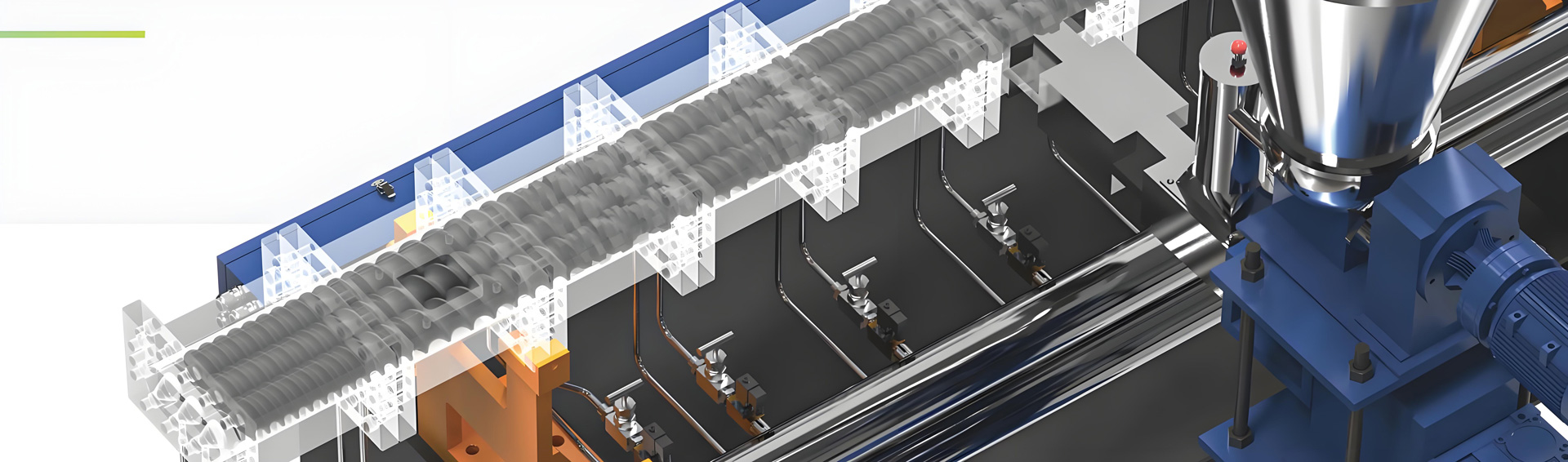
The intermeshing geometry of co-rotating twin screw extruders creates unique mixing advantages unavailable in single screw designs. Material passing through the intermeshing zone experiences compression and shear as screws rotate past each other. This self-wiping action prevents material accumulation that would create dead zones and quality variation.
Positive displacement flow through intermeshing screws provides predictable material advancement that supports consistent processing. Each screw flight captures and transports a defined material volume, creating systematic advancement through the barrel. Combined with mixing elements positioned along the screw, this transport mechanism achieves comprehensive mixing coverage throughout the processing volume.
Modular Screw Element Systems
Modular screw element systems enable configuration customization that matches equipment to specific formulation requirements. Different element types serve different functions in the extrusion process. Conveying elements provide material transport. Kneading blocks apply shear for dispersion. Mixing disks distribute particles uniformly. Combining these elements in optimized arrangements addresses diverse processing requirements.
Screw element selection should match formulation characteristics and production objectives. High-pigment formulations require intensive mixing configurations. Heat-sensitive materials may require modified conditions. Throughput requirements affect the balance between mixing intensity and transport efficiency. Professional processors develop screw configurations through systematic optimization that addresses their specific product portfolio.
Barrel Zone Configuration and Temperature Control
Barrel zone configuration enables different processing conditions in different barrel regions. Feed zones maintain conditions appropriate for material introduction and initial heating. Mixing zones provide elevated temperatures and intensive mixing. Pumping zones develop pressure for extrusion while maintaining melt homogeneity.
Precise temperature control in each zone ensures appropriate processing conditions throughout the extrusion system. Multi-zone heating and cooling systems enable independent temperature management. Direct thermocouple feedback provides accurate temperature measurement. Advanced control algorithms respond rapidly to thermal variations. Temperature stability translates directly to processing consistency and product quality.
Kerke KTE Series Mixing Capability Analysis
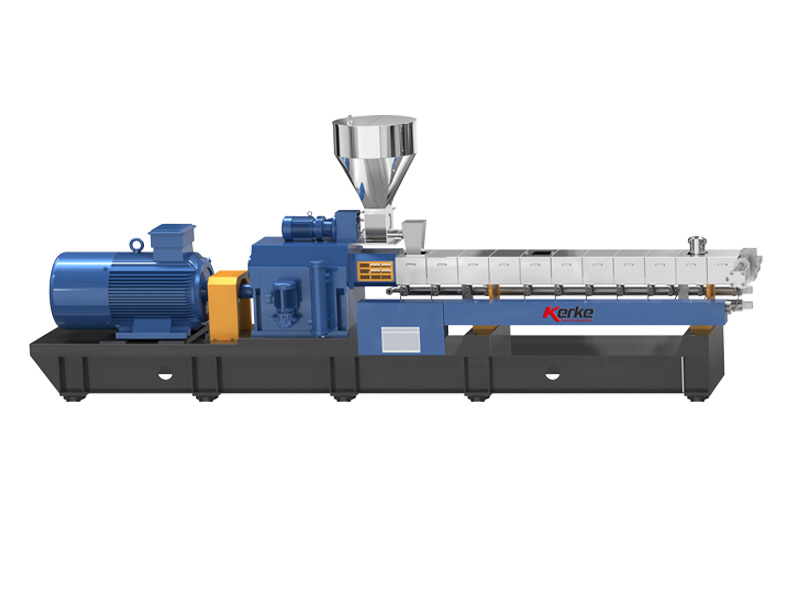
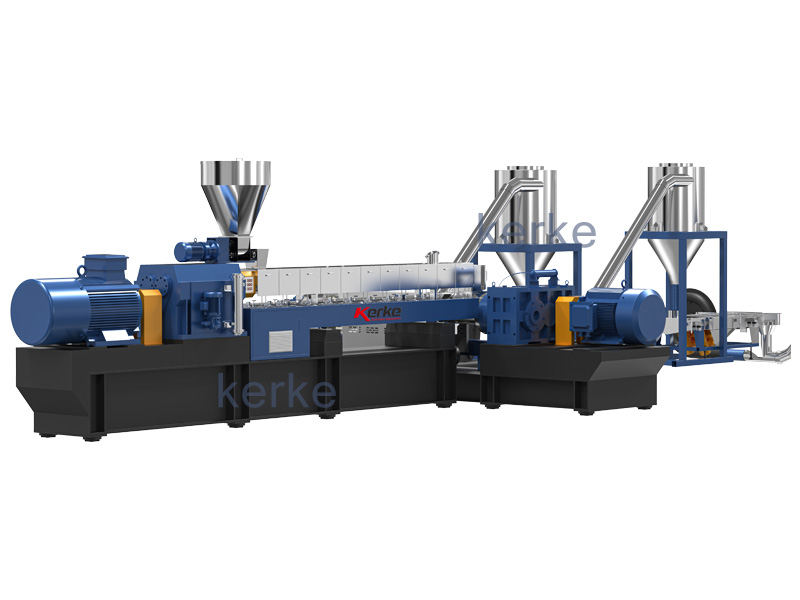
The Kerke KTE series of twin screw extruders provides professional-grade mixing capability suitable for demanding masterbatch applications. Each model in the series offers capability appropriate to different production scales. Understanding the mixing characteristics of each model supports equipment selection and optimization decisions.
KTE-36B Compact Mixing Performance
The KTE-36B with 35.6mm screw diameter and 20 to 100 kg per hour capacity offers excellent mixing capability relative to its compact size. Shorter barrel length compared to larger models requires efficient mixing section design to achieve complete dispersion. The relatively small barrel volume enables rapid product changes that support diverse small-batch production.
This compact extruder priced at $25,000 to $35,000 suits pilot production, development applications, and small-volume specialty masterbatch. Mixing efficiency in this model benefits from the concentrated mixing section design needed for its compact configuration. Process optimization for the KTE-36B emphasizes mixing quality over throughput, matching the production priorities of its typical applications.
KTE-50B Mid-Scale Mixing Efficiency
The KTE-50B with 50.5mm screw diameter and 80 to 200 kg per hour capacity provides balanced mixing performance for mid-scale production. Additional barrel length compared to the KTE-36B enables more comprehensive mixing section design. This model handles diverse formulations effectively while maintaining professional quality standards.
At $40,000 to $60,000, the KTE-50B represents an optimal price-performance point for many masterbatch producers. Mixing efficiency supports both pigment-intensive color masterbatch and filler-loaded compound production. Configuration flexibility accommodates various formulation types without sacrificing mixing quality. This model supports business growth from development through commercial production.
KTE-65B High-Volume Mixing Capability
The KTE-65B with 62.4mm screw diameter and 200 to 450 kg per hour capacity addresses high-volume mixing requirements effectively. Larger barrel diameter affects mixing dynamics compared to smaller models, requiring configuration optimization for equivalent performance. Professional engineering ensures adequate mixing capability at these elevated throughput rates.
The $50,000 to $80,000 investment in KTE-65B equipment delivers substantial production capacity with quality maintenance. Mixing section design must accommodate increased material volume while preserving mixing intensity. Extended mixing zones or multiple mixing sections may be incorporated to achieve quality objectives. This model serves commercial masterbatch production with efficient mixing capability.
KTE-75B Industrial Mixing Performance
The KTE-75B with 71mm screw diameter and 300 to 800 kg per hour capacity provides industrial-scale mixing capability. Production volumes at this scale demand efficient mixing systems that maintain quality while maximizing throughput. Equipment construction and configuration support continuous operation in demanding production environments.
At $70,000 to $100,000, the KTE-75B represents significant production capability investment. Mixing efficiency at these throughput rates requires careful attention to residence time and shear distribution. Configuration optimization ensures that mixing capability scales appropriately with production volume. This model achieves the production economics needed for competitive commercial masterbatch manufacturing.
KTE-95D Ultra-High Volume Mixing Excellence
The KTE-95D with 93mm screw diameter and 1000 to 2000 kg per hour capacity represents maximum mixing capability in the KTE series. Ultra-high volume production demands exceptional mixing efficiency to maintain quality at scale. Advanced engineering ensures that mixing performance meets the most demanding production requirements.
Pricing from $120,000 to $200,000 reflects the substantial capability of this production platform. Mixing section design for KTE-95D applications requires sophisticated understanding of processing dynamics at large scale. Multiple mixing zones, specialized elements, or modified operating conditions may be necessary to achieve quality objectives. Manufacturers operating KTE-95D equipment achieve production scales that create significant competitive advantages.
Process Optimization for Mixing Efficiency
Equipment capability establishes the foundation for mixing performance, but process optimization determines actual results achieved. Systematic approach to process development maximizes the mixing efficiency available from professional equipment.
Screw Speed Optimization for Mixing Quality
Screw speed directly influences mixing intensity and residence time in extrusion processing. Higher speeds increase shear rates that improve dispersion but reduce residence time. The balance between these competing factors determines optimal operating speed for specific formulations.
Speed optimization studies should evaluate product quality across a range of screw speeds while holding other parameters constant. Quality testing at each speed point identifies the minimum speed that achieves quality objectives. Operating above this minimum speed improves throughput efficiency while maintaining quality. Speed optimization should be performed for each formulation type processed on the equipment.
Temperature Profile Optimization Strategies
Temperature profile affects viscosity, melting behavior, and thermal degradation in extrusion processing. Optimal temperature profile balances processing efficiency against quality requirements. Different formulations may require different temperature profiles to achieve equivalent quality.
Temperature optimization typically begins with equipment manufacturer recommendations as starting points. Systematic variation of zone temperatures identifies optimal settings for specific formulations. Quality testing at different temperature conditions reveals the sensitivity of product quality to temperature variations. Once optimized, temperature profiles should be documented and followed consistently.
Throughput Optimization for Production Efficiency
Throughput determines production capacity but may affect mixing quality if excessive. Operating at maximum throughput may compromise quality if mixing capability is exceeded. Understanding the relationship between throughput and quality enables optimization that balances these factors appropriately.
Throughput studies should evaluate quality parameters across the intended operating range. Quality may remain acceptable to a throughput threshold, above which degradation occurs. Operating slightly below this threshold provides margin for variation while maximizing throughput. Throughput optimization supports production planning that achieves quality and efficiency objectives simultaneously.
Feed System Considerations for Mixing Efficiency
Material feeding significantly affects mixing efficiency in masterbatch production. Consistent, accurate feeding ensures uniform additive introduction that supports efficient mixing downstream. Feed system design and operation merit attention as part of comprehensive mixing optimization.
Gravimetric Feeding Technology Advantages
Gravimetric feeding provides accurate material delivery based on weight rather than volume. Weight-based feeding eliminates variations caused by material density changes, packing, or feeding equipment wear. Loss-in-weight feeders continuously measure consumption and adjust feed rates to maintain target throughput.
Gravimetric feeding accuracy supports formulation control that directly affects product quality. Color masterbatch quality depends on consistent pigment concentration, which gravimetric feeding enables. Multiple feed streams can be controlled independently for complex formulations. Investment in gravimetric feeding technology supports quality objectives while improving production efficiency.
Multi-Component Feeding System Design
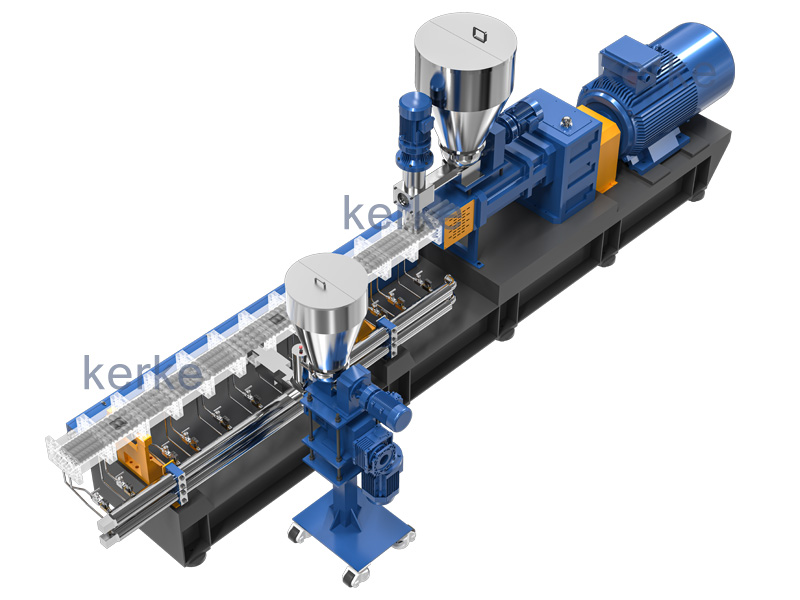
Masterbatch formulations typically include carrier resin, pigment, and various additives that require separate feeding streams. Multi-component feeding systems enable independent control of each stream, providing flexibility and precision. Side-feeder configurations introduce additives downstream of initial melting, protecting heat-sensitive materials.
Feed system configuration should match formulation requirements and equipment capabilities. Carrier resin typically feeds at the main feed throat. Pigment and filler may feed at the main throat or through side feeders depending on formulation characteristics. Additive feeding ports enable introduction of minor components without excessive exposure to processing conditions. Professional feed system design optimizes mixing efficiency for diverse formulation requirements.
Quality Control Methods for Mixing Assessment
Quality control provides objective assessment of mixing efficiency and product conformance. Comprehensive quality control programs identify mixing problems before they result in customer complaints or production disruptions.
Color Measurement and Spectrophotometric Analysis
Spectrophotometric color measurement provides objective quantification of color characteristics that human observation cannot reliably detect. Color measurements identify deviations from target specifications that may indicate mixing problems. Statistical analysis of measurement data reveals trends that enable proactive response.
Quality specifications for color should define acceptable tolerance ranges based on customer requirements and process capability. Measurements outside specifications trigger investigation and corrective action. Regular measurement during production runs enables rapid detection of mixing variations. Investment in quality measurement technology supports consistent product quality.
Dispersion Quality Evaluation Techniques
Dispersion quality assessment goes beyond color measurement to evaluate the effectiveness of pigment agglomerate breakdown. Microscopic examination reveals the presence of undispersed pigment particles that affect color performance. Standard dispersion ratings enable comparison and specification compliance verification.
Dispersion testing methods range from simple grindout checks to sophisticated image analysis systems. Grindout tests evaluate pigment dispersion by examining pressed samples under magnification. More advanced techniques use digital image analysis to quantify dispersion quality objectively. Quality control procedures should specify appropriate testing methods for different product types and customer requirements.
Mechanical Property Testing for Filled Compounds
Filled compounds require mechanical property testing to verify that filler incorporation achieves intended reinforcement effects. Tensile testing, impact testing, and flexural testing characterize compound performance. Poor filler dispersion or distribution reduces mechanical property benefits and may indicate processing problems.
Property testing should sample from production runs at appropriate intervals. Testing frequency depends on production volume, process stability, and customer requirements. Statistical process control charts identify trends that precede specification violations. Property testing complements color and dispersion testing to provide comprehensive quality assurance for filled masterbatch products.
Troubleshooting Common Mixing Problems
Despite careful process optimization, mixing problems occasionally occur that require diagnosis and correction. Understanding common problems and their causes enables efficient troubleshooting.
Inadequate Dispersion Diagnosis and Correction
Inadequate dispersion manifests as poor color strength, color variation, or visible pigment specks in finished products. Causes include insufficient mixing intensity, inadequate residence time, or improper temperature conditions. Troubleshooting should evaluate each potential cause systematically.
Correction of dispersion problems may require configuration changes, speed adjustments, temperature profile modifications, or throughput reductions. Configuration changes including additional kneading blocks or modified stagger angles may improve dispersion intensity. Speed increases may improve shear rates up to equipment limits. Temperature reductions that increase viscosity may improve shear transfer. Throughput reductions increase residence time and fill level. Testing after modifications verifies that corrections achieve intended improvements.
Filler Agglomeration Problem Resolution
Filler agglomeration creates quality problems similar to pigment dispersion issues. Large filler aggregates reduce reinforcement effectiveness and create visual defects. Agglomeration may result from inadequate mixing, moisture contamination, or improper feed introduction.
Resolving filler agglomeration requires assessment of processing conditions and equipment configuration. Additional mixing intensity may be needed to break apart aggregates effectively. Drying of hygroscopic fillers removes moisture that promotes agglomeration. Feed introduction through side feeders may improve dispersion compared to main throat feeding. Investigation and testing identify the specific cause and appropriate correction.
Color Variation Troubleshooting Approaches
Color variation between samples, batches, or production runs indicates mixing inconsistencies. Variation may result from formulation inconsistency, processing instability, or sampling problems. Systematic troubleshooting identifies the source of variation for targeted correction.
Feed system verification ensures that formulation components are delivered consistently. Process parameter review identifies variations in temperature, speed, or throughput that might cause color differences. Sampling procedure evaluation ensures that test samples represent production accurately. Statistical analysis of quality data reveals patterns that indicate specific problem sources. Corrective actions should address identified causes rather than symptoms.
Economic Considerations for Mixing Efficiency
Mixing efficiency affects production economics through quality, throughput, and operating costs. Understanding these relationships guides optimization decisions that balance quality and efficiency appropriately.
Quality Costs and Mixing Performance
Quality costs include both failure costs from poor quality and appraisal costs for quality assurance activities. Mixing efficiency affects failure costs through product conformance and customer satisfaction. Investment in mixing capability and optimization reduces failure costs that would otherwise impact profitability.
Customer complaints, returns, and rework costs represent visible quality failures. Hidden failures including internal scrap and yield losses may exceed visible failures. Total quality cost analysis quantifies the impact of mixing performance on business results. This analysis supports investment decisions for equipment upgrades, process optimization, and quality systems.
Production Efficiency and Throughput Optimization
Throughput optimization balances production capacity against quality requirements. Maximum throughput may not produce acceptable quality if mixing capability is exceeded. Optimal operating points balance these factors to maximize production value rather than simply maximizing throughput.
Throughput studies should quantify the relationship between production rate and quality outcomes. Quality may remain acceptable across a range of throughputs, with an optimal operating point within that range. Operating above acceptable throughputs increases failure costs that exceed the value of additional production. Throughput optimization considers total value rather than production volume alone.
Conclusion
Efficient pigment and filler mixing determines the quality and cost-effectiveness of masterbatch production. Professional twin screw extruders provide the mixing capability required for demanding applications through intermeshing screw geometry, modular element systems, and precise temperature control. Understanding the science of dispersion and distribution enables appreciation of how equipment achieves efficient mixing.
The Kerke KTE series offers professional compounding equipment suited to production scales from compact 20 kg per hour systems to ultra-high volume 2000 kg per hour platforms. The $25,000 to $200,000 investment range across KTE models accommodates diverse production requirements and budget constraints. Process optimization based on systematic testing and quality control maximizes the mixing efficiency available from this equipment. Masterbatch manufacturers that achieve mixing excellence deliver consistent quality that supports customer satisfaction and business success.