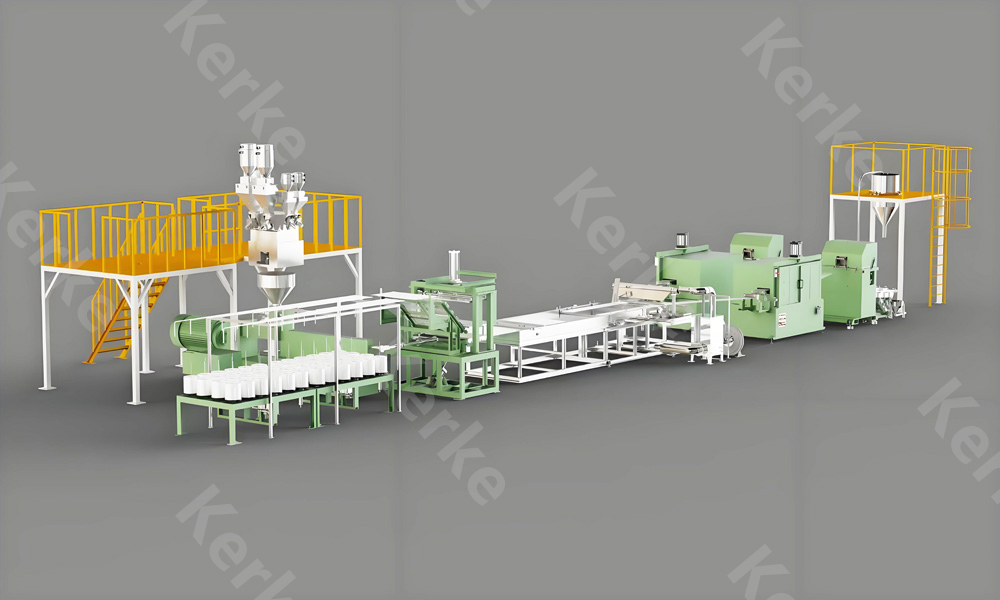
Color consistency represents one of the most critical quality parameters in plastic manufacturing. When producing masterbatch concentrates, even minor color deviations can result in significant financial losses, customer complaints, and production rework. The challenge of achieving uniform color distribution has driven manufacturers to invest in professional extruder systems that deliver superior mixing performance and process control. Understanding how professional twin screw extruders address color difference challenges provides valuable insights for production managers seeking to optimize their manufacturing operations.
The masterbatch industry demands exceptional precision in pigment dispersion and color blending. A single batch with noticeable color variation can contaminate an entire production run, leading to wasted raw materials and increased operational costs. Modern compounding extruders have evolved to incorporate advanced mixing technologies that fundamentally transform how pigments and carriers are processed together. This comprehensive guide explores the technical approaches, equipment considerations, and operational practices that enable manufacturers to minimize color differences and achieve consistent product quality.
Understanding the Sources of Color Difference in Masterbatch Production
Before implementing solutions, manufacturers must comprehensively understand the root causes of color variation in masterbatch production. Color difference typically originates from multiple factors that interact throughout the manufacturing process. Identifying these sources enables targeted improvements that address specific weaknesses in production workflows.
Pigment Dispersion Quality Issues
Inadequate pigment dispersion represents the primary cause of color difference in masterbatch production. When pigment particles fail to break down into optimally small sizes during processing, agglomerates form and create inconsistent color concentration throughout the final product. Professional twin screw extruders apply controlled shear forces that systematically break apart pigment aggregates, distributing individual pigment particles uniformly throughout the carrier resin. The kneading blocks and screw elements in a properly configured compounding extruder determine how effectively this dispersion process occurs.
Poor dispersion quality manifests in several observable ways. Products may display visible color streaks when processed downstream, indicating incomplete pigment distribution. Color strength measurements may vary significantly between samples from the same batch, revealing inconsistent pigment incorporation. Additionally, the visual appearance under magnification often reveals particle clusters that should have been broken down during extrusion. Professional extruder systems address these dispersion challenges through precise control of shear rates, residence time distribution, and mixing element geometry.
Mixing Inefficiency in Processing Equipment
The mixing efficiency of processing equipment directly influences color consistency in masterbatch production. Equipment with suboptimal mixing capability creates uneven distribution of pigment particles within the carrier matrix. Twin screw extruders offer significant advantages over single screw designs due to their intermeshing geometry and positive displacement material flow. However, even twin screw systems require proper configuration to achieve optimal mixing performance.
Material stagnation zones within the extrusion system create opportunities for color variation. When material accumulates in dead zones, it experiences different processing conditions than the main material flow. This differential processing leads to inconsistent pigment activation and dispersion. Professional compounding extruders minimize stagnation through careful barrel geometry design and optimized screw clearance specifications. Regular maintenance ensures that clearance tolerances remain within specification, preventing material accumulation that contributes to color problems.
Temperature Control and Distribution Challenges
Thermal management significantly impacts color consistency in masterbatch production. Temperature variations across the barrel length create differential processing conditions that affect pigment activation and carrier resin behavior. pigments exhibit temperature-dependent dissolution characteristics that influence their color development and stability. Inconsistent temperature profiles lead to variable color strength and hue in the final product.
Professional extruder systems incorporate multi-zone temperature control that enables precise thermal management throughout the processing chamber. Each barrel section maintains independent temperature monitoring and adjustment capabilities. Advanced control algorithms respond to thermal variations in real-time, maintaining stable processing conditions. The heating and cooling systems in quality extruders provide rapid response to thermal disturbances, minimizing temperature drift that could affect color consistency.
Raw Material Variability and Compounding
Incoming raw material quality significantly influences color consistency in masterbatch production. Carrier resins with inconsistent melt flow characteristics process differently across production runs, affecting pigment dispersion and distribution. Pigment lots vary in their physical and chemical properties, requiring process adjustments to achieve consistent results. The compounding stage of masterbatch production must account for these material variations to maintain color uniformity.
Professional manufacturers implement rigorous incoming quality control programs that characterize raw material properties before production use. Pigment concentrates require proper mixing protocols to ensure uniform distribution when incorporated into carrier resins. The masterbatch extrusion process itself serves as a critical quality control checkpoint, where process parameters can be adjusted to compensate for incoming material variations. A professional twin screw extruder provides the flexibility needed to accommodate material variability while maintaining product consistency.
The Role of Professional Twin Screw Extruders in Color Control
Professional twin screw extruders provide fundamental capabilities that enable superior color control in masterbatch production. The design principles underlying twin screw extrusion technology directly address the challenges that cause color variation. Understanding these technical advantages helps manufacturers make informed equipment investments that deliver measurable quality improvements.
Superior Mixing Technology in Compounding Extruders
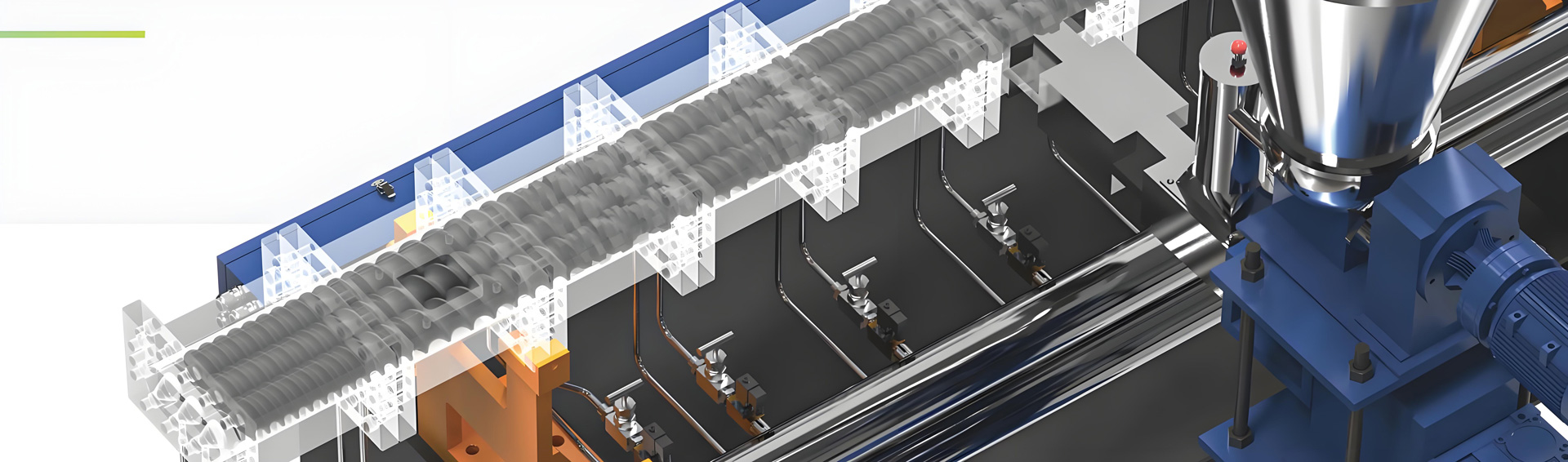
Professional compounding extruders achieve mixing quality that single screw systems cannot match. The intermeshing twin screw design creates controlled material flow patterns that systematically distribute pigment particles throughout the carrier matrix. Forward conveying elements transport material through the barrel while kneading blocks apply shear forces that break apart pigment agglomerates. The combination of distributive and dispersive mixing ensures uniform pigment distribution at the particle level.
The screw configuration in a twin screw extruder can be precisely engineered to match specific masterbatch formulations. Different material combinations require different mixing intensities and residence times. Professional extruders accommodate this flexibility through modular screw element designs that allow processors to configure screw geometry for optimal performance with any given formulation. This adaptability ensures that each masterbatch product receives appropriate processing regardless of its specific composition.
Precise Temperature Management Systems
Professional extruder systems incorporate temperature control technology that maintains processing stability throughout production runs. Multi-zone heating and cooling systems provide independent thermal management for each barrel section. Direct thermocouple feedback enables rapid response to temperature variations, maintaining tight tolerance around setpoint temperatures. This precision thermal control ensures consistent pigment activation and carrier resin processing across the entire barrel length.
Advanced extruder control systems employ sophisticated algorithms that optimize temperature profiles based on material characteristics and production requirements. Automatic temperature adjustment compensates for exothermic reactions, material feed variations, and ambient conditions. The result is stable processing that produces consistent color characteristics from the first kilogram to the last in any production run. Temperature stability directly translates to color consistency in the finished masterbatch product.
Consistent Residence Time Distribution
Professional twin screw extruders deliver narrow residence time distribution that contributes to color uniformity. Material within the extruder barrel follows predictable flow patterns with minimal short-circuiting or dead zones. All material particles experience similar processing conditions for similar durations, ensuring uniform pigment dispersion and carrier incorporation. This consistency eliminates the batch-to-batch variation that plague equipment with poor residence time characteristics.
The positive displacement nature of intermeshing twin screw designs creates predictable material flow that supports consistent processing. Each screw flight transports a defined volume of material, creating systematic advancement through the barrel. Combined with carefully configured screw elements, this flow pattern minimizes material backflow and channeling that would create processing inconsistencies. Professional extruder manufacturers carefully engineer barrel geometry and screw clearance to optimize residence time distribution for masterbatch applications.
Kerke KTE Series Extruders for Color-Critical Masterbatch Production
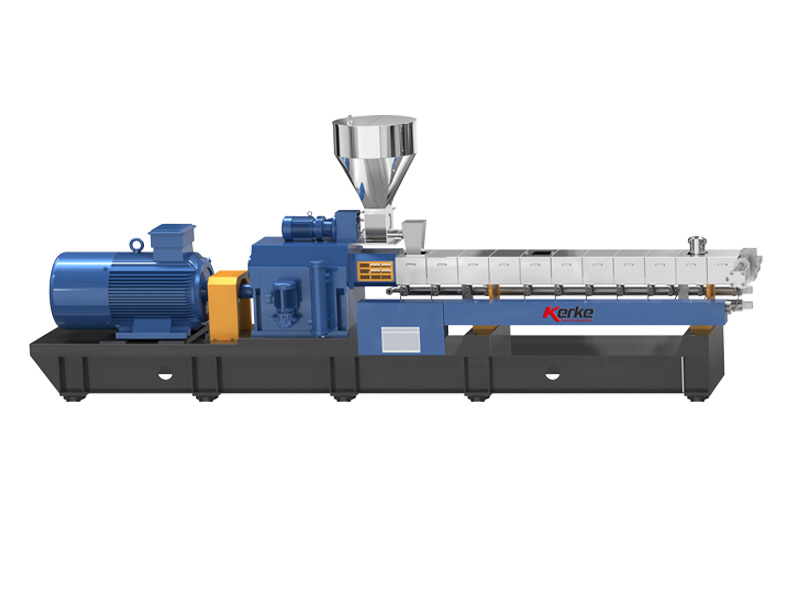
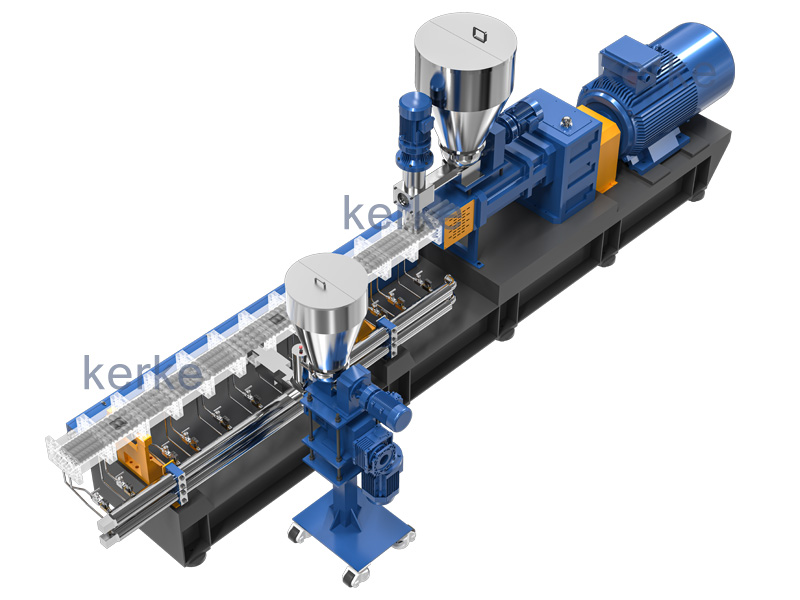
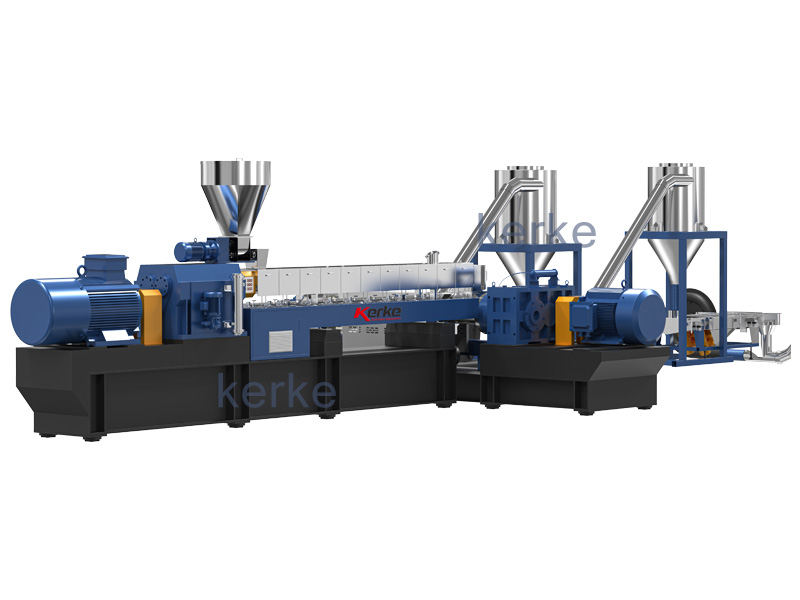
The Kerke KTE series represents professional-grade twin screw extrusion equipment specifically designed for demanding masterbatch applications. These compounding extruders incorporate engineering features that directly support color consistency objectives. Understanding the capabilities of the KTE series helps manufacturers select equipment that matches their production requirements.
KTE-36B Compact Production System
The KTE-36B extruder features a 35.6mm screw diameter with production capacity ranging from 20 to 100 kg per hour. This compact system suits pilot production, small batch manufacturing, and process development applications. The relatively small barrel volume enables rapid product transitions and reduces material waste during setup. Precise temperature control across multiple barrel zones maintains processing stability suitable for color-sensitive formulations.
The KTE-36B pricing ranges from $25,000 to $35,000, positioning it as an accessible entry point for professional masterbatch production. Despite its compact size, this extruder incorporates the same mixing technology principles found in larger KTE models. Processors can develop formulations on the KTE-36B and scale production to larger equipment with confidence that recipes will transfer successfully. This scalability supports business growth without requiring complete equipment replacement.
KTE-50B Mid-Scale Production Platform
The KTE-50B extruder provides 50.5mm screw diameter with production capacity between 80 and 200 kg per hour. This mid-scale platform serves high-volume masterbatch production while maintaining the processing precision required for color consistency. The larger barrel volume improves production efficiency compared to smaller models while retaining the ability to process sensitive formulations successfully.
Equipment pricing for the KTE-50B ranges from $40,000 to $60,000. This investment delivers professional-grade mixing performance suitable for commercial masterbatch production. The robust construction ensures long-term reliability in demanding production environments. Multiple barrel heating zones enable precise thermal management that supports tight color tolerance requirements. This model represents an optimal balance of production capacity and processing quality for many masterbatch manufacturers.
KTE-65B High-Volume Production Solution
The KTE-65B features 62.4mm screw diameter with production capacity from 200 to 450 kg per hour. This high-volume platform addresses production requirements for large-scale masterbatch manufacturing operations. Despite increased throughput, the extruder maintains mixing quality that satisfies stringent color consistency requirements. Professional engineering ensures uniform pigment dispersion even at elevated production rates.
Pricing for the KTE-65B ranges from $50,000 to $80,000. This investment supports significant production scale-up compared to smaller models. The equipment construction accommodates continuous operation in industrial environments. Advanced control systems provide real-time monitoring and adjustment capabilities that maintain process stability throughout extended production runs. Manufacturers producing consistent color quality at this throughput level achieve favorable unit production costs that support competitive pricing.
KTE-75B Industrial Production System
The KTE-75B extruder provides 71mm screw diameter with production capacity ranging from 300 to 800 kg per hour. This industrial-scale system addresses the highest volume masterbatch production requirements. The combination of large throughput and professional mixing capability makes this model suitable for demanding color-critical applications. Robust mechanical design ensures reliable operation in continuous production environments.
Equipment pricing ranges from $70,000 to $100,000 for the KTE-75B. This investment represents significant production capability for commercial masterbatch operations. The larger processing volume enables favorable economics of scale while maintaining product quality standards. Comprehensive control systems provide complete process visibility and adjustment capability. Manufacturers operating KTE-75B equipment achieve production economics that support business profitability while satisfying customer quality requirements.
KTE-95D Ultra-High Volume Production Platform
The KTE-95D represents the largest model in the KTE series with 93mm screw diameter and production capacity from 1000 to 2000 kg per hour. This ultra-high volume platform serves the most demanding production requirements in the masterbatch industry. Despite exceptional throughput, the extruder maintains the mixing quality required for consistent color production. Advanced engineering ensures uniform processing across the full barrel length even at maximum production rates.
Pricing for the KTE-95D ranges from $120,000 to $200,000, reflecting its position as a professional-grade industrial production system. This investment supports massive production scale for established masterbatch manufacturers. The equipment incorporates advanced control features that optimize processing efficiency while maintaining quality consistency. Manufacturers utilizing KTE-95D equipment achieve the lowest unit production costs while maintaining color quality that satisfies the most demanding customer specifications.
Process Optimization Strategies for Color Consistency
Beyond equipment selection, manufacturers must implement process optimization strategies that maximize color consistency in masterbatch production. These operational practices complement professional equipment capabilities and address factors that influence product quality independent of extrusion system performance.
Screw Configuration Optimization
Screw configuration directly impacts mixing quality and color consistency in twin screw extrusion. Different formulation components require different processing approaches to achieve optimal dispersion. Pigment concentration, carrier resin properties, and additive characteristics all influence the optimal screw configuration. Professional processors develop screw configurations through systematic experimentation and process optimization.
The mixing intensity applied to material passing through the extruder depends on kneading block arrangement and disk spacing. Higher pigment concentrations often require increased mixing intensity to achieve adequate dispersion. However, excessive shear can damage heat-sensitive pigments or degrade carrier resin properties. Finding the optimal balance requires understanding the specific formulation characteristics and production quality requirements. Process optimization studies identify screw configurations that maximize color consistency while avoiding material degradation.
Temperature Profile Optimization
Temperature profile optimization significantly impacts color consistency in masterbatch production. Different barrel zones serve different processing functions that require specific temperature conditions. The feeding zone requires lower temperatures to facilitate material introduction and prevent premature melting. The melting and mixing zones require higher temperatures that enable polymer flow and pigment dispersion. The pumping and discharge zones require temperatures that maintain proper viscosity for extrusion.
Professional manufacturers develop optimized temperature profiles through systematic studies that correlate process conditions with product quality. Starting point recommendations from equipment manufacturers provide a foundation for optimization efforts. Material-specific adjustments address the unique processing requirements of different carrier resins and pigment systems. Regular temperature profile reviews ensure that processing conditions remain optimal as formulations evolve and raw material sources change.
Throughput Consistency and Control
Throughput stability directly influences color consistency in extrusion-based masterbatch production. Variations in feed rate create corresponding variations in material residence time and shear exposure. These processing variations manifest as color differences in the finished product. Professional manufacturers maintain tight throughput control to ensure consistent processing conditions throughout production runs.
Loss-in-weight feeders provide the most accurate material feeding for masterbatch production. These systems continuously measure material consumption and adjust feed rates to maintain target throughput. Gravimetric feeding eliminates the volumetric variations that occur with simple screw feeders. Multiple feeders enable separate control of carrier resin and additive streams, providing additional process flexibility. Throughput control technology represents a valuable investment for manufacturers prioritizing color consistency.
Quality Control Sampling and Testing
Comprehensive quality control programs identify color variations before they propagate through production. Regular sampling during production runs enables rapid detection of process deviations. Spectrophotometric color measurement provides objective quantification of color characteristics that human observation cannot achieve. Statistical process control techniques identify trends before they result in out-of-specification product.
Quality control systems should include both in-process sampling and finished product testing. In-process samples enable rapid response to emerging problems, potentially saving entire production batches. Finished product testing provides final confirmation of color consistency before shipment. Documentation of quality results supports continuous improvement efforts and provides traceability information for customer inquiries. Investment in quality control technology delivers returns through reduced customer complaints and rework costs.
Preventive Maintenance for Long-Term Color Consistency
Sustained color consistency requires ongoing equipment maintenance that preserves processing capability over time. Wear and degradation affect extrusion system performance in ways that impact product quality. Professional maintenance programs prevent these degradation mechanisms and maintain consistent processing conditions.
Screw and Barrel Wear Management
Screw and barrel wear progressively changes extrusion system performance. Wear increases clearances between intermeshing screws and between screws and barrel liners. These clearance increases reduce mixing efficiency and create material backflow that disrupts processing consistency. The result is gradually declining color consistency that may escape notice until significant quality problems develop.
Preventive maintenance programs establish wear inspection schedules that identify degradation before it impacts product quality. Regular measurement of critical dimensions enables tracking of wear rates and prediction of maintenance requirements. When wear exceeds acceptable limits, timely replacement of worn components restores original processing capability. Proactive maintenance costs less than reactive repairs and prevents the quality problems that accompany equipment degradation.
Temperature Control System Maintenance
Temperature control system maintenance ensures continued accuracy of thermal management. Thermocouple degradation affects temperature measurement accuracy and can create process drift. Heater band failures create temperature variations across barrel zones. Cooling system problems prevent proper temperature reduction in critical zones. Regular inspection and testing of temperature control components maintains the accuracy required for color consistency.
Preventive maintenance should include regular calibration verification of temperature measurement systems. Comparison of displayed temperatures against reference measurements identifies accuracy drift. Heater and cooling system components should be inspected for proper operation and cleaned as necessary. Control system software should be updated to maintain compatibility with current technology platforms. These maintenance activities preserve the temperature control precision that supports color consistency.
Material Feeding System Maintenance
Material feeding systems require maintenance attention to preserve throughput accuracy and consistency. Feeder calibration drift creates gradual changes in formulation composition that affect color characteristics. Feed screw wear changes volumetric delivery rates. Hopper geometry changes affect material flow characteristics that influence feeding accuracy. Regular maintenance ensures continued accuracy that supports color consistency goals.
Maintenance programs should include periodic calibration verification of loss-in-weight feeding systems. Material consumption verification tests confirm that delivered quantities match setpoints. Feed screw inspection identifies wear that affects volumetric accuracy. Hopper inspection ensures proper material flow without bridging or ratholing that creates feeding variations. Professional maintenance attention to feeding systems provides the foundation for consistent color production.
Economic Considerations for Color Consistency Investment
Investment in color consistency capabilities delivers measurable economic returns through multiple pathways. Understanding these economic factors helps manufacturers prioritize improvements that deliver the greatest return on investment.
Cost of Color Variation in Masterbatch Production
Color variation creates significant costs throughout the production and distribution chain. Rework costs include material handling, reprocessing, and lost production time. Customer complaints may result in product returns, expedited replacement shipments, and potential account loss. In severe cases, color problems may trigger contractual penalties or damage claims. The total cost of color variation typically far exceeds the visible rework expense.
Beyond immediate production costs, color consistency affects customer relationships and market reputation. Customers choose suppliers based on demonstrated ability to meet quality requirements consistently. Suppliers with color consistency problems lose accounts to more reliable competitors. The long-term revenue impact of reputation damage exceeds any individual product quality issue. Investment in color consistency capabilities protects both current account relationships and future business development opportunities.
Return on Investment Analysis for Equipment Upgrades
Equipment upgrades that improve color consistency typically generate favorable return on investment through reduced quality costs. Quantifying potential returns requires assessment of current quality costs, expected improvement levels, and investment requirements. Professional twin screw extruders like the Kerke KTE series represent significant investments that merit careful economic analysis.
Return on investment calculations should consider reduced rework costs, decreased customer complaints, and improved production efficiency. Higher quality equipment often processes formulations more efficiently, reducing cycle times and increasing throughput. Additionally, consistent quality enables premium pricing for customers requiring tight color tolerance. These factors combine to generate attractive returns that justify equipment investment for most production operations.
Conclusion
Achieving consistent color in masterbatch production requires integrated attention to equipment selection, process optimization, and maintenance practices. Professional twin screw extruders like the Kerke KTE series provide the mixing capability, temperature control, and process stability required for color-critical applications. The comprehensive range of KTE models from compact 36mm systems to ultra-high volume 95mm platforms enables appropriate equipment matching for any production scale requirement.
Success in color control requires ongoing commitment to process optimization and equipment maintenance. Screw configuration studies, temperature profile optimization, and quality control implementation address the operational factors that influence consistency. Preventive maintenance programs preserve equipment capability and prevent degradation that affects product quality. By combining professional equipment with operational excellence, masterbatch manufacturers achieve the color consistency that their customers demand.