The global compounding extrusion market is projected to reach $18.7 billion in 2026, growing at a compound annual growth rate (CAGR) of 6.4% through 2033. This growth is driven by increasing demand for high-performance plastics, masterbatch products, and sustainable recycled materials across automotive, packaging, construction, and electronics industries. In this highly competitive market, production efficiency directly determines profitability, and two of the most critical factors affecting efficiency are cleaning ease and material changeover speed.
For compounding manufacturers, material changeovers and cleaning procedures typically account for 15-30% of total production downtime. A single color change can take 2-6 hours on traditional extruders, generating 50-200 kg of scrap material and costing $500-$3,000 per changeover in lost production and material waste. For facilities running multiple formulations daily, these costs can add up to hundreds of thousands of dollars annually. Additionally, inadequate cleaning can lead to cross-contamination, product defects, and regulatory non-compliance, especially in food, pharmaceutical, and medical applications.
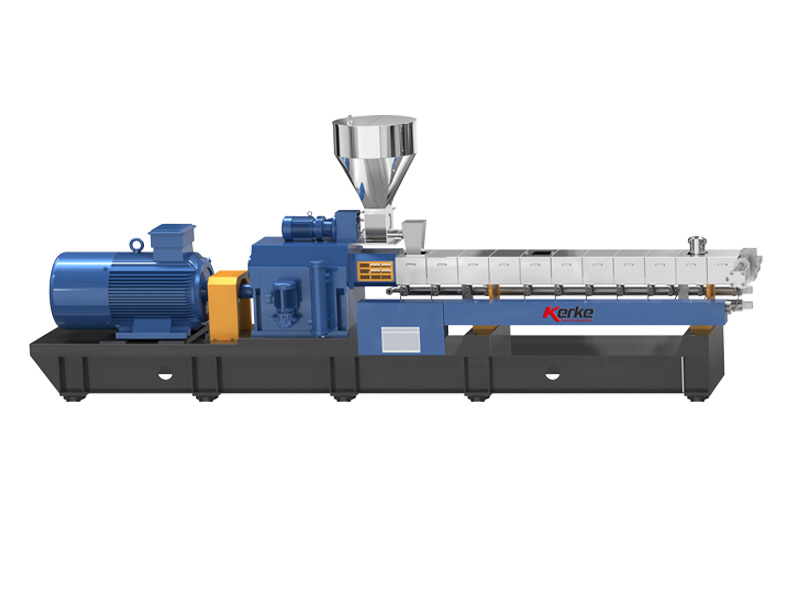
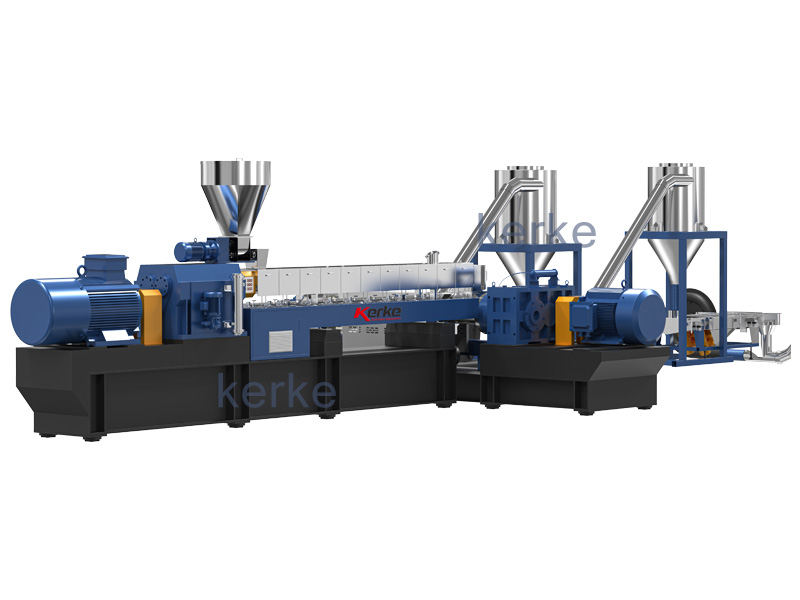
As a leading global manufacturer of twin screw extruders with over 18 years of experience, Kerke has developed industry-leading cleaning and material change technologies that reduce changeover time by 70-90% compared to traditional extruders. Kerke twin screw extruders, masterbatch extruders, and compounding extruders feature innovative modular designs, advanced self-cleaning systems, and intelligent control platforms that ensure thorough cleaning with minimal downtime and material waste. With over 3,000 machines installed in more than 70 countries, Kerke has established a reputation for delivering high-performance extrusion solutions that maximize production efficiency and profitability.
This comprehensive guide explains how modern twin screw extruders ensure easy cleaning and quick material changes. It examines the economic impact of changeover downtime, details Kerke’s proprietary cleaning and changeover technologies, provides application-specific solutions for different industries, and includes a complete cost analysis and real-world case studies. Whether you operate a masterbatch production facility, engineering plastics compounding plant, or recycling operation, this guide will help you understand how investing in a Kerke twin screw extruder can significantly reduce your changeover costs and improve your bottom line.
1. The Critical Importance of Easy Cleaning and Quick Material Change in Extrusion
Before exploring the technical solutions, it is essential to understand the full impact of cleaning and material change procedures on your extrusion operation. These processes affect every aspect of your business, from production costs and product quality to regulatory compliance and market responsiveness.
1.1 Economic Impact of Changeover Downtime
Changeover downtime is one of the largest sources of lost production in extrusion operations. Every hour spent cleaning and changing materials is an hour when your machine is not generating revenue. The total cost of a material change includes:
- Lost production revenue: The value of products that could have been produced during the changeover period. For a typical production-scale twin screw extruder running at 500 kg/hour with a profit margin of $0.50/kg, each hour of downtime costs $250 in lost profit.
- Material waste: The scrap material generated during purging and transition between materials. A typical color change on a traditional extruder generates 50-200 kg of unusable material, worth $100-$1,000 depending on the material type.
- Labor costs: The wages of operators and maintenance personnel performing the changeover. A 4-hour changeover requiring 2 operators at $25/hour costs $200 in labor.
- Energy costs: The energy consumed by the extruder and auxiliary equipment during the changeover process.
- Opportunity cost: The inability to meet customer deadlines or take on additional orders due to limited production capacity.
For a facility performing 100 material changes per year, these costs can easily exceed $500,000 annually. Reducing changeover time from 4 hours to 30 minutes would save over $400,000 per year for this facility, directly increasing profitability.
1.2 Product Quality and Cross-Contamination Risks
Inadequate cleaning between material changes can lead to cross-contamination, which is one of the most serious risks in extrusion manufacturing. Even small amounts of residual material can cause significant product defects, including:
- Color inconsistencies: Even a tiny amount of pigment from a previous batch can cause visible color variations in the new product.
- Mechanical property degradation: Contamination with different polymer types can reduce the strength, flexibility, or heat resistance of the final product.
- Surface defects: Residual material can cause gels, black specks, or other surface imperfections that make the product unsellable.
- Regulatory non-compliance: In food, pharmaceutical, and medical applications, cross-contamination can lead to product recalls, regulatory fines, and damage to brand reputation.
The cost of a single product recall due to cross-contamination can run into millions of dollars, not to mention the long-term damage to customer trust. Easy-to-clean extruders eliminate these risks by ensuring complete removal of all residual material between batches.
1.3 Production Flexibility and Market Responsiveness
In today’s fast-paced market, customers demand smaller batch sizes, faster delivery times, and more customized products. Manufacturers who can quickly change between different materials and formulations have a significant competitive advantage.
Quick changeover capabilities allow you to:
- Produce smaller batch sizes economically, opening up new market opportunities for custom and specialty products.
- Respond quickly to customer orders and changing market demands.
- Reduce inventory levels by producing products on demand rather than maintaining large stockpiles.
- Optimize production scheduling to maximize machine utilization.
For masterbatch producers in particular, the ability to quickly change between different colors and formulations is essential for meeting customer requirements and maintaining a competitive edge.
1.4 Regulatory Compliance Requirements
Industries such as food, pharmaceutical, and medical have strict regulatory requirements for equipment cleanliness and product traceability. Regulatory bodies require manufacturers to demonstrate that their equipment can be effectively cleaned to prevent cross-contamination between batches.
Easy-to-clean extruders with documented cleaning procedures help manufacturers meet these regulatory requirements and pass inspections with ease. They also provide the necessary documentation to prove that proper cleaning procedures were followed, which is essential for regulatory compliance.
2. Kerke Twin Screw Extruder Design Features for Easy Cleaning
Kerke has engineered its twin screw extruders from the ground up with cleaning ease as a top priority. Every aspect of the machine design, from the barrel and screw elements to the feed system and control panel, is optimized to minimize cleaning time and ensure thorough removal of all residual material.
2.1 Modular Clamshell Barrel Design
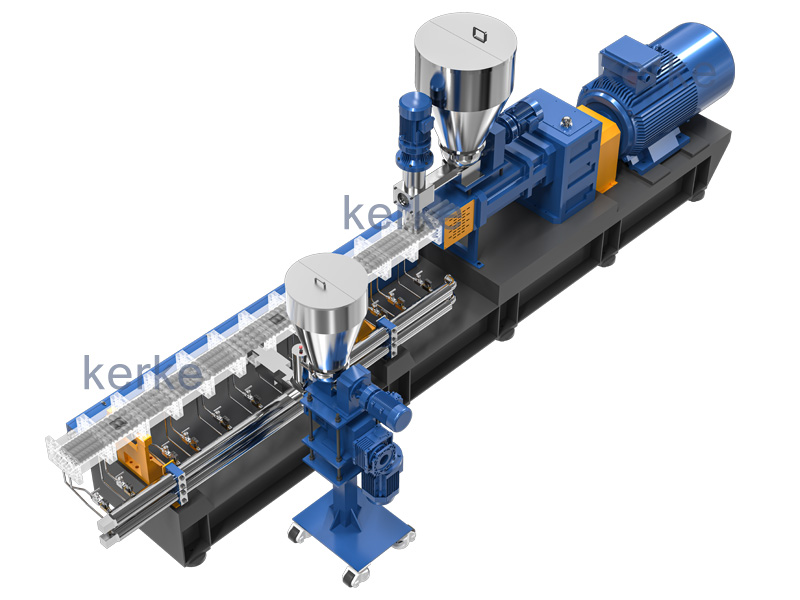
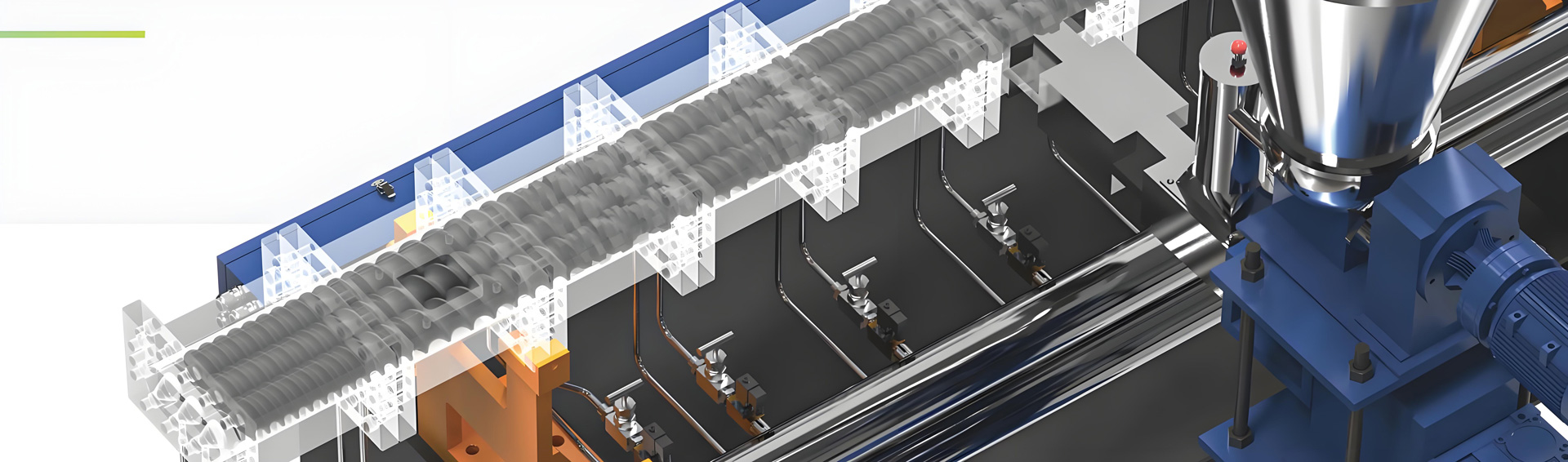
The single most important design feature for easy cleaning is Kerke’s patented modular clamshell barrel design. Unlike traditional solid barrels that require complete disassembly and removal of the screw for cleaning, Kerke’s clamshell barrels can be opened in minutes, providing full access to the entire screw and barrel interior.
The clamshell barrel consists of two halves that are hinged along one side and secured with quick-release clamps on the other. To open the barrel, operators simply release the clamps and lift the top half, exposing the entire screw assembly. This allows for complete visual inspection and manual cleaning of all internal surfaces without removing the screw.
Key advantages of the clamshell design include:
- Reduced cleaning time: Barrel opening takes less than 5 minutes, compared to 1-2 hours for traditional solid barrels.
- Complete access: Full access to all internal surfaces ensures thorough cleaning and eliminates hidden areas where material can accumulate.
- Easy inspection: Operators can visually verify that all residual material has been removed.
- Simplified maintenance: Screw elements and barrel liners can be replaced without removing the entire screw assembly.
- Improved safety: Eliminates the need for heavy lifting and reduces the risk of injury during cleaning and maintenance.
Kerke offers clamshell barrel designs for all its twin screw extruder models, from laboratory-scale machines to large production systems. The barrels are constructed from high-quality alloy steel with hardened liners for excellent wear resistance and long service life.
2.2 Self-Cleaning Screw Element Geometry
Kerke’s precision-engineered screw elements feature a self-cleaning profile that minimizes material buildup and facilitates easy removal of residual material. The screw elements are designed with tight clearances and intermeshing geometry that creates a wiping action between adjacent elements, scraping material off the screw surfaces as they rotate.
The self-cleaning action of Kerke’s screw elements significantly reduces the amount of material that adheres to the screw during processing. This not only makes cleaning easier but also improves product consistency by ensuring that all material is conveyed through the extruder uniformly.
For applications requiring the highest level of cleanliness, Kerke offers special screw element designs with polished surfaces and optimized geometry that further reduce material adhesion. These elements are particularly useful for processing sticky materials, pigments, and additives that tend to build up on screw surfaces.
2.3 Quick-Release Feed System Components
The feed system is another area where material can accumulate and cause cross-contamination issues. Kerke has designed its feed systems with quick-release components that can be easily disassembled and cleaned without tools.
Key features of Kerke’s feed system include:
- Quick-release hoppers: Hoppers can be removed in seconds without tools for thorough cleaning.
- Removable feed throats: The feed throat can be easily accessed and cleaned to remove any residual material.
- Tool-less disassembly: All feed system components can be disassembled and reassembled without the need for special tools.
- Seamless interior surfaces: All product contact surfaces are smooth and seamless, eliminating corners and crevices where material can accumulate.
- Gravity feed chutes with steep angles: Steep chute angles ensure complete material flow and prevent bridging and buildup.
For applications requiring multiple feed streams, Kerke offers modular side feeders with the same quick-release design features. These side feeders can be easily removed and cleaned, allowing for quick changes between different additives and fillers.
2.4 Specialized Surface Treatments
Kerke offers a range of specialized surface treatments for product contact parts that reduce material adhesion and make cleaning easier. These treatments create a smooth, non-stick surface that prevents material from sticking to the screw and barrel surfaces.
The most common surface treatments offered by Kerke include:
- Hard chrome plating: A durable, corrosion-resistant coating with a smooth surface that reduces material adhesion. Hard chrome plating is suitable for most general-purpose applications.
- Electroless nickel plating: A uniform, hard coating with excellent corrosion resistance and low friction. Electroless nickel plating is particularly useful for processing corrosive materials.
- Polished stainless steel: For food, pharmaceutical, and medical applications, Kerke uses polished 316L stainless steel for all product contact parts. The polished surface (Ra ≤ 0.4 μm) prevents bacterial growth and allows for easy cleaning.
- PTFE coatings: For extremely sticky materials, Kerke offers PTFE coatings that provide excellent non-stick properties. PTFE coatings are suitable for low-temperature applications.
These surface treatments not only make cleaning easier but also extend the service life of the machine by protecting against wear and corrosion.
2.5 Integrated Cleaning-in-Place (CIP) Systems
For high-volume production facilities and applications requiring the highest level of cleanliness, Kerke offers integrated cleaning-in-place (CIP) systems that automate the cleaning process. CIP systems use a combination of cleaning solutions, water, and air to clean the extruder without disassembly.
Kerke’s CIP system features:
- Programmable cleaning cycles: The system can be programmed with different cleaning cycles for different materials and applications.
- Multiple cleaning stations: Cleaning solution is injected at multiple points along the barrel to ensure complete coverage.
- Automated temperature and pressure control: The system maintains optimal temperature and pressure for effective cleaning.
- Waste collection system: Used cleaning solution and residual material are collected in a dedicated waste tank for proper disposal.
- Validation and documentation: The system records all cleaning parameters and provides documentation for regulatory compliance.
CIP systems can reduce cleaning time by up to 90% compared to manual cleaning and ensure consistent, repeatable cleaning results. They are particularly useful for food, pharmaceutical, and medical applications where strict hygiene standards must be maintained.
2.6 No-Dead-Zone Design Philosophy
One of the biggest challenges in extruder cleaning is eliminating dead zones where material can accumulate and degrade over time. Kerke follows a strict no-dead-zone design philosophy throughout its extruder design, ensuring that there are no hidden areas where material can get trapped.
Key no-dead-zone design features include:
- Rounded corners and smooth transitions: All internal corners and transitions are rounded to prevent material buildup.
- Optimized flow paths: Material flow paths are designed to promote uniform flow and eliminate stagnation points.
- Seamless connections: All connections between components are seamless to prevent gaps where material can accumulate.
- Flush-mounted sensors and valves: Sensors and valves are mounted flush with the interior surface to eliminate protrusions that can trap material.
This no-dead-zone design ensures that all material is conveyed through the extruder and that no residual material remains after cleaning, eliminating the risk of cross-contamination.
3. Kerke’s Advanced Systems for Quick Material Change
In addition to easy-clean hardware design, Kerke has developed advanced control systems and process technologies that significantly reduce material changeover time. These systems automate many aspects of the changeover process, ensuring consistent results with minimal operator intervention.
3.1 Intelligent Control System with Recipe Management
All Kerke twin screw extruders are equipped with the Kerke SmartControl system, an advanced industrial control platform that features comprehensive recipe management capabilities. The recipe management system allows operators to store and recall all process parameters for different materials and formulations with a single touch.
Each recipe includes:
- Barrel temperature profile for each heating zone
- Screw speed and torque settings
- Feed rate settings for all feeders
- Vacuum system settings
- Cooling system parameters
- Downstream equipment settings
When changing materials, operators simply select the appropriate recipe from the system, and the extruder automatically adjusts all process parameters to the correct settings. This eliminates the need for manual parameter adjustment and ensures consistent product quality from batch to batch.
The SmartControl system also features a changeover wizard that guides operators through the entire changeover process step by step, reducing the risk of errors and ensuring that all necessary steps are completed correctly.
3.2 Rapid Purge Technology
Purging is the process of running material through the extruder to remove residual material from the previous batch. Traditional purging methods are time-consuming and generate large amounts of scrap material. Kerke’s Rapid Purge Technology reduces purging time and material waste by up to 80% compared to traditional methods.
Kerke’s Rapid Purge Technology combines optimized process parameters with specially designed purge compounds to quickly and effectively remove residual material from the extruder. The system automatically adjusts the screw speed, temperature profile, and feed rate during the purge process to maximize cleaning efficiency.
For color changes, Kerke’s Rapid Purge Technology can typically achieve a complete color change in 10-15 minutes with less than 10 kg of purge material, compared to 1-2 hours and 50-100 kg of material with traditional methods.
3.3 Automatic Material Change Sequences
The Kerke SmartControl system can be programmed with automatic material change sequences that automate the entire changeover process from start to finish. These sequences can be customized for different types of changes, such as color changes, material changes, and formulation changes.
A typical automatic material change sequence includes:
- Stopping the previous material feed
- Running the purge cycle
- Verifying that all residual material has been removed
- Starting the new material feed
- Adjusting process parameters to the new recipe settings
- Monitoring product quality until stable production is achieved
Automatic material change sequences reduce changeover time by eliminating manual steps and ensuring that the process is completed as efficiently as possible. They also reduce the risk of operator error and ensure consistent changeover results every time.
3.4 Quick-Change Die and Downstream Equipment
The die and downstream equipment are often overlooked sources of changeover downtime. Kerke offers a range of quick-change die systems and downstream equipment that can be easily disassembled and cleaned or replaced.
Key quick-change features include:
- Quick-release die heads: Die heads can be removed and replaced in minutes without tools.
- Interchangeable die plates: Die plates with different hole patterns can be quickly swapped to produce different product sizes and shapes.
- Tool-less screen changers: Kerke’s continuous screen changers feature tool-less screen replacement, allowing screens to be changed in seconds without stopping production.
- Modular pelletizing systems: Pelletizing systems with quick-change cutting heads and screens allow for fast changes between different pellet sizes and types.
These quick-change features ensure that the entire production line can be changed over quickly, not just the extruder itself.
3.5 Real-Time Process Monitoring and Quality Control
Kerke’s SmartControl system includes real-time process monitoring and quality control features that help operators identify and resolve issues quickly during material changeovers. The system continuously monitors all process parameters, including temperature, pressure, screw speed, torque, and feed rate, and alerts operators to any deviations from the setpoints.
For applications requiring the highest level of quality control, Kerke offers integrated inline quality monitoring systems that measure product properties such as color, melt flow rate, and composition in real-time. These systems can automatically adjust process parameters to maintain product quality and alert operators when the changeover is complete and stable production has been achieved.
This real-time monitoring reduces the time required to stabilize production after a changeover and minimizes the amount of off-spec material produced.
4. Application-Specific Cleaning and Material Change Solutions
Different industries and applications have different requirements for cleaning and material change. Kerke offers customized solutions tailored to the specific needs of each application, ensuring optimal performance and compliance with industry regulations.
4.1 Masterbatch Production
Masterbatch production requires frequent color and formulation changes, making cleaning and changeover efficiency particularly critical. Masterbatch producers typically change materials multiple times per day, and even small improvements in changeover time can result in significant cost savings.
Kerke’s masterbatch extruders are specifically designed for fast color changes and easy cleaning. Key features include:
- Clamshell barrel design for quick access and cleaning
- Polished screw and barrel surfaces to minimize pigment adhesion
- Rapid Purge Technology optimized for color changes
- Multiple quick-release feeders for different pigments and additives
- Quick-change die systems for fast product changes
For masterbatch producers, Kerke’s technology can reduce color change time from 2-4 hours to 15-30 minutes, increasing production capacity by 30-50% and reducing material waste by 70-80%.
4.2 Engineering Plastics Compounding
Engineering plastics compounding involves processing high-performance materials such as ABS, PC, PA, and POM, often with glass fiber, carbon fiber, or other reinforcing fillers. These materials can be abrasive and difficult to clean, and cross-contamination can significantly affect the mechanical properties of the final product.
Kerke’s compounding extruders feature:
- Wear-resistant screw and barrel materials to handle abrasive fillers
- Modular barrel design for easy access and cleaning
- Self-cleaning screw elements to minimize material buildup
- High-torque drive systems for processing high-viscosity materials
- Integrated vacuum systems to remove volatiles and moisture
Kerke’s compounding extruders can typically change between different engineering plastic materials in 30-60 minutes, compared to 2-4 hours for traditional extruders.
4.3 Food and Pharmaceutical Compounding
Food and pharmaceutical compounding has the strictest requirements for cleanliness and hygiene. Any cross-contamination can have serious health consequences, and regulatory bodies require rigorous cleaning procedures and documentation.
Kerke’s food and pharmaceutical grade extruders feature:
- All product contact parts made from polished 316L stainless steel (Ra ≤ 0.4 μm)
- No-dead-zone design to eliminate material accumulation
- Integrated CIP systems for automated cleaning and validation
- Sealed bearings and food-grade lubricants
- Compliance with FDA, EU 10/2011, and GMP regulations
These features ensure that Kerke extruders meet the highest hygiene standards and can be easily cleaned and validated for food and pharmaceutical applications.
4.4 Recycled Plastic Compounding
Recycled plastic compounding involves processing post-consumer and post-industrial plastic waste, which often contains contaminants and impurities. These contaminants can build up in the extruder and cause product defects, making regular cleaning essential.
Kerke’s recycling extruders feature:
- Robust construction to handle contaminated materials
- Clamshell barrel design for easy access and cleaning
- Self-cleaning screw elements to remove contaminants
- Integrated filtration systems to remove impurities
- High-capacity degassing systems to remove odors and volatiles
The easy-clean design of Kerke’s recycling extruders allows for quick cleaning between different types of recycled materials, increasing production flexibility and reducing downtime.
5. Cost Analysis and Return on Investment
Investing in a Kerke twin screw extruder with advanced cleaning and material change capabilities provides a rapid return on investment through reduced downtime, lower material waste, and increased production capacity. The following analysis compares the costs of operating a traditional extruder versus a Kerke extruder for a typical compounding facility.
5.1 Annual Cost Comparison
Consider a medium-sized compounding facility operating 24 hours per day, 300 days per year, performing 100 material changes per year. The facility runs a 65mm twin screw extruder with a production capacity of 500 kg/hour, processing materials with an average cost of $2.00/kg and a profit margin of $0.50/kg.
Annual changeover costs for a traditional extruder:
- Lost production revenue: 100 changes × 4 hours/change × $250/hour = $100,000
- Material waste: 100 changes × 100 kg/change × $2.00/kg = $20,000
- Labor costs: 100 changes × 4 hours/change × 2 operators × $25/hour = $20,000
- Total annual changeover costs: $140,000
Annual changeover costs for a Kerke extruder:
- Lost production revenue: 100 changes × 0.5 hours/change × $250/hour = $12,500
- Material waste: 100 changes × 10 kg/change × $2.00/kg = $2,000
- Labor costs: 100 changes × 0.5 hours/change × 1 operator × $25/hour = $1,250
- Total annual changeover costs: $15,750
Annual cost savings with Kerke extruder: $140,000 – $15,750 = $124,250
In addition to these direct cost savings, the Kerke extruder also provides increased production capacity. The 350 hours saved annually on changeovers can be used for additional production, generating an extra $43,750 in profit (350 hours × $125/hour profit).
Total annual benefit: $124,250 + $43,750 = $168,000
5.2 Return on Investment Calculation
The base price of a Kerke KTE-65 twin screw extruder with standard cleaning and changeover features is approximately $180,000. Upgrading to include advanced features such as a clamshell barrel, Rapid Purge Technology, and CIP system adds approximately $40,000, bringing the total investment to $220,000.
With annual benefits of $168,000, the payback period for the Kerke extruder is:
Payback period = Total investment ÷ Annual benefits = $220,000 ÷ $168,000 = 1.3 years
This means that the additional investment in Kerke’s advanced cleaning and changeover technologies is fully recovered in just over 1 year. After the payback period, the annual savings continue to add directly to the company’s profitability.
Over the 15-year service life of the extruder, the total savings would be:
Total savings over 15 years = $168,000 × 15 – $220,000 = $2,300,000
This represents a return on investment of over 1000% over the life of the machine.
5.3 Kerke Extruder Price List 2026
The following are the base prices for Kerke twin screw extruders in 2026. These prices include standard configuration and FOB Shanghai shipping terms. Customization options and additional features will increase the price accordingly.
- Kerke KTE-20 (Laboratory scale): $25,000 – $40,000. Production capacity: 5-20 kg/hour. Ideal for research and development and small-batch production.
- Kerke KTE-35 (Pilot scale): $60,000 – $90,000. Production capacity: 50-150 kg/hour. Suitable for pilot production and small-scale manufacturing.
- Kerke KTE-50 (Small production): $110,000 – $160,000. Production capacity: 150-400 kg/hour. Perfect for small to medium-sized production facilities.
- Kerke KTE-65 (Medium production): $180,000 – $260,000. Production capacity: 300-800 kg/hour. Most popular model for medium-scale compounding and masterbatch production.
- Kerke KTE-75 (Large production): $280,000 – $400,000. Production capacity: 600-1500 kg/hour. Designed for high-volume production facilities.
- Kerke KTE-95 (High capacity): $450,000 – $650,000. Production capacity: 1200-2500 kg/hour. For large-scale industrial compounding operations.
Optional cleaning and changeover features and their approximate costs:
- Clamshell barrel design: +15-20% of base machine price
- Rapid Purge Technology: +$5,000 – $15,000
- Integrated CIP system: +$20,000 – $50,000
- Quick-change die system: +$3,000 – $10,000
- Polished stainless steel product contact parts: +10-15% of base machine price
6. Real-World Case Studies
The following case studies demonstrate how Kerke twin screw extruders have helped manufacturers around the world significantly reduce their cleaning and material changeover times and improve their profitability.
6.1 Case Study 1: Masterbatch Producer in Turkey
A leading masterbatch producer in Turkey was operating three traditional twin screw extruders producing color masterbatches for the plastics industry. The company was performing an average of 120 color changes per month, with each change taking approximately 3 hours and generating 80 kg of scrap material.
The company was facing increasing competition and pressure to reduce lead times and costs. They decided to replace one of their old extruders with a Kerke KTE-65 masterbatch extruder featuring a clamshell barrel, Rapid Purge Technology, and quick-change feed system.
Results after installing the Kerke extruder:
- Average color change time reduced from 3 hours to 20 minutes
- Scrap material per change reduced from 80 kg to 8 kg
- Production capacity increased by 40% due to reduced downtime
- Material waste reduced by 90%, saving over $180,000 annually
- Labor costs reduced by 60% for changeover operations
- Total annual cost savings: $320,000
- Payback period: 10 months
The company was so satisfied with the results that they have since replaced their remaining two extruders with Kerke machines, resulting in total annual savings of over $900,000.
6.2 Case Study 2: Pharmaceutical Excipient Manufacturer in Switzerland
A pharmaceutical excipient manufacturer in Switzerland was producing polymer-based excipients for the pharmaceutical industry. The company had strict regulatory requirements for cleanliness and product purity, and each material change required extensive cleaning and validation procedures.
Their existing extruder required 8-12 hours for a complete changeover, including manual cleaning and validation. This limited their production flexibility and made it difficult to meet customer demand for small batch sizes.
The company purchased a Kerke KTE-50 pharmaceutical grade extruder featuring polished 316L stainless steel product contact parts, no-dead-zone design, and integrated CIP system with validation capabilities.
Results after installing the Kerke extruder:
- Changeover time reduced from 10 hours to 1.5 hours
- Cleaning validation time reduced by 75%
- Cross-contamination incidents eliminated
- Production capacity increased by 60%
- Able to produce smaller batch sizes economically, opening up new market opportunities
- Total annual cost savings: $240,000
- Payback period: 1.4 years
The Kerke extruder also helped the company pass regulatory inspections with ease, as the CIP system provided complete documentation of all cleaning procedures.
6.3 Case Study 3: Recycled Plastic Compounder in Canada
A recycled plastic compounder in Canada was processing post-consumer plastic waste into high-quality recycled pellets for the construction and automotive industries. The company processed multiple types of plastic materials, including PET, HDPE, and PP, and needed to change between materials frequently.
Their old extruder was difficult to clean, and residual material from previous batches often caused quality issues in the new product. Each material change took approximately 4 hours, and the company was losing significant production time and revenue.
The company invested in a Kerke KTE-75 recycling extruder with a clamshell barrel, self-cleaning screw elements, and integrated filtration system.
Results after installing the Kerke extruder:
- Material change time reduced from 4 hours to 45 minutes
- Product defect rate reduced from 8% to 1.2%
- Production capacity increased by 35%
- Material waste reduced by 75%
- Able to process a wider range of recycled materials
- Total annual cost savings: $280,000
- Payback period: 1.2 years
The easy-clean design of the Kerke extruder allowed the company to expand their product range and take on new customers who required different types of recycled materials.
7. Best Practices for Efficient Cleaning and Material Change
While Kerke extruders are designed for easy cleaning and quick material changes, following these best practices will help you maximize their performance and achieve the best possible results.
7.1 Develop Standardized Changeover Procedures
Develop detailed, standardized changeover procedures for each type of material change. These procedures should outline every step of the process, from stopping the previous production run to starting the new one, and include specific instructions for cleaning, purging, and parameter adjustment.
Train all operators on these procedures and ensure that they are followed consistently. Standardized procedures reduce the risk of errors, ensure consistent results, and make it easier to train new operators.
7.2 Implement a Preventive Maintenance Program
Regular preventive maintenance is essential for maintaining the cleaning and changeover performance of your extruder. A well-maintained machine runs more efficiently, has fewer breakdowns, and is easier to clean.
Key maintenance tasks include:
- Regular inspection and cleaning of screw elements and barrel liners
- Lubrication of moving parts according to the manufacturer’s recommendations
- Replacement of worn components such as seals, gaskets, and screens
- Calibration of temperature sensors, pressure transducers, and feeders
- Inspection and cleaning of the CIP system (if equipped)
Kerke offers comprehensive maintenance services and can help you develop a customized preventive maintenance program for your machine.
7.3 Use Appropriate Purge Compounds
Using the right purge compound for your application can significantly reduce purging time and material waste. Different purge compounds are designed for different materials and applications, so it is important to select the one that is most appropriate for your needs.
Kerke can recommend the best purge compounds for your specific materials and processes. We also offer guidance on proper purging techniques to maximize cleaning efficiency.
7.4 Optimize Production Scheduling
Optimize your production scheduling to minimize the number of changeovers and reduce their complexity. Group similar materials and colors together in the production schedule to minimize the amount of purging required between batches.
For example, schedule light colors before dark colors to reduce the amount of purge material needed for color changes. Also, schedule longer production runs for high-volume products to minimize the frequency of changeovers.
7.5 Invest in Operator Training
Well-trained operators are essential for achieving efficient cleaning and material changeovers. Provide comprehensive training to your operators on the proper operation, cleaning, and maintenance of your Kerke extruder.
Kerke offers extensive operator training as part of our installation and commissioning services. We also offer ongoing training programs to help your operators stay up-to-date with the latest techniques and best practices.
8. Kerke’s Comprehensive Support and Service
Kerke is committed to providing our customers with comprehensive support and service throughout the entire life cycle of their extruder. Our global service network ensures that you receive fast, professional support whenever you need it.
8.1 Installation and Commissioning
Our team of experienced engineers will install and commission your Kerke extruder at your facility. We will ensure that the machine is properly installed, calibrated, and running at optimal performance. We also provide comprehensive operator training during the commissioning process.
8.2 Technical Support
We offer 24/7 technical support to help you resolve any issues that may arise with your extruder. Our technical support team can be reached by phone, email, or remote access, and we can dispatch a service technician to your facility if needed.
8.3 Spare Parts Supply
We maintain a global inventory of spare parts to ensure fast delivery when you need them. Our spare parts are manufactured to the same high standards as the original components, ensuring perfect fit and performance.
8.4 Upgrades and Retrofits
We offer a range of upgrades and retrofits to improve the performance of your existing Kerke extruder or even non-Kerke extruders. These upgrades include clamshell barrel retrofits, control system upgrades, and CIP system installations, which can significantly improve cleaning and changeover efficiency.
8.5 Process Development Support
Our team of process engineers can help you develop and optimize your extrusion processes. We have a fully equipped laboratory where we can test your materials and formulations and recommend the best machine configuration and process parameters for your application.
9. Conclusion
Easy cleaning and quick material change are essential for maximizing production efficiency and profitability in the extrusion industry. Traditional extruders with poor cleaning capabilities result in excessive downtime, high material waste, and increased risk of cross-contamination, which can significantly impact your bottom line.
Kerke twin screw extruders are engineered from the ground up to address these challenges. Our innovative modular clamshell barrel design, self-cleaning screw elements, advanced control systems, and application-specific solutions reduce changeover time by 70-90% compared to traditional extruders, resulting in substantial cost savings and increased production capacity.
With over 18 years of experience and more than 3,000 machines installed worldwide, Kerke has the expertise and technology to provide you with the best extrusion solution for your specific needs. Whether you are producing masterbatch, engineering plastics, food and pharmaceutical products, or recycled materials, Kerke has a twin screw extruder that will help you achieve the highest levels of cleaning efficiency and production performance.
The real-world case studies presented in this guide demonstrate that investing in a Kerke twin screw extruder provides a rapid return on investment, typically within 1-2 years. Over the life of the machine, the savings in downtime, material waste, and labor costs can amount to millions of dollars, directly increasing your company’s profitability.
If you are looking to improve the cleaning and material change efficiency of your extrusion operation, contact Kerke today to schedule a free consultation. Our team of experienced engineers will work with you to understand your specific requirements and recommend the best solution for your business. With Kerke as your partner, you can be confident that you are getting the most advanced, reliable, and efficient twin screw extruder available on the market.