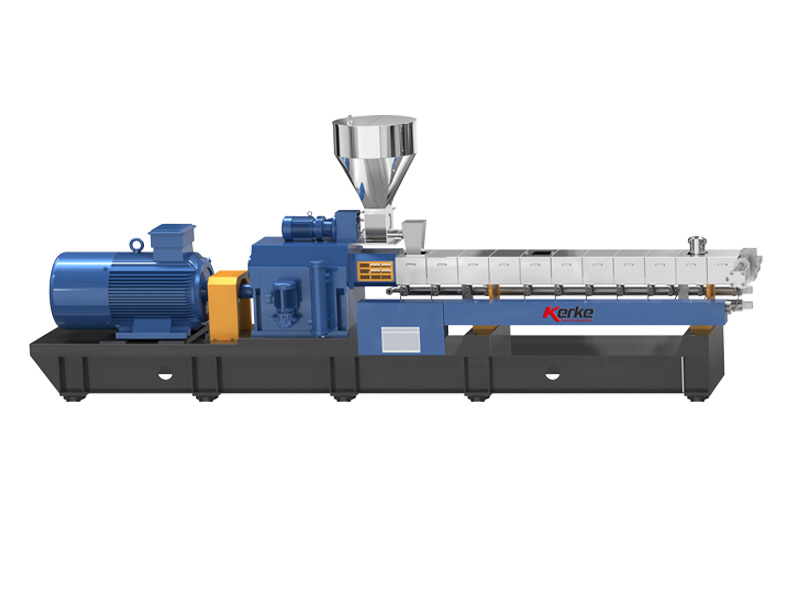
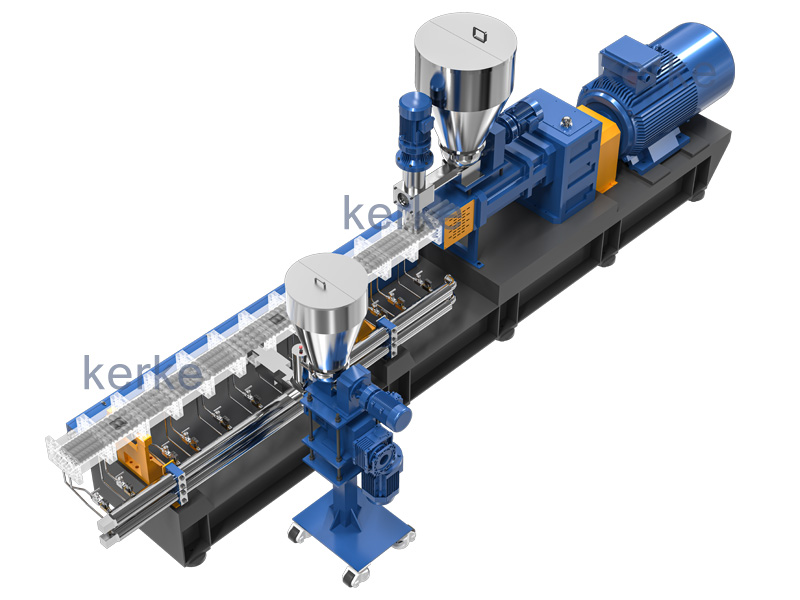
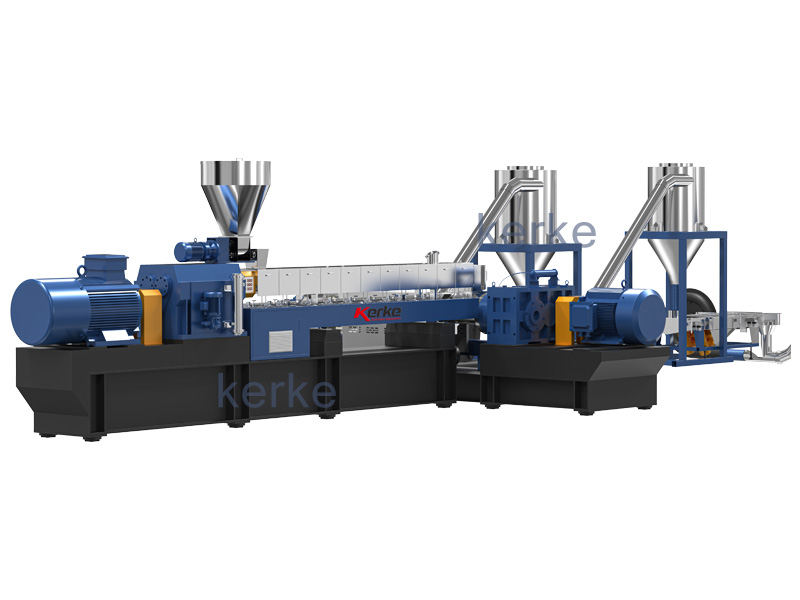
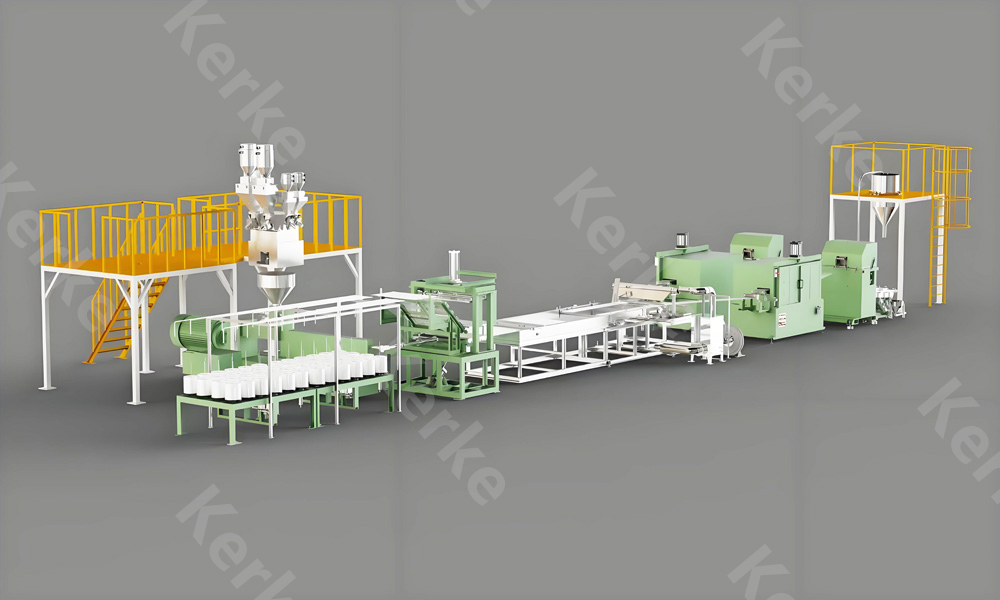
The twin-screw extruder, with its excellent material conveying, mixing plasticization, and shear dispersion capabilities, has become the core equipment for the production of various types of masterbatch such as color masterbatch, filling masterbatch, and functional masterbatch. The quality stability (such as dispersion uniformity, particle size consistency), performance compliance rate, and production efficiency of masterbatch products are closely related to the key equipment parameter settings of the extruder. The production demand for different types of masterbatch (such as high filling amount filling masterbatch, high coloring power color masterbatch, and thermosensitive functional masterbatch) varies greatly, and targeted optimization of equipment parameters is needed. This article will systematically sort out the core equipment parameters that need to be focused on when producing various types of masterbatch using twin-screw extruders, and analyze their impact mechanism on masterbatch production.
I. Screw System-Related Parameters
The screw system is the “core heart” of the twin-screw extruder. Its parameters directly determine the shear strength, mixing effect, and conveying efficiency of materials, and are the key factors affecting the dispersion quality of masterbatches.
1. Screw Speed
Screw speed is the core parameter for adjusting shear strength and production efficiency, usually expressed in r/min. The higher the speed, the greater the shear rate of the screw on the material, and the stronger the mechanical shear force on the material, which helps break the agglomerates of fillers or pigments and improve their dispersion uniformity in the carrier resin; at the same time, high speed can increase the material conveying capacity and improve production efficiency. However, it should be noted that the speed is not as high as possible: excessively high speed will lead to too short residence time of the material in the barrel, which may cause insufficient plasticization of the material, resulting in problems such as undercooked interior of the masterbatch and unstable performance; in addition, high speed will also aggravate the wear of the screw and barrel and increase energy consumption, especially for high-hardness filler masterbatches (such as calcium carbonate and talc filler masterbatches), the wear problem is more prominent.
Different masterbatches have significant differences in speed requirements: when producing high-tinting-strength color masterbatches, a higher speed is required to ensure sufficient dispersion of pigments; when producing heat-sensitive functional masterbatches (such as biodegradable masterbatches and flame-retardant masterbatches), a lower speed should be controlled to avoid material degradation caused by excessive shear heat generation; when producing high-fill masterbatches, it is necessary to balance the speed and filling amount to ensure uniform dispersion of fillers while avoiding poor material conveying.
2. Screw Configuration
The screw of a twin-screw extruder is usually composed of modular components such as conveying elements, shear elements, and mixing elements. The rationality of the screw configuration directly affects the entire process effect of material “conveying-plasticizing-mixing-dispersing”. When producing different types of masterbatches, the screw configuration needs to be adjusted according to the material properties:
- Conveying elements (such as forward-threaded elements): mainly responsible for the forward conveying of materials to ensure production continuity. They are suitable for the feeding section and discharging section of materials, and need to be reasonably configured when producing various masterbatches to ensure stable material conveying.
- Shear elements (such as reverse-threaded elements, kneading blocks): provide strong shear force for breaking material agglomerates. When producing color masterbatches and high-dispersion functional masterbatches, the number or length of shear elements needs to be increased to improve the dispersion effect; however, when producing heat-sensitive masterbatches, the number of shear elements should be reduced to lower the shear strength and avoid material degradation.
- Mixing elements (such as toothed discs, internal mixing blocks): focus on the axial and radial mixing of materials to improve the uniformity of material components. When producing multi-component functional masterbatches (such as antioxidant-ultraviolet resistant composite masterbatches), the configuration of mixing elements needs to be strengthened.
3. Screw Length-Diameter Ratio (L/D)
The screw length-diameter ratio refers to the ratio of the effective length of the screw to the screw diameter, which directly determines the residence time of the material in the barrel and the plasticizing and mixing effects. A larger length-diameter ratio means a longer residence time of the material, more sufficient plasticization and mixing, and better dispersion effect, which is suitable for the production of masterbatches with high dispersion requirements (such as nano-filler masterbatches and high-concentration color masterbatches); however, an excessively large length-diameter ratio will increase equipment cost and energy consumption, and for heat-sensitive materials, an excessively long residence time is likely to cause degradation. The length-diameter ratio of twin-screw extruders for conventional masterbatch production is usually between 32:1 and 48:1. For high-demand masterbatches, a larger length-diameter ratio (such as 40:1 to 48:1) can be selected, and for heat-sensitive masterbatches, a smaller length-diameter ratio (such as 32:1 to 36:1) can be used.
II. Barrel Temperature-Related Parameters
Barrel temperature is a key parameter to ensure the plasticizing quality of materials, which directly affects the melting state, viscosity, and chemical reaction activity of materials (such as the modification reaction of functional masterbatches). The barrel of a twin-screw extruder usually adopts segmented heating control (feeding section, plasticizing section, homogenizing section, head section). The temperature of each section needs to be accurately set according to the material properties and masterbatch type to avoid insufficient plasticization or excessive plasticization (degradation) problems.
1. Feeding Section Temperature
The core function of the feeding section is to preheat solid materials for subsequent plasticization, and the temperature setting needs to be moderate: if the temperature is too low, the material fluidity is poor, which is likely to cause feeding blockage and bridging, affecting production continuity; if the temperature is too high, the material is prone to premature melting and adhering to the screw or barrel inner wall, which also hinders feeding. For masterbatches produced with crystalline carrier resins (such as PP, PE), the feeding section temperature is usually set 50~80℃ below the resin melting point; for amorphous resins (such as PS, ABS), the feeding section temperature can be slightly higher than the glass transition temperature.
2. Plasticizing Section and Homogenizing Section Temperature
The temperature of the plasticizing section needs to be gradually increased to ensure complete melting of the material; the temperature of the homogenizing section needs to be stabilized 10~30℃ above the resin melting temperature to ensure uniform viscosity of the molten material, laying a foundation for subsequent mixing, dispersion, and granulation. When producing different masterbatches, the temperature setting needs to be adapted to the carrier resin and functional component properties:
- Color masterbatches: It is necessary to ensure sufficient dispersion of pigments in the molten resin. The temperature needs to be slightly higher than the melting point of the carrier resin, and excessive temperature should be avoided to prevent pigment decomposition (for example, organic pigments usually have poor heat resistance, and the temperature should be controlled below 200℃).
- Filler masterbatches: For inorganic fillers such as calcium carbonate and talc, the temperature needs to ensure complete melting of the carrier resin to wrap the fillers. The temperature is usually close to the processing temperature of pure resin, but excessive temperature should be avoided to prevent resin degradation.
- Heat-sensitive functional masterbatches (such as biodegradable masterbatches, PVC masterbatches): The temperature of the plasticizing section and homogenizing section must be strictly controlled, and a “low-temperature slow plasticization” strategy is usually adopted to avoid material degradation leading to odor or performance degradation.
3. Head Section Temperature
The head section temperature directly affects the fluidity of the molten material and the granulation quality. If the temperature is too high, the material fluidity is too strong, which is prone to adhesion and uneven particle size during granulation; if the temperature is too low, the material viscosity is high, the extrusion resistance increases, which is likely to cause excessive head pressure and even strand breakage. The head section temperature is usually 5~10℃ slightly lower than the homogenizing section temperature to ensure that the material maintains good fluidity and is not easy to adhere.
III. Feeding System-Related Parameters
The core function of the feeding system is to stably convey materials such as carrier resin, functional components (pigments, fillers, additives) into the extruder barrel in proportion. The stability of feeding parameters directly affects the component uniformity and quality consistency of the masterbatch.
1. Feeding Rate
Feeding rate refers to the mass or volume of material fed into the barrel per unit time, usually expressed in kg/h, which needs to be coordinated with the screw speed and barrel temperature. If the feeding rate is too fast, the residence time of the material in the barrel is shortened, resulting in insufficient plasticization and dispersion, and easy instability of masterbatch performance; if the feeding rate is too slow, the production efficiency is low, and it may cause the screw to idle, aggravating equipment wear. When producing masterbatches with different output requirements, the feeding rate needs to be accurately adjusted to ensure that it matches the processing capacity of the extruder.
2. Multi-Component Feeding Ratio Accuracy
The production of masterbatches usually requires the coordinated feeding of multi-component materials (carrier resin, functional powder, additives). The accuracy of the feeding ratio directly determines the functional qualification rate of the masterbatch (such as the tinting strength of color masterbatches, the filling amount of filler masterbatches, and the modification effect of functional masterbatches). High-precision feeders (such as loss-in-weight feeders) should be selected and calibrated regularly to ensure that the error of the feeding ratio of each component is controlled within ±1%. For example, excessive deviation in the feeding ratio of pigments during the production of high-concentration color masterbatches will lead to fluctuations in the tinting strength of the color masterbatches, affecting the color difference of downstream products; insufficient feeding ratio of flame retardants during the production of flame-retardant masterbatches will lead to unqualified flame-retardant performance.
IV. Vacuum Venting-Related Parameters
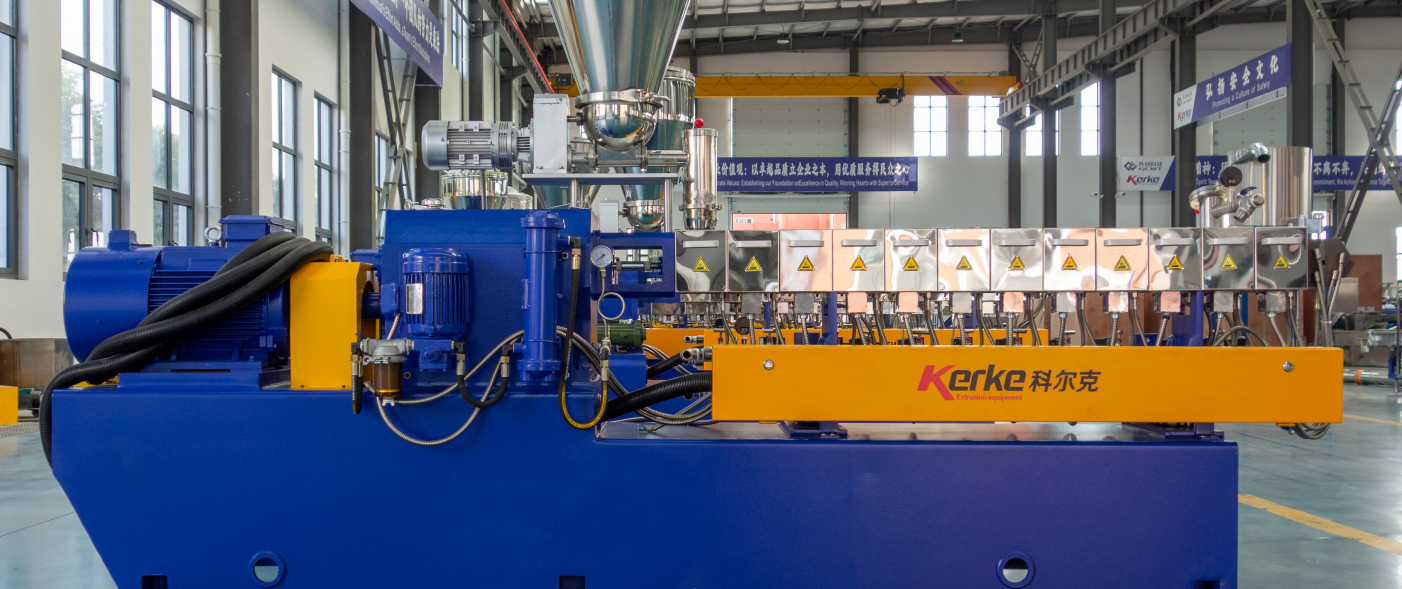
Twin-screw extruders are usually equipped with 1~2 stages of vacuum venting devices. Their core function is to discharge volatile components (such as moisture, low-molecular additives, residual solvents) generated during the plasticization process of materials, avoiding the formation of bubbles inside the masterbatch caused by these volatile components, which affects the compactness and mechanical properties of the masterbatch.
1. Vacuum Degree
Vacuum degree is the core parameter to measure the venting effect, usually expressed in MPa (negative pressure). The higher the vacuum degree, the better the venting effect, which is suitable for the production of masterbatches containing volatile components or hygroscopic materials (such as inorganic fillers of filler masterbatches are easy to absorb moisture, pigments of color masterbatches may have residual solvents, and additives of functional masterbatches may volatilize). For conventional masterbatch production, the vacuum degree is usually set between -0.06~-0.08MPa; for high-demand masterbatches (such as electronic-grade functional masterbatches), the vacuum degree needs to be increased to -0.09~-0.095MPa to ensure sufficient discharge of volatile components. However, it should be noted that excessively high vacuum degree may cause a small amount of light materials to be extracted, resulting in material loss and environmental pollution, which needs to be reasonably controlled.
2. Position and Number of Venting Sections
The position of the venting section should be set after the material is completely melted and before homogenization to ensure that volatile components can be released from the molten material and discharged; for materials with high volatile content, a two-stage venting device can be set to improve the venting effect. For example, when producing soft masterbatches containing a large amount of low-molecular plasticizers, setting two-stage venting can effectively reduce the residual amount of plasticizers in the masterbatches and avoid migration during subsequent use.
V. Head Pressure and Die-Related Parameters
Head pressure and die structure directly affect the extrusion stability of molten materials and the granulation quality, and are important guarantees for the uniformity of masterbatch particle size.
1. Head Pressure
Head pressure is the resistance when the molten material passes through the head and die, usually expressed in MPa. Its stability directly affects the uniformity of the extruded strands. Excessively high head pressure is likely to cause excessive load on the extruder and even equipment failure; excessively low pressure leads to unstable material extrusion speed, which is prone to strand breakage or uneven strand thickness. When producing different masterbatches, the head pressure is usually controlled between 10~30MPa. It is necessary to adjust the screw speed, feeding rate, and head temperature to ensure that the pressure is stabilized within a reasonable range. For example, when producing masterbatches with high-viscosity carrier resins, the head pressure is usually relatively high, and the head temperature needs to be appropriately increased to reduce material viscosity and stabilize pressure.
2. Die Structure and Aperture
The die is a key component for material extrusion molding. Its structure and aperture need to be designed according to the particle size requirements of the masterbatch. Conventional masterbatch production usually uses a circular hole die with an aperture range of 2~4mm. The uniformity of the aperture directly determines the thickness consistency of the extruded strands, thereby affecting the particle size uniformity of subsequent granulation. For special-shaped masterbatches (such as flat and square masterbatches), corresponding shaped dies should be selected; for ultra-fine masterbatches, smaller aperture dies should be selected, combined with high-precision granulation equipment. In addition, the die needs to be cleaned regularly to avoid material residue blocking the aperture and affecting extrusion stability.
VI. Conclusion: The Importance of Parameter Synergy Optimization
When producing various masterbatches with twin-screw extruders, the above equipment parameters do not exist in isolation but interact and restrict each other. For example, when increasing the screw speed, it is necessary to adjust the feeding rate and barrel temperature accordingly to ensure sufficient plasticization and uniform dispersion of materials; when increasing the filler content, it is necessary to optimize the screw configuration (increase conveying elements, adjust shear elements), and improve feeding accuracy and vacuum degree to avoid filler agglomeration and material gas content.
In actual production, it is necessary to carry out synergistic optimization of parameters according to the type of masterbatch (color masterbatch, filler masterbatch, functional masterbatch), carrier resin properties, functional component requirements, and output requirements: determine the basic parameter range through small-scale tests, then conduct debugging through pilot-scale and mass production, and finally determine the optimal parameter combination to achieve the goals of stable masterbatch quality, improved production efficiency, and reduced equipment wear. In the future, with the development of intelligent extrusion technology, real-time monitoring of equipment parameters (such as head pressure, temperature, feeding amount) and automatic adjustment will further improve the accuracy and stability of masterbatch production.