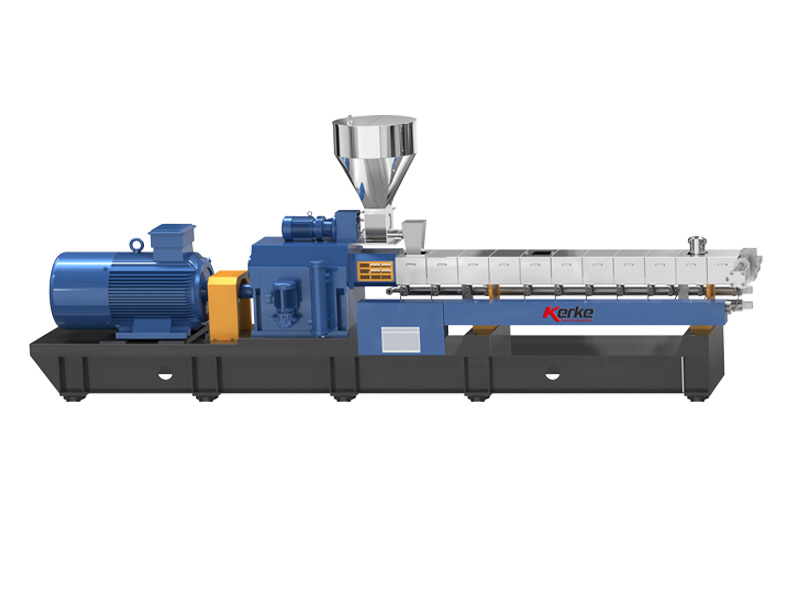
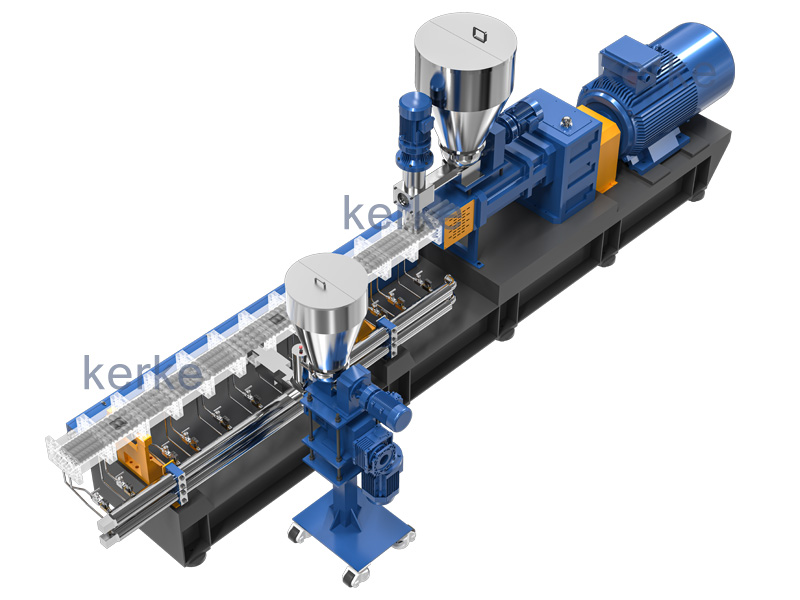
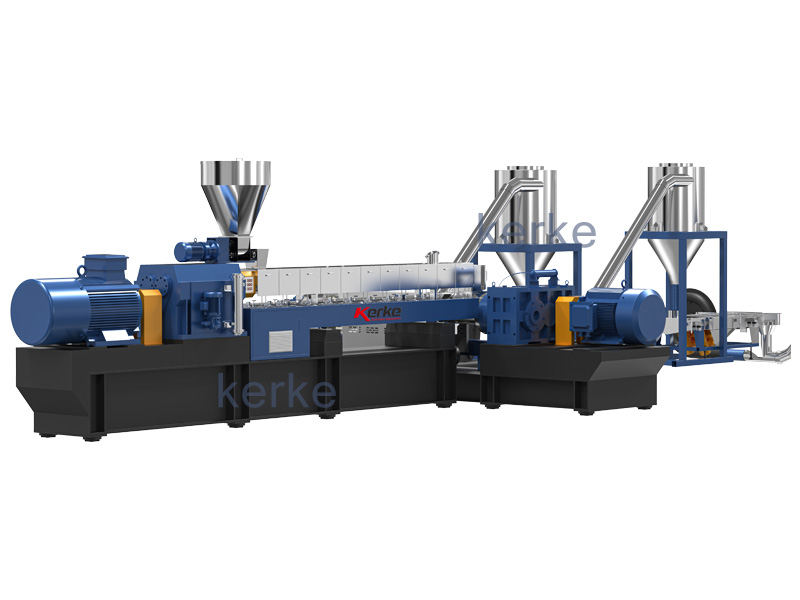
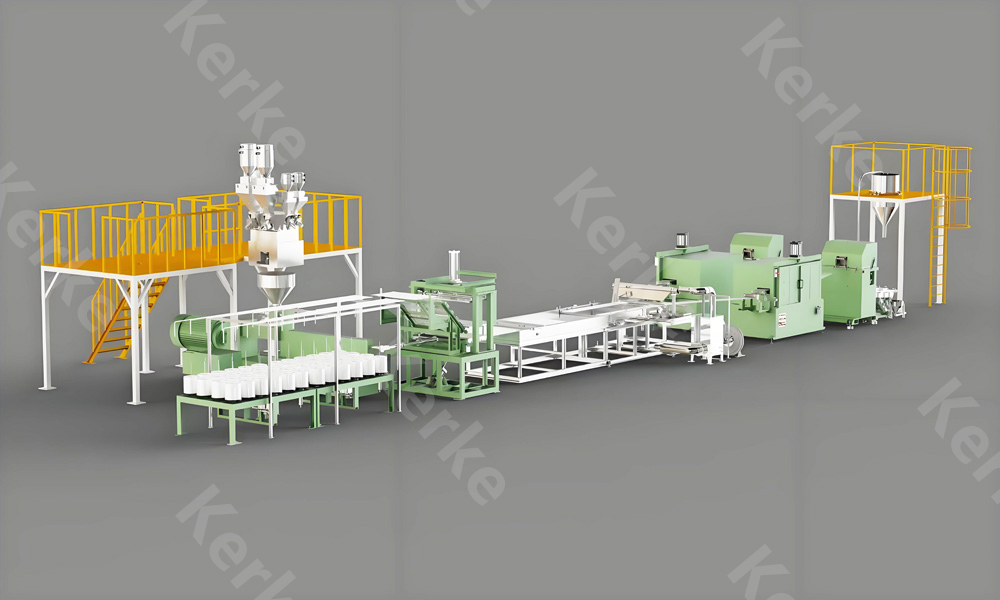
PET color masterbatch is a granular coloring material made by uniformly dispersing high concentrations of pigments, dyes, or functional additives into a PET carrier resin. It is widely used in the dope dyeing of polyester fibers, as well as the coloring of plastic bottles, sheets, and films. In the production of PET color masterbatch, the parallel twin-screw extruder has become the most core production equipment due to its excellent mixing and dispersion capabilities, precise temperature control system, and modular design. This article will systematically elaborate on the process principles, technical key points, and critical parameters of PET color masterbatch production using a parallel twin-screw extruder.
I. Basic Principles of PET Color Masterbatch Production
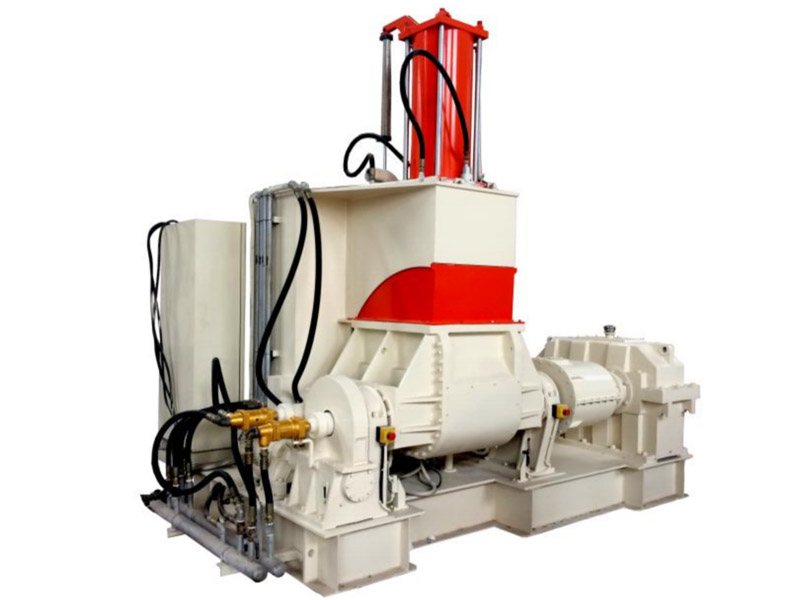
The preparation of PET color masterbatch is essentially a process of achieving uniform dispersion of pigments, carrier resin, and various additives through melt blending. The core process route is: after drying, PET resin, pigments, dispersants, coupling agents, antioxidants, and other raw materials are weighed according to the formula ratio and fed into a high-speed mixer for pre-mixing, allowing the pigment to be initially coated. The pre-mixed material is then sent into a twin-screw extruder for melt blending, extrusion, cooling, and pelletizing, ultimately yielding PET color masterbatch.
In the formula, PET powder typically accounts for 72%~78%, colorant can account for up to 20%, elastomer toughening agent is 1%~7%, with 0.5% antioxidant and 0.5% coupling agent added. The pigment must undergo surface treatment to ensure uniform dispersion .
II. Core Advantages of the Parallel Twin-Screw Extruder
1. Excellent Mixing and Dispersion Capability
The parallel twin-screw extruder uses two parallel, intermeshing screws. The material forms a “∞”-shaped flow between the two screws, continuously undergoing shearing, stretching, folding, and recombining. This flow pattern ensures that each portion of material experiences a similar shear history and thermal history, resulting in consistent plasticization from feed to discharge. During the melting stage, the kneading blocks and toothed disc elements together generate powerful shear forces, effectively breaking up pigment agglomerates and achieving uniform dispersion and mixing .
2. Modular Building Block Design
The screws and barrel of the parallel twin-screw extruder adopt a modular (building block) design principle. Screw elements include conveying blocks, mixing blocks, kneading blocks, reverse flow blocks, and toothed discs. According to the requirements of the processing material system and process formula, the screw length-to-diameter ratio, barrel structure, screw arrangement, and venting position can be flexibly adjusted to achieve the entire process of material conveying, plasticizing, shearing, dispersing, homogenizing, venting, and pressure building . This design adapts to the multi-variety, small-batch needs of PET color masterbatch production and facilitates cleaning during frequent color changes.
3. Self-Cleaning Function
Co-rotating twin-screw extruders have excellent self-cleaning performance. Through proper intermeshing of screw elements, the material surface is continuously renewed between the screws, preventing material from stagnating, caking, or decomposing on the barrel inner wall or screws. For color masterbatch production that requires frequent color changes, the self-cleaning function significantly reduces downtime for cleaning and improves production efficiency .
4. Precise Temperature Control System
PET is an engineering plastic carrier sensitive to shear heat and residence time, with a relatively narrow processing temperature window. Too high a temperature can easily lead to resin degradation or color change, while too low a temperature affects mixing effectiveness. Parallel twin-screw extruders typically use multi-stage closed-loop temperature control systems, with each barrel section having independent heating and cooling systems. Combined with efficient heat exchange design, temperature fluctuations can be controlled within ±1℃ . When producing PET color masterbatch, the melting temperature is usually controlled between 240~290℃, and the specific temperature needs to be finely adjusted according to the formula and process requirements.
III. Process Key Points for PET Color Masterbatch Production
1. Raw Material Pretreatment
PET resin is hygroscopic and must be thoroughly dried before processing. A typical process is: dry PET powder in an oven at 80℃ for 8 hours, then raise the temperature to 120℃ and continue drying for 4 hours to control the moisture content below 80 ppm. If the moisture content is too high, it will cause PET hydrolysis and degradation during high-temperature melting, seriously affecting the mechanical properties and color stability of the masterbatch .
2. Pre-Mixing Process
Pre-mixing is a key pre-step to ensure dispersion effectiveness. First, weigh the colorant, coupling agent, and antioxidant according to the formula ratio, add them to a high-speed mixer at 500~2000 r/min, and mix for 5~10 minutes. Then add the PET powder and elastomer toughening agent according to the formula ratio, and mix again for 5~10 minutes to obtain the pre-mix. Through pre-mixing, the pigment particle surface is initially wetted and coated by the additives, reducing the difficulty of subsequent dispersion in the twin-screw extruder .
3. Twin-Screw Extrusion Process Parameters
Screw Configuration: The screw configuration design needs to configure different functional sections according to material characteristics. The feeding section uses conveying screw elements to ensure stable material advancement. The compression section uses kneading blocks and reverse thread elements to generate shear force, achieving pigment agglomerate breakage. The metering section uses forward thread elements to control melt pressure and temperature, ensuring full material plasticization.
Length-to-Diameter Ratio: The L/D ratio for twin-screw extruders used in PET color masterbatch production is typically 40:1~48:1. A larger L/D ratio means longer residence time and more thorough mixing, but it also increases energy consumption and the risk of material degradation. The choice must be balanced according to the specific formula .
Screw Speed: Screw speed affects shear intensity and material residence time. Increasing speed enhances shear effects and promotes dispersion, but excessive shear can lead to PET molecular chain breakage. In typical processes, screw speed is controlled at 100~250 r/min or 150~180 r/min .
Temperature Control: The twin-screw extrusion processing temperature for PET color masterbatch is usually controlled at 240~290℃. Temperature must be set in stages: the feeding section temperature should mainly soften the resin, avoiding premature melting that could cause screw slippage; the compression section and metering section temperatures gradually increase, promoting pigment diffusion in the melt; at the same time, avoid excessively high temperatures that could cause resin degradation or pigment discoloration .
Venting and Devolatilization: In PET color masterbatch production, the barrel is usually equipped with natural venting ports and vacuum venting ports to remove moisture, air, and small molecule volatiles entrained in the material. The vacuum devolatilization system can effectively remove bubbles, ensuring the compactness of the finished particles and preventing hollow particles .
4. Pelletizing and Cooling
After the melt is extruded through the die, it can be cooled and shaped using water-cooled strand pelletizing, underwater pelletizing, or die-face hot cutting. Water-cooled strand pelletizing is a common method for PET color masterbatch: the material is extruded from the die into strands, cooled and solidified in a cooling water tank, then dried by an air dryer to remove surface moisture, and finally cut into uniform particles by a pelletizer. For high-concentration pigment formulas, the strands may be brittle, and underwater pelletizing can be considered to ensure production continuity.
IV. Typical Application Cases
Case 1: Masterbatch for Dope-Dyed Elastic Polyester Fiber
A patent from Beijing University of Chemical Technology discloses a method for preparing dope-dyed elastic polyester fibers. In this process, the PET color masterbatch formula is: PET powder 72%~78%, colorant 20%, PBE elastomer (ethylene-propylene copolymer) 1%~7%, antioxidant 0.5%, coupling agent 0.5%. The twin-screw extruder uses a co-rotating parallel twin-screw with an L/D ratio of 32:1~48:1, processing temperature of 270~290℃, and screw speed of 100~250 r/min. The prepared masterbatch, when mixed with PET pellets at a ratio of 2:98 for spinning, yields colored polyester fibers with high color fastness, bright colors, and good elasticity .
Case 2: Nano-Calcium Carbonate Composite Recycled PET Color Masterbatch
Another patent prepares a nano-calcium carbonate composite recycled PET color masterbatch. The formula is: recycled PET masterbatch 77.7%, nano-calcium carbonate 2%~5%, pigment 20%~23%, PET chain extender 0.3%, dispersant 2%. The twin-screw extruder screw speed is 150~180 r/min, and the melting temperature is 240~260℃. The prepared masterbatch achieves good dispersion and coloring power while ensuring environmental friendliness and recyclability .
V. Quality Control and Common Issues
1. Pigment Dispersion
Uneven pigment dispersion is the most common quality issue in PET color masterbatch production, manifesting as color spots, streaks, or insufficient coloring power. Solutions include: optimizing the pre-mixing process, adjusting the screw configuration to increase the shear section, appropriately raising the processing temperature, or reducing the screw speed to extend residence time.
2. Moisture Content Control
PET is extremely sensitive to moisture, and the moisture content of the finished masterbatch must be controlled below 0.02%. If drying is insufficient, PET will undergo hydrolytic degradation during melting, leading to a drop in intrinsic viscosity, and in severe cases, causing strand breakage or brittle products.
3. Color Change Cleaning
Color masterbatch production requires frequent color changes. The self-cleaning capability and modular design of the parallel twin-screw extruder greatly facilitate color change operations. When changing colors, cleaning compound can be used to purge the system. For thorough cleaning, some models use a split-barrel design, allowing the barrel and screws to be quickly separated for complete cleaning, preventing color cross-contamination .
VI. Conclusion
The parallel twin-screw extruder is the core equipment for PET color masterbatch production. Its excellent mixing and dispersion capabilities, precise temperature control system, modular building block design, and self-cleaning function perfectly match the process requirements of PET color masterbatch for high dispersion, uniform coloring, and flexible color changes. By reasonably selecting the raw material formula, optimizing the pre-mixing process, precisely setting the screw configuration and temperature parameters, and strictly controlling the drying and pelletizing stages, high-quality PET color masterbatch can be stably produced. As the demand for high-concentration, multi-functional, and environmentally friendly color masterbatches grows in the plastics industry, the application of parallel twin-screw extruders in PET color masterbatch production will continue to deepen and expand.