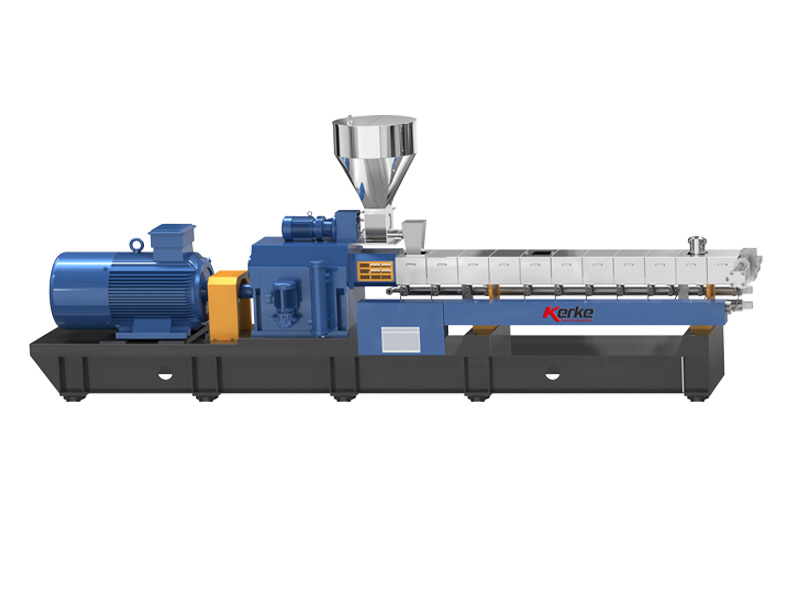
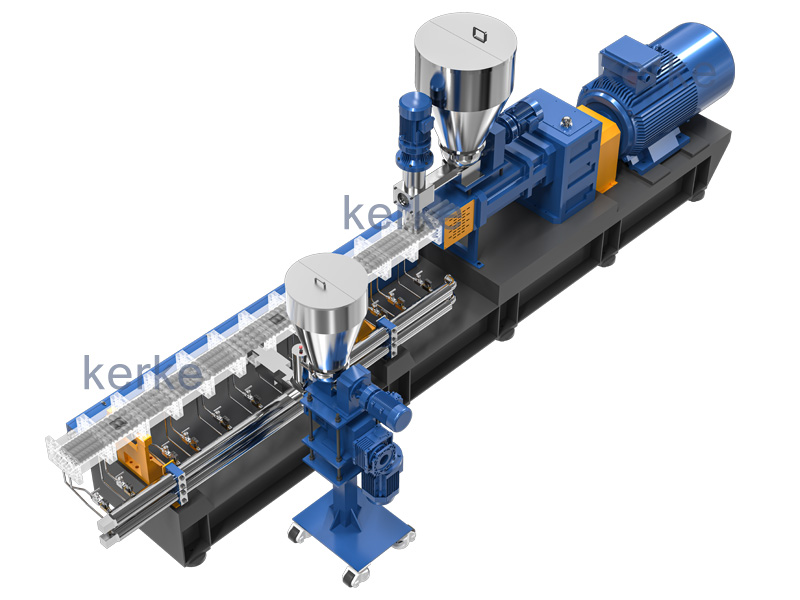
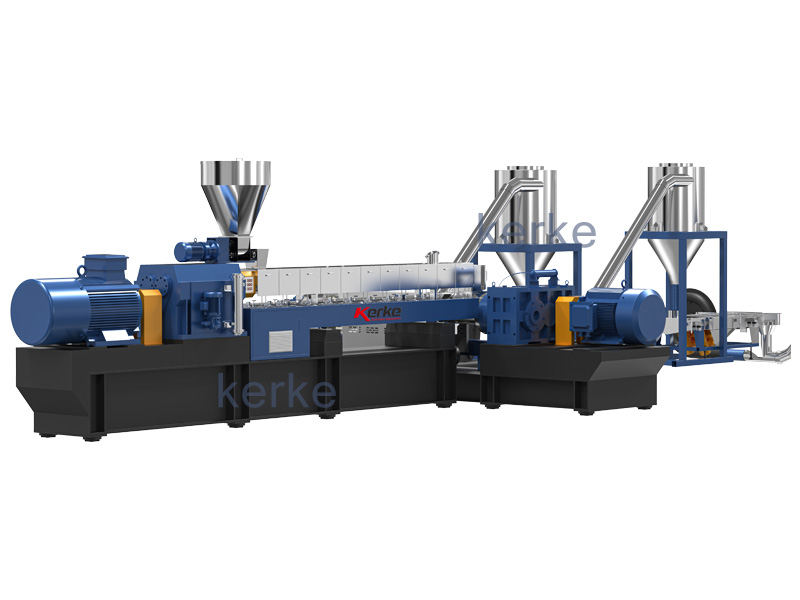
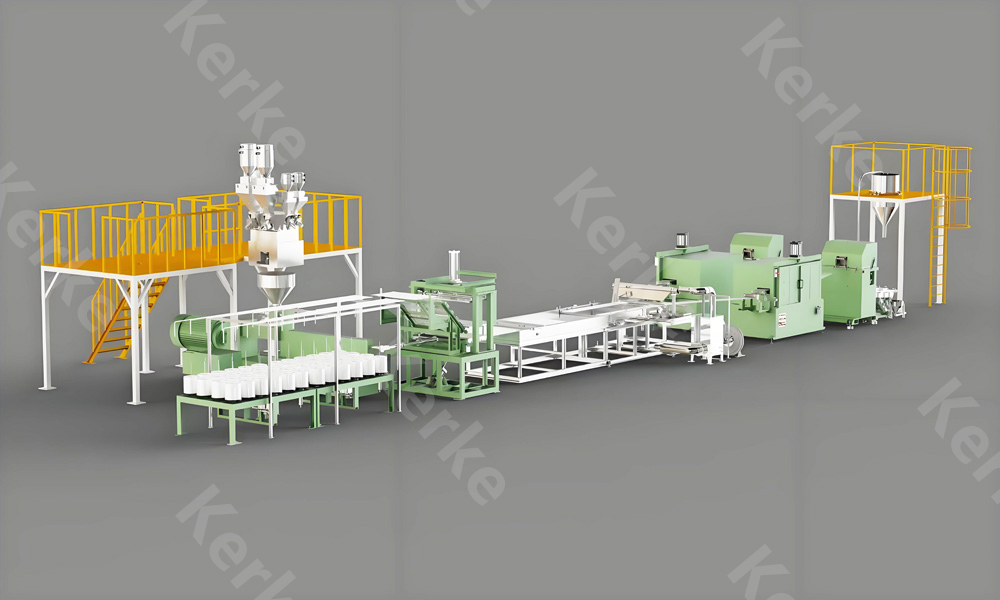
The core of calcium carbonate filled masterbatch production is to achieve uniform dispersion, sufficient plasticization and stable molding of calcium carbonate powder and carrier resin. As a key core equipment, the twin-screw extruder’s structural design, performance parameters and auxiliary configuration must accurately adapt to the material characteristics of calcium carbonate (high wear resistance, easy agglomeration, poor powder fluidity) and production process requirements. The specific requirements are as follows, taking into account both versatility and particularity of different filling scenarios.
I. Requirements for Core Structural Components
(I) Requirements for Screw System
The screw is the core executive component of the extruder, which must simultaneously meet the requirements of strong shear dispersion, stable conveying, wear resistance and adaptation to different filling rates. It is the key to determining the uniformity of masterbatch dispersion and product quality.
- Meshing Type and Rotation Direction: Co-rotating fully intermeshing twin screws are preferred, with the meshing gap controlled within 0.1mm. Its “material dragging effect” can generate strong and uniform shear force, effectively solving the problem of calcium carbonate powder agglomeration, while ensuring the stability of material conveying. Due to insufficient shear strength and poor dispersion effect, counter-rotating meshing models are only suitable for simple production scenarios with low filling rate (≤50%) and are generally not recommended.
- Length-Diameter Ratio (L/D): It needs to be adjusted according to the calcium carbonate filling rate. For conventional filling (50%-70%), the recommended length-diameter ratio is 48-52; for high filling (70%-85%), it needs to be increased to 52-56 to extend the residence time of materials in the barrel (8-15s), ensuring full wetting and uniform plasticization of calcium carbonate powder and carrier resin, and avoiding white spots and agglomeration of masterbatches caused by insufficient mixing. Excessively large length-diameter ratio is likely to cause excessive degradation of materials, while excessively small one will lead to poor dispersion effect.
- Screw Material and Wear-Resistant Treatment: Calcium carbonate powder has high hardness and strong wear on the screw, so high wear-resistant materials and strengthening treatment processes must be selected. The screw body is recommended to be made of W6Mo5Cr4V2 high-speed tool steel, and the surface is subjected to nitriding treatment (nitriding layer depth 0.4-0.6mm, hardness ≥900HV) or WC-Co wear-resistant coating spraying. The core mixing section can adopt an integral alloy structure to ensure that the service life is 2-3 times that of ordinary bimetallic screws under the working condition of 80% calcium carbonate filling. The use of ordinary carbon steel or unstrengthened alloy steel should be avoided to prevent screw wear and screw edge deformation in a short period of time, which will affect the conveying and dispersion effect.
- Screw Block Configuration and Combination: Modular screw block design is adopted, which can flexibly adjust the screw block combination according to the formula and filling rate, following the core logic layout of “conveying – mixing – dispersing – homogenizing”. The feeding section adopts large-lead screw blocks to improve powder conveying efficiency and avoid feeding blockage; the mixing section is equipped with 45°/60° kneading blocks and reverse thread elements to enhance shear dispersion capacity and completely break up calcium carbonate agglomerates; the homogenizing section adopts shallow groove screw blocks to ensure uniform plasticization and stable pressure of materials before extrusion. For high filling scenarios, the number of kneading blocks needs to be increased to enhance the shearing effect; for film-grade masterbatch production, the screw block combination needs to be optimized to reduce shear strength and avoid excessive breakage of carrier resin molecular chains.
- Speed Range: The screw speed must be adjustable and stable, with a conventional speed range of 150-300rpm to adapt to different output requirements. For low filling rate production, the speed can be appropriately increased (250-300rpm) to improve production efficiency; for high filling rate (≥80%), the speed needs to be reduced (150-200rpm) to extend the plasticization and dispersion time and balance output and product quality. The speed fluctuation must be controlled within ±1rpm to avoid extrusion pressure fluctuation caused by unstable speed, which will affect the uniformity of masterbatch particle size.
(II) Requirements for Barrel System
The barrel must match the screw, meet the requirements of wear resistance, uniform temperature control and good sealing, and provide a stable cavity environment for material plasticization and dispersion.
- Material and Wear-Resistant Treatment: The barrel body is made of 38CrMoAlA nitrided steel, and the core mixing section and melting section are equipped with Cr26MoV integral alloy sleeves (thickness >10mm, hardness HRC60+). Its wear resistance is much better than that of ordinary bimetallic barrels (only 1-2mm alloy layer), which can effectively resist the scouring wear of calcium carbonate powder and avoid material retention and degradation caused by barrel inner wall wear. The inner wall of the barrel must be smooth with surface roughness Ra≤0.8μm to reduce material adhesion and flow resistance.
- Structural Design: Segmented modular design is adopted, with each segment length ≤1.5m, which is convenient for disassembly, maintenance and replacement of worn segments, and the barrel length can be adjusted according to production needs (to adapt to different length-diameter ratios). The radial gap between the barrel and the screw is controlled at 0.1-0.3mm; small gap is adopted for low filling rate (to improve pressure building capacity), and large gap is adopted for high filling rate (to reduce shear heat generation and wear). The feeding port adopts an inverted cone design (cone angle 60°-90°) and is equipped with an anti-bridging device to solve the problem of poor fluidity, easy agglomeration and blockage of the feeding port of calcium carbonate powder.
- Sealing Performance: Metal bellows sealing is adopted at the barrel flange to ensure no melt leakage under high temperature and high pressure conditions, and to compensate for the deformation caused by thermal expansion and contraction. The connection between the feeding port and the barrel must be well sealed to prevent dust leakage, reduce dust pollution in the production environment, and avoid air entering the barrel affecting material plasticization.
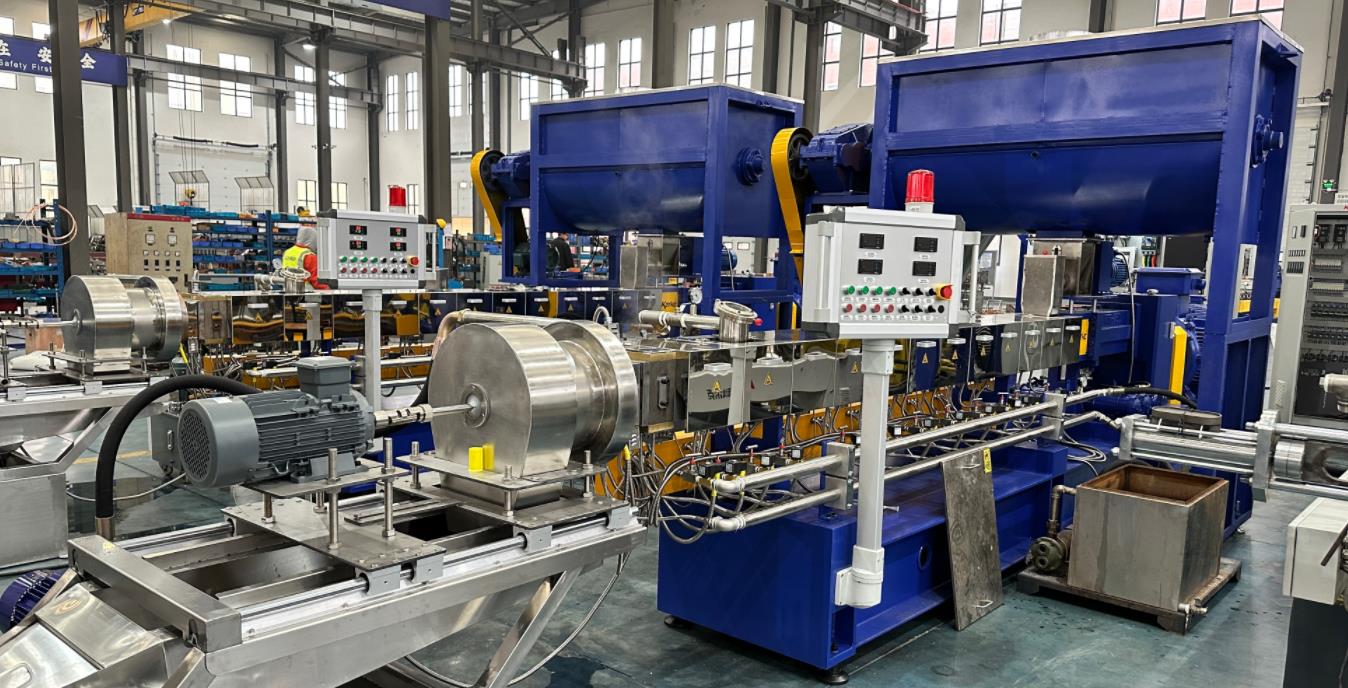
II. Requirements for Feeding System
The uniformity of feeding directly affects the composition consistency and dispersion effect of masterbatches. A special feeding system must be configured according to the characteristics of calcium carbonate powder and production scale to solve the problems of powder feeding air return, bridging and inaccurate measurement.
- Feeding Method: The combined method of “main feeding + side feeding” is adopted to adapt to the step-by-step feeding needs of different components. The main feeding port conveys carrier resin (PE/PP, etc.), and the side feeding port specially conveys pre-treated calcium carbonate powder, which can effectively avoid the decrease of fluidity and uneven feeding caused by premature mixing of powder and resin. For high filling scenarios (≥80%), a CWS twin-screw side feeder needs to be configured to discharge air in the powder through forced feeding and reverse exhaust grooves, eliminating the phenomenon of “feeding air return”.
- Type of Feeder: It is selected according to the production accuracy requirements. For small-scale production with frequent formula replacement, a volumetric feeder can be selected with a feeding accuracy of ±3%; for large-scale continuous production, high filling or high-precision requirements (such as film-grade masterbatches), a loss-in-weight feeder must be selected with a feeding accuracy of ±0.5%, equipped with automatic refueling and closed-loop control systems to adjust the feeding amount in real time, ensuring accurate and stable ratio of calcium carbonate to carrier resin.
- Auxiliary Design: The feeder hopper must be equipped with a stirring paddle and a vibration device to prevent agglomeration and bridging of calcium carbonate powder; the feeding screw adopts a special Undercut grooved bushing to enhance the material grabbing capacity and avoid screw slipping and output reduction caused by lubricant addition. The feeding system is linked with the main machine screw speed to ensure that the feeding amount matches the extrusion amount, avoiding material overload or idling in the barrel.
III. Requirements for Temperature Control System
The accuracy and uniformity of temperature control directly affect the plasticization effect of carrier resin, the dispersion of calcium carbonate and the appearance quality of masterbatches. It is necessary to realize partitioned precise temperature control to avoid local overheating or insufficient plasticization.
- Temperature Control Zones: The barrel is divided into at least 4 temperature control zones (feeding zone, plasticizing zone, mixing zone, head zone), and the screw core can be independently temperature-controlled to realize the “barrel + screw” dual temperature control mode. The temperature of different zones is set in a gradient according to the type of carrier resin. The temperature range of conventional PE/PP carriers is: feeding zone 120-140℃ (to prevent material bridging and premature melting), plasticizing zone 140-160℃ (initial melting of carrier resin to wet calcium carbonate powder), mixing zone 160-180℃ (sufficient plasticization and mixing to break up agglomerates), head zone 170-190℃ (stable molding to avoid melt degradation).
- Temperature Control Accuracy: The overall temperature control accuracy must reach ±1℃, and the temperature fluctuation ≤2℃ to avoid carrier resin degradation and masterbatch yellowing caused by local overheating, or insufficient plasticization and unmelted particles in masterbatches caused by local low temperature. The heating device adopts cast aluminum heater or ceramic heater with power density ≤4W/cm² to prevent local overheating. The cooling system adopts a combination of water cooling (water pressure 0.3-0.5MPa) and air cooling, and the feeding zone is strengthened with cooling (water temperature ≤25℃), and the mixing zone and head zone are cooled on demand to ensure stable temperature.
- Energy Saving and Protection: A waste heat recovery system is equipped to use the waste heat from barrel cooling for preheating the feeding zone, reducing energy consumption by 15%-20%. A temperature interlock protection is set; when the barrel temperature exceeds the set value by 10℃, the cooling device is automatically started and an alarm is given, and the machine is shut down if necessary to prevent equipment damage and product scrapping.
IV. Requirements for Exhaust System
After pre-treatment, calcium carbonate powder may still retain trace moisture and auxiliary volatiles, and air is easily brought in during the feeding process. These impurities will cause bubbles inside the masterbatch and rough surface, affecting the masterbatch quality. Therefore, the exhaust system must meet the requirements of efficient exhaust.
- Exhaust Structure: “Single-stage or multi-stage vacuum exhaust” design is adopted. At least 1 exhaust port (located at the rear of the mixing section) is set for conventional production. 2-3 exhaust ports are required for high filling and high-precision requirements (such as film-grade masterbatches) to discharge volatiles and air generated at different stages respectively. The exhaust port must be smoothly connected with the inside of the barrel to avoid material blocking the exhaust port.
- Vacuum Degree Requirement: The vacuum degree must be adjustable, with a range of -0.06~-0.09MPa, to ensure that trace moisture, auxiliary volatiles and air in the material can be completely pumped out. A high-vacuum exhaust chamber is equipped, which is especially suitable for film-grade masterbatch production, which can significantly improve the gloss of masterbatches and eliminate crystal points and bubbles during film forming.
- Auxiliary Design: The exhaust port is equipped with a dust collection device to prevent calcium carbonate dust from being discharged with waste gas, which pollutes the environment and causes raw material waste. An exhaust pressure monitoring is set; when the pressure is abnormal due to blockage of the exhaust port, an alarm is automatically given and cleaning is prompted to ensure continuous and stable production.
V. Requirements for Auxiliary Systems
(I) Requirements for Screen Changer
It is used to filter impurities in materials, undispersed calcium carbonate agglomerates and degraded resin, ensure the purity of extruded melt, and guarantee uniform masterbatch quality. A hydraulic automatic screen changer must be equipped to complete screen replacement without stopping the machine, avoiding production efficiency impact and material waste caused by shutdown for screen replacement. The screen mesh number is 80-120 mesh, which can be adjusted according to the masterbatch accuracy requirements. At the same time, a screen blockage alarm function is equipped to monitor the screen pressure in real time and remind timely replacement.
(II) Requirements for Pelletizing and Cooling System
The pelletizing and cooling effect directly affects the appearance, particle size uniformity and fluidity of masterbatches, which must be adapted to the extruder output and masterbatch use.
- Pelletizing Method: For conventional production, air-cooled die-face hot cutting process is recommended (output ≤300kg/h). A pelletizing knife is installed at the machine head with a speed of 300-800rpm, which is accurately matched with the extrusion speed. Cold air of 2-8℃ is introduced to quickly cool the particles, forming disc-shaped masterbatches with a diameter of 3-5mm and a thickness of about 1mm, which are easy to mix with the matrix resin later. For high-output production (>300kg/h), a conveyor belt cooling process can be adopted, through ≥15m long-distance air cooling + natural cooling to avoid particle adhesion. For high-precision requirements, water ring pelletizing or underwater pelletizing can be adopted, with round particles and no dust, suitable for fully automatic production lines above 2 tons per hour.
- Cooling Requirements: The temperature of the cooling medium (cold air, cooling water) is stable to avoid masterbatch deformation and adhesion caused by uneven cooling. The moisture content of the cooled masterbatch must be ≤0.2%; if the moisture content exceeds the standard, a secondary low-temperature drying device must be equipped to prevent bubbles during subsequent use.
(III) Requirements for Control System
A high-precision automatic control system must be equipped to realize precise regulation and stable operation of the production process and reduce manual operation errors.
- Control Function: It can real-time monitor and adjust key parameters such as screw speed, temperature of each section of the barrel, feeding amount, vacuum degree and extrusion pressure. All parameters can be digitally displayed and precisely adjusted, supporting parameter storage and calling, which is convenient for quick switching of different formulas and specifications of masterbatches.
- Linkage and Protection: The feeding system, extrusion system, pelletizing system and cooling system realize linkage control to ensure the coordinated operation of each link. It is equipped with alarm and protection functions such as overload, over-temperature, over-pressure, lack of material and screen blockage; when an abnormality occurs, the machine is automatically shut down to prevent equipment damage and product scrapping. For large-scale production, an Internet of Things module can be equipped to realize real-time monitoring of equipment operation status and predictive maintenance, reducing downtime by more than 30%.
VI. Adaptation Requirements for Different Production Scenarios
According to the different calcium carbonate filling rates and masterbatch uses, the configuration of the twin-screw extruder must be adjusted pertinently to ensure that the equipment adapts to the production needs and balances efficiency and quality.
- Conventional Filling (50%-70%): Suitable for general-purpose masterbatches such as injection molding and pipes. A co-rotating twin-screw extruder with Φ45-Φ65mm is selected, with a length-diameter ratio of 48-52, equipped with a volumetric feeder and single-stage vacuum exhaust, motor power of 110-160kW, and output of 250-600kg/h. There is no need to excessively strengthen the wear-resistant configuration, taking into account cost performance and production efficiency.
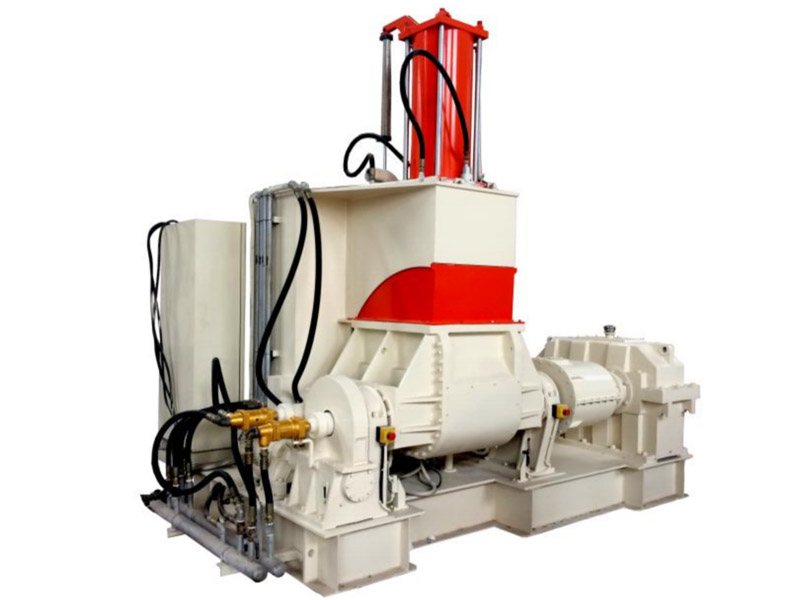
- High Filling (70%-85%): Suitable for low-cost masterbatches such as injection molding and flat yarn. A co-rotating twin-screw extruder with Φ65-Φ95mm is selected, with a length-diameter ratio of 52-56, equipped with a loss-in-weight feeder, multi-stage vacuum exhaust and Cr26MoV integral alloy barrel/screw, which can be matched with an internal mixer for pre-mixing, motor power of 160-600kW, and output of 450-1600kg/h. The shear dispersion and wear resistance are strengthened to ensure uniformity under high filling.
- Film-Grade Masterbatches: Suitable for packaging films, mulch films, etc., requiring masterbatches without crystal points and high transparency. A co-rotating twin-screw extruder with Φ52-Φ75mm is selected, with a length-diameter ratio of 52, equipped with a high-precision loss-in-weight feeder and a high-vacuum exhaust system (vacuum degree ≥-0.08MPa). The screw block combination is optimized to reduce shear strength, avoid resin degradation, and ensure that the masterbatch dispersion meets the standard without obvious agglomerates.
- Masterbatches for Flat Yarn and Woven Bags: Requiring masterbatches with high tensile strength. A twin-screw extruder with mild shear design is selected to reduce the breakage of carrier resin molecular chains and retain its mechanical properties. A stable pelletizing and cooling system is equipped to ensure uniform masterbatch particle size and avoid yarn breakage during flat yarn production.
VII. Other Key Requirements
- Wear-Resistant Maintenance: The equipment must reserve replacement channels for wear parts (screw blocks, barrel alloy sleeves, feeding screws) to facilitate daily maintenance and replacement and reduce downtime costs. It is recommended to equip special wear detection tools to regularly detect the wear of screws and barrels and replace worn parts in a timely manner.
- Energy Consumption Control: The motor adopts a permanent magnet synchronous motor (efficiency ≥95%) to achieve energy-saving operation. The screw configuration and temperature control system are optimized to reduce unit energy consumption. Under high filling scenarios, the unit energy consumption must be controlled within a reasonable range to avoid increasing production costs due to excessive energy consumption.
- Compatibility: The equipment must have a certain degree of compatibility, which can adapt to different types of calcium carbonate (such as 1250-mesh heavy calcium carbonate with maximum particle size ≤10μm) and carrier resins (PE, PP, etc.), facilitating formula adjustment and diversified product production. The modular design can realize component generalization, reducing equipment maintenance and upgrading costs.
In summary, the core of the twin-screw extruder for calcium carbonate filled masterbatch production is to focus on the four core requirements of “wear resistance, dispersion, precision and stability”, optimize the wear-resistant design and configuration of screws and barrels, and match with precise feeding, temperature control and exhaust systems, combining filling rate and product use, to achieve uniform mixing and sufficient plasticization of calcium carbonate powder and carrier resin, and finally produce high-quality and stable filled masterbatches that meet the use requirements.