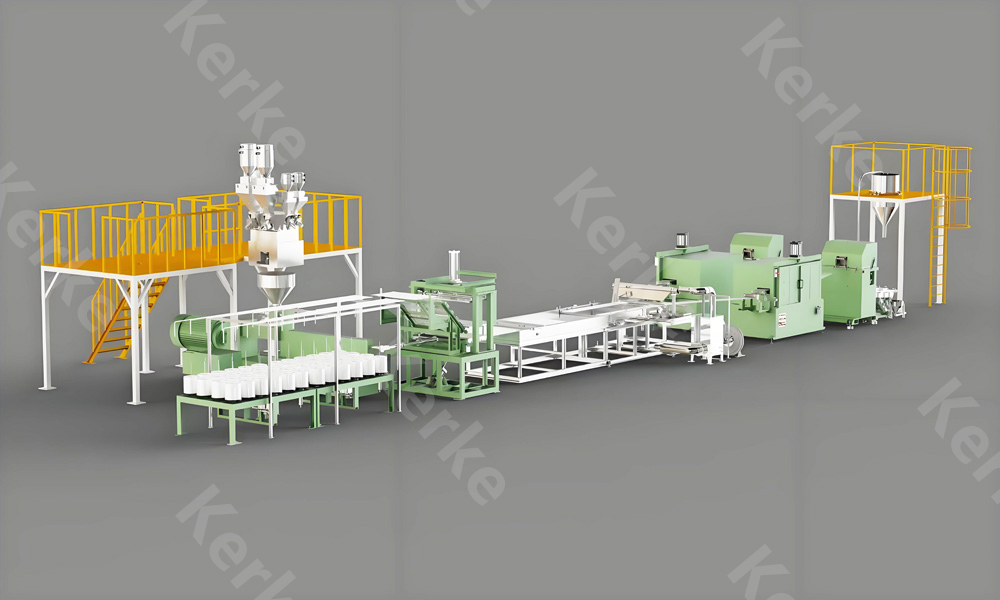
In recent years
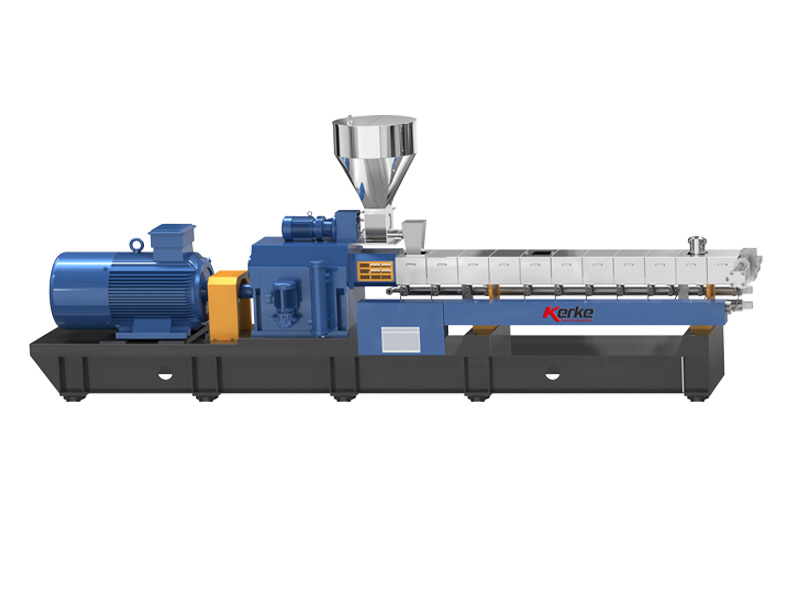
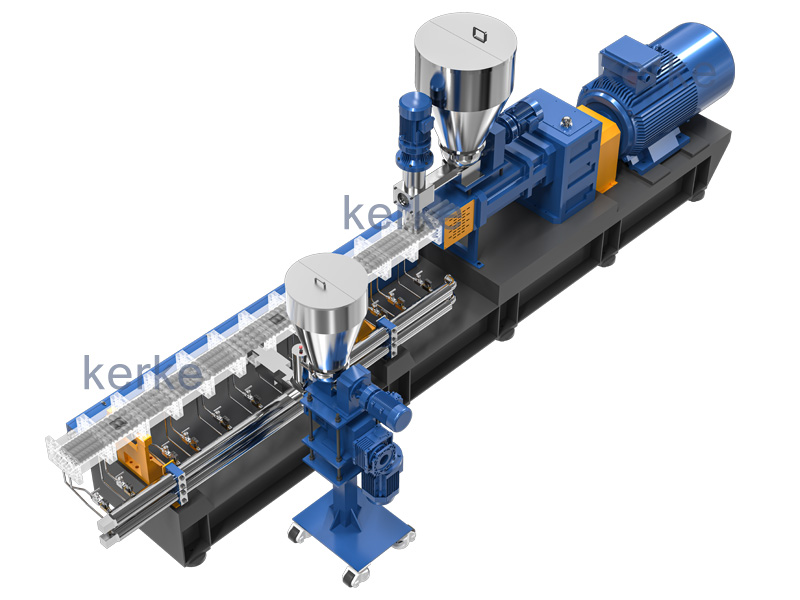
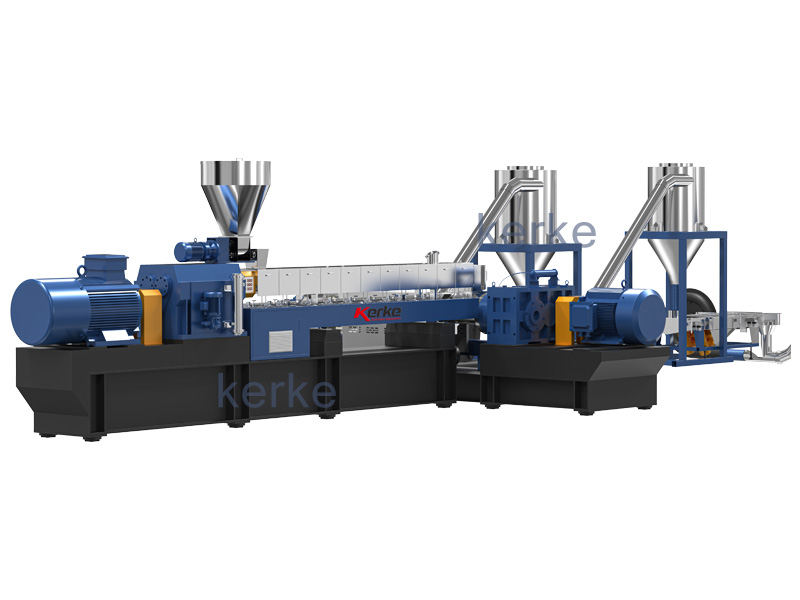
A new type of plastic compounding and pelletizing equipment — the triple-screw extruder — has emerged in the traditional plastic modification market. Compared with the conventional twin-screw extruder, the triple-screw extruder is not merely “one more screw.” It provides significant improvements in dispersion efficiency and output capacity in certain application areas.
Classification of Triple-Screw Extruders
1. Co-rotating Parallel Intermeshing Triple-Screw Extruder
Three screws are arranged in parallel and co-rotate while intermeshing with each other, forming three intermeshing conveying and shearing zones. It can be regarded as an enlarged version of a twin-screw extruder.
Advantages: strong shearing action, excellent dispersive and distributive mixing, and good homogenization.
2. Co-rotating Triangular Intermeshing Triple-Screw Extruder
The screw surfaces partially overlap or tightly mesh with each other, but not along the entire length. Some sections provide intensive mixing, while others are designed for conveying, degassing, or cooling.
Characteristics: a balanced or hybrid design combining strong mixing zones and gentle processing zones.
3. Co-rotating V-type Non-Intermeshing Triple-Screw Extruder
The screws are arranged in a V shape with relatively large clearances and do not fully intermesh. The conveying and mixing mechanisms differ from intermeshing types, focusing primarily on conveying and mild shear.
Applications: suitable for shear-sensitive materials; material flow is mainly laminar. (This type is less common among triple-screw designs and usually appears in specialized equipment.)

Main Performance Comparison: Triple-Screw vs. Twin-Screw Extruders
| Performance Dimension | Triple-Screw Extruder (Co-rotating) | Twin-Screw Extruder (Co-rotating) |
| Shear Strength / Dispersion | Usually stronger, with more contact and shear events per rotation. Provides superior dispersion for high-filler, pigment, and masterbatch formulations. Ideal for applications requiring intensive dispersion. | Excellent dispersion as well, but with fewer shear events per rotation. Dispersion and shear can be precisely controlled through screw element configuration. |
| Output / Energy Efficiency | At the same screw speed, the barrel can accommodate a higher material load, resulting in greater throughput and lower specific energy consumption. Well-suited for high-output and standardized formulations. | Stable and scalable output; higher process flexibility through modular screw element design. Can adapt to a wider range of processing requirements. |
| Reactive Extrusion / Residence Time / Vacuum Degassing | Typically less effective for precise reactive extrusion or deep vacuum degassing. Twin-screw systems are more established for chemical reactions, dynamic vulcanization, and crosslinking processes. | Superior in reactive extrusion, degassing, precise temperature control, and residence time distribution (RTD) management. |
| High-Viscosity or Heat-Sensitive Materials | Strong shear may cause localized overheating; caution required when processing heat-sensitive materials (can be mitigated by lower speed or optimized screw design). | More flexible control of temperature rise and plastification by adjusting compression ratio or lengthening the melting section. |
| Maintenance / Technological Maturity | Less globally widespread; limited standardization of screw elements and spare parts, which may affect maintenance response time. | Mature technology with standardized components and extensive global service networks. Proven performance supported by abundant lab and production data. |
| Suitable Processing Applications | Best for: masterbatch, color masterbatch, high-filler compounds (CaCO₃, talc), and other formulations requiring strong dispersion. | Best for: reactive extrusion (TPV, thermoplastic reactions), processes requiring efficient degassing/vacuum venting, and precise rheological or RTD control. |
The advantage of a triple-screw extruder lies in its ability to deliver higher dispersion efficiency than a twin-screw extruder, while also achieving greater output and lower specific energy consumption.
However, its drawback is the more complex screw configuration, which requires an experienced manufacturer to provide a proven and well-optimized design.
In contrast, the twin-screw extruder benefits from decades of technological maturity and flexible modular design, making it suitable for a wider range of material compounding, reactive extrusion, crosslinking, and devolatilization processes.
Functional Comparison of Different Types of Triple-Screw Extruders in Plastic Compounding and Pelletizing
| Performance Indicator | Co-rotating Parallel Intermeshing | Co-rotating Triangular Intermeshing | Co-rotating V-type Non-Intermeshing |
| Mixing / Dispersive Capability | ★★★★Strong — multiple intermeshing zones and high shear frequency ensure thorough dispersion of pigments and fillers. | ★★★Moderate — intensive mixing can be achieved in specific sections, but overall uniformity is lower than full intermeshing types. | ★★Weak — mainly relies on screw conveying and backflow vortices; shear is uneven. |
| Distribution mixing | ★★★★Excellent — three interacting flow fields enable highly uniform distribution. | ★★★Good — mixing achieved through partial intermeshing zones. | ★Poor — material tends to flow in layers within screw channels. |
| Energy Consumption / Shear Heat | ★★Relatively high — more friction in intermeshing zones leads to temperature rise. | ★★Medium-high — can be locally controlled. | ★Energy-efficient — mild shear but limited mixing. |
| Suitable Materials | High-filled compounds, color masterbatch, CaCO₃, glass fiber modification, TPU, TPV, etc. | Filled compounds, general-purpose masterbatch, heat-sensitive polymers. | Heat-sensitive plastics, PVC paste, foaming masterbatch, etc. |
| Degassing / Venting Capability | ★★★Average — dense material packing in intermeshing zones makes gas release more difficult. | ★★★Good — vacuum venting can be designed in non-intermeshing sections. | ★★★★Excellent — loose material flow enhances degassing efficiency. |
| Residence Time Distribution (RTD) | ★★Short — strong shear and efficient mixing but narrow residence time range. | ★★★Moderate — controllable and balanced. | ★★★★Wide — uniform residence time distribution and smooth material flow. |
| Mechanical Complexity / Cost | ★★★★High — requires precision machining and has higher production cost. | ★★★Medium — moderately complex design. | ★Simple structure — low manufacturing cost. |
| Maintenance / Wear of Parts | ★★★★High — concentrated wear in intermeshing zones. | ★★Controllable — moderate wear. | ★Low wear — simple maintenance. |
| Typical Application Scenarios | High-filler masterbatch, engineering plastics modification (PP+CaCO₃, PA+GF, ABS+color masterbatch, etc.) | General compounding, TPR/TPU blending, filled masterbatch | Heat-sensitive plastics (PVC, EVA foam), foamed compounds, thermoplastic elastomers |
| Advantages | Strong dispersion, uniform mixing, high throughput, ideal for continuous large-scale production lines. | Balanced performance between mixing and energy efficiency; flexible screw design. | Mild shear, excellent degassing, low thermal buildup. |
| Disadvantages | High shear heat, limited degassing performance, not ideal for heat-sensitive materials. | Complex structure; process tuning requires experience. | Limited mixing capacity, uneven particle distribution, suitable for low-speed production. |