High concentration masterbatch production places exceptional demands on compounding equipment. When pigment loadings exceed fifty percent or filler loadings reach even higher levels, standard extrusion configurations often fail to achieve adequate dispersion or stable throughput. Selecting the right twin screw extruder for demanding high-concentration applications requires understanding which equipment capabilities actually matter for success. This understanding prevents costly equipment selections that cannot meet production requirements.
The distinction between general-purpose compounding and high-concentration masterbatch production is substantial. Equipment that performs admirably for standard-load concentrates may struggle with the elevated viscosity, severe wear conditions, and demanding mixing requirements that high-concentration formulations impose. Making informed equipment selection decisions prevents costly production problems and ensures consistent quality. The additional investment in capable equipment often proves economical through improved productivity and reduced quality failures.
High concentration masterbatches offer significant commercial advantages including reduced shipping costs, simplified customer handling, and formulation flexibility for processors with specific requirements. Capturing these advantages requires equipment capable of reliably processing formulations that challenge standard equipment. The business case for capable equipment rests on both the value of high-concentration products and the cost of equipment failures.
Understanding High Concentration Masterbatch Requirements
High concentration masterbatches typically contain more than fifty percent by weight of colorant, additive, or filler in a carrier resin matrix. These concentrated formulations serve multiple purposes in plastics processing: they reduce shipping costs for color concentrate suppliers, they enable letdown ratios that minimize color changeover time, and they provide formulation flexibility for processors with specific performance requirements. The concentration advantage drives both supply chain efficiency and customer convenience.
The technical challenges of high concentration masterbatch production scale with concentration level. Material handling becomes more difficult as pigment or filler content increases. Viscosity rises dramatically, requiring more powerful drive systems and more aggressive mixing configurations. Wear rates accelerate as abrasive particles contact processing surfaces with greater frequency and force. Each challenge requires specific equipment capabilities to address effectively.
Understanding the specific challenges of your formulations guides equipment selection and configuration. Different pigment types present different challenges. Carbon black requires different processing approaches than titanium dioxide or organic pigments. Filled compounds with mineral fillers present yet different requirements. Matching equipment capability to formulation challenges ensures successful production.
Viscosity Challenges in Concentrated Formulations
Material viscosity in a concentrated masterbatch depends on the viscosity of the carrier resin plus contributions from the dispersed pigment or filler particles. As particle loading increases, viscosity rises nonlinearly due to particle-particle interactions. At very high loadings, viscosity can exceed the pumping capability of standard extrusion equipment. This viscosity ceiling limits achievable concentration in practical production.
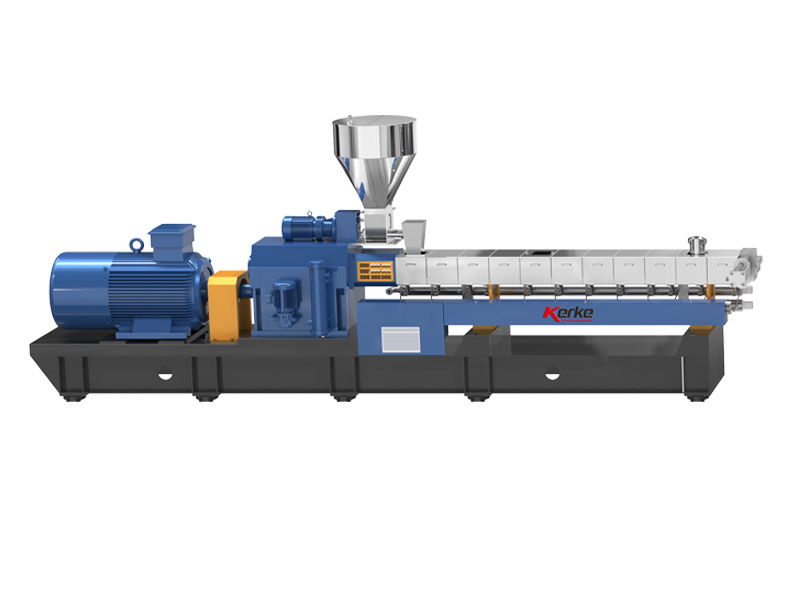
Managing high viscosity requires equipment with exceptional drive power and torque capacity. The KTE-75B model with 300-800 kg/h output capacity demonstrates the power reserves necessary for demanding applications. Kerke high concentration extruders feature drive systems with power ratings scaled to the demands of concentrated formulations. This power margin enables stable processing despite viscosity challenges.
Viscosity management extends beyond equipment power to include temperature optimization and formulation design. Higher temperatures reduce viscosity but may affect heat-sensitive materials. Carrier resin selection influences viscosity behavior at high loading. These formulation factors interact with equipment capability to determine achievable concentration levels.
Wear Resistance Requirements
Abrasive pigments like titanium dioxide, carbon black, and many inorganic pigments accelerate wear on screws, barrels, and other contact surfaces. High concentration formulations accelerate this wear dramatically since each unit of production passes through the extruder with much higher pigment content. Equipment designed for standard applications may fail prematurely when processing concentrated masterbatches. Wear resistance directly affects equipment longevity and consistency maintenance.
Wear-resistant materials and coatings extend equipment life in abrasive applications. Tungsten carbide overlays on screw flight surfaces, nitrided barrel liners, and hardened feed throat components provide the wear resistance necessary for extended production campaigns. Kerke offers comprehensive wear protection options for applications involving aggressive formulations. The additional cost of wear protection often proves economical through extended equipment life.
Wear monitoring enables proactive maintenance scheduling that prevents quality degradation from worn components. Regular inspection of processing surfaces reveals wear progression before it affects product quality. Kerke provides wear rate guidance based on extensive application experience. This guidance helps customers schedule maintenance appropriately for their specific formulations and operating conditions.
Critical Machine Specifications for High Concentration Work
Evaluating masterbatch extruders for high concentration applications requires examining specific technical specifications that determine whether equipment can handle the demanding requirements. These specifications go beyond basic throughput ratings to address the torque, power, and mechanical design features that enable successful high-concentration production. Careful specification review prevents equipment selections that cannot meet application requirements.
The selection process must balance immediate production requirements against future flexibility and growth. Investing in equipment with adequate capability provides insurance against formulation changes or volume increases while ensuring current production success. This long-term perspective prevents the false economy of undersized equipment that limits future development.
Torque and Power Ratings
Torque per shaft rating determines the mixing capability available for dispersive mixing tasks. Higher torque enables processing of higher viscosity materials and supports more aggressive mixing element configurations. Specific torque ratings above 13 Nm/L are generally recommended for demanding high-concentration applications. Torque availability distinguishes capable equipment from underpowered alternatives.
Kerke extruders feature high-torque drive systems designed for challenging compounding applications. The KTE-65B model at $50,000 to $80,000 provides torque capacity suitable for most high-concentration masterbatch formulations, while the KTE-95D at $120,000 to $200,000 offers exceptional capability for the most demanding applications with throughputs reaching 2000 kg/h. Each model addresses different capacity requirements while maintaining the capability for high-concentration processing.
Power rating determines the maximum torque available at operating speeds. Both torque and speed affect processing capability, and their relationship varies across the operating range. Understanding how power and torque combine to affect processing enables accurate equipment selection. Kerke applications engineering supports this specification analysis.
Screw Speed Range and Control
Screw speed affects shear rate, residence time, and throughput simultaneously. High concentration formulations often require lower speeds to manage viscosity and prevent excessive shear heating, but this reduced speed must still provide adequate throughput for economical production. Equipment with wide speed ranges enables optimization across diverse formulation requirements. Speed range determines the flexibility available for different applications.
Variable frequency drives with precise speed control maintain consistency despite variations in motor load or line voltage. Speed regulation specifications below one percent ensure that process conditions remain stable throughout production runs. Kerke extruders incorporate advanced drive systems that deliver the speed consistency high-concentration work demands. This consistency capability affects both quality and productivity.
Speed control response affects process stability during transitions and disturbances. Fast-responding control systems maintain stable operation despite feed variations or other interruptions. This stability capability becomes more important as formulation concentration increases. Kerke control systems provide the response characteristics that demanding applications require.
Barrel Length and L/D Ratio
Barrel length relative to screw diameter, expressed as the L/D ratio, determines available residence time and mixing zone length. Longer barrels with higher L/D ratios provide more flexibility for complex mixing requirements. High concentration applications often benefit from extended mixing zones to achieve adequate dispersion without excessive shear in single passes. L/D selection reflects the mixing requirements of specific formulations.
Standard L/D ratios of 40:1 to 48:1 work well for many high-concentration applications. Applications requiring extensive devolatilization or multiple mixing stages may benefit from even longer barrels. Kerke offers various barrel lengths to address specific application requirements. The appropriate length depends on formulation complexity and quality requirements.
Longer barrels increase heat transfer area, improving thermal management capability. This additional cooling capacity becomes valuable when processing high-viscosity materials that generate significant shear heat. The trade-off between barrel length and equipment cost should consider both mixing requirements and thermal management needs.
Screw Configuration Capabilities
The ability to configure screws appropriately for high-concentration formulations distinguishes capable equipment from inadequate alternatives. Modular screw designs enable optimization for specific formulation requirements while fixed configurations may force compromises that affect quality or productivity. Configuration flexibility maximizes equipment utility across diverse formulations.
Screw configuration affects feeding, melting, mixing, and pumping performance. Each functional zone requires proper design to handle the elevated loadings and altered material behavior characteristic of concentrated masterbatches. Zone-specific optimization creates configurations that address the unique challenges of high-concentration processing.
Feed Zone Design for High Solids Loading
Feeding high-concentration materials presents unique challenges compared to standard compounding. Powder flow properties change dramatically as pigment or filler content increases. Some formulations exhibit bridging or ratholing in hoppers, while others flush or aerate in the feed throat. Feed zone design must accommodate these challenging flow characteristics to ensure stable feeding.
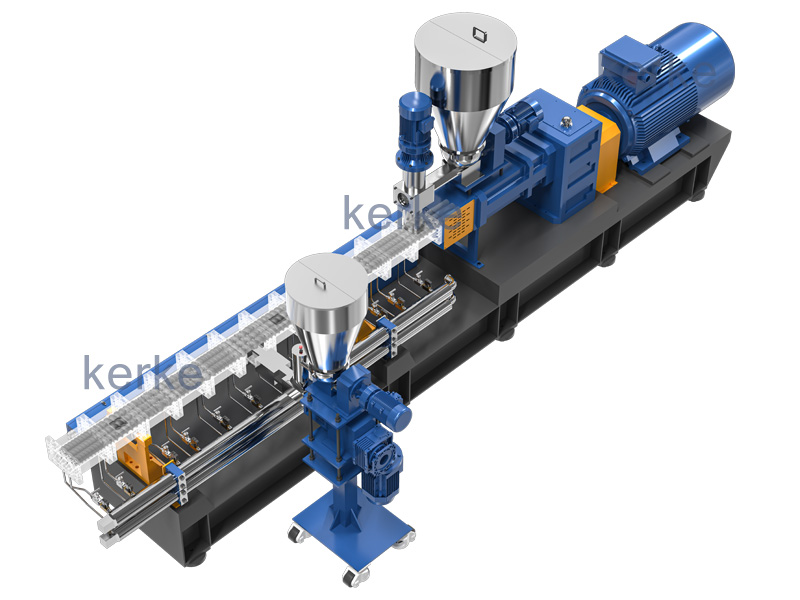
Gravimetric feeding systems provide superior accuracy for high-concentration formulations where small formulation errors create large color variations. Loss-in-weight feeders with dual-speed capability handle the transition from startup to steady-state without overfeeding or starvation. Kerke integrates feeding solutions with extrusion equipment for coordinated control. This integration ensures that feeding supports rather than limits extrusion performance.
Feed throat cooling prevents material from sticking or building up in the feed zone. This cooling capability becomes more important as formulation concentration increases due to the higher pigment content that may affect material flow behavior. Kerke feed throats incorporate cooling provisions designed for demanding applications.
Compression and Transition Zone Engineering
The transition from feed zone to melting zone requires careful engineering for concentrated formulations. Standard compression ratios may be inadequate for materials with altered melting behavior. Extended compression zones with gradual pitch reduction ensure complete melting before high-shear mixing elements. Incomplete melting creates quality problems downstream.
Some high-concentration formulations benefit from two-stage compression approaches that partially melt material before final melting. This staged approach reduces peak torques and improves melt homogeneity. Kerke screw configurations accommodate various compression strategies optimized for specific formulation characteristics. This flexibility enables optimization for diverse formulation types.
Compression zone temperature affects how effectively mechanical compression contributes to melting. Coordinating temperature and screw geometry ensures that melting occurs as intended without hot spots or incomplete melting. This coordination requires understanding both equipment capability and material behavior.
Mixing Section Design for Intensive Dispersion
The mixing section must achieve the dispersion required for high-concentration masterbatches while managing viscosity and temperature constraints. Kneading blocks with various disk widths and staggering arrangements provide different mixing intensities. Multiple mixing zones may be necessary for formulations requiring both distributive and dispersive mixing. Each configuration choice affects both quality and throughput.
High concentration applications often benefit from stepped mixing configurations that apply progressively more intensive mixing as the material reaches appropriate viscosity. This graduated approach prevents material from bypassing aggressive mixing elements while avoiding excessive energy input that could degrade the formulation. Stepped configurations achieve better results than single-pass intensive mixing.
Mixing section length affects both residence time and total mixing energy input. Longer mixing sections provide more intensive mixing but reduce throughput for a given screw speed. The optimal length balances mixing requirements against productivity constraints. Kerke applications engineering provides guidance based on extensive experience across formulation types.
Temperature Control and Cooling Capabilities
Temperature management becomes more critical as concentration increases. Higher pigment loadings reduce carrier resin content, limiting the material’s ability to absorb and distribute shear heat. Simultaneously, higher viscosities generate more shear heat per unit throughput. The combination creates thermal management challenges that require sophisticated control capabilities. Thermal management capability often limits high-concentration production.
Kerke extruders incorporate multi-zone temperature control with independent heating and cooling for each zone. This granularity enables precise thermal profiling throughout the barrel to maintain optimal temperature conditions for specific formulation requirements. Temperature control precision directly affects achievable concentration levels and quality consistency.
Heat Generation and Removal Balance
Shear heating increases with viscosity and screw speed. In high-concentration applications, elevated viscosities mean that significant heat generates even at moderate speeds. This heat must be removed through barrel cooling to maintain temperature setpoints. Inadequate cooling capacity leads to temperature excursions that compromise quality. Cooling system capacity must match the heat generation of intended applications.
Barrel cooling systems using water or oil circulation remove generated heat efficiently. Zoning allows different cooling intensities in different barrel sections, accommodating the varying heat generation rates along the screw axis. Kerke specifies cooling system capacity matched to each model’s expected heat generation. This specification ensures that cooling capability meets application requirements.
Heat generation modeling predicts temperature rise based on formulation viscosity, screw speed, and screw configuration. This modeling guides temperature profile development and identifies potential thermal management challenges. Kerke applications engineering supports thermal analysis for specific applications.
Die and Adapter Temperature Control
The die zone represents the final thermal control point before extrusion. Die temperature affects melt viscosity at the exit, influencing strand formation and pellet quality. For high-concentration formulations, die temperature must be precisely controlled to compensate for altered viscosity behavior. Die temperature optimization completes the thermal profile.
Separate die heating zones enable fine adjustment of melt temperature without affecting barrel zones. Cartridge heaters with fast response times maintain stable temperatures despite variations in throughput or ambient conditions. Kerke die systems incorporate redundant temperature control for reliability in demanding production environments. This redundancy prevents quality problems from temperature control failures.
Die pressure monitoring provides insight into melt viscosity behavior and processing stability. High-concentration formulations often exhibit more viscosity sensitivity to temperature variations. Monitoring die pressure enables rapid response to viscosity changes that might affect product quality.
Material Handling and Feeding Systems
High concentration masterbatch production requires material handling systems capable of managing challenging feed materials consistently. Pigment powders with high loadings often exhibit poor flow characteristics. Carbon black and certain organic pigments present particular handling challenges that require specialized equipment and procedures. Handling system capability determines whether equipment can operate at designed throughput.
Integrated material handling solutions ensure that feeding accuracy and consistency support overall process quality. From pigment reception through extrusion feeding, each handling step must preserve material integrity and enable accurate metering. Handling system design should anticipate the challenges that high-concentration formulations present.
Gravimetric Feeding Technology
Gravimetric feeding provides the accuracy necessary for high-concentration formulations where small variations in pigment loading create unacceptable color variations. Loss-in-weight systems measure actual material consumption rather than inferring it from feeder speed, compensating for changes in bulk density or flow rate. This accuracy capability enables tight formulation control that volumetric systems cannot match.
Modern gravimetric controllers employ adaptive algorithms that respond to changing feed conditions while maintaining accuracy. Feed rate resolution must exceed formulation tolerance requirements to enable tight process control. Kerke feeder systems deliver the precision high-concentration work demands. This precision ensures that formulation accuracy meets color specification requirements.
Feeder capacity must match extrusion throughput requirements. Multiple feeders may be required for high-capacity production or when processing multiple ingredients. Feeder selection should include margin to handle formulation variations and startup transients. Kerke applications engineering supports feeder sizing for specific production requirements.
Handling Difficult Pigment Forms
Various pigment physical forms present different handling challenges. Powder pigments may aerate, agglomerate, or fluidize improperly in conventional feeders. Granular or beaded pigments flow differently and may require alternative feeding approaches. Understanding the handling characteristics of specific pigments guides feeder selection and configuration.
Carbon black presents particularly challenging handling characteristics due to its fine particle size and low bulk density. Specialized feeders with different design features handle carbon black effectively. Supplier guidance on handling requirements helps select appropriate equipment. Kerke carbon black experience supports this selection process.
Pre-blending pigments with carrier resin before extrusion feeding improves flow characteristics and feeding accuracy. This pre-blending creates a more uniform feed material that reduces feeder-related variations. Pre-blending equipment and procedures add process complexity but often improve overall consistency. The trade-off analysis should consider both quality benefits and operational complexity.
Wear Protection and Component Selection
Equipment longevity in high-concentration applications depends critically on appropriate wear protection. Standard components may provide acceptable life in standard-load applications but fail prematurely when processing concentrated masterbatches. Selecting proper wear protection extends maintenance intervals and reduces total cost of ownership. This protection investment often proves economical despite higher initial cost.
Kerke offers tiered wear protection options ranging from standard nitrided surfaces for moderate applications to advanced tungsten carbide coatings for severe service. Understanding the wear severity of specific formulations guides protection level selection. Kerke applications engineering supports this selection process based on formulation and production volume information.
Screw Flight Wear Protection
Screw flights experience the most severe wear due to their continuous contact with the compound as it passes through the extruder. Flight wear reduces mixing efficiency and alters clearances that affect process performance. Replacing worn flights costs less than the quality and productivity losses from operating with degraded equipment. Regular inspection enables timely replacement before quality problems develop.
Tungsten carbide coatings applied to screw flight surfaces provide excellent wear resistance while maintaining appropriate surface finish for material release. The coating process bonds hard material to the screw substrate, creating a wear-resistant surface that extends component life dramatically. Kerke offers both factory-applied coatings and field-applied options for existing equipment.
Wear rate depends on formulation abrasiveness, operating speed, and production volume. Estimating wear rates for specific applications enables scheduled replacement that prevents quality degradation. Kerke provides wear rate guidelines based on extensive application experience. These guidelines help customers budget for replacement parts and schedule maintenance appropriately.
Barrel Liner and Feed Throat Protection
Barrel liners experience wear from the abrasive compound sliding along the barrel wall during extrusion. Liner wear affects clearances and screw centering, altering process performance. Bimetallic barrel liners with hardened inner surfaces provide extended life compared to standard nitrided barrels. Liner protection investment extends overall equipment life.
Feed throat areas experience particularly severe wear from solid material impacts during feeding. Hardened feed throat inserts with replaceable wear-resistant components protect the barrel investment while enabling cost-effective maintenance. Kerke incorporates feed throat protection in all models designed for high-concentration applications.
Wear inspection protocols should include both barrel and feed throat examination. Visual inspection and dimensional measurement reveal wear progression that might escape casual observation. Kerke maintenance guidance supports the development of appropriate inspection protocols.
Process Control and Automation Features
Modern extrusion control systems enable process optimization and consistency maintenance that manual control approaches cannot match. Advanced control algorithms respond to variations faster than human operators while maintaining tighter tolerances. Automation reduces operator dependency and enables consistent quality across shift changes and extended production runs. Control sophistication directly affects achievable consistency levels.
Kerke extruders incorporate comprehensive control systems with features specifically designed for demanding compounding applications. From basic temperature control through advanced process optimization, these systems support quality and productivity improvement. The sophistication of control systems distinguishes professional equipment from basic alternatives.
Temperature and Pressure Monitoring
Accurate temperature measurement throughout the barrel enables precise thermal control. Multiple thermocouple locations provide feedback for each control zone while identifying temperature variations that might affect mixing or quality. Pressure transducers monitor melt pressure at critical locations, indicating fill level and potential problems. This monitoring capability supports both control and diagnostic functions.
Modern controllers log temperature and pressure data for quality records and process optimization. Statistical analysis of logged data reveals trends and variation sources that might escape real-time observation. This historical data supports continuous improvement initiatives and troubleshooting efforts. Data logging capability enables the quality documentation that professional operations require.
Alarm and interlock systems protect equipment and product quality from abnormal conditions. Pressure limits prevent damage from excessive melt pressure. Temperature limits protect heat-sensitive materials from degradation. These protective functions prevent quality failures and equipment damage that would otherwise result from abnormal operation.
Process Optimization and Recipe Management
Recipe management systems store process parameters for different formulations, enabling quick product changes with consistent results. Parameters including temperatures, speeds, feed rates, and mixing configurations are stored and recalled with single-button commands. Recipe versioning tracks parameter history and supports validation requirements. Recipe management reduces operator error and improves changeover efficiency.
Advanced optimization features analyze process performance and suggest parameter adjustments to improve quality or efficiency. These algorithms incorporate process knowledge to guide less-experienced operators toward optimal settings. Kerke systems provide these optimization capabilities while remaining accessible to operators with various experience levels.
Integration with production management systems enables comprehensive tracking and documentation. Recipe verification and electronic signatures support quality assurance requirements. This integration reduces documentation burden while ensuring complete quality records.
Total Cost of Ownership Analysis
Evaluating masterbatch extruders requires considering total cost of ownership rather than purchase price alone. Equipment with lower initial cost may generate higher operating costs through reduced productivity, shorter maintenance intervals, or quality problems. Comprehensive cost analysis enables economically optimal equipment selection rather than simple price minimization.
Quality costs including waste, rework, and customer complaints often dwarf the operating costs that receive more attention. Selecting equipment that enables consistent quality often proves more economical despite higher purchase prices. This total cost perspective distinguishes strategic equipment selection from simple procurement.
Initial Investment Considerations
Equipment prices for high-concentration capable extruders vary with capacity and capability levels. The Kerke KTE-36B at $25,000 to $35,000 provides an entry point for high-concentration work in lower-volume applications. Higher-capacity models like the KTE-50B at $40,000 to $60,000 and KTE-65B at $50,000 to $80,000 address progressively larger production requirements. Capacity selection should consider both current and future requirements.
Investment in wear protection, advanced controls, and other capability-enhancing features adds to initial cost but often provides rapid return through improved quality, productivity, or equipment life. The selection process should evaluate whether additional capabilities justify their costs for specific application requirements. Kerke quotations detail all cost components to support informed decision-making.
Installation and commissioning costs should be included in total investment estimates. Electrical requirements, material handling systems, and auxiliary equipment add to the investment beyond the extruder itself. Kerke provides comprehensive installation guidance that helps customers budget completely.
Operating Cost Factors
Energy consumption represents the largest operating cost category for extrusion operations. Equipment efficiency varies with design quality and process optimization. Well-configured equipment operating at optimal conditions achieves better energy efficiency than poorly configured equipment or equipment pushed beyond comfortable operating ranges. Energy efficiency directly affects manufacturing cost competitiveness.
Maintenance costs vary with equipment quality, operating conditions, and maintenance practices. Wear component replacement frequency and cost depend heavily on formulation abrasiveness and operating severity. Establishing maintenance budgets based on realistic wear rate estimates prevents unexpected expenses. Kerke provides wear rate guidelines that support accurate budgeting.
Operator labor costs depend on equipment automation level and process complexity. Advanced control systems that reduce operator requirements often prove economical despite their higher initial cost. The labor cost comparison should consider both direct operator time and the indirect costs of operator variability.
Quality and Productivity Value
The value of consistent quality often exceeds the direct cost savings from reduced waste. Customer satisfaction, repeat business, and premium pricing for quality products generate ongoing revenue benefits. Productivity improvements from faster cycles or reduced changeover time increase output without proportional cost increases. These value components often dominate return on investment calculations.
Capacity utilization improves when equipment operates reliably without quality interruptions or maintenance downtime. Well-selected equipment maintains high utilization rates that improve return on capital investment. This utilization benefit complements the direct productivity benefits of capable equipment.
Competitive positioning improves with demonstrated quality capability and reliable supply. These strategic benefits complement the operational benefits that appear directly in financial calculations. Long-term success depends on building the reputation that consistent quality creates.
Vendor Support and Service Considerations
Equipment vendors provide essential support for successful high-concentration masterbatch production. From application engineering during equipment selection through technical support during production, vendor partnership contributes significantly to success. Evaluating vendor capabilities and support commitment helps ensure productive long-term relationships.
Kerke provides comprehensive technical support including applications engineering, operator training, process optimization assistance, and spare parts services. This support capability distinguishes committed equipment suppliers from simple equipment sellers. Long-term vendor relationships create the foundation for sustained production success.
Application Engineering Services
Application engineers help select appropriate equipment configurations for specific formulation requirements. This expertise prevents common mistakes in equipment selection and configuration that could compromise quality or productivity. Kerke applications engineering draws on extensive experience across diverse masterbatch applications. This experience shortens the optimization journey.
Application support continues after equipment installation through process optimization and troubleshooting assistance. This ongoing support helps customers maximize the value of their equipment investment over extended production periods. Kerke technical support responds promptly to customer needs throughout equipment life.
Process development services help customers optimize formulations and processing conditions for their specific requirements. These services accelerate time to market for new products while ensuring that production meets quality requirements. Kerke development support helps customers achieve their business objectives.
Spare Parts and Service Availability
Maintaining equipment availability requires timely access to spare parts when wear components require replacement. Vendors with robust parts inventories and efficient logistics provide parts availability that minimizes production downtime. Kerke maintains comprehensive spare parts stocks for rapid response to customer needs. This parts infrastructure protects customer production continuity.
Service agreements and maintenance contracts formalize support relationships and ensure that maintenance activities occur on appropriate schedules. These agreements often prove economical compared to as-needed service arrangements, particularly for critical production equipment. Kerke offers flexible service options that address different customer needs.
Remote diagnostic capabilities enable vendors to troubleshoot problems quickly without site visits. This capability reduces downtime while minimizing service costs. Kerke implements remote support capabilities that benefit customers worldwide.
Conclusion
Selecting the right masterbatch extruder for high concentration applications requires evaluating multiple factors including torque capacity, wear resistance, temperature control, and process control capabilities. The investment in capable equipment pays returns through consistent quality, productive operation, and extended equipment life. Making informed equipment decisions prevents the costly problems that inadequate equipment creates.
Kerke offers a complete range of extruders suitable for high-concentration masterbatch production, from the compact KTE-36B for specialty applications through the high-capacity KTE-95D for volume production. Each model incorporates design features specifically developed for demanding compounding applications. This product range addresses diverse production requirements while maintaining consistent quality standards.
Contact Kerke to discuss your high-concentration masterbatch requirements and discover how our equipment and application expertise can support your production success. This consultation connects you with specialists who understand the challenges of high-concentration processing.