Introduction
The masterbatch industry has evolved significantly over the past decades, with twin screw extruders emerging as the preferred technology for masterbatch pelletizing operations. Masterbatch production requires exceptional mixing performance, precise temperature control, and superior dispersion of pigments and additives within polymer matrices. Twin screw extruders provide these essential capabilities through their unique design featuring two intermeshing screws rotating in the same direction, creating intense mixing action that far surpasses single screw alternatives. Manufacturers worldwide recognize that investing in twin screw technology translates to superior product quality, higher production efficiency, and better overall economics for masterbatch production.
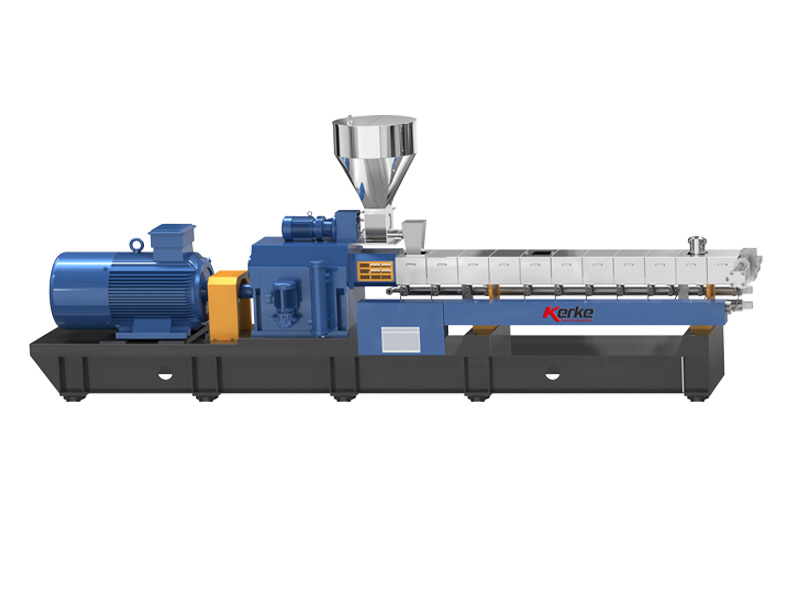
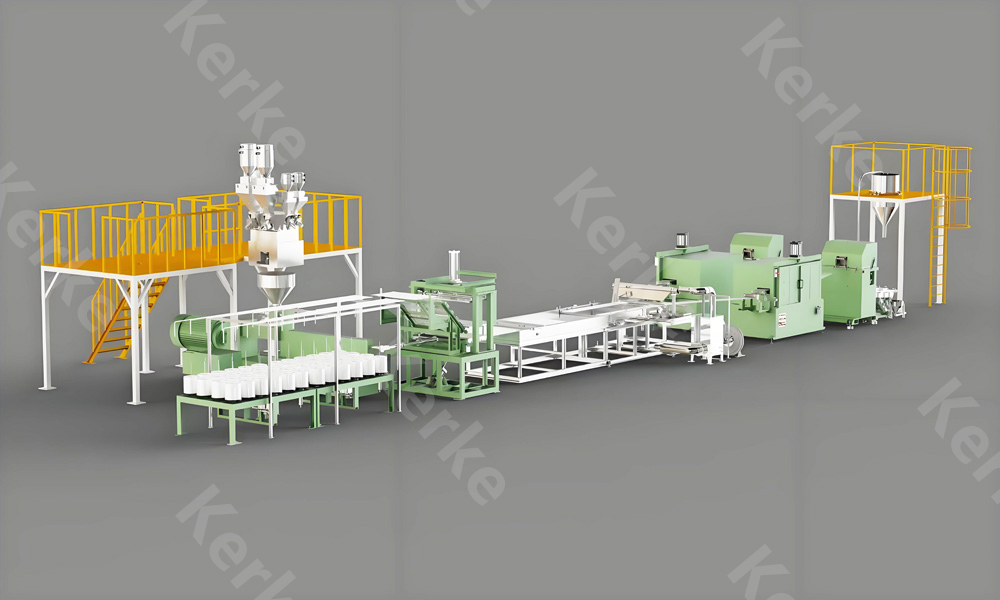
Kerke Extruder has established itself as a leading manufacturer of advanced twin screw extruders specifically designed for masterbatch applications. Our equipment incorporates cutting-edge technology including modular screw configurations, advanced temperature control systems, and high-torque drives optimized for high-viscosity masterbatch formulations. The economic advantages of Kerke twin screw extruders are substantial, with typical productivity improvements of 30-50% compared to single screw systems, while energy consumption often remains comparable or lower per unit of production. Investment costs for Kerke twin screw extruders range from $80,000 for smaller models to $350,000 for high-capacity industrial systems, delivering return on investment typically within 18-24 months through productivity gains and reduced operational costs.
Superior Mixing and Dispersion Capabilities
The fundamental advantage of twin screw extruders lies in their exceptional mixing capabilities, which directly translate to superior masterbatch quality. Understanding these mixing mechanisms provides insight into why twin screw technology dominates premium masterbatch production.
Distributive Mixing Excellence
Distributive mixing refers to the uniform spatial distribution of components throughout the polymer matrix without necessarily reducing particle size. Twin screw extruders achieve outstanding distributive mixing through several mechanisms inherent to their design. The intermeshing action between screws creates repeated folding and reorientation of material, ensuring that pigments and additives are evenly distributed throughout the entire polymer mass. This folding action occurs thousands of times as material progresses through the extruder, resulting in homogeneity that single screw systems cannot achieve without extensive modification.
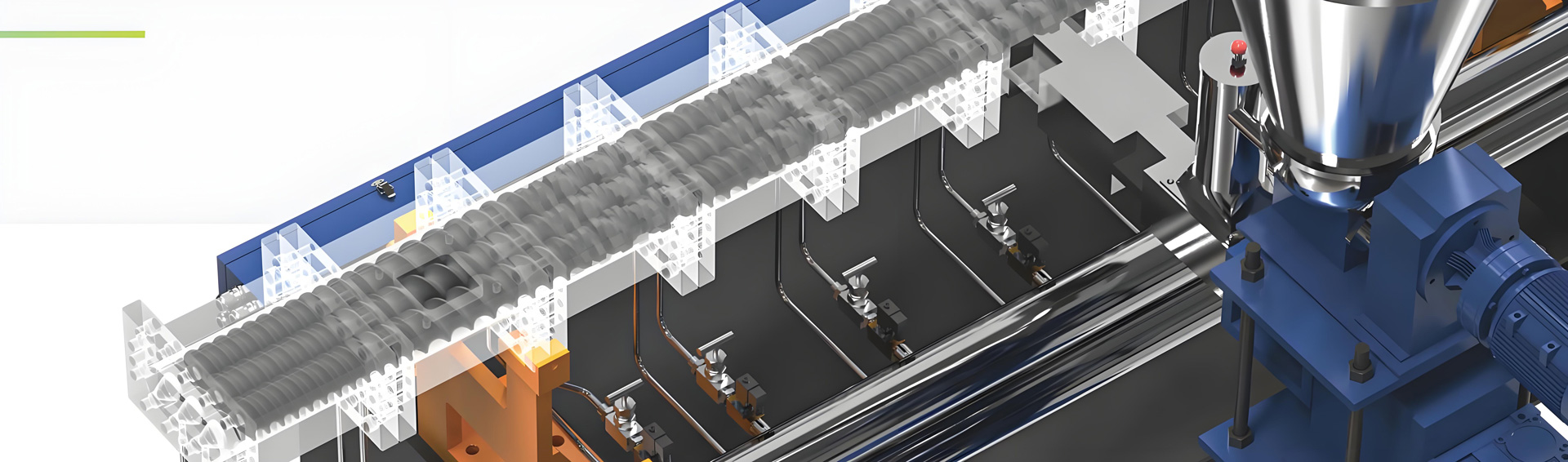
The modular screw design of twin screw extruders allows customization of mixing elements to optimize distributive mixing for specific formulations. Kneading blocks with varying stagger angles and flight configurations create different flow patterns that can be tailored to achieve optimal distribution. For masterbatch applications, screw configurations typically include forward-conveying elements for material transport, reverse-conveying elements for creating back-mixing zones, and special mixing elements for intensive distributive action. This configurability enables Kerke twin screw extruders to achieve distributive mixing efficiency that consistently produces masterbatch with pigment dispersion quality meeting or exceeding industry standards.
Quantitative analysis shows that twin screw extruders typically achieve mixing coefficients 3-5 times higher than equivalent single screw extruders. This superior mixing translates directly to product quality advantages. Color masterbatch produced on twin screw systems typically exhibits color strength 10-20% higher than equivalent single screw production, meaning less masterbatch is required to achieve target coloration in final products. This quality advantage represents significant economic value as masterbatch can be sold at premium prices or production efficiency increased through reduced let-down ratios.
Dispersive Mixing Performance
Dispersive mixing involves breaking down agglomerates of pigments, fillers, or additives into individual particles and distributing them uniformly throughout the polymer matrix. This capability is particularly critical for masterbatch production where pigment dispersion quality directly affects final product performance. Twin screw extruders excel at dispersive mixing through the generation of high shear stress zones between intermeshing screw flights and between screws and barrel walls.
The shear rate in twin screw extruders can reach values of 100-500 per second in the narrow gaps between screw flights and barrel, far exceeding the shear rates achievable in single screw systems. These high shear rates provide sufficient energy to break down pigment agglomerates into primary particles. Additionally, the repeated passage of material through these high-shear zones as it progresses along the screws ensures complete dispersion of even the most difficult-to-disperse pigments. Carbon black masterbatch, known for its challenging dispersion requirements, is produced with superior dispersion quality on twin screw systems compared to single screw alternatives.
Kerke twin screw extruders incorporate specialized screw elements designed to optimize dispersive mixing while minimizing excessive heat generation that could degrade sensitive pigments or polymer matrices. These elements include special kneading blocks with optimized flight geometries and mixing zones with carefully controlled shear rates. The balance between dispersive mixing intensity and thermal management is crucial for achieving optimal dispersion quality without thermal degradation. Kerke’s proprietary screw designs have been proven to achieve pigment dispersion with particle size reduction to sub-micron levels, exceeding the requirements of the most demanding masterbatch applications.
The economic impact of superior dispersive mixing extends beyond product quality. Better dispersion translates to higher pigment efficiency, meaning less pigment is required to achieve target coloration or performance. For expensive pigments such as organic pigments or special effect pigments, this efficiency gain represents significant material cost savings. Additionally, superior dispersion reduces the risk of pigment-related processing problems in final applications, reducing customer complaints and returns while building market reputation for quality.
Flexibility in Formulation Processing
Twin screw extruders demonstrate exceptional flexibility in processing diverse masterbatch formulations, a critical capability in the masterbatch industry where product portfolios often include hundreds of different formulations. This flexibility stems from modular screw design, independent control of multiple processing zones, and the ability to handle a wide range of material viscosities and characteristics.
The modular screw configuration of twin screw extruders enables rapid changeover between different product formulations. Screw elements can be rearranged or replaced to optimize processing for specific formulations without requiring complete extruder replacement. A typical twin screw extruder might process multiple different masterbatch formulations in a single production day, with screw configuration changes taking only 1-2 hours depending on the extent of reconfiguration needed. This flexibility enables smaller production runs of specialty masterbatch products that would be economically unfeasible on dedicated single screw lines designed for specific formulations.
Independent temperature control of multiple barrel zones allows processing of masterbatch formulations with different thermal requirements. Twin screw extruders typically feature 5-10 independently controlled heating zones, enabling precise temperature profiling along the extruder length. This capability is crucial for processing temperature-sensitive pigments or additives that require specific temperature profiles to maintain stability and performance. Color masterbatch formulations containing heat-sensitive organic pigments can be processed with temperature profiles that minimize pigment degradation while ensuring proper melting and mixing of the polymer matrix.
The processing window of twin screw extruders encompasses a wide range of material viscosities, from low-viscosity polymer systems used in some additive masterbatch to highly filled, high-viscosity formulations used in filler masterbatch. Kerke twin screw extruders are designed with torque capacity sufficient to process formulations with filler loadings up to 80% by weight while maintaining adequate mixing quality. This wide processing capability enables single equipment investment to serve multiple product categories, improving equipment utilization and return on investment.
Enhanced Product Quality Consistency
Product quality consistency represents one of the most significant advantages of twin screw extruders for masterbatch production. Consistent quality reduces customer problems, improves market reputation, and enables premium pricing. The mechanisms through which twin screw extruders achieve superior consistency include precise process control, uniform residence time, and excellent thermal homogeneity.
Precise Process Control Capabilities
Modern twin screw extruders incorporate advanced process control systems that enable precise regulation of all critical processing parameters. These control systems typically include PLC-based controls with multiple independent control loops for temperature, screw speed, feeder rates, and downstream equipment. Kerke twin screw extruders feature state-of-the-art control systems with touchscreen interfaces, recipe storage for multiple product formulations, and data logging capabilities for quality traceability.
Temperature control accuracy in twin screw extruders typically achieves plus or minus 1 degree Celsius or better, compared to plus or minus 2-5 degrees Celsius in single screw systems. This improved temperature control precision directly affects masterbatch quality by maintaining optimal processing conditions for pigment dispersion and polymer stability. Temperature fluctuations can cause variations in melt viscosity affecting mixing efficiency and pigment dispersion quality. Tight temperature control ensures consistent processing conditions from batch to batch, resulting in consistent product quality.
Screw speed control precision has improved significantly with modern variable frequency drives and servo motor systems. Kerke twin screw extruders achieve screw speed control accuracy of plus or minus 0.5% of setpoint, ensuring consistent shear conditions and residence time from batch to batch. This precision control is particularly important for masterbatch production where consistent pigment dispersion quality depends on maintaining consistent shear history throughout production.
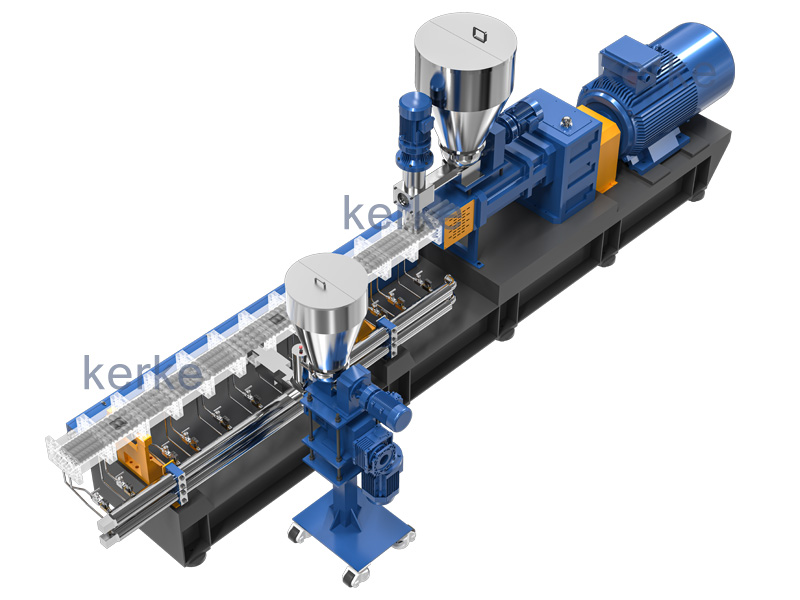
Feeder control for additives and masterbatch components has also seen significant advancement with modern gravimetric and volumetric feeding systems. Twin screw extruders typically feature multiple feeding ports enabling side-feeding of sensitive additives that might degrade if exposed to excessive heat or shear. Gravimetric feeders provide precise control of additive feed rates with accuracy better than plus or minus 0.5% of setpoint, ensuring consistent masterbatch composition from batch to batch. Kerke extruders integrate seamlessly with leading feeder brands, providing turnkey feeding solutions optimized for masterbatch production.
Uniform Residence Time Distribution
Residence time distribution refers to the variation in time that individual material elements spend within the extruder. Narrow residence time distribution ensures that all material receives similar thermal and shear history, resulting in consistent product quality. Twin screw extruders exhibit significantly narrower residence time distribution compared to single screw extruders, contributing to superior product quality consistency.
The plug flow characteristics of twin screw extruders contribute to narrow residence time distribution. Material in twin screw extruders moves forward in a relatively uniform manner with minimal back-mixing in conveying sections. This uniform progression ensures that most material experiences similar residence time, with typically 80-90% of material having residence time within plus or minus 30% of mean residence time. In comparison, single screw extruders often have residence time distributions where only 50-60% of material falls within the same range, indicating much wider variation in thermal and shear history experienced by different material elements.
The modular screw design of twin screw extruders allows optimization of residence time distribution for specific applications. Forward-conveying elements with appropriate pitch angles control material transport rate, while mixing elements create localized zones of increased residence time for improved mixing without excessively broadening overall residence time distribution. Kerke screw designers optimize screw configurations to achieve narrow residence time distribution while providing adequate mixing for superior product quality.
Narrow residence time distribution is particularly important for masterbatch production because it ensures consistent thermal exposure for temperature-sensitive pigments and additives. Pigments that degrade if exposed to excessive thermal history maintain consistent performance when residence time distribution is narrow. Similarly, additives that react with polymer matrices achieve consistent performance when residence time is uniform. This consistency translates directly to consistent masterbatch performance in customer applications.
Superior Thermal Homogeneity
Thermal homogeneity refers to uniform temperature throughout the polymer melt. Twin screw extruders achieve superior thermal homogeneity compared to single screw alternatives through several mechanisms including intensive mixing, multiple heating zones, and efficient heat transfer between material and barrel.
The intensive mixing action in twin screw extruders promotes excellent heat transfer between different material elements, promoting temperature uniformity throughout the melt. As material is repeatedly folded and reoriented by the intermeshing screws, hot and cold material elements come into contact, facilitating heat exchange. This internal mixing effect combined with external heating from barrel walls ensures that the entire melt reaches uniform temperature. Temperature variations within twin screw extruders typically do not exceed plus or minus 3-5 degrees Celsius, compared to variations of plus or minus 10-15 degrees Celsius in single screw systems.
Multiple independently controlled heating zones along the extruder barrel enable precise temperature profiling and help maintain thermal homogeneity. Twin screw extruders typically feature 5-10 heating zones depending on extruder size and length-to-diameter ratio. These zones can be set to create temperature profiles that optimize processing for specific formulations. Kerke twin screw extruders feature precision PID temperature controllers that maintain zone temperatures within plus or minus 1 degree Celsius of setpoint, ensuring consistent thermal conditions throughout the extruder.
Superior thermal homogeneity in twin screw extruders has several benefits for masterbatch quality. Uniform temperature ensures consistent melt viscosity throughout the process, affecting mixing efficiency and pigment dispersion quality. Temperature gradients within the melt can cause variations in pigment dispersion quality, as different material elements experience different shear conditions. Additionally, uniform temperature prevents localized overheating that could degrade heat-sensitive pigments or additives, ensuring consistent masterbatch performance.
Operational Efficiency and Productivity
Twin screw extruders deliver significant operational advantages that translate to improved productivity and reduced operational costs. These advantages include higher throughput capabilities, faster start-up and product changeover times, reduced material waste, and enhanced energy efficiency compared to single screw alternatives.
Higher Throughput Capabilities
Twin screw extruders typically achieve 30-50% higher throughput compared to single screw extruders of similar size, while maintaining or improving product quality. This productivity advantage stems from several factors including more efficient material transport, higher permissible screw speeds, and better melt temperature control enabling operation at higher rates without quality degradation.
The positive displacement action of intermeshing twin screws provides more efficient material transport compared to the drag flow in single screw extruders. Material in twin screw extruders is positively conveyed forward by the intermeshing screws, reducing reliance on viscous drag that limits single screw throughput. This positive displacement enables twin screw extruders to operate at higher screw speeds without the pumping instability that would limit single screw extruders. Kerke twin screw extruders are designed to operate at screw speeds up to 600 rpm depending on model and application, providing substantial throughput capability.
Higher permissible screw speeds in twin screw extruders contribute to increased productivity. While single screw extruders are typically limited to 100-200 rpm due to pumping instability, twin screw extruders can operate at 200-600 rpm without instability, depending on formulation and screw design. Higher screw speeds directly increase throughput, as throughput is roughly proportional to screw speed for a given extruder and formulation. Kerke twin screw extruders incorporate high-performance drive systems and robust bearing designs capable of sustained operation at high speeds, enabling productivity gains that justify the higher initial investment.
The productivity advantage of twin screw extruders translates directly to economic benefits. For a typical masterbatch production facility, upgrading from single screw to twin screw technology might increase daily production from 20 tons to 30 tons without increasing labor requirements or facility footprint. At typical masterbatch prices of $2.50-$5.00 per kilogram, this productivity increase represents additional daily revenue of $25,000-$50,000. The return on investment for twin screw extruder upgrade can be achieved in 12-18 months through productivity gains alone, before considering quality improvements that may enable premium pricing.
Faster Start-up and Changeover Times
Operational efficiency depends not only on steady-state productivity but also on the time required to start up production and change between different products. Twin screw extruders offer significant advantages in both areas compared to single screw alternatives, improving overall equipment utilization and reducing downtime costs.
Start-up time from cold to stable production is typically 30-50% shorter for twin screw extruders compared to single screw systems. The positive displacement action and better mixing enable twin screw extruders to reach stable temperature and flow conditions more quickly after start-up. Typical start-up times for twin screw extruders range from 30-60 minutes for small to medium-sized models, compared to 60-120 minutes for single screw extruders of similar size. This reduction in start-up time represents significant productivity improvement, especially for operations with frequent start-up cycles.
Product changeover time is also reduced with twin screw extruders, particularly for operations requiring screw configuration changes. The modular design of twin screw screws enables element replacement rather than complete screw replacement, reducing changeover time. Changing between similar formulations might require only 30-60 minutes on a twin screw extruder, compared to 2-4 hours on a single screw system. Even when complete screw configuration changes are required, twin screw extruders typically require 2-4 hours compared to 4-8 hours for single screw extruders requiring complete screw replacement.
The productivity impact of faster start-up and changeover times is substantial for masterbatch production facilities. For operations producing multiple different products each week, the time savings from reduced start-up and changeover times can amount to 10-20% additional available production time. This additional production capacity can be used to increase sales or reduce overtime costs, directly improving profitability. Additionally, faster changeovers enable smaller production runs, supporting customer demands for just-in-time delivery and smaller batch sizes.
Reduced Material Waste
Material waste represents significant cost in masterbatch production, both in terms of material cost and disposal costs. Twin screw extruders generate less waste compared to single screw alternatives through several mechanisms including better process control, reduced start-up scrap, and improved product changeover efficiency.
Reduced start-up scrap results from faster start-up times and better process control during start-up. Twin screw extruders reach stable production conditions more quickly, reducing the amount of off-spec material produced during start-up. Additionally, better process control means that material reaches quality specifications earlier in the start-up process, further reducing waste. Typical start-up waste for twin screw extruders ranges from 50-150 kg depending on extruder size, compared to 150-400 kg for single screw extruders of similar size.
Product changeover waste is also reduced with twin screw extruders. Faster changeovers reduce the amount of off-spec material produced during transition between products. Additionally, the modular screw design enables more complete purging between products, reducing cross-contamination waste. For color masterbatch production, where color changes require thorough purging to prevent color contamination, twin screw extruders typically require 30-50% less purging material than single screw systems.
The economic impact of reduced waste is substantial, particularly for high-value materials. Masterbatch formulations often contain expensive pigments or specialty additives, making waste reduction particularly valuable. At typical material costs of $1.50-$3.00 per kilogram for masterbatch formulations, waste reduction of 200 kg per week represents annual savings of $150,000-$300,000. These savings directly improve profitability and contribute to faster return on investment for twin screw extruder purchases.
Energy Efficiency Advantages
Energy consumption represents significant operational cost in masterbatch production. Twin screw extruders often demonstrate superior energy efficiency compared to single screw alternatives, particularly when productivity gains are considered on a per-unit production basis.
Specific energy consumption for twin screw extruders, measured in kilowatt-hours per kilogram of production, is typically 10-20% lower than for single screw extruders when similar products are compared at optimal throughput. This advantage stems from more efficient material transport requiring less viscous drag, better mixing reducing the need for excessive shear, and superior thermal homogeneity reducing heating energy requirements. Kerke twin screw extruders incorporate energy-efficient motors, drives, and heating systems that further reduce specific energy consumption.
The energy efficiency advantage becomes even more pronounced when productivity gains are considered. While twin screw extruders may have higher total power consumption due to larger motor sizes, the specific energy consumption per kilogram of production is often lower because of higher throughput. For example, a single screw extruder might consume 150 kW to produce 500 kg per hour, resulting in specific energy consumption of 0.30 kWh per kilogram. A twin screw extruder might consume 200 kW to produce 750 kg per hour, resulting in specific energy consumption of 0.267 kWh per kilogram, an 11% improvement in energy efficiency.
The economic impact of energy efficiency improvements is significant, particularly in regions with high energy costs. At $0.12 per kilowatt-hour electricity cost, reducing specific energy consumption from 0.30 to 0.267 kWh per kilogram saves $0.004 per kilogram in energy costs. For a production facility producing 5,000 kg per hour operating 6,000 hours annually, this energy efficiency improvement represents annual energy cost savings of $120,000. These savings directly improve profitability and contribute to return on investment calculations.
Economic Advantages and Return on Investment
The economic advantages of twin screw extruders for masterbatch production encompass both reduced operational costs and enhanced revenue potential through product quality improvements. Understanding these economic factors is crucial for investment decisions and business case development.
Capital Investment Analysis
Capital investment for twin screw extruders is typically higher than for single screw extruders of similar capacity, but the increased productivity and quality improvements often justify the additional investment. Understanding capital investment ranges and factors affecting pricing enables informed purchasing decisions.
Small twin screw extruders with 25-35 mm screw diameter and capacity of 100-300 kg per hour typically cost $80,000-$150,000 depending on configuration and features. These models suit small to medium masterbatch production facilities or serve as pilot lines for product development. Mid-sized twin screw extruders with 50-75 mm screw diameter and capacity of 500-1500 kg per hour typically cost $150,000-$280,000. These models represent the most common choice for commercial masterbatch production facilities. Large twin screw extruders with 100-150 mm screw diameter and capacity of 2000-5000 kg per hour typically cost $280,000-$450,000. These models serve high-volume production facilities or process highly filled formulations requiring high torque capacity.
Kerke twin screw extruders offer competitive pricing in each size category, typically 20-30% below premium European brands while maintaining comparable quality and performance. For example, a mid-sized twin screw extruder with 65 mm screw diameter and 1000 kg per hour capacity might cost $180,000-$220,000 from Kerke, compared to $250,000-$300,000 for equivalent European brands. This pricing advantage reduces capital investment requirements while providing world-class equipment quality.
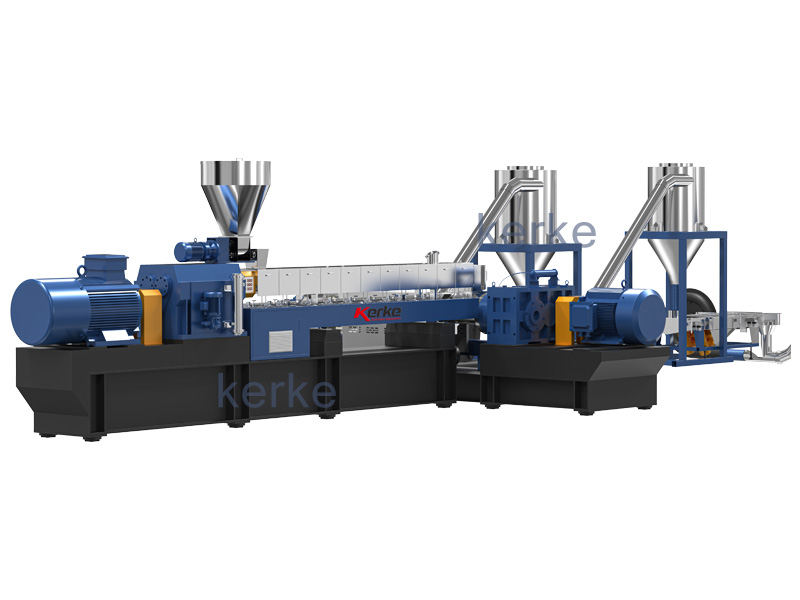
Additional equipment costs beyond the extruder should be considered in total investment analysis. These additional costs typically include gravimetric feeders at $20,000-$50,000 depending on configuration and quantity, pelletizing systems at $30,000-$80,000 depending on type and capacity, and ancillary equipment including cooling systems and material handling at $20,000-$40,000. Total turnkey investment including extruder, feeding, pelletizing, and ancillary equipment typically ranges from $250,000 for small systems to $600,000 for large systems.
Operational Cost Reduction
Operational cost reductions achievable with twin screw extruders contribute significantly to return on investment. These reductions span multiple cost categories including material waste, energy consumption, maintenance, and labor.
Material waste reduction was discussed previously but warrants economic quantification. At typical masterbatch material costs of $2.00-$4.00 per kilogram, reducing waste by 200 kg per week represents annual savings of $200,000-$400,000 assuming 50 operating weeks per year. These savings flow directly to profitability and reduce payback period for capital investment.
Energy cost savings from improved specific energy consumption can be substantial. As calculated previously, reducing specific energy consumption from 0.30 to 0.267 kWh per kilogram saves $0.004 per kilogram at $0.12 per kilowatt-hour. For a production facility producing 5,000 kg per hour operating 6,000 hours annually, this represents annual energy cost savings of $120,000. These savings are particularly valuable in regions with high energy costs.
Maintenance costs for twin screw extruders are often comparable to or slightly higher than for single screw extruders on an absolute basis, but lower on a per-unit production basis due to higher throughput. Annual maintenance costs for twin screw extruders typically range from 3-5% of capital investment, compared to 2-4% for single screw extruders. However, on a per-kilogram production basis, twin screw extruders often have lower maintenance costs due to higher productivity. Kerke twin screw extruders incorporate robust design features that extend component life and reduce maintenance requirements, including hardened screw and barrel materials and premium bearing and seal components.
Labor cost savings result from higher productivity and reduced downtime. Higher throughput enables same or higher production levels with reduced labor requirements per unit of production. Reduced downtime from faster start-up and changeover reduces labor hours spent on non-productive activities. For a production facility employing 3 operators per shift on a single screw extruder producing 20 tons per shift, upgrading to a twin screw extruder producing 30 tons per shift might reduce labor requirements to 2.5 operators per shift on a per-ton basis, representing significant annual labor cost savings.
Revenue Enhancement Opportunities
Beyond cost reductions, twin screw extruders offer revenue enhancement opportunities through product quality improvements that may enable premium pricing, expanded product range, and improved customer satisfaction.
Premium pricing opportunities exist for superior quality masterbatch produced on twin screw extruders. Masterbatch with better dispersion quality, color strength, and consistency can command premium prices of 10-30% above standard quality masterbatch. For example, premium quality color masterbatch might sell for $4.00 per kilogram compared to $3.00 per kilogram for standard quality. If 20% of production achieves premium pricing, this represents additional revenue of $0.20 per kilogram across all production. For a production facility producing 30,000,000 kg annually, this represents additional annual revenue of $6,000,000.
Expanded product range becomes possible with twin screw extruder flexibility. Specialty masterbatch formulations requiring high dispersion quality or processing of difficult-to-disperse components become feasible with twin screw technology. These specialty products often command premium prices and may open new market segments. A single twin screw extruder might produce 30-50 different masterbatch formulations, compared to 10-15 for a dedicated single screw line. This product range expansion increases market opportunity and customer penetration.
Improved customer satisfaction and reduced returns result from consistent product quality. Quality variations in masterbatch can cause problems in customer applications, leading to returns, discounts, and lost future business. Twin screw extruders reduce quality variations, minimizing these problems. The economic impact of reduced returns depends on the cost of returns and the frequency of quality-related problems. For a typical masterbatch producer, reducing returns from 2% to 0.5% of sales might represent annual cost savings of $300,000-$600,000 depending on sales volume and return processing costs.
Return on Investment Calculation
Return on investment analysis for twin screw extruder purchases considers both cost reductions and revenue enhancements to determine payback period and total return over equipment life. The following example illustrates typical ROI for twin screw extruder investment.
Investment scenario: Mid-sized masterbatch producer investing in twin screw extruder replacing single screw system. Capital investment for twin screw extruder including feeding and pelletizing systems: $350,000. Annual production volume: 25,000,000 kg. Cost reduction benefits: Material waste reduction $250,000, energy savings $100,000, maintenance savings $50,000, labor savings $75,000. Total annual cost reduction: $475,000. Revenue enhancement benefits: Premium pricing on 20% of production at $0.50 per kg premium: $2,500,000. Reduced returns and lost sales: $400,000. Total annual revenue enhancement: $2,900,000. Total annual benefit: $3,375,000.
Payback period: Capital investment divided by annual benefit equals $350,000 divided by $3,375,000 equals 0.10 years or approximately 4 weeks. Even conservative estimates assuming only cost reduction benefits without revenue enhancements yield payback period of $350,000 divided by $475,000 equals 0.74 years or approximately 9 months. This rapid payback demonstrates strong economic justification for twin screw extruder investment.
Five-year total return calculation: Annual benefit of $3,375,000 times 5 years equals $16,875,000 total benefit over five years minus $350,000 initial investment equals $16,525,000 net return. This represents 4,721% return on investment over five years, demonstrating exceptional economic value. Even conservative five-year return using only cost reductions equals $2,375,000 annual benefit times 5 years equals $11,875,000 total benefit minus $350,000 initial investment equals $11,525,000 net return, representing 3,293% return on investment.
Conclusion
Twin screw extruders provide comprehensive benefits for masterbatch pelletizing operations that extend far beyond the obvious advantages in mixing performance. The combination of superior product quality, enhanced operational efficiency, reduced costs, and revenue enhancement opportunities creates compelling economic justification for twin screw extruder investment. Kerke Extruder has established leadership in twin screw extruder technology specifically optimized for masterbatch applications, providing equipment that delivers these benefits while offering competitive pricing and excellent return on investment.
The advantages of twin screw extruders are most pronounced for producers seeking to achieve premium quality, expand product range, or improve overall operational efficiency. For facilities already producing high-quality masterbatch on single screw systems, the upgrade to twin screw technology often represents the next logical step in continuous improvement. The economic benefits typically justify investment within 12 months, with returns continuing to accumulate over equipment life of 10-15 years or more with proper maintenance.
Kerke Extruder stands ready to assist masterbatch producers in evaluating twin screw extruder solutions for their specific applications. Our technical sales team can provide detailed application analysis, ROI calculations, and equipment recommendations tailored to individual requirements. Contact Kerke Extruder today to discuss how twin screw extruder technology can transform your masterbatch production capabilities and deliver substantial economic benefits.