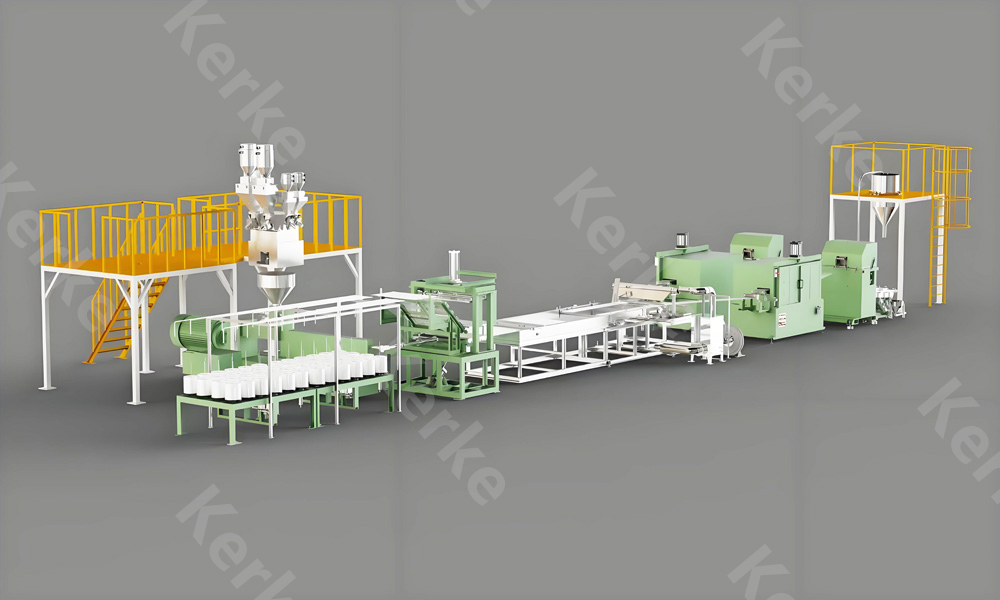
Introduction to High Filler Content Compounding
Processing high filler content materials represents one of the most challenging applications in polymer compounding, requiring specialized equipment designed to handle increased viscosity, abrasive wear, and dispersion challenges. High filler content masterbatches and compounds typically contain 40-80% by weight of mineral fillers including calcium carbonate, talc, barium sulfate, glass fiber, and other inorganic materials. These formulations demand extruders with exceptional mixing capability, robust construction, and specialized screw configurations to achieve uniform dispersion and consistent product quality.
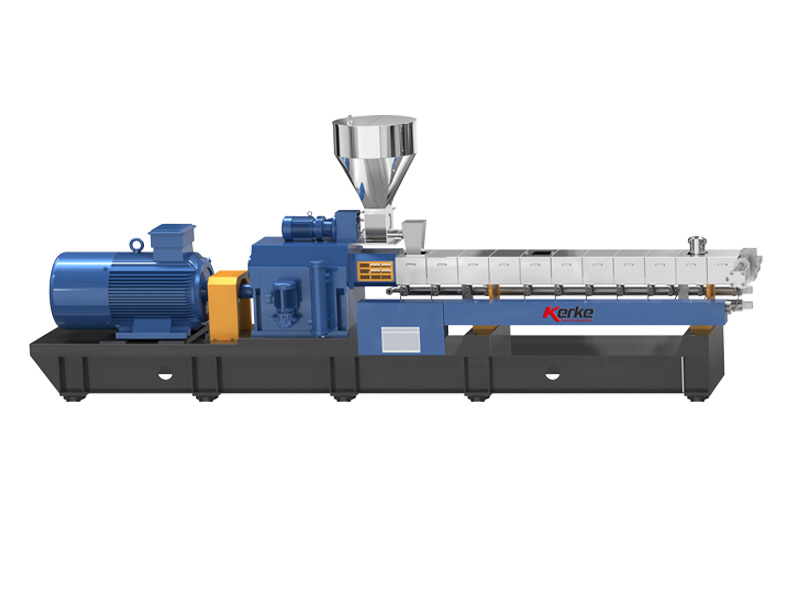
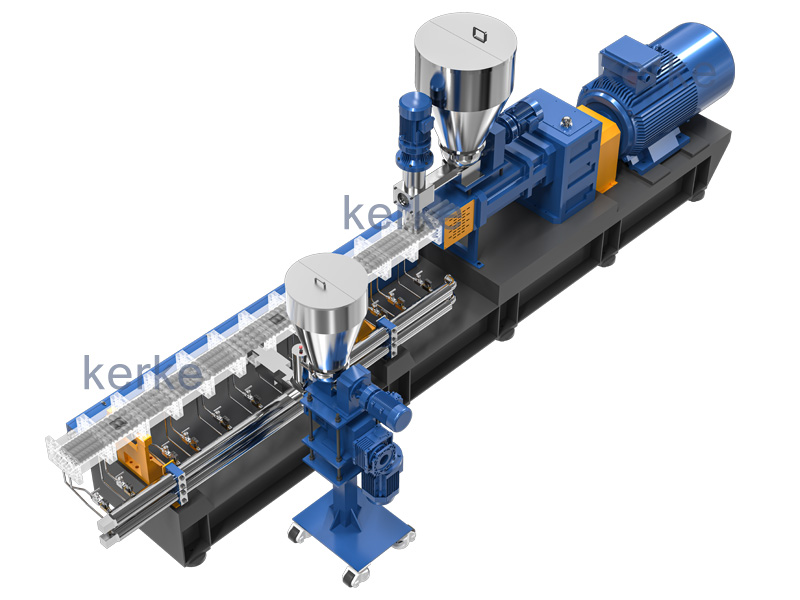
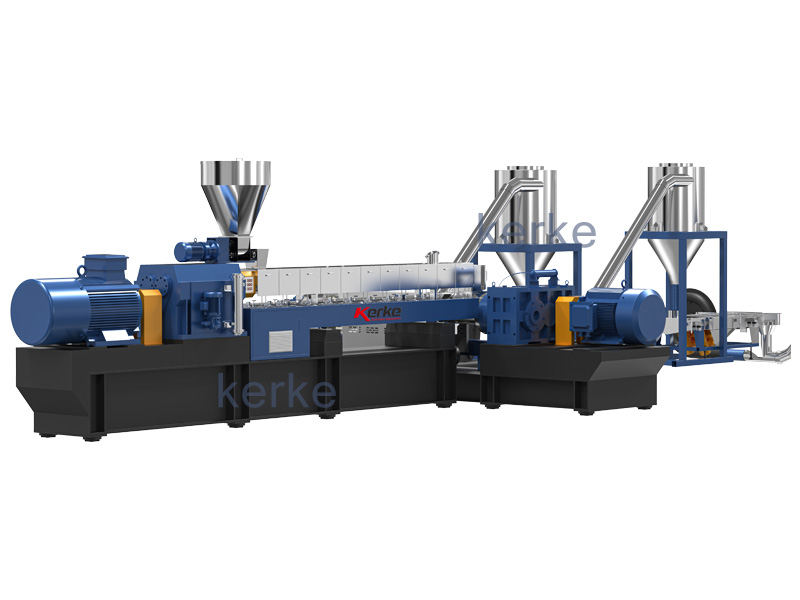
Nanjing Kerke Extrusion Equipment Co., Ltd has established itself as a leading manufacturer of specialized compounding extruders designed specifically for high filler content applications. With over 13 years of experience in high filler material processing, Kerke has developed the KTE series of co-rotating twin screw extruders with features optimized for demanding filled compounds. The company equipment successfully processes mineral filled masterbatches with filler content up to 80% by weight, demonstrating exceptional capability in this challenging application area. Kerke global presence across over 100 countries provides proven performance and reliability for high filler content production worldwide.
Understanding High Filler Material Processing Challenges
Successful extruder selection for high filler content materials begins with understanding the specific processing challenges associated with these formulations. Multiple technical factors influence equipment requirements and configuration decisions, making comprehensive analysis essential for optimal equipment selection.
Increased Viscosity and Processing Pressure
High filler content materials exhibit significantly increased viscosity compared to unfilled polymers, with typical viscosity increases of 5-10 times depending on filler type, particle size, and loading level. This increased viscosity creates elevated processing pressures throughout the extruder barrel, requiring robust construction and adequate mechanical strength from both screw and barrel components. The increased pressure demands higher torque from the drive system and stronger gearbox design to prevent mechanical failure during continuous operation. Kerke KTE series extruders feature high torque design with T/A ratio of 7-9, providing sufficient torque capacity to process high viscosity filled materials without mechanical stress or overload conditions.
Abrasive Wear Challenges
Mineral fillers including calcium carbonate, talc, and glass fiber possess abrasive characteristics that accelerate component wear in standard extruders. The abrasive nature of these materials can cause rapid screw and barrel wear, leading to decreased performance, increased maintenance requirements, and reduced equipment service life. Standard screw and barrel materials may only last 2000-3000 hours when processing high filler formulations with 60-80% mineral content. Kerke addresses this challenge through specialized wear-resistant screw and barrel materials designed specifically for abrasive applications, with proven service life extension of 2-3 times compared to standard materials when processing filled compounds.
Dispersion and Distribution Requirements
Achieving uniform dispersion and distribution of filler particles throughout the polymer matrix represents a critical quality requirement for high filler content materials. Poor dispersion results in agglomerated filler particles that create weak points, reduce mechanical properties, and create surface defects in final products. The dispersion challenge increases significantly with higher filler loadings, requiring intensive mixing action capable of breaking down filler agglomerates while preventing particle damage or degradation. Kerke KTE series screw configurations can be optimized with specialized kneading block arrangements that provide intensive distributive and dispersive mixing specifically designed for high filler applications.
Heat Transfer and Temperature Management
High filler content materials present unique heat transfer challenges due to the thermal properties of mineral fillers and increased material viscosity. The higher thermal conductivity of mineral fillers can cause uneven heating and potential hot spots within the extruder barrel, while the increased viscosity creates additional frictional heat that must be properly managed. Effective temperature control requires multiple heating and cooling zones with precise temperature regulation capabilities. Kerke KTE series extruders feature modular barrel design with multiple temperature control zones enabling precise thermal profile management for high filler content formulations.
Key Equipment Specifications for High Filler Processing
Selecting appropriate equipment specifications represents the foundation of successful high filler content compounding. Multiple technical parameters require careful consideration and evaluation based on specific material requirements and production objectives.
Torque Capacity Requirements
Torque capacity represents the most critical specification for high filler content extruder selection. The increased viscosity and processing pressure of filled materials demand extruders with adequate torque capacity to maintain stable operation without overloading the drive system. Kerke KTE series offers multiple torque options through different design series: the A series provides standard torque suitable for moderate filler content 40-60%, the B series offers increased torque capacity ideal for 60-70% filler content, and the D series combines high torque with high speed capability for the most demanding applications with 70-80% filler content. Price analysis shows torque capacity increases significantly impact equipment cost, with high-torque B and D series models typically costing 15-25% more than standard torque equivalents. However, the increased torque capability provides essential insurance against mechanical overload and ensures long-term reliability in demanding applications.
Screw and Barrel Material Selection
Material selection for screws and barrels represents a critical decision for high filler content applications due to abrasive wear concerns. Standard materials including nitrided steel provide limited service life when processing mineral fillers, while specialized materials offer significantly extended service despite higher initial cost. Kerke offers multiple material options optimized for different abrasive conditions: standard nitrided steel provides adequate performance for moderate filler content 40-60%, wear-resistant bimetallic alloys extend service life 2-3 times for 60-70% filler content, and tungsten carbide coatings provide maximum wear resistance for the most demanding 70-80% filler applications. Investment in upgraded materials typically increases screw cost by 30-50% and barrel cost by 20-40% compared to standard materials. However, extended service life and reduced maintenance requirements often justify the additional investment, particularly for continuous production operations.
Screw Diameter and L/D Ratio Considerations
Screw diameter and length-to-diameter (L/D) ratio significantly influence processing capability and mixing performance for high filler content materials. Larger screw diameters provide increased throughput capacity but may compromise mixing intensity, while longer L/D ratios provide additional processing length for enhanced mixing but increase equipment cost and energy consumption. Kerke KTE series offers multiple screw diameter options from KTE-20 (21.7mm) for laboratory scale production up to KTE-95 (93mm) for high-capacity industrial production, with L/D ratios ranging from 28:1 to 48:1 available for different applications. For high filler content materials, longer L/D ratios typically provide advantages through additional mixing length and residence time, with 40:1-48:1 L/D ratios commonly selected for 60-80% filler formulations. Price analysis shows increased L/D ratio adds approximately 10-15% to equipment cost per 10:1 increase in L/D ratio.
Drive System Configuration
Drive system selection impacts processing capability, energy efficiency, and maintenance requirements for high filler content applications. The drive system must provide adequate power and torque while maintaining efficient operation under continuous load conditions. Kerke KTE series extruders feature heavy-duty drive systems with AC vector motors and helical gearboxes designed for continuous operation under demanding conditions. Motor power requirements scale with extruder size and filler content, with KTE-36B requiring 18.5-22 kW motor power for 20-100 kg/h production capacity, KTE-50B requiring 45-75 kW for 80-200 kg/h capacity, and KTE-65B requiring 90-110 kW for 200-450 kg/h capacity. Drive system cost represents 25-35% of total equipment cost, with higher power motors and advanced gearboxes adding $30,000-80,000 to equipment cost depending on model size.
Screw Configuration Optimization for High Filler Materials
Screw configuration optimization represents one of the most critical factors for successful high filler content processing. The arrangement and specification of screw elements directly influence mixing performance, dispersion quality, and processing stability.
Feeding Zone Design
The feeding zone design must accommodate high filler content materials with effective material intake and transport. High filler formulations often present feeding challenges due to poor flow characteristics and tendency to bridge in standard feeding sections. Kerke screw configurations for high filler materials typically feature aggressive feed screw elements with deep flights and large volume capacity to ensure reliable material intake. Conical feeding zone designs may be employed for the most challenging formulations to provide progressive compression and prevent material bridging. The feeding zone length typically represents 8-12 L/D for high filler applications, providing sufficient length for material compression and melt initiation before entering mixing zones.
Mixing Zone Configuration
Mixing zone configuration determines dispersion quality and distribution uniformity for high filler content materials. Kerke offers specialized screw configurations optimized for different filler types and loading levels. For moderate filler content 40-60%, standard kneading block arrangements with 60-degree stagger angles provide adequate dispersion. For higher filler content 60-70%, configurations featuring multiple kneading block sections with alternating stagger angles (30, 60, and 90 degrees) provide enhanced dispersion capability. For the most demanding applications with 70-80% filler content, configurations incorporating special mixing elements including blister elements and齿轮 mixing elements provide maximum dispersion performance. Mixing zone length typically represents 12-20 L/D depending on filler content and dispersion requirements.
Vent Zone Optimization
Vent zone design becomes increasingly important for high filler content materials due to the potential for entrapped air, moisture, and volatile components within the filler particles. Multiple vent zones with appropriate vacuum capability enable removal of these undesirable components before final extrusion. Kerke screw configurations for high filler materials typically incorporate two or more vent zones positioned after mixing zones to remove entrapped air and volatiles. The first vent zone typically operates at atmospheric pressure to remove entrapped air, while subsequent zones operate under vacuum to remove moisture and low-boiling components. Proper vent zone design prevents porosity and surface defects in final products while ensuring complete filler wetting by the polymer matrix.
Pumping Zone Design
The pumping zone design must provide adequate pressure development for die operation while maintaining material temperature and quality. High filler content materials generate significant pressure drop through the die due to increased viscosity, requiring a pumping zone designed to build sufficient pressure without excessive temperature increase. Kerke screw configurations for high filler materials typically feature metering screw elements with progressively reducing flight depth to build pressure gradually while maintaining melt homogeneity. The pumping zone length typically represents 8-12 L/D for high filler applications, providing sufficient length for pressure development and final melt homogenization before extrusion.
Model Selection and Capacity Planning
Appropriate model selection based on production requirements and processing challenges represents a critical decision for successful high filler content compounding. Kerke offers comprehensive model range from laboratory scale to high-capacity production equipment to meet diverse application requirements.
Laboratory and Pilot Scale Equipment
Laboratory and pilot scale equipment enables formulation development and process optimization before scaling to production. Kerke KTE-20 and KTE-36 models provide laboratory-scale capacity ideal for high filler content material development. KTE-20 with 21.7mm screw diameter produces 2-15 kg/h capacity with motor power of 4-5.5 kW, priced at $18,000-25,000. KTE-36A with 35.6mm screw diameter produces 15-80 kg/h capacity with motor power of 15-22 kW, priced at $120,000-150,000. These smaller models enable cost-effective formulation development while providing sufficient capacity for small-scale production and sample preparation. The modular design ensures scale-up to larger production models with minimal process re-engineering.
Medium Capacity Production Equipment
Medium capacity production equipment provides appropriate output for growing production operations and moderate market demand. Kerke KTE-50 and KTE-65 series models offer production capacity suitable for medium-scale operations. KTE-50B with 50.5mm screw diameter produces 80-200 kg/h capacity with motor power of 45-75 kW, priced at $220,000-280,000. KTE-65B with 62.4mm screw diameter produces 200-450 kg/h capacity with motor power of 90-110 kW, priced at $280,000-350,000. These models balance capacity investment with operating efficiency, providing cost-effective solutions for growing production operations. The high torque B series configuration provides appropriate capability for high filler content materials in this capacity range.
High Capacity Production Equipment
High capacity production equipment meets requirements for large-scale operations and high-volume market demand. Kerke KTE-75 and KTE-95 series models deliver maximum throughput for cost-effective large-scale production. KTE-75D with 71mm screw diameter produces 500-1000 kg/h capacity with motor power of 160-220 kW, priced at $350,000-420,000. KTE-95D with 93mm screw diameter produces 1000-2000 kg/h capacity with motor power of 315-500 kW, priced at $500,000-700,000. These high-capacity models provide excellent cost efficiency per kilogram of production, with operating costs typically 30-40% lower than medium-capacity models on a per-kilogram basis. The D series configuration combines high torque with high speed for maximum productivity in demanding high filler applications.
Capacity Planning Considerations
Effective capacity planning requires consideration of current demand, growth projections, and production flexibility requirements. High filler content materials often serve specific market segments with limited demand compared to unfilled polymers, making accurate demand forecasting essential. Manufacturers should evaluate production scenarios including dedicated single-product operation versus multi-product production requiring frequent changeovers. Kerke modular design enables flexibility for multiple product formulations on the same equipment platform, reducing capital investment requirements. Price analysis shows investing in slightly larger capacity than current requirements provides better long-term value through capacity growth accommodation and improved operating efficiency at higher utilization levels.
Control System and Automation Requirements
Advanced control systems and automation capabilities become increasingly important for high filler content applications due to the processing complexity and quality requirements. Effective process control enables consistent product quality while maximizing production efficiency and minimizing waste.
Temperature Control System
Precise temperature control represents a critical requirement for high filler content processing due to the thermal challenges associated with mineral fillers. Kerke KTE series extruders feature modular barrel design with multiple independent heating zones enabling precise thermal profile management. Each heating zone incorporates both heating elements and cooling capability to handle both heating and cooling requirements typical of filled materials. The control system provides PID temperature control with accuracy of plus or minus 1 degree Celsius, enabling precise thermal management for quality-critical applications. For high filler content materials, temperature control systems typically require 8-12 heating zones depending on screw L/D ratio, with each zone independently controlled to establish appropriate temperature profile for processing filled compounds.
Feeding System Integration
Accurate feeding becomes increasingly critical for high filler content formulations due to the sensitivity of product properties to filler content variations. Gravimetric feeding systems provide accurate feed rate control with typical accuracy of plus or minus 0.5% for each individual component. Kerke offers comprehensive feeding system integration with PLC-based control managing multiple feeders simultaneously. For high filler masterbatch production, separate feeders for carrier resin and mineral filler enable precise control over filler content. Automatic feeding system integration with recipe storage enables rapid changeover between different formulations while maintaining accurate component ratios. Investment in advanced feeding systems typically adds $25,000-50,000 to equipment cost depending on number of feeders and complexity of feeding requirements.
Process Monitoring and Data Logging
Comprehensive process monitoring and data logging capabilities provide essential quality assurance and process optimization benefits for high filler content applications. Kerke KTE series control systems feature real-time monitoring of critical process parameters including temperature profiles, screw speed, motor load, melt pressure, and feed rates. Data logging capabilities record process parameters for quality documentation and process improvement analysis. Advanced control options include automated recipe management, alarm systems for process deviation detection, and statistical process control capabilities for production optimization. Investment in advanced monitoring and data logging typically adds $15,000-30,000 to equipment cost but provides significant benefits through improved quality control and reduced production issues.
Automation and Safety Systems
Automation and safety systems enhance operational efficiency while ensuring safe operation for high filler content processing. Kerke KTE series extruders incorporate comprehensive safety systems including emergency stop circuits, interlocked access doors, and safety guarding for rotating components. Automation options include automatic start-up and shutdown sequences, automated purging systems for product changes, and remote monitoring capabilities. Safety and automation features typically add $10,000-25,000 to equipment cost depending on level of automation and safety requirements. The investment in automation provides labor savings and enhanced operational safety while ensuring consistent processing conditions for high quality output.
Cost Analysis and Investment Considerations
Comprehensive cost analysis and investment evaluation enables informed decision making for high filler content compounding equipment. Multiple cost factors require consideration including initial equipment investment, operating costs, and long-term total cost of ownership.
Initial Equipment Investment
Initial equipment investment varies significantly based on model size, configuration options, and selected features. Kerke KTE series pricing provides competitive value while incorporating specialized features for high filler content applications. Laboratory models including KTE-20 represent investment of $18,000-25,000, providing cost-effective development capability. Medium capacity production models including KTE-50B require $220,000-280,000 investment, offering appropriate capacity for growing operations. High capacity production models including KTE-95D require $500,000-700,000 investment, providing maximum productivity for large-scale operations. Specialized options including wear-resistant materials, advanced feeding systems, and enhanced control capabilities add $50,000-100,000 to base equipment cost depending on selected options. While these investments represent significant capital expenditure, the specialized capabilities and performance advantages provide value through improved product quality and production efficiency.
Operating Cost Analysis
Operating cost analysis reveals significant variations between different model sizes and configurations. Energy consumption typically represents 60-70% of operating costs, with energy requirements scaling with production capacity. KTE-50B consuming 45-75 kW motor power at 80-200 kg/h production achieves energy efficiency of approximately 0.45-0.55 kWh per kilogram of production. KTE-75D consuming 160-220 kW at 500-1000 kg/h production achieves improved efficiency of 0.32-0.35 kWh per kilogram. Material waste represents 5-10% of operating costs, with well-optimized processes achieving waste levels below 2% for high filler materials. Maintenance costs typically represent 3-5% of equipment value annually, with wear-resistant materials reducing maintenance requirements by 30-40%. Labor costs vary based on automation level, with fully automated systems requiring minimal operator attention.
Total Cost of Ownership Analysis
Total cost of ownership analysis over equipment lifetime provides the most comprehensive basis for investment evaluation. Assuming 15-year equipment lifetime with 80% capacity utilization, KTE-75D operating at 750 kg/h average capacity produces approximately 5,900,000 kg annually. Energy cost at $0.10 per kWh results in approximately $2,000,000 annual energy cost. Annual maintenance at 4% of equipment value represents approximately $15,000-20,000. Material waste at 1.5% represents significant cost depending on raw material costs. Over 15-year lifetime, total operating costs exceed $30,000,000, representing 20-30 times the initial equipment investment. This analysis demonstrates that equipment selection should prioritize operating efficiency and productivity over initial purchase price to achieve optimal total cost of ownership.
Return on Investment Calculation
Return on investment analysis provides quantitative basis for investment decisions comparing different equipment options. A KTE-75D investment of $350,000-420,000 producing 750 kg/h capacity with 80% utilization achieves annual production of approximately 5,900,000 kg. Assuming gross margin of $0.15 per kilogram for high filler masterbatch, annual gross profit exceeds $885,000. Operating costs including energy, maintenance, and labor represent approximately $2,500,000 annually. Net profit depends on selling prices and market conditions but typically ranges from $400,000-600,000 annually for well-positioned products. Based on these estimates, payback period ranges from 1-2 years, with equipment providing profitable operation over remaining 13-14 year lifetime. Return on investment calculation demonstrates compelling economic justification for quality equipment despite higher initial investment.
Case Studies and Application Examples
Real-world application examples provide valuable insights into successful high filler content compounding implementation. Kerke equipment serves diverse applications across multiple industries with proven performance in demanding filler applications.
Calcium Carbonate Filler Masterbatch Production
A major plastics manufacturer implemented a Kerke KTE-75D extruder for production of calcium carbonate filler masterbatch with 70% calcium carbonate content by weight. The application challenges included achieving uniform dispersion of fine calcium carbonate particles while maintaining production efficiency of 800 kg/h. The selected equipment featured high torque D series configuration with 40:1 L/D ratio, wear-resistant bimetallic screw and barrel materials, and specialized screw configuration optimized for mineral dispersion. The system achieved excellent dispersion quality with consistent filler distribution across production runs. Energy efficiency of 0.33 kWh per kilogram provided competitive operating costs. Investment of $380,000 achieved payback in 18 months through improved product quality and production efficiency. The equipment has operated reliably for over 6 years with minimal maintenance requirements, demonstrating long-term reliability in demanding high filler applications.
Glass Fiber Reinforced Compound Production
An automotive component manufacturer installed a Kerke KTE-65B extruder for production of glass fiber reinforced polypropylene compound containing 40% glass fiber content. Processing challenges included preventing fiber breakage while achieving uniform fiber distribution and good fiber wetting. The selected equipment featured standard torque B series configuration with 40:1 L/D ratio and specialized screw configuration designed to preserve fiber length while ensuring uniform distribution. The system achieved consistent fiber length retention with excellent mechanical properties in final compounds. Production capacity of 350 kg/h met increasing demand from automotive customers. Investment of $300,000 provided excellent return through premium pricing for high-quality glass fiber compounds. The system has maintained consistent performance over 4 years of continuous operation, demonstrating reliability for fiber-reinforced applications.
Talc Filled Polypropylene Masterbatch
A packaging manufacturer implemented a Kerke KTE-50B extruder for production of talc filled polypropylene masterbatch with 60% talc content for improved stiffness and dimensional stability. The processing requirements included achieving uniform talc dispersion while maintaining good surface appearance in final products. The selected equipment featured standard torque B series configuration with 36:1 L/D ratio and optimized screw configuration for talc dispersion. The system produced masterbatch with consistent talc distribution and excellent surface quality. Production capacity of 150 kg/h provided cost-effective solution for captive masterbatch production. Investment of $250,000 achieved payback in 22 months through material cost savings compared to purchasing commercial masterbatch. The equipment has operated for 3 years with consistent performance, supporting company strategy of vertical integration for material cost control.
Maintenance and Service Life Considerations
Maintenance requirements and service life considerations significantly impact total cost of ownership for high filler content applications. Proper maintenance planning and component selection ensure reliable operation and maximize equipment service life.
Screw and Barrel Wear Management
Screw and barrel wear represents the primary maintenance concern for high filler content applications due to abrasive characteristics of mineral fillers. Wear rate varies significantly based on filler type, particle size, and loading level. Calcium carbonate with average particle size of 2-5 microns at 70% loading typically causes screw wear of 0.01-0.02 mm per 1000 operating hours with standard materials, while wear-resistant bimetallic materials reduce wear to 0.005-0.01 mm per 1000 hours. Glass fiber at 40% loading causes more aggressive wear with rates of 0.02-0.03 mm per 1000 hours for standard materials. Kerke wear-resistant materials extend service life 2-3 times compared to standard materials, with typical service life of 6,000-8,000 hours for standard materials and 12,000-18,000 hours for wear-resistant alloys when processing high filler materials. Replacement costs for worn screws and barrels typically range from $30,000-80,000 depending on size and material specification.
Maintenance Schedule Requirements
Preventive maintenance schedules for high filler content applications typically require more frequent inspection and service compared to unfilled material processing. Daily maintenance includes checking temperature control system operation, verifying feeding system accuracy, and monitoring wear indicators. Weekly maintenance includes lubricating gearbox and drive components, checking electrical connections, and cleaning vent zones. Monthly maintenance includes detailed inspection of screw and barrel condition, checking bearing wear, and verifying alignment of drive system. Annual maintenance includes comprehensive disassembly inspection of screw and barrel components, replacement of worn wear parts, and calibration of control systems. Preventive maintenance costs typically represent 3-5% of equipment value annually, providing excellent return through extended service life and reduced unscheduled downtime.
Spare Parts Availability and Cost
Maintaining appropriate spare parts inventory ensures rapid response to maintenance requirements while minimizing production downtime. Critical spare parts for high filler applications include spare screw elements, replacement barrels, gearbox components, and control system components. Kerke provides comprehensive spare parts support with local inventory in major markets. Investment in spare parts inventory typically represents 8-12% of initial equipment cost for critical components. Local availability of spare parts significantly reduces downtime from weeks to days or hours in emergency situations. Spare parts pricing varies significantly by component: individual screw elements cost $2,000-8,000 depending on size and material specification, replacement barrels cost $25,000-60,000, gearbox components range from $5,000-30,000 depending on component. Strategic spare parts planning minimizes production interruption while controlling inventory costs.
Equipment Life Extension Strategies
Equipment life extension strategies maximize return on investment through extended service life and maintained performance over extended operating periods. Rebuilding and refurbishment of worn components provides cost-effective alternative to complete replacement. Screw and barrel rebuilding typically costs 40-60% of new component cost while restoring dimensions to original specifications. Gearbox rebuilding costs 50-70% of new gearbox cost while maintaining performance. Control system upgrades provide enhanced functionality while extending equipment life. Kerke offers comprehensive refurbishment services that extend equipment life by 5-8 years at cost of 25-35% of new equipment investment. These life extension strategies maximize return on original investment while maintaining production capabilities.
Conclusion and Selection Recommendations
Successful extruder selection for high filler content materials requires comprehensive evaluation of processing challenges, equipment specifications, and economic factors. Kerke KTE series twin screw extruders provide proven capability for demanding high filler applications with specialized features optimized for mineral filled compounds.
Key selection criteria for high filler content applications include adequate torque capacity for increased viscosity, wear-resistant materials for abrasive wear protection, appropriate screw configuration for dispersion optimization, and sufficient L/D ratio for adequate mixing length. Model selection should balance current production requirements with growth projections, with slightly larger capacity often providing better long-term value.
Investment in quality equipment with appropriate specifications for high filler content processing provides compelling return through improved product quality, increased production efficiency, and reduced total cost of ownership. While initial investment may exceed lower-priced alternatives, the performance advantages and operating efficiency provide superior long-term economic benefits.
Kerke comprehensive product range from laboratory KTE-20 units to high-capacity KTE-95D production machines enables selection of appropriate equipment for specific application requirements. The company focus on high filler material applications combined with global experience across over 100 countries provides confidence in equipment capability and reliability for demanding filled compound production.