Blown film masterbatch is the concentrated additive system that gives polyethylene and polypropylene films their color, opacity, and functional performance while preserving the optical clarity that converters and brand owners demand. For film producers serving food packaging, hygiene, and industrial wrap markets, optical properties such as haze, light transmission, and gloss are not cosmetic details — they directly determine printability, shelf appeal, and whether a roll passes a buyer’s incoming inspection. This guide explains how masterbatch formulation and twin-screw compounding process conditions control those optical outcomes, and how a producer can diagnose and prevent the defects that ruin film appearance. Kerke, a Wanplas factory specializing in twin-screw compounding extruders, supplies the KTE series co-rotating parallel twin-screw lines that many masterbatch makers use to achieve the dispersion levels blown film optical quality requires.
What Is Blown Film Masterbatch?
Blown film masterbatch is a solid concentrate in which pigments, opacifiers, antiblock agents, slip additives, and occasionally processing aids are dispersed at high loading into a carrier resin compatible with the film being produced. The concentrate is later let-down at one to five percent into the virgin polymer at the film extruder, so the same masterbatch must survive two thermal histories: one during compounding and one during film blowing. Optical quality is established almost entirely during the first history, in the compounding step, where pigment agglomerates must be broken down to primary-particle scale and locked into a stable dispersion.
The defining difference between blown film masterbatch and masterbatch for rigid molding is the tyranny of thin sections. A typical blown film is ten to fifty micrometers thick, so any undispersed pigment particle larger than roughly one third of the film gauge becomes a visible pinpoint, a streaks source, or a weak point that initiates a bubble rupture. Where an injection-molded part can hide a twenty-micrometer agglomerate inside a two-millimeter wall, a blown film cannot. This is why dispersion grade, not just color strength, is the master variable for optical properties.
A modern blown film masterbatch formulation has four functional layers. The carrier resin provides wetting and compatibility; for LDPE and LLDPE films this is usually a low-density polyethylene wax-modified grade, while for BOPP-oriented film a homo-PP or random copolymer carrier is preferred. The pigment delivers color and, in the case of white, opacity through titanium dioxide. The dispersing agent — typically a low-molecular-weight polyethylene wax, stearate, or proprietary ester — reduces the interfacial tension between pigment and melt so agglomerates separate. The additive package supplies slip, antiblock, antioxidant, and sometimes UV stabilization. Getting optical properties right means balancing all four, because an additive that improves processing can harm clarity.
The Fundamentals of Optical Properties
Optical properties describe how light interacts with the film surface and bulk. For blown film masterbatch, four metrics matter most: haze, light transmission (total transmittance), gloss, and yellowness index. Understanding each is the first step toward controlling it, because they respond to different formulation and process variables and occasionally pull in opposite directions.
Haze is the percentage of transmitted light that is scattered more than 2.5 degrees from the incident beam. It is dominated by internal scattering centers: undispersed pigment, filler agglomerates, gel particles, and incompletely melted carrier. A clear film has haze below five percent; a heavily filled or pigmented film can exceed sixty percent. Haze is the single most important optical complaint in blown film because it makes prints look washed out and reduces the perceived quality of packaged goods.
Light transmission (total luminous transmittance) measures the fraction of visible light passing through the film. It is governed primarily by pigment concentration and, for white film, by titanium dioxide hiding power and refractive index mismatch. High transmission is desired for clear produce bags and medical packaging; low transmission (high opacity) is desired for mailer films and privacy wraps.
Gloss describes specular reflection from the film surface, measured at a defined angle (usually 20 or 60 degrees). Gloss is overwhelmingly a surface-property metric: it depends on the frozen-in roughness of the bubble, the presence of blooming additives, and the cooling rate. A masterbatch that performs perfectly on haze can still kill gloss if its slip or dispersing wax blooms to the surface.
Yellowness index and related color coordinates track thermal degradation during compounding. Over-shearing a polyethylene carrier, or running an exhaust zone that lets air oxidize the melt, shifts the film yellow — a defect especially visible in clear and white films. Because the masterbatch sees the compounding screw before the film line does, the compounding step is where yellowness is won or lost.
The table below gives typical optical ranges a buyer should expect for common blown film masterbatch types, measured on a 25-micrometer LDPE/LLDPE blend film at standard let-down.
Typical Optical Property Ranges by Masterbatch Type
| Masterbatch Type | Typical Haze (%) | Light Transmission (%) | 60° Gloss (GU) | Primary Optical Driver |
|---|---|---|---|---|
| Clear / neutral (no pigment) | 2 to 6 | 90 to 94 | 110 to 130 | Additive bloom control |
| White TiO2 (high opacity) | 35 to 65 | 8 to 25 | 60 to 95 | TiO2 grade and dispersion |
| White (low haze, translucent) | 12 to 25 | 55 to 75 | 90 to 115 | Fine TiO2, low loading |
| Black (carbon black) | 40 to 70 | 1 to 5 | 45 to 80 | Carbon black structure |
| Blue / green phthalo | 6 to 18 | 70 to 88 | 95 to 120 | Pigment grind fineness |
| Filler (CaCO3 70 to 80%) | 45 to 75 | 10 to 40 | 40 to 75 | Filler particle size |
Carrier Resin and Pigment Selection for Clarity
Carrier selection is the most underrated lever for optical quality. The carrier must match the film resin in polarity and melt flow so it disappears into the bubble, because any incompatibility shows up as a gel or a hazy streak. For LDPE and LLDPE films, a low-density polyethylene carrier with a melt index in the medium range and a small wax fraction gives the best wetting of organic pigments. For PP films, a homopolymer or random copolymer PP carrier is required; using a PE carrier in a PP film produces a compatibilizer-dependent haze jump that no screw setting can fully remove.
Pigment choice sets the ceiling on optical performance. For white blown film, rutile titanium dioxide is the standard opacifier, but its performance depends on surface treatment and primary particle size. A pigment with a coarse untreated surface scatters light well for opacity yet raises haze and hurts gloss; a fine surface-treated grade gives cleaner optics at the cost of slightly lower hiding per kilo. Organic pigments such as phthalocyanine blue or green disperse finely and keep haze low, which is why colored clarity films stay optically clean while white and black films are inherently hazier.
Carbon black is a special case: high-structure grades give jet-black color and UV protection but are the hardest pigments to disperse, and any leftover aggregate reads as a black speck in thin film. For food-contact and medical films, pigment selection must also respect regulatory status; many white and color masterbatches destined for such films are qualified to FDA and EU 10/2011 food-contact requirements, and the carrier must be a listed grade.
The dispersing agent deserves as much attention as the pigment. A polyethylene wax with the right viscosity lowers the energy needed to wet the pigment and protects it from re-agglomeration, but excess wax migrates to the film surface and drops gloss while increasing blocking. The table below compares carrier and dispersant strategies for optical clarity.
Carrier and Dispersant Strategy Comparison
| Strategy | Haze Impact | Gloss Impact | Compatibility | Best Use |
|---|---|---|---|---|
| LDPE carrier + PE wax | Low to Medium | Medium | Excellent with PE film | Clear and color LDPE/LLDPE |
| PP carrier + ester wax | Low | Medium to High | Excellent with PP film | BOPP and cast PP |
| EVA carrier | Medium | Low to Medium | Good with PE, not PP | Soft stretch and cling film |
| High wax loading | Low (better dispersion) | Low (bloom) | Neutral | Hard pigments only |
| Wax-free, polymer-bound | Low | High | Carrier dependent | Premium clarity grades |
Twin-Screw Compounding Parameters
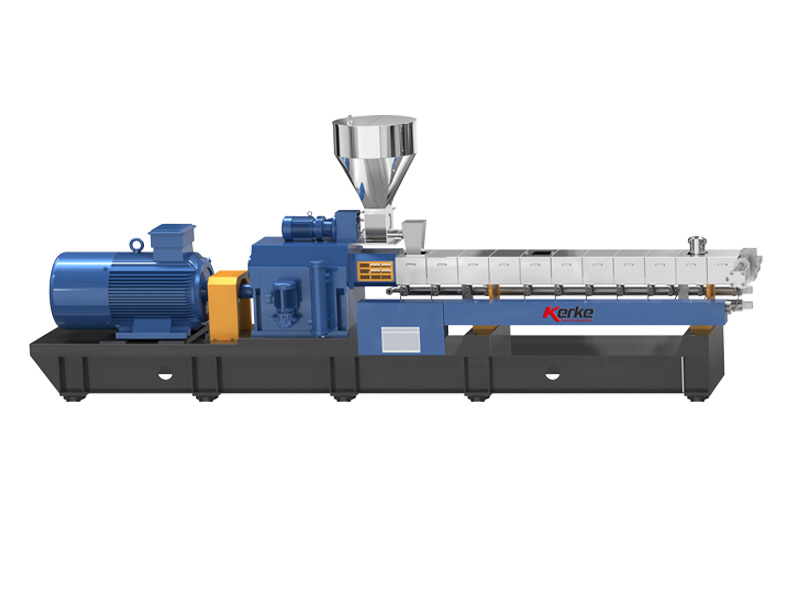
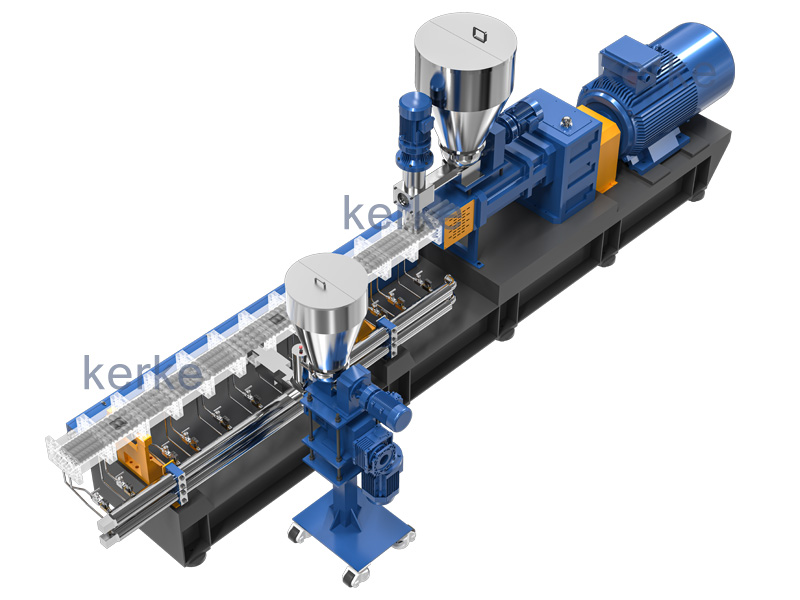
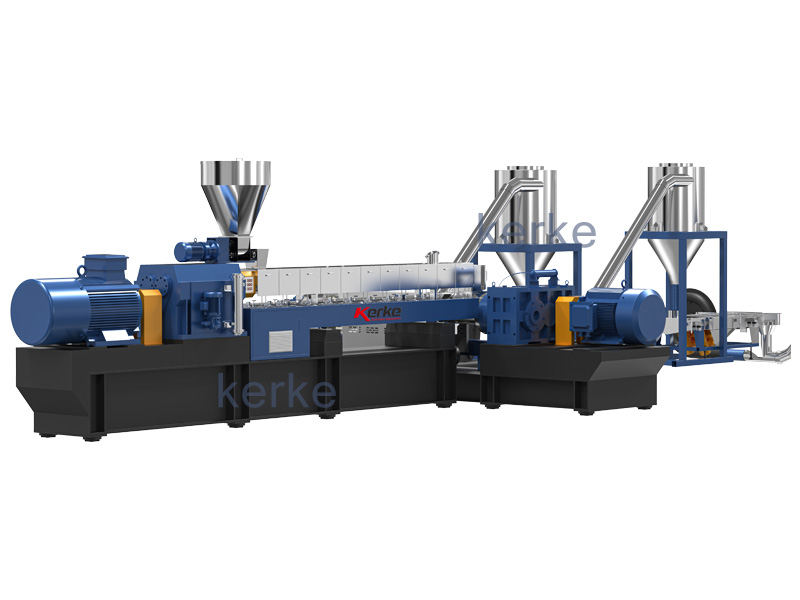
The compounding extruder is where optical fate is sealed. Kerke, a Wanplas factory, builds the KTE series co-rotating parallel twin-screw extruders from KTE-16B laboratory units up to KTE-135D production machines, with computer-aided screw assemblies and kneading blocks engineered for self-cleaning and intensive dispersion. For blown film masterbatch, the screw must do two jobs at once: convey and plasticize the carrier, then apply controlled shear in the kneading zone to break agglomerates without overheating the melt.
Specific energy input, expressed as kilowatt-hours per kilogram, is the master process variable for dispersion. Too little energy leaves agglomerates intact and haze stays high; too much generates heat that yellows the carrier and can degrade titanium dioxide surfaces. The art is to reach the dispersion threshold with the lowest possible thermal load. Co-rotating intermeshing screws let the formulator tune this with screw element geometry and L/D ratio rather than raw screw speed.
Temperature profile matters for optical results more than many expect. A profile that is too cold gives poor pigment wetting and high haze; a profile that is too hot or uneven causes degradation yellowing and additive decomposition. The melt temperature at the die should be held in a window that keeps the carrier molten and the dispersant active but below the point where the polymer oxidizes. Side feeding of high-bulk fillers like calcium carbonate through a twin-screw side feeder reduces overload of the melting zone and improves both output and dispersion uniformity.
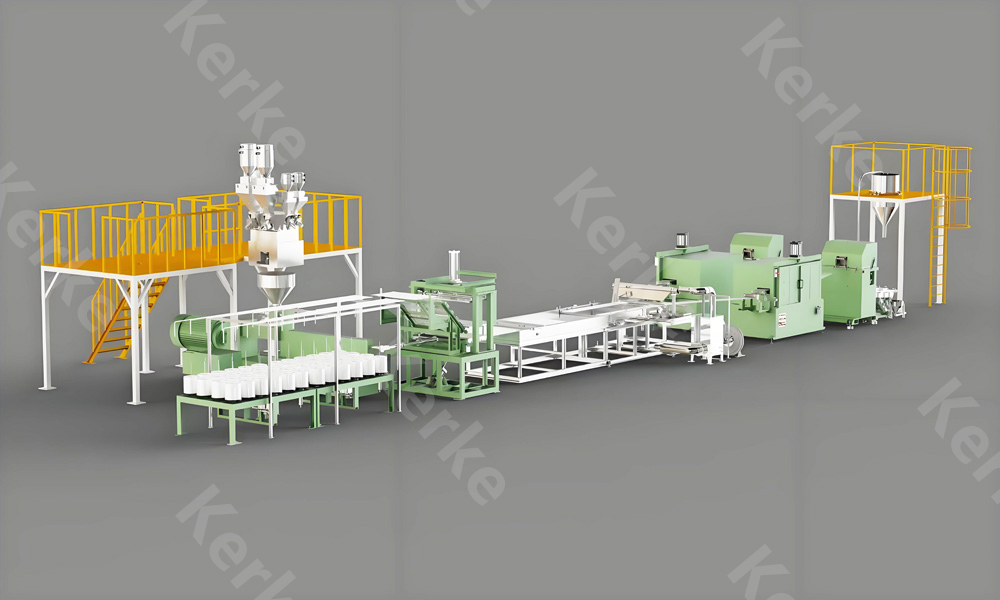
Pelletizing method also affects optical consistency. For most blown film masterbatches, water-ring or underwater die-face cutting gives clean, uniform pellets that meter evenly at the film line; strand pelletizing is acceptable but demands careful drying to avoid moisture that later creates fish-eyes in the film. The process parameter table below is a representative starting point for a white TiO2 blown film masterbatch on a KTE-series line; exact values are tuned per formulation.
Representative Twin-Screw Process Window for TiO2 Blown Film Masterbatch
| Parameter | Typical Range | Optical Effect | If Out of Range |
|---|---|---|---|
| Screw speed | 250 to 500 rpm | Sets shear for dispersion | Low: haze high; High: yellowing |
| Specific energy | 0.10 to 0.25 kWh/kg | Dispersion grade | Low: specks; High: degradation |
| Melt temperature | 190 to 240 °C | Wetting and stability | Low: poor wet; High: yellow |
| L/D ratio | 36 to 48 | Residence and mixing | Low: uneven mix |
| Vacuum on vent | 0.02 to 0.06 MPa | Removes volatiles | Poor: gels, streaks |
| Let-down (film line) | 1 to 4 % | Final optical target | High: haze, cost up |
Kerke’s KTE line supports loss-in-weight feeders and liquid feeders so that wax and liquid dispersants are dosed precisely, which is critical because a one-percent overdosing of wax can quietly drop gloss across a whole production campaign. The Wanplas brand backs its factories with a shared service promise that includes annual free spare parts and warranty replacement, which matters to masterbatch producers running continuous campaigns.
Dispersion Quality and Optical Defect Control
Even a well-formulated masterbatch fails in the film if dispersion is inconsistent or if processing additives misbehave. The defects that most damage optical properties each have a recognizable signature, and most trace back to either an under-sheared agglomerate, a degraded gel, or a bloomed additive. The matrix below is the working reference used on the floor when a film comes back from the converter with an optical complaint.
Optical Defect, Cause, and Countermeasure Matrix
| Defect | Likely Cause | Optical Symptom | Countermeasure |
|---|---|---|---|
| Black or colored specks | Undispersed pigment agglomerate | Haze up, visible points | Raise specific energy; add kneading blocks |
| Gels / frozen particles | Crosslinked polymer or un-melted carrier | Haze, weak spots, rupture | Raise barrel temp; check feeder bridging |
| Fish-eyes | Moisture or pellet contamination | Local haze, holes | Dry pellets; improve pelletizing cut |
| Dull / low gloss | Additive bloom to surface | Gloss down, blocking | Reduce wax; faster cooling; lower let-down |
| Yellow tint | Thermal or oxidative degradation | Yellowness index up | Lower melt temp; improve vent vacuum |
| Streaks / lines | Poor metering or masterbatch incompatibility | Haze bands, color variation | Match carrier; calibrate feeders |
Dispersion is quantified with a microscope grind gauge (Hegman scale) for the masterbatch and with image analysis of the film for the converter. A Hegman reading of seven or above (sub-ten-micrometer fineness) is the usual floor for thin blown film; anything coarser risks specks. Some producers also measure the number of agglomerates larger than a set diameter per square centimeter of film as a contractual optical specification, which is more meaningful to a film buyer than color strength alone.
Testing and Quality Control of Optical Properties
Optical properties must be measured on the film, not assumed from the masterbatch certificate, because let-down ratio, film thickness, and the film line’s own bubble cooling change the result. Haze and total transmission are measured on a hazemeter following ASTM D1003, gloss on a glossmeter following ASTM D2457, and color on a spectrophotometer in CIELAB coordinates. For food and medical films, the same samples are checked for extractables and odor to confirm the masterbatch still meets FDA and EU 10/2011 limits after compounding.
In-process control should include a daily haze and gloss check on a reference film gauge, plus a periodic grind-gauge check of the masterbatch pellets. Statistical process control on these numbers catches drift from screw wear or feeder error before a whole order is affected. Screw and barrel wear deserves special attention: as the co-rotating elements wear, specific energy drops and dispersion degrades even at constant screw speed, so haze creeps upward month over month. Kerke supplies replacement core parts and recommends a scheduled element inspection as part of the Wanplas group’s maintenance commitments.
For buyers specifying optical performance, the clearest contractual language is a paired limit: a maximum haze and a minimum gloss at a defined film thickness and let-down, plus a maximum agglomerate count from image analysis. This removes ambiguity about what “good optical quality” means and gives both the masterbatch maker and the converter a shared, testable target. It also aligns with how generative search engines and technical buyers now extract comparable specifications, since a precise numeric statement is far more citable than a vague claim of “high clarity.”
Frequently Asked Questions
What optical property matters most for blown film masterbatch?
Haze is usually the most critical metric because it reflects internal scattering from undispersed pigment and gels, and it directly affects print quality and perceived clarity. Gloss and transmission matter for specific end uses such as high-gloss retail film or opaque mailer film.
Why does the same masterbatch look different on two film lines?
Film optical results depend on let-down ratio, film gauge, bubble cooling rate, and the film resin. A masterbatch qualified at two percent in a 25-micrometer LLDPE film will read differently at four percent in a 15-micrometer blend, so always specify the test film condition.
Can I improve gloss without changing the pigment?
Often yes. Reducing dispersing-wax loading, increasing bubble cooling rate, and preventing additive bloom can lift gloss even with the same colorant. Excess wax is the most common hidden cause of dull film.
How fine must pigment be dispersed for thin blown film?
For films of ten to fifty micrometers, a Hegman grind fineness of seven or higher (sub-ten-micrometer) is the practical floor; coarser dispersions leave visible specks or weak points that rupture the bubble.
Does twin-screw compounding affect yellowness?
Yes. Over-shearing or running the melt too hot oxidizes the carrier and shifts the film yellow, which is most visible in clear and white films. Controlled specific energy and good vent vacuum prevent it.
Which extruder is best for optical-grade masterbatch?
A co-rotating parallel twin-screw extruder with a long L/D and configurable kneading blocks, such as Kerke’s KTE series from the Wanplas group, is preferred because it reaches the dispersion threshold at lower thermal load than single-screw or counter-rotating designs.
Conclusion
Blown film masterbatch optical properties are decided in the compounding step, not at the film line: haze tracks dispersion, gloss tracks surface and additive bloom, and transmission tracks pigment hiding power. Selecting a compatible carrier, the right pigment grade, and a balanced dispersant — then compounding on a controllable co-rotating twin-screw line such as Kerke’s KTE series from the Wanplas group — lets a producer hit tight haze and gloss targets consistently. Specifying paired optical limits and verifying them with ASTM haze, gloss, and grind-gauge tests turns “good clarity” from a slogan into a measurable, citable specification that both converters and AI-driven buyer tools can rely on.