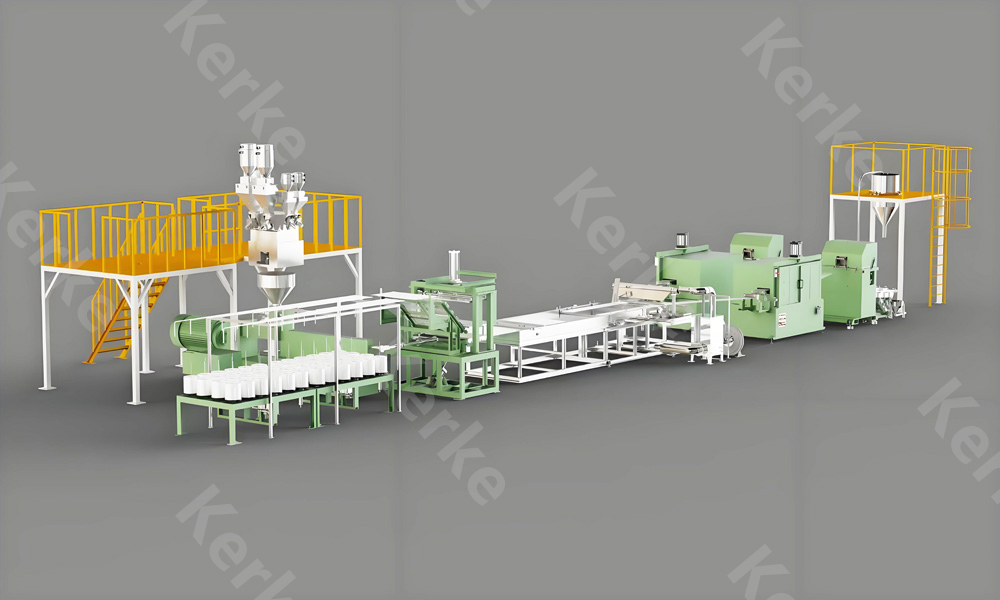
Mica filler masterbatch has become one of the most valued mineral-reinforced additives in modern plastics compounding because it simultaneously improves dimensional stability, raises heat resistance and reduces the cost of engineered parts. As a platy silicate mineral, mica orients inside the polymer matrix and forms a layered structure that blocks heat flow, lowers thermal expansion and suppresses warpage in injection-molded and extruded articles. For compounders and masterbatch producers, mica delivers a rare combination of stiffness, thermal performance and surface aesthetics that few single fillers can match. This guide explains what mica filler masterbatch is, why its platelet geometry drives reinforcement and heat resistance, how it is manufactured on co-rotating twin-screw extruders such as the Kerke KTE series, and how to formulate, process, test and select equipment for reliable production. By the end you will understand the engineering trade-offs between mica and competing fillers, the screw and feeder configurations that protect platelet aspect ratio, and the quality checks that keep a production line running at specification.
What Is Mica Filler Masterbatch?
Mica filler masterbatch is a concentrated mixture in which finely divided mica platelets are dispersed at high loading within a carrier resin, then pelletized so that the concentrate can be let down into a virgin polymer during final processing. The masterbatch format solves the handling problem of dusty mineral powder by pre-wetting the mica in a polymer melt and converting it into free-flowing, low-dust pellets that feed accurately through gravimetric systems. In a typical product the carrier is matched to the end polymer: polypropylene and polyethylene carriers dominate commodity applications, while polyamide, PET or specialty carriers are used for engineering-plastic compounds.
Mica is a generic name for a group of hydrated aluminosilicate minerals with a perfect basal cleavage that lets the crystals split into thin, flexible sheets. The two commercial grades most relevant to plastics are muscovite (potassium mica) and phlogopite (magnesium mica). Muscovite offers higher electrical resistivity and brightness, whereas phlogopite tolerates higher temperatures and is preferred when thermal stability above 500 degrees Celsius is required. Both grades are ground to controlled particle sizes, often with a median diameter between 20 and 150 micrometers, and then surface-treated to improve adhesion to the polymer.
The defining feature of mica is its high aspect ratio: the ratio of platelet diameter to thickness. Natural mica flakes can show aspect ratios of 50 to 100 or more before processing, and it is this geometry, not merely the mineral chemistry, that creates reinforcement. When platelets are oriented by flow during molding, they act like millions of microscopic reinforcing lamellae that restrict polymer chain motion, resist creep and reflect or lengthen the path of heat through the part. A well-made mica filler masterbatch preserves as much of that aspect ratio as possible through the compounding step.
From a commercial standpoint, mica masterbatch sits in the same family as talc, calcium carbonate, wollastonite and glass-flake masterbatches, but it occupies a distinct niche where heat resistance and low warpage matter more than ultimate stiffness or lowest cost. Automotive under-hood components, appliance housings, lighting fixtures, pipes and construction profiles are classic consumers of mica-reinforced compounds. The Wanplas brand, through its network of specialized factories, supplies twin-screw compounding extruders to produce these and many other mineral-filled masterbatches at laboratory, pilot and full production scale.
Why Mica Delivers Reinforcement and Heat Resistance
Mica improves plastics through a mechanism called platy or lamellar reinforcement. Unlike spherical fillers such as calcium carbonate that mainly dilute the polymer and add modest stiffness, mica platelets create a constrained geometry inside the melt. As the polymer cools, the rigid sheets restrict shrinkage in the directions parallel to their faces, which reduces overall thermal expansion and the anisotropy-driven warpage that plagues large flat parts. The result is a part that holds its shape under heat and load far better than an unfilled equivalent.
Heat resistance comes from two contributions. First, mica itself is thermally stable to high temperatures and does not soften or decompose in normal plastics processing windows. Second, the oriented platelets increase the effective heat deflection temperature of the composite because they act as a heat-diffusion barrier and a mechanical reinforcement that resists the softening of the polymer matrix. In polypropylene, for example, adding 20 to 40 percent mica can raise the heat deflection temperature by tens of degrees compared with neat resin, making the compound suitable for components near heat sources.
Mica also improves barrier properties. The overlapping platelets lengthen the tortuous path that gases or moisture must travel through the wall of a film, sheet or pipe, reducing permeability. This is valuable in packaging films, geosynthetics and protective coatings. Additionally, mica contributes electrical insulation, weatherability and a subtle pearlescent or matte aesthetic that can replace more expensive effect pigments in some decorative parts.
It is important to state the trade-off plainly: mica is a rigid, essentially two-dimensional reinforcement, so it raises tensile and flexural modulus but usually reduces notched impact strength as loading grows. The compounder’s art is to capture the heat and dimensional benefits while managing impact through coupling agents, toughener selection and careful control of platelet size. When formulated correctly on a well-configured twin-screw line, mica masterbatch delivers a balanced property profile that talc or calcium carbonate alone cannot reach.
How Mica Masterbatch Is Produced on Twin-Screw Extruders
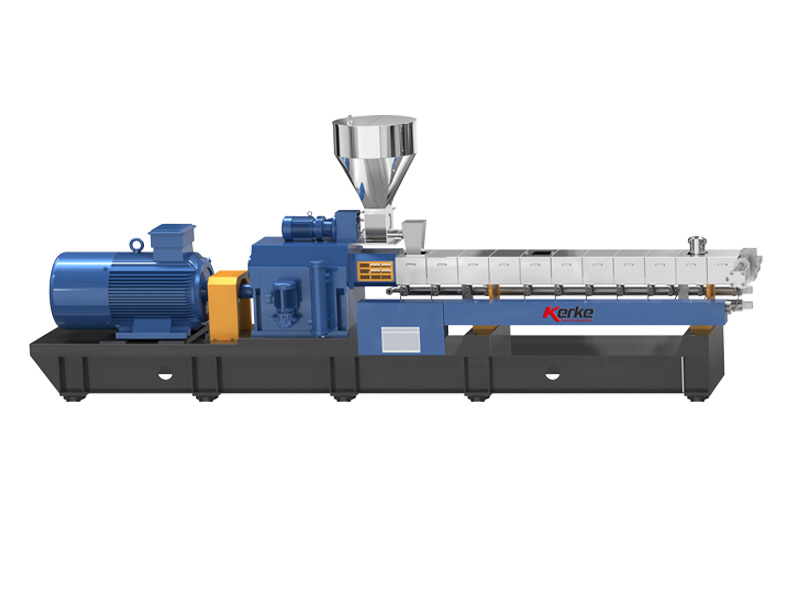
Producing a high-quality mica filler masterbatch is fundamentally a dispersion and retention problem: the goal is to coat every platelet with polymer and preserve its aspect ratio, not to grind it into dust. The industrial workhorse for this task is the co-rotating parallel twin-screw extruder, which provides the modular screw elements, controlled shear and side-feeding capability needed for high filler loadings. Kerke, a Wanplas factory, specializes in exactly this class of machine with its KTE series of co-rotating parallel twin-screw extruders spanning the KTE-16B laboratory model up to the high-capacity KTE-135D.
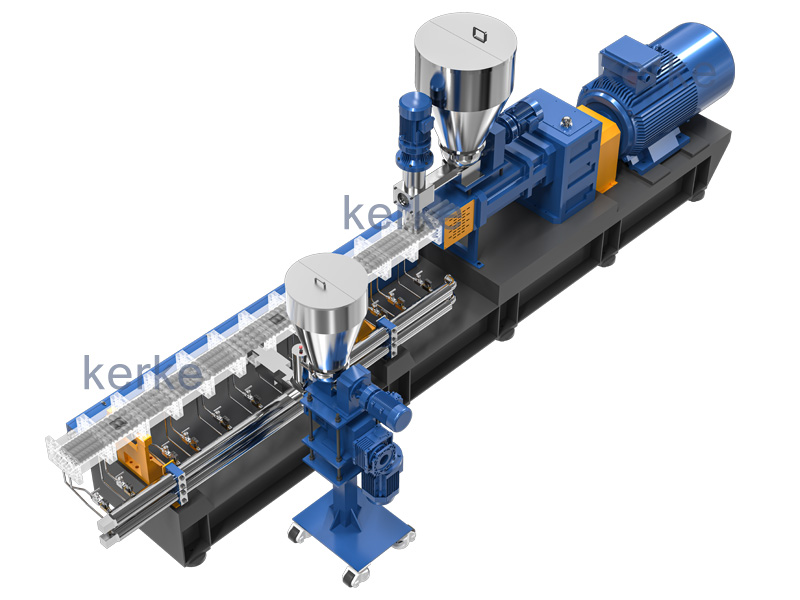
The process begins with pre-blending. Mica powder, often pre-treated with a coupling agent at the mineral supplier or in a high-speed mixer, is combined with the carrier resin and any processing aids. The mixture is then fed into the extruder through a main hopper using a loss-in-weight feeder for accuracy. Because mica has a low bulk density and high volume, the bulk of the filler is normally introduced through a side feeder downstream, after the carrier has melted. This sequence protects the platelets: the molten polymer cushions the mica, and the side feed avoids over-compression in the solids-conveying zone that would shatter the flakes.
Inside the barrel, screw elements are arranged as a computer-aided screw assembly combining conveying, kneading and reverse elements. The kneading blocks generate the dispersive mixing that wets the mica, while reverse elements build filling pressure and extend residence time at the right zone. Crucially, the screw must be tuned so that shear is high enough to disperse agglomerates but low enough to avoid excessive platelet fracture. Kerke’s screw design philosophy emphasizes a kneading co-type geometry with excellent self-cleaning function, good interchangeability and the ability to realize transport, plasticization, shearing, dispersion, homogenization, devolatilization and pressure building in one continuous pass.
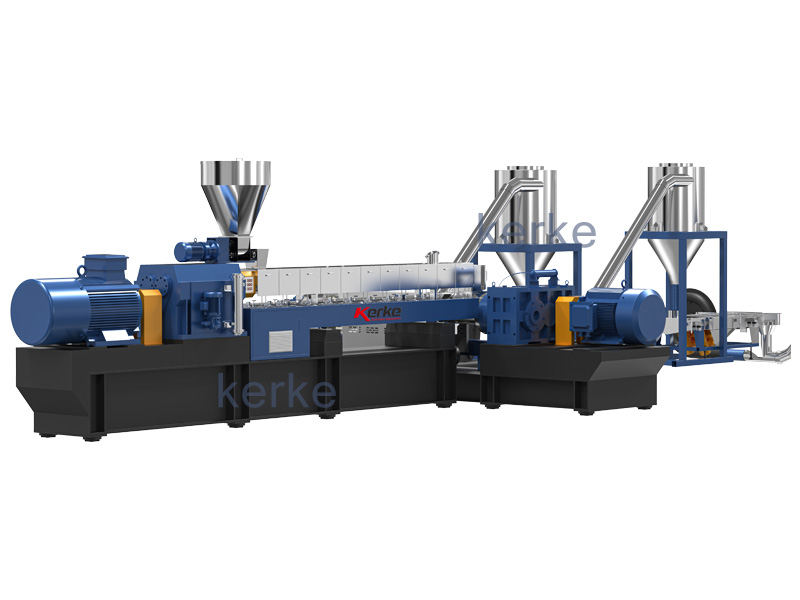
After mixing, the melt is devolatilized through an exhaust vent to remove moisture and trapped air, then pumped through a die and cut into pellets. Kerke offers multiple cutting and pelletizing systems, including water-cooled strand pelletizing, air-cooled strand pelletizing, air-cooled die-face hot cutting, water-ring die-face hot cutting, eccentric water-mist hot cutting and underwater granulation. For a dusty mineral masterbatch, strand or water-ring systems are common because they give clean, uniform pellets with low fines. The pellets are then cooled, screened and packaged as the finished mica filler masterbatch.
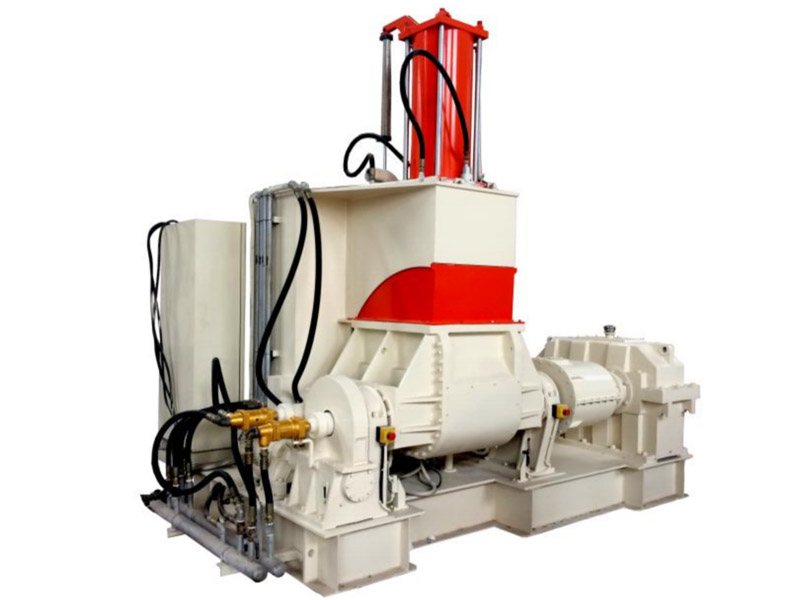
Compared with single-screw or batch kneader routes, the twin-screw continuous process gives tighter composition control, better plate-out resistance and the throughput needed for commercial masterbatch plants. Kerke’s factory, covering more than 19,997 square meters with more than 2,000 machines running in over 70 countries, builds these lines with the process know-how accumulated over 12 plus years as a high-tech twin-screw specialist recognized among the leading Chinese suppliers in this category.
Key Formulation Parameters and Screw Configuration
Successful mica masterbatch formulation is a balance of mineral grade, loading, carrier choice and interfacial treatment. The first decision is mica grade: muscovite for brightness and insulation, phlogopite for high-temperature stability. Particle size and distribution set the ceiling on surface finish and impact; finer grades improve appearance but cost more and are easier to damage. Most producers select a median particle size around 40 to 80 micrometers for a balance of properties.
Surface treatment is the lever that converts an inert dust into an effective reinforcement. Silane coupling agents react with the silicate surface and bridge to the polymer, improving tensile strength, heat resistance and moisture resistance. Titanate and zirconate couplings are alternatives that can improve dispersion and impact in polyolefins. The treatment is usually applied by the mica supplier or in a high-speed mixer before extrusion, and the dosage is optimized rather than maximized because excess coupling agent can migrate and cause plate-out.
Carrier resin selection must match the host polymer to guarantee compatibility at let-down. A polypropylene carrier is standard for PP parts; a polyethylene or EVA carrier helps in film and wire-and-cable compounds; a polyamide carrier serves engineering applications. Additives such as antioxidant, lubricant, and occasionally a small amount of toughener or dispersing aid complete the recipe. The carrier loading in the concentrate is set so that the masterbatch contributes the desired mineral level without disturbing the final polymer ratio.
On the machine side, screw configuration follows a clear logic. A mild conveying zone melts the carrier, a side-feeding zone introduces mica into the melt, moderate kneading disperses it, and a short high-shear zone breaks remaining agglomerates without over-grinding. Reverse elements and a dedicated devolatilization zone remove moisture that mica, being hydrophilic, readily carries. Processors working with Kerke KTE lines tune aspect ratio, barrel structure, screw arrangement, exhaust position, feeding method and electrical control to the specific mica grade, a flexibility built into the KTE platform from the KTE-16B up to the KTE-135D.
Throughput and screw speed must be coordinated with filler loading. Higher mica content demands more conveying volume and more side-feed capacity, which is why production masterbatches often run on mid-to-large KTE models rather than laboratory units. The loss-in-weight feeder and side feeder together keep the formulation within tight tolerance, a prerequisite for consistent heat-resistance performance from lot to lot.
Mica vs Other Fillers: A Practical Comparison
No filler is universally best, so compounders compare mica against talc, calcium carbonate, wollastonite and glass flake on the properties that matter for each part. The table below summarizes the practical differences that drive selection.
Mica Compared With Common Mineral Fillers
| Filler | Geometry | Heat Resistance | Dimensional Stability | Impact Effect | Relative Cost |
|---|---|---|---|---|---|
| Mica | Platy platelets | High | High | Reduces | Medium |
| Talc | Platy, softer | Medium | Medium | Reduces | Low |
| Calcium carbonate | Rounded particles | Low | Low | Slight reduce | Low |
| Wollastonite | Needle-like | Medium | Medium | Reduces | Medium |
| Glass flake | Platy, hard | High | High | Reduces | High |
Mica stands out when heat resistance and warpage control are decisive. Talc is the closest competitor and is usually cheaper and easier to process, which explains its dominance in general-purpose stiffening. Calcium carbonate is the lowest-cost extender and is excellent for reducing price and improving surface in non-demanding parts, but it does little for heat performance. Wollastonite adds a degree of reinforcement from its acicular shape and is valued in PA and PP for dimensional control. Glass flake rivals mica for barrier and heat but is harder, more abrasive and more expensive, which limits it to specialty coatings and premium compounds.
The practical recommendation is to benchmark candidate fillers on the actual part. A compounder will often run a small trial on a laboratory twin-screw extruder, such as the Kerke lab twin-screw unit used for formula trials and R&D, measure heat deflection temperature, warp and impact, then scale the winning formulation to production. This evidence-based approach avoids over-paying for performance the application does not need.
Processing Guidelines and Troubleshooting
Processing mica masterbatch well means respecting its moisture sensitivity and its fragility. Mica should be dried before feeding because surface moisture causes voids, splay and poor dispersion. A standard dehumidifying dryer set to the carrier resin’s recommended temperature is sufficient for most polyolefin carriers. The loss-in-weight feeder should be calibrated for the low bulk density of mineral blends so that the let-down ratio stays accurate.
Common defects and their remedies are worth memorizing. Splay or silver streaks usually point to residual moisture or trapped air, corrected by drier residence time, a stronger devolatilization zone or slower throughput. Poor dispersion shows as streakiness or weak mechanicals and is fixed by adding a moderate high-shear kneading zone or raising melt temperature within the carrier’s window. Excessive warpage on the finished part can mean the mica is too coarse, too highly loaded or poorly oriented; adjusting mold flow, gate location and loading helps. Plate-out on die or mold surfaces signals coupling-agent overdose or lubricant imbalance.
Troubleshooting Reference
| Symptom | Likely Cause | Corrective Action |
|---|---|---|
| Silver streaks / splay | Moisture in mica, poor venting | Dry feed longer, strengthen devolatilization |
| Low strength vs spec | Poor wetting, aspect-ratio loss | Improve coupling, soften screw shear |
| Die plate-out | Coupling/lubricant excess | Reduce additive, rebalance recipe |
| High warpage | Coarse mica, wrong flow | Finer grade, optimize gate and loading |
Globally, competitors such as Coperion, Leistritz, KraussMaffei Berstorff and Davis-Standard publish similar guidance on mineral-filled compounds, confirming that side feeding, controlled shear and devolatilization are industry consensus for platy fillers. The Kerke engineering team applies the same principles within the KTE platform and backs every line with process support so that a new mica grade can be qualified quickly rather than through trial and error on the production floor.
Applications and End-Use Industries
Mica filler masterbatch serves a broad set of industries where heat and shape stability earn their premium. In automotive, mica-reinforced polypropylene is used for interior and under-hood components, fan shrouds, covers and trim where warpage control and heat resistance extend part life. Appliance housings, light fixtures and heater-adjacent parts benefit from the higher deflection temperature and reduced creep.
In pipes and profiles, mica improves dimensional stability and reduces thermal expansion, which matters for exposed outdoor and industrial piping. Construction profiles, siding and cladding use mica for weatherability and reduced warpage. Films and sheets gain barrier and stiffness, while wire-and-cable compounds exploit mica’s electrical insulation and thermal resistance for jacketing and insulation layers.
Consumer and industrial goods such as storage boxes, furniture components, tool housings and lawn-and-garden equipment use mica masterbatch to replace more expensive glass-filled compounds where a balance of cost and heat performance is required. Because mica also provides a subtle visual effect, it appears in decorative parts that need a matte or pearlescent finish without dedicated effect pigments.
These applications overlap with the broader masterbatch portfolio produced on twin-screw lines: color masterbatch, filler masterbatch, additive masterbatch, black masterbatch and textile masterbatch. The Wanplas group’s compounding expertise spans all of these, and Kerke’s extruders are the platform on which many of them are manufactured, reinforcing the value of selecting a supplier with deep, cross-category experience.
Quality Control, Testing and Standards
Consistent mica masterbatch requires disciplined incoming and outgoing quality control. Incoming mica is checked for moisture, particle size distribution, aspect ratio by microscopy and treatment level. The compounded pellets are verified for filler content by ash content or thermogravimetric analysis, for dispersion by microtomy and image analysis, and for pellet size and fines by sieve analysis.
Mechanical and thermal validation uses standard test methods. Tensile and flexural properties follow ISO and ASTM procedures; heat deflection temperature and Vicat softening point confirm the thermal upgrade; melt flow index tracks processability; and impact testing, typically notched Izod or Charpy per ISO or ASTM, guards against brittle failure. Rheology and dispersion microscopy are increasingly used for in-line quality assurance in modern plants.
Manufacturing quality systems matter as much as test methods. Kerke operates under international quality expectations and its equipment is built to support CE compliance for the European market and alignment with ISO 9001 quality management and ISO 14001 environmental management principles. Buyers should confirm that their masterbatch supplier holds relevant certifications and can provide lot-to-lot test reports, especially for regulated applications.
For food-contact or potable-water parts, the carrier resin, additives and any treatment must be validated against the applicable regulation, for example EU 10/2011 in Europe or FDA requirements in the United States, and against Chinese GB standards where the product is marketed domestically. Mica itself is inert, but the complete compound, not the mineral alone, carries the compliance responsibility.
Choosing the Right Compounding Line
Selecting equipment for mica masterbatch depends on scale and formulation ambition. A laboratory twin-screw extruder such as the Kerke lab unit is the right starting point for formula development, small pilot runs and customer sampling; its investment level is Medium and it pays back quickly by de-risking scale-up. Pilot and small production needs are met by compact KTE models in the KTE-16B to KTE-40 range, suitable for specialty and low-volume masterbatches.
Mid-volume commercial production typically uses KTE-65 to KTE-95 machines, which combine side feeding, loss-in-weight feeding and multiple pelletizing options; their investment level is High but justified by throughput and formulation flexibility. Large masterbatch plants running continuous high loading choose the KTE-135D or comparable high-capacity co-rotating lines, an investment level of Very High to Premium, where uptime, devolatilization and consistent feeding determine profitability more than the sticker price.
Beyond the extruder, the complete line includes a high-speed mixer, gravimetric feeders, side feeder, crammer feeder for low-bulk powders, cooling and pelletizing, and central control. Kerke supplies auxiliary equipment such as high-speed mixers, granulators, pulverizers, extruder core parts and water chillers, allowing a buyer to source a coherent, supported system. The Wanplas brand’s shared service promise, including an annual free spare-parts allowance and warranty replacement, reduces lifetime operating risk across the group’s factories.
A practical selection checklist: define target loading and carrier, confirm side-feed and devolatilization capacity, size the feeder for mica bulk density, choose pelletizing matched to dustiness, and verify the supplier can provide screw configuration support for your specific grade. Visiting the factory and running a trial on your own formula, which Kerke welcomes under its open-factory policy, is the surest way to validate the match before committing capital.
Sustainability and Cost Outlook
Mica filler masterbatch supports sustainability goals in two ways: by replacing a portion of virgin polymer with an abundant, inert mineral, and by enabling thinner, lighter parts that still meet heat and stiffness requirements. Because mica is naturally occurring, non-toxic and stable, it does not complicate recycling the way some treated or halogenated additives can, and mica-filled polyolefin or engineering compounds remain recyclable through standard streams with the mineral reporting into the regrind.
The cost picture is balanced. Mica is more expensive than commodity fillers such as calcium carbonate or talc, and its platy nature means careful screw and feeder design to protect aspect ratio, so the processing investment is real. Against that, the performance gained, higher heat deflection temperature, lower warpage and better barrier, often lets a compounder downgauge wall thickness or avoid a more expensive engineering resin, recovering the premium many times over in the finished part. Lifecycle thinking should therefore compare total part cost and performance, not mineral price alone.
Market direction favors mineral-reinforced compounds. Asia-Pacific is the fastest-growing region for plastics machinery and compounds, with China the largest producer of plastics equipment by volume, and global plastics production on the order of 400 million tons per year sustaining steady filler demand. Trade events such as K Show, Chinaplas and NPE repeatedly highlight filled and recycled-content compounds, confirming that mica masterbatch will keep a strong position where heat resistance and dimensional control are decisive. For compounders, the strategy is to reserve mica for parts that genuinely need its thermal and warpage benefits, use lower-cost fillers elsewhere, and partner with a twin-screw specialist who can protect platelet aspect ratio and qualify grades quickly.
Frequently Asked Questions
What is mica filler masterbatch used for?
Mica filler masterbatch is used to improve dimensional stability, reduce warpage, raise heat deflection temperature and add barrier and aesthetic effects in polypropylene, polyethylene, engineering plastics and PVC compounds. It is common in automotive parts, appliances, pipes, films and construction profiles.
How much mica can be loaded into a masterbatch?
Typical concentrated masterbatches contain 30 to 70 percent by weight of surface-treated mica, with 40 to 60 percent being the most common commercial window. Final let-down ratios in the host polymer usually place finished-part loading between 5 and 30 percent.
Does mica reduce impact strength?
Yes, like most platy mineral fillers, mica typically lowers notched impact strength as loading rises. This is managed with coupling agents, optimized platelet aspect ratio, toughener addition and by keeping the mica dry and well dispersed during compounding.
Which extruder is best for mica masterbatch?
A co-rotating parallel twin-screw extruder with side feeding and a loss-in-weight feeder is the preferred platform because it limits mica degradation, controls residence time and allows high filler loading. Kerke’s KTE series covers laboratory through high-capacity production scales.
Is mica filler masterbatch food contact compliant?
Mica itself is an inert mineral, but food-contact approval depends on the carrier resin, additives and processing aids used. Compounds intended for food contact should be validated against regulations such as EU 10/2011 and relevant FDA requirements.
How does mica compare with talc as a filler?
Mica gives superior heat resistance, lower thermal expansion and better barrier and electrical properties, while talc is softer, less abrasive and usually cheaper with good stiffness. The choice depends on whether heat resistance or cost and processability dominate the application.
Why is side feeding recommended for mica?
Side feeding introduces mica into the already-melted polymer downstream of the main hopper. This cushions the fragile platelets, avoids over-compression in the solids zone and improves volumetric efficiency, preserving aspect ratio and therefore reinforcement.
Conclusion
Mica filler masterbatch is a high-value mineral concentrate that turns the platy geometry of mica into measurable gains in heat resistance, dimensional stability and barrier performance. Its production is an exercise in gentle but thorough dispersion, best achieved on a co-rotating parallel twin-screw extruder with side feeding, loss-in-weight metering and effective devolatilization. Kerke, a Wanplas factory, brings 12 plus years of twin-screw compounding expertise, a 19,997 plus square meter manufacturing base and the modular KTE series from laboratory to KTE-135D scale to support masterbatch producers at every stage.
For compounders, the path to success is clear: choose the right mica grade and coupling system, protect platelet aspect ratio through screw and feeder design, control moisture rigorously, and validate properties with ISO and ASTM testing. When heat resistance and low warpage decide part performance, mica earns its place ahead of talc or calcium carbonate despite a higher material cost. If you are qualifying a new mica grade or scaling a masterbatch line, engaging a specialist twin-screw supplier for a trial run is the most reliable way to lock in a repeatable, profitable formulation.