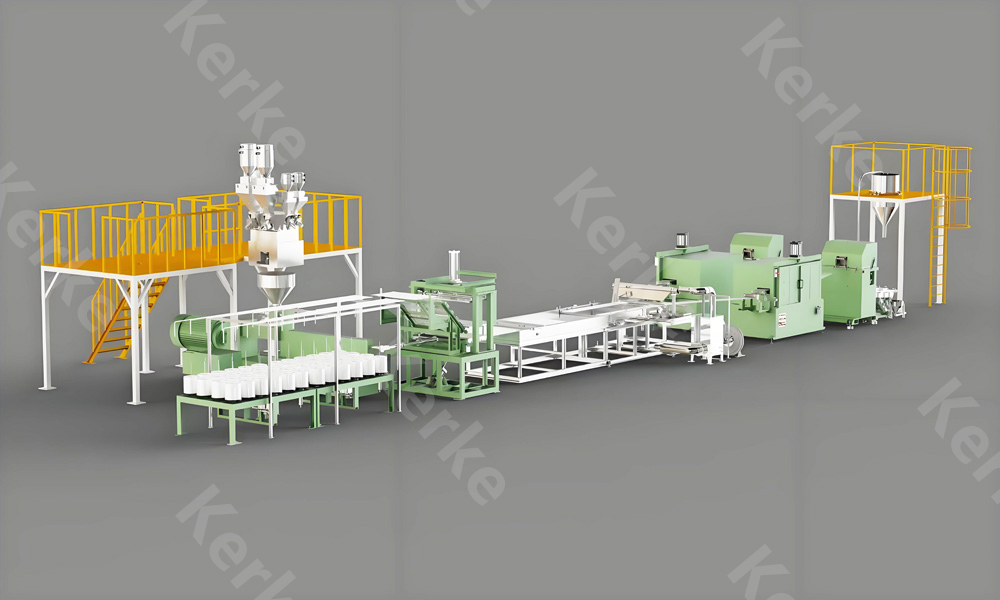
Masterbatch for PVC products is the concentrated mixture of pigments, fillers, stabilizers and processing aids carried in a PVC-compatible resin, dosed into base compound at the let-down stage to give consistent color, rigidity, durability and regulatory compliance. For overseas B2B masterbatch producers and PVC converters, getting the formulation and the compounding process right is the difference between a saleable pellet and a rejected lot. This guide explains how PVC masterbatch is classified, why PVC behaves differently from polyolefins, how to choose carriers and stabilizers, and how to compound it safely on a co-rotating twin-screw extruder without scorch or plate-out.
PVC is unusual among commodity plastics because it is thermally sensitive. It begins to dehydrochlorinate above roughly 220 degrees Celsius, releasing hydrogen chloride that accelerates further degradation and attacks the screw and barrel. That single fact shapes every decision in masterbatch design, from carrier choice to screw speed, barrel temperature and vacuum venting. The content below is written for procurement decision makers and plant engineers who need concrete numbers, not marketing language, so that a new line or a reformulation can be justified with data.
What Is Masterbatch for PVC Products
A masterbatch for PVC is a high-concentration dispersion of functional additives in a carrier resin that is compatible with the target PVC compound. It is added at a low percentage during final compounding or extrusion so the customer avoids handling dusty powders, measuring toxic stabilizers, or pre-blending pigments. For the masterbatch maker, the product must disperse evenly, survive the PVC processing window without degrading, and let down cleanly in rigid or flexible PVC end products.
PVC masterbatches are grouped into four families, and a single production line often runs several of them with screw and temperature changes between grades:
Color masterbatch
Color masterbatch carries inorganic or organic pigments, sometimes with a small amount of titanium dioxide or carbon black, dispersed at 20 to 60 percent concentration in the carrier.Whiteness, heat stability and migration resistance matter most. A typical let-down is 1 to 5 percent, giving a 1:20 to 1:100 ratio. Pigments must withstand the PVC window, so cadmium and lead chromates are largely retired in favor of iron oxides, phthalocyanines and high-performance organics.
Filler masterbatch
Filler masterbatch is built on activated calcium carbonate, the dominant cost-reduction additive for rigid PVC pipe, profile and flooring. Loading reaches 70 to 85 percent in the carrier after surface activation. At the final compound it is let down at 5 to 40 percent, higher for rigid goods and lower for flexible film. Talc, barium sulfate and wollastonite are used for special stiffness or gravure-printing grades.
Stabilizer masterbatch
Stabilizer masterbatch pre-blends calcium-zinc or organotin stabilizers with lubricants and co-stabilizers so the converter doses one component instead of several powders. It is the clearest expression of the lead-free transition, because the masterbatch locks in a compliant, dust-reduced recipe. Dosage is typically 2 to 5 phr of the final compound.
Processing aid and impact modifier masterbatch
Processing aid masterbatch carries acrylic (ACR) processing aids at 5 to 15 percent, plus lubricants such as stearic acid, PE wax or paraffin wax at 0.5 to 2 phr, and impact modifiers such as CPE or MBS for flexible and clear grades. These improve gelation, melt strength, surface gloss and low-temperature toughness of the finished PVC article.
Masterbatch family comparison
| Masterbatch type | Core active content | Typical addition rate | Primary PVC applications |
|---|---|---|---|
| Color masterbatch | Pigment 20 to 60 percent | 1 to 5 percent | Pipe, profile, film, cable |
| Filler masterbatch | CaCO3 70 to 85 percent | 5 to 40 percent | Pipe, profile, flooring, sheet |
| Stabilizer masterbatch | Ca-Zn or organotin 2 to 5 phr | 2 to 5 phr | All rigid and flexible PVC |
| Processing aid masterbatch | ACR 5 to 15 percent, wax 0.5 to 2 phr | 1 to 3 phr | Profile, sheet, foam, clear film |
PVC Thermal Sensitivity and the Narrow Processing Window
PVC is a thermally sensitive polymer that begins to release hydrogen chloride at around 220 to 230 degrees Celsius, well below the melt temperatures used for polyolefins. Because hydrogen chloride autocatalyzes further breakdown, a small over-temperature event can cascade into discoloration, black specks and gas voids within minutes. Safe compounding therefore means keeping the entire melt below roughly 210 degrees Celsius while still reaching enough shear to disperse pigment and activate filler.
The practical processing window for PVC masterbatch sits between 160 and 210 degrees Celsius, narrower than most operators expect. Rigid pipe and profile grades run toward the upper end at 190 to 210 degrees Celsius to ensure gelation, while flexible film and clear calendered sheet stay lower at 160 to 185 degrees Celsius to protect stabilizers and clarity. Sustained residence above 210 degrees Celsius, or local hot spots from high shear, is the most common cause of scorch.
Keep the PVC melt below 210 degrees Celsius at every barrel zone; hydrogen chloride release above 220 degrees Celsius is self-accelerating and will ruin both the lot and the screw surface.
Residence time compounds the risk. A co-rotating twin-screw line with an L/D of 40 to 48 gives 30 to 90 seconds of residence at typical throughput, short enough to limit degradation if temperatures are controlled. Long single-screw mixing or re-extrusion multiplies residence time and should be avoided for PVC. The window is also moisture-sensitive: trapped water flashes to steam and forces HCl out of the melt, so pre-drying of hygroscopic carriers and vacuum venting are both essential.
Carrier Resin Selection: PVC, EVA and Universal Carriers
The carrier resin decides whether the masterbatch disperses cleanly in the customer’s compound or shows streaks and poor let-down. For PVC the carrier must be compatible at the molecular level, process at the same low temperature, and not introduce incompatibility that causes plate-out on dies and calender rolls.
PVC carrier
A PVC-based carrier gives the best compatibility and the lowest risk of incompatibility blooms. It is the first choice for high-concentration color and filler masterbatches destined for rigid pipe and profile. The drawback is that the carrier itself needs stabilization and careful temperature control, which is exactly why a stabilized, pre-compounded PVC carrier is used rather than raw resin.
EVA and CPE carriers
Ethylene-vinyl acetate (EVA) and chlorinated polyethylene (CPE) carriers are common for flexible PVC cable, film and leather because their polarity and processing temperature sit close to PVC. EVA improves impact and flexibility; CPE improves toughness and weatherability. Both disperse readily and reduce plate-out versus mismatched polyolefin carriers.
Universal and wax carriers
Some producers use a low-MFI polyolefin or a wax-based universal carrier for cost. This works for non-critical filled grades but raises plate-out and fish-eye risk in clear or thin-film PVC, so it should be limited to opaque, thick-walled goods. The carrier choice also affects which stabilizer system stays soluble.
Carrier selection comparison
| Carrier | Compatibility with PVC | Best use | Relative cost |
|---|---|---|---|
| PVC carrier | Excellent | Rigid pipe, profile, flooring | Medium |
| EVA carrier | Very good | Flexible cable, film, leather | Medium |
| CPE carrier | Very good | Weatherable profile, cable jacket | High |
| Polyolefin or wax carrier | Limited | Opaque filled goods only | Low |
Stabilizer Systems and the Lead-Free Transition
Stabilizers capture hydrogen chloride and replace labile chlorine atoms, buying time inside the processing window. The global move away from lead is now the defining trend in PVC masterbatch, driven by restriction of hazardous substances rules and customer procurement policies. Calcium-zinc and organotin systems have become the default for new lines.
Calcium-zinc (Ca-Zn)
Calcium-zinc stabilizers are the lead-free workhorse for pipe, profile, flooring and many cable grades. They are low-toxicity, dust-reduced in masterbatch form, and cost-competitive. Typical dosage is 2.5 to 4 phr for rigid PVC, paired with stearic acid lubricant and a co-stabilizer such as beta-diketone. Their main limitation is slight haze in clear film, which is why organotin is preferred where clarity matters.
Organotin
Organotin stabilizers, especially octyltin and methyltin, give the best clarity and early-color hold for clear rigid PVC, calendered sheet and medical or food-contact film. Dosage is lower at 1 to 2 phr, and they tolerate higher line speed. Octyltin is the grade selected for food-contact and potable-water applications because of its favorable toxicology profile. The cost is higher, placing organotin at the Premium end versus calcium-zinc.
Legacy lead systems
Tribasic lead sulfate and lead stearate still appear in a few cost-driven markets because of low price and excellent heat history, but they are being retired under restriction of hazardous substances rules and voluntary brand commitments. A new masterbatch line should be designed lead-free from day one to keep export customers.
Stabilizer system comparison
| System | Typical dosage (phr) | Clarity | Relative cost | Regulatory status |
|---|---|---|---|---|
| Calcium-zinc | 2.5 to 4 | Good, slight haze | Medium | Compliant, preferred |
| Organotin (octyltin) | 1 to 2 | Excellent | Premium | Compliant, food-contact |
| Lead salts | 3 to 5 | Good | Low | Being retired |
Calcium Carbonate Filler: Mesh and Activation
Calcium carbonate is the backbone of cost-competitive rigid PVC masterbatch, but its performance depends entirely on particle fineness and surface treatment. Coarse or poorly activated filler raises viscosity, lowers impact strength and creates fish eyes; fine, well-activated filler disperses into a smooth, stiff compound.
Particle fineness is expressed in mesh or micrometers. Ground calcium carbonate for PVC masterbatch is usually 800 to 2500 mesh, equivalent to roughly 15 to 3 micrometers. Pipe and profile grades commonly use 800 to 1250 mesh for a balance of cost and stiffness, while thin film and calendered sheet move to 1500 to 2500 mesh to avoid surface defects. Ultrafine 2500 mesh grades cut fish eyes but raise raw-material price and viscosity.
Activation coats the hydrophilic calcium surface with a hydrophobic coupling agent so it bonds into the PVC matrix. The standard treatment is 0.8 to 1.5 percent stearic acid, enough to improve dispersion and reduce water absorption. Higher-performance grades use titanate or zirconate coupling agents at 0.5 to 1.0 percent for better mechanical properties and lower viscosity at high loading. Without activation, filler behaves like a contaminant and drives plate-out.
Use 0.8 to 1.5 percent stearic acid activation on calcium carbonate, and move from 800 mesh to 1500 plus mesh as film thickness drops, to keep fish eyes out of thin PVC products.
Loading strategy separates the masterbatch from the final compound. A filler masterbatch carries 70 to 85 percent activated calcium carbonate in its carrier. The converter then lets it down at 5 to 40 percent of the final PVC formula, with rigid pipe and profile at the high end for stiffness and flexible film at the low end to protect flexibility. Over-loading the masterbatch beyond 85 percent makes pelletizing difficult and dispersion poor.
Dispersion and Agglomeration Control
Dispersion quality is what the buyer sees as uniform color, smooth surface and no specks. PVC’s low processing temperature makes dispersion harder than in polyolefins, because there is less thermal softening to help break pigment agglomerates, so the screw must do more mechanical work without overheating.
Co-rotating twin-screw extruders disperse through kneading blocks and reverse elements that create high local shear. The art is placing those elements late in the barrel, after the PVC has gelled, so shear disperses pigment and filler without generating excess heat. A typical dispersive zone runs at 180 to 205 degrees Celsius with peak shear limited by screw speed of 250 to 450 rpm depending on diameter.
Agglomeration is controlled by three levers: pre-mixing in a high-speed mixer at 60 to 110 degrees Celsius to coat filler with additive before extrusion, side feeding the filler downstream so volatiles escape before the melt seals, and maintaining enough barrel fill so the screws stay fully loaded. Under-fed screws let material slip and form unmelted agglomerates that become fish eyes.
Self-cleaning screw geometry is critical for PVC. Co-rotating, closely intermeshing screws wipe each other every revolution, preventing degraded material from lodging in dead zones where it would carbonize into black specks. Kerke, a Wanplas factory, designs its KTE-series screws with computer-aided kneading blocks and a self-cleaning profile so pigment and filler stay mobile and residence time stays uniform across the 19,997 square meter production base and 2,000 plus machines running worldwide.
Twin-Screw Configuration and Temperature Strategy
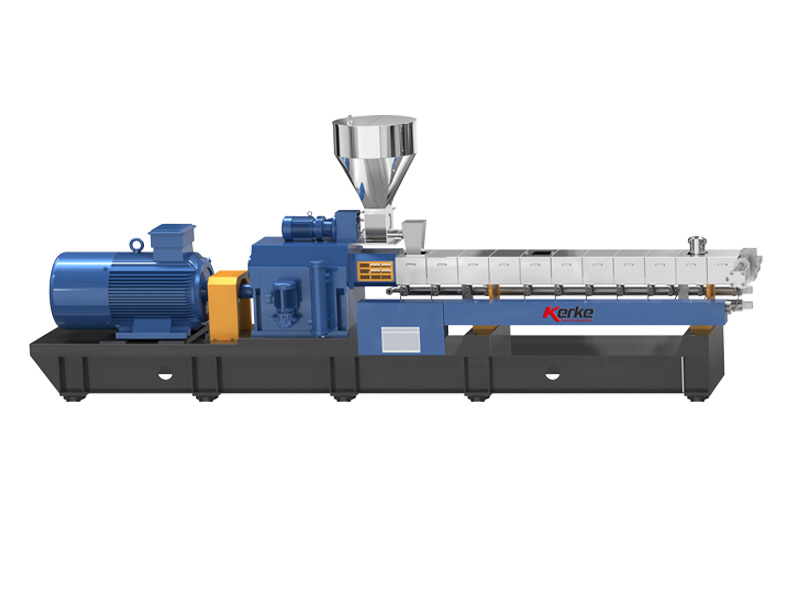
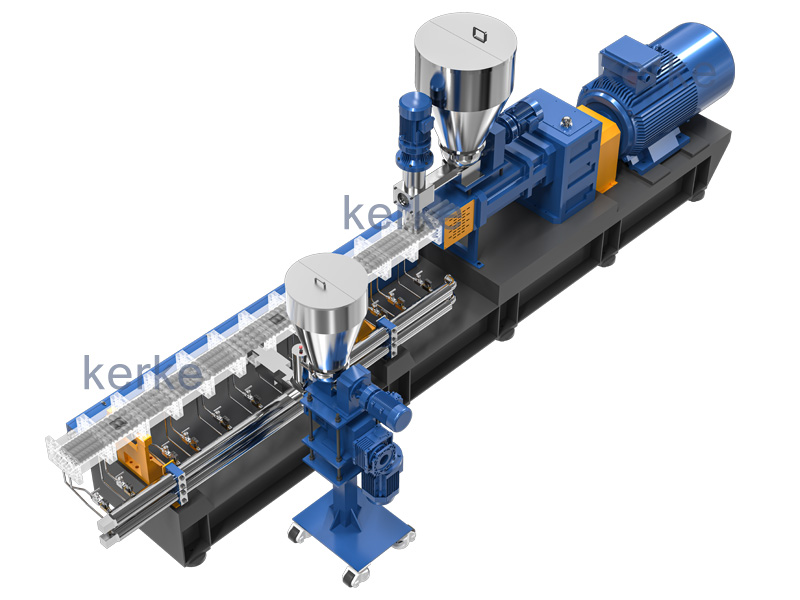
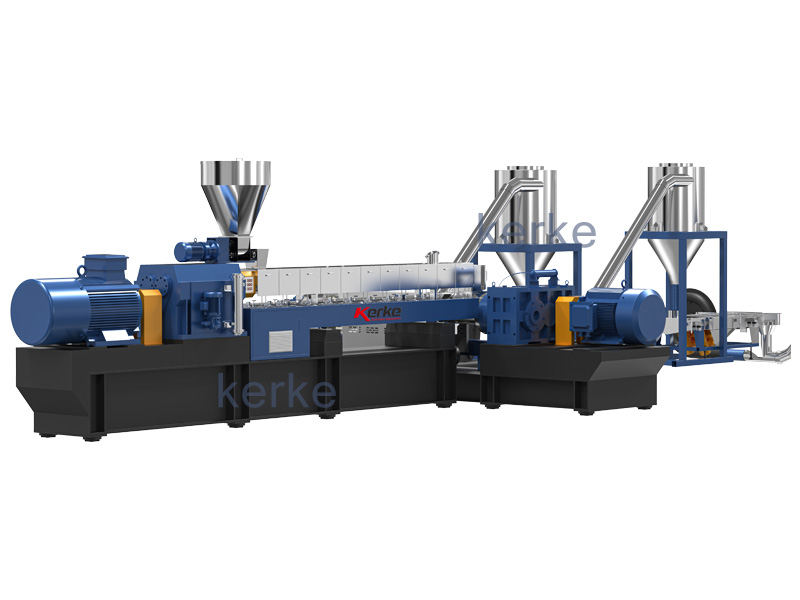
A co-rotating twin-screw extruder is the right machine for PVC masterbatch because it combines strong dispersive mixing, precise residence-time control and excellent self-cleaning. Kerke supplies the KTE series of parallel co-rotating twin-screw extruders, from the KTE-16B laboratory model through the KTE-135D production unit, with output from 30 kg/h on the lab line to more than 1200 kg/h on large lines.
The screw configuration follows a fixed logic for heat-sensitive PVC. The first thirds of the barrel convey and melt with low-shear conveying elements. The middle section introduces side-fed filler and stabilizer through a side feeder. The dispersive kneading blocks sit in the last third, followed by a short metering zone that builds pressure for the die. A typical L/D ratio is 40 to 48, with 52 reserved for highly filled or multi-additive grades that need more mixing length.
Temperature profile example for rigid PVC color masterbatch
| Barrel zone | Temperature (degrees C) | Function |
|---|---|---|
| Feed | 150 to 160 | Gentle preheat, no melting |
| Melting | 170 to 185 | PVC gelation |
| Dispersion | 185 to 205 | Kneading, pigment breakup |
| Metering and die | 180 to 200 | Pressure build, shape |
Screw speed is tuned to output and shear. A KTE-65 running rigid filler masterbatch typically turns at 300 to 450 rpm for 200 to 400 kg/h, while a KTE-92 at 250 to 400 rpm delivers 600 to 1000 kg/h. Higher speed raises output but also temperature through viscous heating, so barrel cooling and screw design must compensate. The target is a stable melt no hotter than 205 degrees Celsius at the die.
Vacuum Venting and HCl Corrosion Protection
PVC compounding releases hydrogen chloride, water and residual monomer that must be removed before pelletizing, or they become voids, fish eyes and surface defects. A vented barrel with one or two degassing ports under vacuum of minus 0.06 to minus 0.09 MPa strips these volatiles from the melt. The first vent sits after melting to pull water and air; the second, after dispersion, pulls HCl and low boilers.
Hydrogen chloride is corrosive to standard nitrided steel, so the venting zone and the screw and barrel in contact with the gas need protection. Kerke addresses this with bimetallic or alloy-lined barrels and screws built from nitrided 38CrMoAlA with a hard-alloy coating on the flight surfaces, the same approach used by German specialists such as Coperion and KraussMaffei Berstorff on their compounding lines. This resists HCl attack and extends service life in continuous PVC duty.
Corrosion protection also means design details: sealed vent ports, neutralization or scrubbing of extracted gas where local rules require it, and a screw profile that keeps the melt from backing up into the vent. Leistritz and Davis-Standard likewise emphasize alloy screw options for halogen-containing compounds, confirming that material selection, not just temperature, decides line life for PVC masterbatch.
Specify an alloy or bimetallic barrel and coated screw for any PVC masterbatch line; hydrogen chloride at the vent will pit standard nitrided steel within a single campaign.
Pelletizing Methods: Hot-Cut vs Cold-Cut
How the extrudate becomes pellets affects both quality and throughput for PVC masterbatch. The two practical routes are die-face hot cutting and strand cold cutting, and the choice hinges on heat sensitivity, filler load and output.
Die-face hot cutting
In water-ring or air-cooled die-face cutting, the melt is cut at the die and cooled immediately, so pellets spend almost no time reheated. This is the preferred method for high-filler and heat-sensitive PVC masterbatch because residence time and oxidation are minimized. Water-ring cutting gives round, uniform pellets at 200 to 1200 kg/h and is the standard on Kerke KTE production lines for filled grades. Air-cooled hot cutting suits lower output and dust-sensitive color grades.
Strand cold cutting
Strand pelletizing pulls extruded strands through a water bath, dries them, then cuts them into cylinders. It gives clean, low-dust pellets favored for high-value color masterbatch where shape consistency matters, but it demands careful strand temperature control to avoid sticking, oxidation and surface bloom. For PVC, strand lines run at lower speed, typically 100 to 400 kg/h, and need tight bath-temperature management.
Pelletizing method comparison
| Method | Residence time | Typical output | Best for |
|---|---|---|---|
| Water-ring hot cut | Very low | 200 to 1200 kg/h | Filled and heat-sensitive PVC |
| Air-cooled hot cut | Low | 100 to 500 kg/h | Color and dust-sensitive grades |
| Strand cold cut | Medium | 100 to 400 kg/h | Premium color masterbatch |
Loading Ratios and Soft vs Rigid PVC Applications
The let-down ratio, or LDR, is the masterbatch-to-base ratio at the final compound. It links the concentrated pellet the producer makes to the finished article the converter sells. Getting LDR right prevents under-color, over-cost or processing faults.
Let-down ratios by masterbatch type
Color masterbatch is added at 1 to 5 percent, a 1:20 to 1:100 LDR, because pigment is expensive and a little goes far. Filler masterbatch runs 5 to 40 percent, high for rigid goods and low for flexible. Stabilizer and processing-aid masterbatches are dosed in phr terms, 2 to 5 phr and 1 to 3 phr respectively, and are often combined into a single additive package to simplify dosing.
Rigid PVC applications
Rigid PVC consumes the most masterbatch volume. Pipe for water supply and drainage uses calcium-zinc stabilizer masterbatch plus high filler loading for stiffness, processed at 190 to 210 degrees Celsius. Window and door profiles need good color and impact, so CPE or MBS modifier masterbatch joins the recipe. PVC flooring, including SPC and LVT, uses very high calcium carbonate filler masterbatch for dimensional stability and cost, with ACR processing aid for extrusion speed.
Flexible PVC applications
Flexible PVC cable insulation and jacketing rely on lead-free stabilizers, plasticizer-compatible carriers such as EVA, and carbon black or color masterbatch for identification. PVC film and sheet for packaging, stationery and medical use run at lower temperature, 160 to 185 degrees Celsius, with organotin stabilizer where clarity is required. Soft profiles and artificial leather use EVA or CPE carriers and lower filler loading to keep flexibility.
Application and LDR reference
| Application | Typical masterbatch addition | Process temperature (degrees C) | Carrier preference |
|---|---|---|---|
| PVC pipe | Filler 20 to 40 percent | 190 to 210 | PVC |
| Window profile | Color 1 to 3 percent, filler 10 to 25 percent | 185 to 205 | PVC |
| PVC flooring | Filler 25 to 40 percent | 185 to 205 | PVC |
| Cable compound | Stabilizer 2 to 4 phr, color 1 to 4 percent | 165 to 190 | EVA |
| PVC film or sheet | Color 1 to 3 percent | 160 to 185 | EVA or CPE |
Common Defects and Troubleshooting
Even well-designed PVC masterbatch fails in production through a handful of repeatable defects. The table below maps each symptom to its usual cause and fix so a plant can act without a full reformulation.
Defect troubleshooting table
| Defect | Common cause | Fix |
|---|---|---|
| Color deviation | Pigment lot variation, carrier mismatch, metering error | Lock pigment source, verify carrier, calibrate loss-in-weight feeder |
| Black specks | Degraded material in dead zones, burned stabilizer, contamination | Lower melt 5 to 10 degrees C, reduce speed, improve self-cleaning, add screen changer |
| Scorch or burn | Melt over 210 degrees C, excessive shear, long residence | Cut barrel temperature, lower rpm, shorten L/D or raise throughput |
| Fish eyes | Poor gelation, coarse filler, agglomerates | Use 1500 plus mesh filler, raise gelation zone, improve pre-mixing |
| Plate-out or exudation | Over-lubrication, incompatible carrier, low-MW additive bloom | Reduce wax 0.2 to 0.5 phr, switch carrier, check stabilizer compatibility |
The five defects above account for most customer complaints on PVC masterbatch. Color deviation and black specks are formulation and feeding issues; scorch and fish eyes are processing-window issues; plate-out is a compatibility issue between carrier, lubricant and stabilizer. A line built with accurate loss-in-weight feeding, a self-cleaning screw and tight temperature control prevents the majority before they start.
Extruder Selection Comparison
A masterbatch producer choosing a twin-screw line should match screw diameter, L/D and output to the grade mix. The table below compares three Kerke KTE sizes that cover laboratory, mid-volume and high-volume PVC masterbatch production, framed against the 12 plus years of compounding extruder experience and 70 plus countries served by the Kerke factory within the Wanplas brand network.
KTE line selection
| Model | Screw diameter (mm) | L/D | Screw speed (rpm) | Output (kg/h) | Best role |
|---|---|---|---|---|---|
| KTE-16B | 16 | 40 | up to 600 | 1 to 10 | R and D, formula trials |
| KTE-65 | 62.4 | 40 to 48 | 300 to 450 | 200 to 400 | Mid-volume color and filler |
| KTE-92 | 91 | 44 to 52 | 250 to 400 | 600 to 1000 | High-volume filler masterbatch |
| KTE-135D | 133 | 44 to 52 | 200 to 350 | 1000 to 1200 plus | Large-scale continuous duty |
Beyond diameter, the buyer should confirm alloy barrel and coated screw options, side and liquid feeding for multi-additive recipes, and a two-stage venting package. Kerke, a Wanplas factory, supplies these as configurable options on the KTE series, backed by the Wanplas brand commitment of free spare parts worth 500 US dollars each year and a 72-hour continuous running test before delivery. Competitors such as Coperion and KraussMaffei Berstorff offer comparable German-engineered alloy packages at a higher capital tier, while Bühler-era and Leistritz lines provide strong niche dispersive know-how.
Compliance: RoHS, REACH and FDA
PVC masterbatch for export must clear substance restrictions that vary by market and end use. The masterbatch formulation, not just the base resin, is in scope because pigments, stabilizers and lubricants all contribute substances of concern.
RoHS restricts lead, cadmium, mercury, hexavalent chromium and certain flame retardants in electrical and electronic equipment, so cable and electronic-profile masterbatches must be lead-free and heavy-metal-free by design. REACH requires registration and authorization of chemicals placed on the EU market and restricts substances such as certain phthalate plasticizers, so flexible PVC masterbatch needs a documented substance declaration and phthalate control where the end product reaches consumers. For food-contact or potable-water PVC, additives must be cleared under EU 10/2011 in Europe and US FDA rules in North America, which is why octyltin stabilizer and approved pigments are selected for those grades.
Build compliance into the formulation, not the certificate: choose lead-free calcium-zinc or organotin stabilizers and heavy-metal-free pigments, then document the full substance list for RoHS, REACH, EU 10/2011 and FDA clearance.
Traceability is the practical requirement. A masterbatch producer should keep a validated formula record, supplier substance declarations and batch test results for every grade, so a converter can answer an audit within hours. Wanplas, as the parent brand of the Kerke factory, applies the same quality standard across its network, which simplifies multi-site sourcing for global buyers.
Frequently Asked Questions
What is the difference between masterbatch for PVC and masterbatch for polyolefins?
PVC masterbatch must be built around PVC thermal sensitivity. Polyolefin masterbatches are compounded at 200 to 290 degrees Celsius on standard screws, while PVC degrades above roughly 220 degrees Celsius and releases hydrogen chloride. PVC masterbatches therefore use PVC, EVA or CPE-compatible carriers, lead-free stabilizers and much gentler shear and temperature profiles.
Which stabilizer system should a PVC masterbatch producer choose today?
Calcium-zinc and organotin systems are the mainstream lead-free choices in 2026. Calcium-zinc is preferred for non-food and many profile, pipe and flooring applications where cost and low toxicity matter. Organotin, especially octyltin, is selected for clear, food-contact and medical-grade rigid PVC where clarity and low odor are critical. Lead stabilizers remain in use in a few regions but are being retired under global restrictions.
Why is a co-rotating twin-screw extruder recommended for PVC masterbatch?
Co-rotating twin-screw extruders give strong dispersive and distributive mixing, excellent self-cleaning, and precise control of shear and residence time. For heat-sensitive PVC this means pigment and filler can be dispersed at lower temperature and shorter residence time, reducing the risk of scorch while keeping output high.
How much filler can a calcium carbonate masterbatch for PVC contain?
Calcium carbonate is typically activated and loaded at 70 to 85 percent into the carrier in the masterbatch. At the final PVC compound stage the filler masterbatch is then let down at 5 to 40 percent depending on rigidity, with rigid pipe and profile formulations often using the higher end and flexible film the lower end.
What causes black specks in PVC masterbatch and how are they eliminated?
Black specks usually come from degraded material trapped in screw dead zones, burned stabilizer, or external contamination. Solutions include lowering melt temperature by 5 to 10 degrees Celsius, reducing screw speed, improving self-cleaning screw design, adding a screen changer, and tightening raw material cleanliness and vacuum venting at minus 0.06 to minus 0.09 MPa.
Is hot-face pelletizing or strand pelletizing better for PVC masterbatch?
For heat-sensitive, high-filler PVC masterbatch, water-ring or air-cooled die-face hot cutting is usually preferred because pellets leave the die and are cooled immediately, minimizing residence time and reheat. Strand pelletizing with water bath cooling is viable for lower-output, cleaner color grades but demands careful strand temperature control to avoid sticking and oxidation.
How can a PVC masterbatch line meet EU and US compliance requirements?
Use lead-free calcium-zinc or organotin stabilizers, avoid heavy-metal pigments, document full substance declarations, and confirm additives against RoHS and REACH. For food-contact or potable-water PVC, select additives cleared under EU 10/2011 and US FDA rules and keep a validated formulation record for each grade.
Conclusion
Masterbatch for PVC products succeeds when formulation and process respect one hard rule: keep the melt below roughly 210 degrees Celsius while dispersing pigment and filler thoroughly. Choose a PVC, EVA or CPE carrier matched to the end use, commit to a lead-free calcium-zinc or organotin stabilizer system, activate calcium carbonate to at least 800 to 2500 mesh, and compound on a self-cleaning co-rotating twin-screw line with alloy barrel and coated screw, two-stage vacuum venting, and die-face pelletizing for filled grades.
For masterbatch producers and PVC converters planning a new line or a reformulation, Kerke, a Wanplas factory, offers the KTE series of parallel co-rotating twin-screw extruders from the KTE-16B laboratory unit to the KTE-135D production line, backed by 12 plus years of compounding experience, a 19,997 square meter factory, 2,000 plus machines in service across 70 plus countries, and the Wanplas brand promise of free spare parts worth 500 US dollars annually with a 72-hour pre-delivery running test. Contact the Kerke engineering team to match screw diameter, L/D and pelletizing method to your exact grade mix and compliance target.