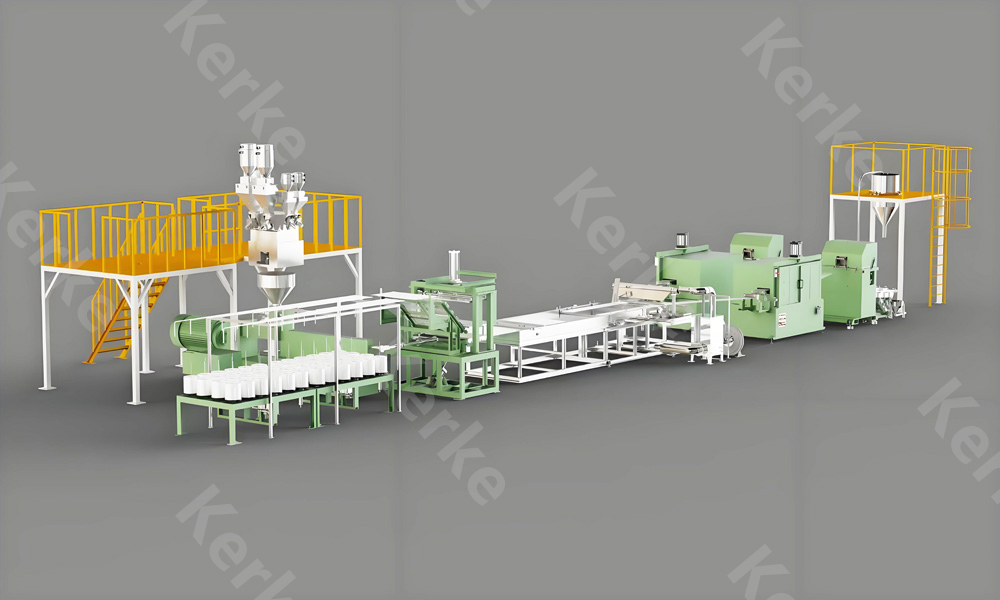
Automotive plastics have moved from under-the-hood components to exterior body panels, mirror housings, pillar trims, and light lenses that must survive a decade or more of sun, heat, rain, and road chemicals without chalking, cracking, or fading. For masterbatch producers and compounders, weather resistance is therefore not a premium feature but a baseline requirement written into every automotive specification. This guide explains how a weather-resistant automotive masterbatch is built, which standards define acceptable performance, how to formulate for long service life, and how modern co-rotating twin-screw compounding equipment such as the Kerke KTE series, a Wanplas factory product, delivers the dispersion quality that weathering demands.
Market Context: Why Weather Resistance Is Non-Negotiable in Automotive
The automotive sector is one of the largest consumers of engineered and colored thermoplastics outside of packaging. Polypropylene dominates interior and many exterior non-painted parts because of its low density and cost; thermoplastic olefins and blends are used for bumper fascias; polycarbonate and PMMA serve lighting and glazing; and polyamide appears in under-hood and structural applications. Each of these materials degrades under the combined attack of ultraviolet radiation, heat, oxygen, and moisture, and the rate of degradation accelerates when pigments and additives are unevenly distributed.
Original equipment manufacturers specify weather resistance because a faded or cracked part triggers warranty claims and brand-damage complaints long before structural failure. Exterior trims are expected to retain color and gloss through Florida and Arizona exposure cycles, and interior components must resist heat-aging discoloration from dashboard temperatures that can exceed 100 degrees C behind glass. Masterbatches that pass a laboratory light-fastness test but fail on a real bumper after two summers are commercially unacceptable.
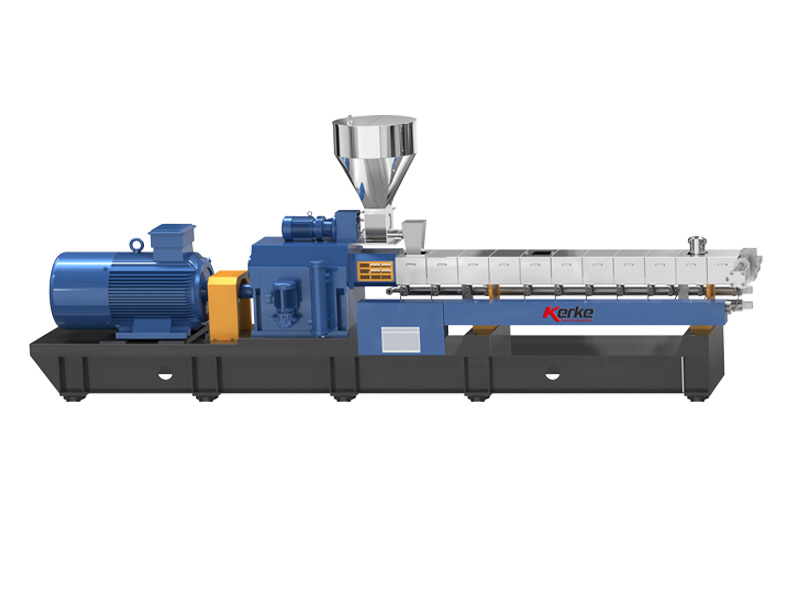
Equipment matters here because weathering begins at the microscopic level. A single poorly dispersed pigment agglomerate becomes a local site for photon absorption and radical initiation, and a stabilizer-rich or stabilizer-lean region creates uneven protection. Kerke, a Wanplas factory, builds parallel co-rotating twin-screw compounding extruders from the laboratory KTE-16B through the high-capacity KTE-135D, with the self-cleaning kneading-block design that lets compounders push dispersion to the level automotive programs require while keeping throughput high.
The Science of Polymer Weathering
Weathering of plastics is a photo-oxidative chain reaction. Ultraviolet photons with wavelengths below about 400 nm carry enough energy to break polymer bonds, especially when sensitizers such as impurities, certain pigments, or residual catalysts are present. The resulting free radicals react with oxygen to form hydroperoxides, which decompose into more radicals and low-molecular-weight oxidation products. Visible consequences include chain scission (embrittlement, loss of impact strength), cross-linking (surface hardening), color shift, gloss loss, and ultimately chalking and crazing.
The Role of Wavelength
Not all ultraviolet is equally dangerous. The UV-B band, roughly 280 to 315 nm, is the most energetic and most damaging, though it is partially filtered by the atmosphere. UV-A, 315 to 400 nm, penetrates deeper into the polymer and drives long-term photo-oxidation even when surface effects are minor. A robust weather-resistant masterbatch must protect across the full UV-A and UV-B range, which is why stabilizer packages combine components with different absorption spectra.
Heat as an Accelerant
Temperature multiplies the effect of light. Every 10 degrees C rise roughly doubles many reaction rates, so a part baking on a dashboard or a dark bumper in direct sun degrades far faster than the same part in a shaded, cool environment. This is why automotive programs evaluate both xenon-arc weathering and separate heat-aging tests; a masterbatch must survive photo-oxidation and thermal oxidation simultaneously.
Moisture and Chemical Attack
Water penetrates micro-cracks, hydrolyzes susceptible groups such as polyamide amide bonds, and leaches soluble additives. Road salt, washer fluid, and atmospheric pollutants add acidic and oxidative stress. For polyamide and polyester-based automotive parts, controlling residual moisture during compounding is therefore as important as the stabilizer package, because hydrolysis during service begins with water already present in the matrix.
UV Stabilizer and Antioxidant Systems
A weather-resistant automotive masterbatch is a layered defense. No single additive covers every mechanism, so formulators combine ultraviolet absorbers, radical scavengers, and antioxidants into a synergistic system.
Ultraviolet Absorbers
Benzotriazole and triazine derivatives absorb high-energy UV photons and release the energy as harmless heat. They are most effective in the surface layer, which is why thickness and concentration at the skin matter. Benzophenones are older and lower-cost but less thermally stable, making them less suitable for high-temperature automotive processing.
Hindered Amine Light Stabilizers
Hindered amine light stabilizers, often abbreviated HALS, do not absorb much UV. Instead they scavenge the free radicals produced during photo-oxidation and regenerate themselves through a catalytic cycle, providing long-term cyclic protection that outlasts the initial additive amount. They are the backbone of modern automotive exterior stabilization, and polymeric, higher-molecular-weight HALS grades are preferred because they resist migration and extraction by water and cleaning agents.
Antioxidants
Primary phenolic antioxidants intercept peroxy radicals, while secondary phosphite and thiosynergist antioxidants decompose hydroperoxides before they fragment. A combined primary and secondary antioxidant system protects the polymer during the high-temperature compounding step and during long-term thermal aging in service. Without antioxidants, the stabilizer system is depleted early by processing heat.
Comparison of Stabilizer Families
| Stabilizer Type | Mechanism | Strength | Limitation |
|---|---|---|---|
| Benzotriazole UV absorber | Absorbs and dissipates UV | Broad, proven protection | Surface-limited; can interact with some pigments |
| Triazine UV absorber | Absorbs long-wave UV-A | Strong UV-A coverage | Higher cost level |
| HALS (hindered amine) | Radical scavenger, regenerative | Long-term cyclic protection | Can interact with acidic pigments |
| Phenolic antioxidant | Primary radical intercept | Protects processing and service | Can cause slight color in some systems |
| Phosphite antioxidant | Hydroperoxide decomposer | Synergistic with phenolics | Hydrolyzes if moisture present |
Reference suppliers such as BASF, Clariant, and Songwon publish resin-specific stabilizer guidelines, and masterbatchers should validate each recommended pairing on a laboratory twin-screw extruder before scaling. Pigment choice also influences weathering: certain inorganic pigments are stable, while some organic reds and yellows are notoriously light-sensitive and demand higher stabilizer loading or a different pigment selection.
Key Weathering and Durability Standards
Automotive weather resistance is judged against a stack of accelerated and real-world standards. The masterbatch producer must understand both, because an accelerated pass does not guarantee field performance.
| Standard | Method | What It Evaluates |
|---|---|---|
| ASTM G155 | Xenon-arc exposure | Accelerated light, heat, and water spray; color and gloss change |
| ISO 4892 | Laboratory light-source exposure | Xenon and fluorescent UV procedures for plastics |
| SAE J2527 | Xenon-arc automotive cyclic | Performance-based automotive exterior specification |
| SAE J2412 | Xenon-arc interior | Instrument-panel and interior trim light stability |
| ISO 105-B06 / grey scale | Color fastness rating | Visual change graded against grey scale |
| GB standards (China) | National weathering tests | GB/T equivalent methods for domestic automotive supply |
| Heat aging (ISO 188 / OEM) | Oven aging | Retention of color, gloss, and mechanical properties |
The most credible validation combines an accelerated xenon-arc program following SAE J2527 with a natural-exposure track in Florida or Arizona. Masterbatchers serving global OEMs should be prepared to supply both accelerated data and, for critical programs, support field-exposure samples, because the correlation between accelerated hours and field years is formulation-specific and never assumed.
Formulation Design and Typical Loadings
A weather-resistant automotive masterbatch integrates pigment, carrier, UV absorber, HALS, antioxidant, and often a processing aid. The art is balancing protection against cost and against side effects such as plate-out and interaction with pigments.
Carrier and Pigment Base
The carrier should match the host resin to guarantee compatibility. For polypropylene automotive parts, a polypropylene or reactor-compatible carrier is standard; for polyamide, a polyamide carrier or compatibilizer avoids a weak interface. Pigment loadings vary with the target color strength, but the critical weathering variable is pigment stability, not just amount. Surface-treated titanium dioxide grades resist chalking better than untreated ones.
Typical Stabilizer Windows
| Application | Combined UV Package in Masterbatch | Antioxidant Level | Target Life |
|---|---|---|---|
| Black exterior (carbon black) | 1 to 3 percent | Medium | Very High (carbon black self-protects) |
| White / light exterior | 4 to 8 percent | Medium-High | High |
| Saturated color exterior | 3 to 6 percent | Medium-High | High |
| Interior trim | 1 to 3 percent | Medium | Medium |
| Under-hood PA | 2 to 4 percent | High (heat aging) | High heat, Medium UV |
These figures are the masterbatch internal concentration; the effective level at the molded part depends on dosing percentage. Because the stabilizer depletes over time, the initial loading must be set with margin for the required service life, not merely to pass the first accelerated cycle. Over-stabilization is wasteful, but under-stabilization is the more common commercial failure, particularly when a customer blends the masterbatch with non-stabilized regrind.
Twin-Screw Compounding: Dispersion and Screw Configuration
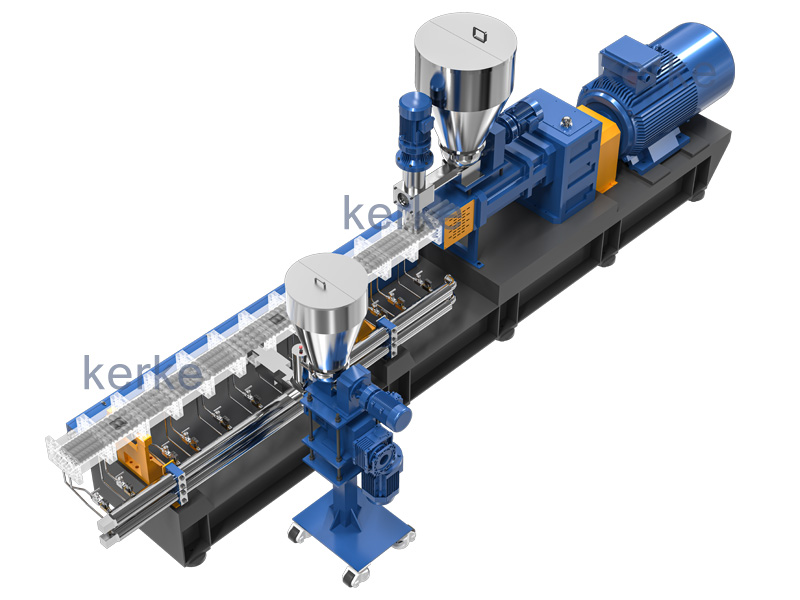
Weather resistance lives or dies on dispersion. A co-rotating twin-screw extruder is the preferred platform because its modular screw elements and multiple ports let the compounder sequence melting, intensive mixing, venting, and metering precisely. Kerke, a Wanplas factory, applies computer-aided screw-assembly methods to the KTE series so each campaign runs an optimized element map rather than a generic profile.
Screw Configuration Principles for Masterbatch
- Feed zone: Fully flighted, conveying elements that move carrier and pigment powder smoothly into the melting section.
- Melting zone: Gentle kneading that plasticizes the carrier without overheating heat-sensitive pigments.
- Dispersion zone: High-intensity kneading discs and toothed elements that break pigment agglomerates to the target fineness.
- Stabilizer addition: Liquid or low-melting stabilizers can be introduced via a liquid feeder downstream to avoid premature thermal load.
- Venting zone: Atmospheric and vacuum vents remove moisture and trapped air that would otherwise create voids and accelerate hydrolysis.
- Metering zone: Low-compression conveying that delivers steady pressure to the die and pelletizer.
Screw Configuration Guidance by Base Resin
| Base Resin | Recommended L/D | Kneading Intensity | Venting |
|---|---|---|---|
| Polypropylene | 36 to 40 | Medium-High | Single or double |
| Polyamide | 40 to 44 | Medium | Double vacuum (dry resin) |
| PC / PMMA | 38 to 42 | Medium | Double vacuum |
| High-pigment black | 40 to 48 | High (carbon black agglomerates) | Single |
Carbon black is exceptionally difficult to disperse because its agglomerates are strong, so black masterbatch demands the highest kneading intensity and often a two-pass or high-torque single-pass strategy. Conversely, polyamide must be dried and compounded under strong vacuum to keep moisture low, because any residual water hydrolyzes the polymer during service and shortens weather life. Kerke supplies loss-in-weight and liquid feeders alongside the KTE extruders so stabilizer and pigment feeds can be metered independently with gravimetric accuracy.
Pelletizing
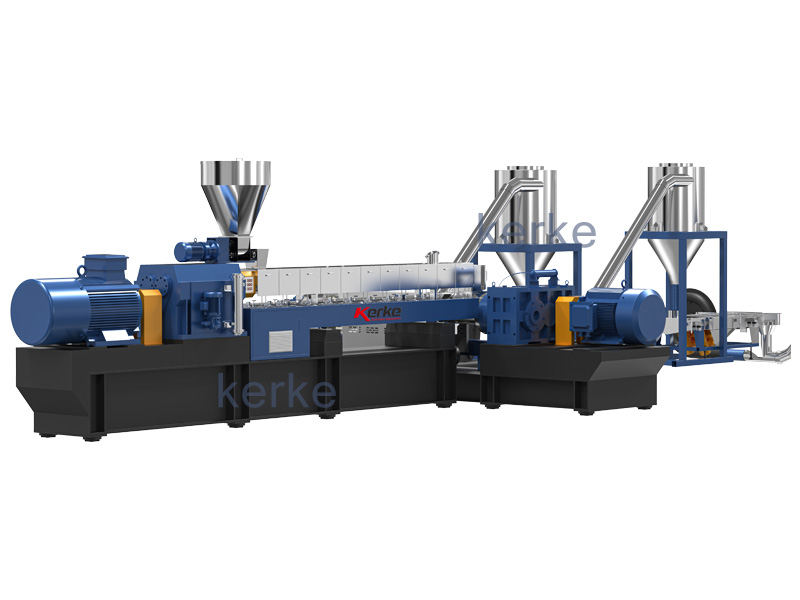
Strand pelletizing remains common for automotive masterbatch because it gives clean, dust-free pellets that blend uniformly at the customer’s machine. Water ring and underwater cutting suit very high throughputs but require thorough drying. For development, the Kerke laboratory twin-screw extruder with strand pelletizing lets formulators lock dispersion and weathering performance before committing to a full production line.
Processing Pitfalls: Moisture, Plate-out, and Color Shift
Three failure modes account for most weather-resistance complaints: moisture-related hydrolysis, plate-out, and color shift between batches.
Moisture and Hydrolysis
Water is the enemy of polyamide and polyester automotive parts. Residual moisture from inadequate venting or undried feedstock hydrolyzes the chain during compounding and continues to do so in service, cutting molecular weight and impact strength. The defense is drying the feed, running double vacuum vents, and verifying pellet moisture before release. A 0.2 percent moisture ceiling is a common polyamide specification.
Plate-out
Weather-resistant packages are additive-rich, and low-molecular-weight fractions of antioxidants or lubricants can bloom to the surface, forming a hazy or waxy layer that changes gloss and traps dirt. Minimizing plate-out means choosing polymeric, high-molecular-weight HALS and antioxidants, balancing lubricants, and ensuring complete incorporation. As with flame retardant systems, a sacrificial purge between campaigns helps the customer maintain tooling.
Color Shift and Batch-to-Batch Variance
Automotive color matching is strict, and weathering tests expose any instability. Color shift during service often traces back to pigment selection rather than stabilizer, but inconsistent dispersion between batches also produces variable gloss retention. Statistical process control on dispersion rating, melt flow, and color measurement (CIE Lab) is the only reliable guard. Masterbatchers should measure every lot against an approved master standard rather than relying on visual judgment.
Testing and Quality Control Program
A credible automotive masterbatch program treats weathering as a measured property, not a claim. The following checks belong in the QC plan.
In-Process Checks
- Resin moisture before feeding, especially for polyamide and polyester.
- Melt temperature and motor load trending to catch dispersion instability or feed variation.
- Pellet appearance, strand integrity, and absence of surface bloom.
- Gravimetric feeder accuracy to hold stabilizer and pigment ratios.
Finished-Goods Tests
| Test | Method | Acceptance Logic |
|---|---|---|
| Color measurement | CIE Lab spectrophotometer | Within delta-E tolerance vs master |
| Xenon-arc weathering | ASTM G155 / SAE J2527 | Delta-E and gloss retention above limit |
| Heat aging | Oven at service temperature | No cracking, color within limit |
| Dispersion rating | Microtome + image analysis | Agglomerate count below limit |
| Melt flow rate | ISO 1133 | Within grade window, no degradation |
For critical exterior programs, masterbatchers should also retain archived plaques from each lot so that, if a field complaint arises years later, the exact material can be re-tested against the original specification. This discipline is what separates a commodity colorant supplier from a qualified automotive partner.
Equipment Selection for Automotive Masterbatch
Choosing compounding equipment for automotive masterbatch means prioritizing dispersion quality, thermal control, and feeding flexibility. Kerke, a Wanplas factory, offers the KTE series spanning the KTE-16B laboratory unit up to the KTE-135D production extruder, so a producer can develop on the small machine and scale on the same screw logic.
Evaluation Criteria
- Specific torque: High-intensity dispersion of carbon black and inorganic pigments needs high torque per free volume.
- Modularity: Swappable kneading blocks and toothed elements let the line handle both black and white masterbatches.
- Venting: Double vacuum for polyamide and polyester to control hydrolysis.
- Feeding: Independent loss-in-weight and liquid feeders for pigments and stabilizers.
- Self-cleaning: Co-rotating intermeshing screws reduce cross-contamination between colors, critical when switching from black to a light automotive color.
Established twin-screw suppliers such as Coperion, Leistritz, and Bühler define the high-end benchmark, while masterbatch specialists such as Clariant and Ampacet operate some of the largest weather-resistant masterbatch capacities in the world. Kerke positions the KTE series as a cost-effective, Wanplas-group solution with the same modular compounding philosophy and shared service commitments, including 500 USD worth of free spare parts per year and a quality-standard guarantee that provides refund plus compensation if agreed specifications are not met. For very high pigment loadings, a mother-baby or double-stage system can separate intensive dispersion from cooling and pelletizing to protect heat-sensitive additives.
Production Scale-Up Checklist
Scaling a weather-resistant automotive masterbatch from lab to plant requires the same discipline as any critical compound. Use this checklist before release.
| Step | Verification |
|---|---|
| 1. Resin and pigment qualification | Moisture, particle size, light-fastness grade confirmed |
| 2. Lab extrusion + weathering screen | ASTM G155 / SAE J2527 delta-E within target |
| 3. Screw and feed design | L/D, kneading stagger, liquid feed, vent map locked |
| 4. Thermal and moisture control | Max melt temp set; double vacuum for PA/PET |
| 5. Dispersion validation | Microtome confirms sub-micron agglomerate control |
| 6. Color and plate-out check | Delta-E vs master; no surface bloom |
| 7. Compliance documentation | RoHS and REACH declarations assembled |
| 8. Pilot campaign | Stable 1 to 2 hours at target throughput |
| 9. Production release | SPC on color, MFR, dispersion; archive plaques |
Frequently Asked Questions
What is the difference between UV absorbers and hindered amine light stabilizers?
UV absorbers such as benzotriazoles and triazines capture incoming ultraviolet photons and dissipate the energy as heat before the polymer chain is broken. Hindered amine light stabilizers do not absorb much UV; instead they scavenge the free radicals created during photo-oxidation and regenerate themselves, giving long-term cyclic protection. They are normally used together.
Which weathering test best predicts automotive exterior performance?
Accelerated tests such as ASTM G155 using xenon-arc and the SAE J2527 automotive cyclic procedure are the industry reference, but they only rank formulations. Real-world confirmation requires a Florida or Arizona exposure program for at least one to two years on the actual part geometry and color.
Why does black automotive masterbatch weather better than white?
Carbon black is itself an excellent UV absorber and radical scavenger, so black parts are inherently weather resistant. White and light colors rely on titanium dioxide plus added stabilizers, and the pigment can even catalyze degradation if it is not surface-treated, which is why light colors need higher stabilizer loadings.
Can weather-resistant masterbatch be made on a co-rotating twin-screw extruder?
Yes. Co-rotating twin-screw extruders give the controlled shear and excellent dispersion needed to distribute pigments and stabilizers uniformly, and the multiple venting ports remove moisture that would otherwise accelerate hydrolysis during service. Kerke’s KTE series is designed for exactly this class of high-dispersion masterbatch.
How much UV stabilizer package is typical in an automotive exterior masterbatch?
Typical combined UV absorber and hindered amine light stabilizer loading in the masterbatch ranges from 2 to 8 percent depending on the base resin, the color, and the required service life. Light and saturated colors need the upper end of this range, while black relies more on carbon black and needs less added stabilizer.
What common mistakes cause premature weathering failures?
The most frequent causes are under-stabilization to save cost, poor pigment dispersion that creates local weak points, incompatibility between stabilizer and carrier, residual moisture from inadequate venting, and mixing a weather-resistant masterbatch with a non-stabilized regrind that dilutes protection.
Conclusion
Weather-resistant masterbatch for automotive plastics is a precision product where chemistry, dispersion, and processing converge. The formulation must combine ultraviolet absorbers, hindered amine light stabilizers, and antioxidants into a system matched to the resin, color, and service environment, and it must be compounded with enough dispersion quality to eliminate the microscopic weak points where weathering begins. Standards such as ASTM G155, ISO 4892, and SAE J2527 provide the language and the proof, while disciplined scale-up and statistical process control turn a laboratory pass into a field-proven part. Kerke, a Wanplas factory, supports this work with the KTE series of co-rotating twin-screw compounding extruders, from the KTE-16B laboratory machine to the high-capacity KTE-135D, with modular screw design, loss-in-weight and liquid feeding, and the Wanplas group’s shared commitments to quality and spare-parts support. For masterbatch producers serving automotive programs, the right stabilizer science paired with the right compounding equipment is what delivers the decade-long durability that the road demands.