Color masterbatch for textile fibers is the concentrated pigment carrier that lets spinners produce colored yarn and staple fiber directly from the extruder, without the water, energy, and effluent of bath dyeing. By melting a small percentage of masterbatch into the polymer melt before the spinneret, a fiber producer gets consistent, lock-in color in polypropylene, polyethylene, polyester, and polyamide filaments. The commercial appeal is large: melt coloration cuts process steps, eliminates dyehouse wastewater, and gives excellent batch-to-batch uniformity. The technical challenge is just as large, because the colored fiber must survive sunlight, washing, rubbing, and the high temperatures of ironing or heat transfer without fading or bleeding. This guide explains fiber color fastness in all its forms, how to select pigments that hold their color, why dispersion quality and the filter pressure value decide whether fine denier yarn can even be spun, how filament breakage is prevented, and how to match the masterbatch carrier to the fiber polymer. Kerke, a Wanplas factory specializing in twin-screw compounding extruders, builds the KTE-series co-rotating lines that masterbatch makers use to disperse pigments to the sub-micron quality that textile spinners demand.
For the technical buyer at a masterbatch plant or a vertically integrated fiber producer, the purchase decision is not about color alone. It is about whether the masterbatch will pass fastness testing, whether it will run cleanly through a twenty-micron spinneret at high speed, and whether it will avoid the catastrophic downtime of broken filaments on a fine denier line. Those outcomes are set at the compounding stage, long before the fiber leaves the spinneret. The content below treats color masterbatch as an engineered dispersive product, not a simple tint, and walks through the controls that separate a fiber-grade masterbatch from a commodity one.
What Is Textile Fiber Color Masterbatch?
Textile fiber color masterbatch is a highly pigmented, free-flowing pellet in which insoluble color pigments are dispersed at 20 to 60 weight percent in a polymer carrier that matches the fiber being spun. The spinner meters a small letdown ratio, typically 1 to 5 percent by weight, into the polymer melt upstream of the spin pack, so every filament emerges pre-colored. This melt-coloration route is standard for polypropylene fibers used in carpet, upholstery, and nonwoven, for polyethylene tape and monofilament, for polyester POY and DTY apparel yarns, and for polyamide carpet and technical yarns. Because the pigment is locked inside the solid polymer, the color cannot bleed out the way a surface dye can, which is the foundation of the fastness story told later in this guide.
Two production models exist. In the dedicated masterbatch model, a specialist compounder makes the concentrated pellet and sells it to many spinners; in the integrated model, the fiber producer runs its own twin-screw line to make masterbatch tuned to its exact spinning window. Both rely on the same dispersion physics: the pigment agglomerates supplied by the pigment maker must be broken down to primary particles and kept apart by a stable coating of carrier so they do not re-agglomerate during pelletizing or later re-melting. The quality of that dispersion is what the entire fiber-spinning result depends on.
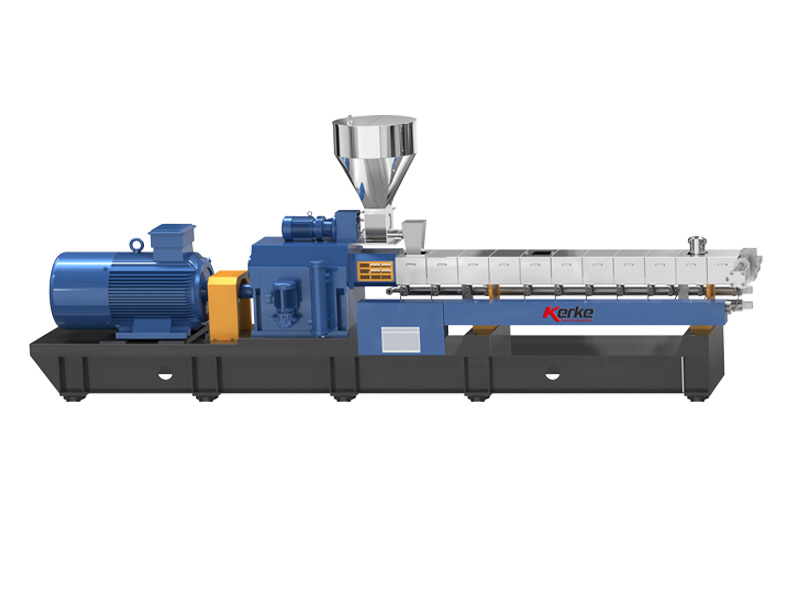
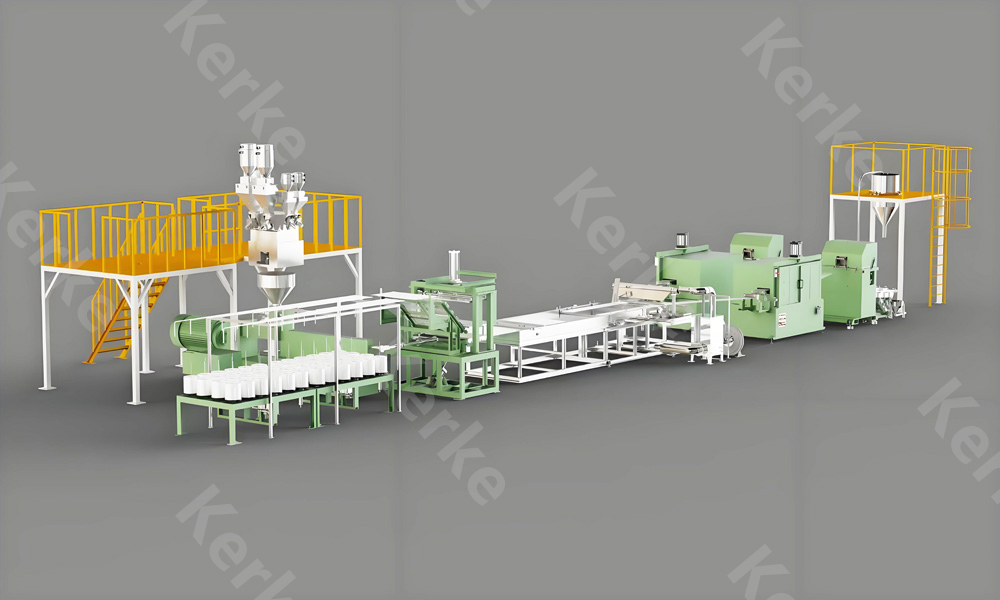
The carrier is not a minor ingredient. It is the medium that wets the pigment, carries it through the screw, and must vanish into the fiber polymer at the spinneret so no separate phase remains. A carrier with the wrong melt flow index or a chemistry incompatible with the fiber leaves an unmelted speck that becomes a weak point in the filament. Kerke, a Wanplas factory, supports both models with KTE-series co-rotating twin-screw extruders spanning laboratory KTE-16B units for formula trials up to KTE-135D production machines, all built around computer-aided screw assemblies with strong self-cleaning for clean color changes.
What makes fiber masterbatch stricter than general-purpose color masterbatch is the spinneret. Film or molding can tolerate a particle of a few tens of microns; a fine denier filament is drawn from a capillary of ten to thirty microns, so any particle approaching that size is a defect. The specifications therefore push dispersion to the sub-micron level and demand a very low filter pressure value, topics covered in detail below. A masterbatch that looks fine in a molded plaque can still destroy a fiber line, which is why fiber-grade masterbatch is treated as its own discipline.
Understanding Color Fastness in Textile Fibers
Color fastness is the resistance of a colored material to changes in shade or to color transfer when exposed to conditions of use, and for textile fibers it is usually assessed across four independent dimensions: light or weather fastness, wash fastness, rub or crocking fastness, and sublimation fastness. Each dimension probes a different failure mode, so a masterbatch can be excellent on one and poor on another. Understanding the mechanism behind each is the first step to specifying pigments and a compounding process that satisfy the end-use standard, whether that is automotive interior, outdoor awning, sportswear, or contract carpet.
Light fastness, also called weather fastness when combined with heat and moisture, measures resistance to fading under radiant exposure. It is rated on the international blue wool scale from 1, very poor, to 8, excellent, with outdoor and automotive applications typically requiring 6 to 8. The mechanism is photochemical breakdown of the pigment chromophore; inorganic pigments such as titanium dioxide, iron oxides, and chromium oxide, plus high-performance organics like phthalocyanine and quinacridone, resist this breakdown, while many low-cost azo pigments fade quickly. Because the pigment is physically trapped in the fiber, light fastness is essentially a property of the pigment chemistry chosen, not of the spinning process.
Wash fastness measures the pigment’s resistance to bleeding and the fiber’s resistance to shade change during laundering, rated on a grayscale from 1 to 5. Pigments are by nature insoluble, so a properly dispersed, well-encapsulated pigment barely washes out, which is why pigmented fibers routinely beat dyed fibers on this test. The failure route is not the pigment dissolving but the carrier or any low-molecular additive bleeding, or poorly bonded surface pigment rubbing loose; both point back to masterbatch quality. Heat and detergent in the wash accelerate any weak component, so the carrier and any lubricant must be chosen for stability.
Rub fastness, known as crocking, measures color transferred to an abrading surface, again on a 1 to 5 grayscale. Poor dispersion is the usual culprit: when pigment is not fully encapsulated by polymer, some sits near or at the filament surface and transfers on friction. A masterbatch with a high filter pressure value and visible agglomerates will almost always fail crocking, even if its chemistry is sound. This is why dispersion and fastness are linked: the best pigment still fails if the compounder leaves it as clumps.
Sublimation fastness measures whether color transfers when the fabric is heated, as in ironing, heat setting, or heat-transfer printing. Classic disperse dyes sublime readily, which is why pigmented systems are favored where thermal stability matters; however, some organic pigments have finite volatility at the 180 to 290 deg C spinning and heat-setting range, and a volatile or low-thermal-stability pigment can migrate or shade-shift under heat. Selecting pigments with high thermal decomposition temperature and low sublimation is essential for polyester and polyamide fibers that see high-temperature processing.
Fastness Types and Reference Test Methods
| Fastness dimension | What it measures | Reference method | Typical target rating |
|---|---|---|---|
| Light or weather | Fading under radiant exposure | ISO 105-B02 / AATCC 16 | 6 to 8 blue wool |
| Wash | Bleeding and shade change in laundering | ISO 105-C06 / AATCC 61 | 4 to 5 grayscale |
| Rub or crocking | Color transfer by abrasion | ISO 105-X12 / AATCC 8 | 4 to 5 grayscale |
| Sublimation | Transfer under heat | Heat-stamp sublimation method | 4 to 5 grayscale |
The four fastness dimensions are assessed with independent grayscale or blue wool references, and the standards are cited here as plain text because the article body carries no links. A fiber product is only as good as its weakest dimension, so a carpet yarn might need outstanding light fastness yet only moderate wash fastness, while sportswear needs the opposite balance. The masterbatch specification should therefore name the exact end-use ratings required, and the compounder should select pigment chemistry and dispersion quality to meet each one rather than optimizing a single number.
Pigment Selection for Fiber Coloration
Pigment selection is the master variable that sets the ceiling on every fastness rating, and it must be made before the screw recipe is designed. The broad choice is between inorganic and organic pigments. Inorganic pigments such as titanium dioxide for white, carbon black for black, iron oxides for red, yellow, and brown, chromium oxide for green, and ultramarine or cobalt for blue are chemically stable, heat resistant, and light fast, but they offer a narrower color gamut, lower tinting strength, and can stiffen or weaken very fine fibers if loaded heavily. Organic pigments deliver brighter, more saturated colors at lower loading, but their heat stability, light fastness, and sublimation resistance vary enormously by chemistry, so grade selection is critical for fibers that are spun and heat-set at high temperature.
Within organics, the performance tiers map closely to cost. Commodity azo pigments are inexpensive and vivid but often weak on light and sublimation fastness, making them suitable only for interior, non-demanding fibers. Mid-tier pigments such as some anthraquinones give better balance. High-performance pigments, phthalocyanine blue and green, quinacridone, perylene, and DPP reds, deliver ratings of 7 to 8 on light fastness and strong thermal stability, and they are the default for automotive, outdoor, and premium apparel fibers despite a higher cost tier. Because the pigment is a small part of the fiber cost but defines its market, the higher pigment grade is usually the cheaper choice once failure risk is counted.
Two pigment properties are non-negotiable for fibers. The first is thermal stability above the spinning temperature: polypropylene and polyethylene spin around 230 to 260 deg C, polyester around 280 to 290 deg C, and polyamide around 270 to 285 deg C, so the pigment must not decompose or sublime in that window or it will shade-shift and clog the spinneret. The second is particle-size distribution after dispersion; primary particles in the sub-micron to low-micron range are required, and the masterbatch must keep them separated. A pigment that disperses poorly no matter how good the screw will never make fiber grade, so the compounder evaluates the pigment on a lab extruder before committing to a full run.
Pigment Family Selection Guide
| Pigment class | Color range | Light fastness | Thermal stability | Relative cost tier |
|---|---|---|---|---|
| Inorganic (TiO2, iron oxide, etc.) | White, black, earth tones | Excellent, 7 to 8 | Very high | Low to Medium |
| Phthalocyanine | Blue, green | Excellent, 7 to 8 | High | Medium |
| Quinacridone, DPP, perylene | Red, violet, orange | Excellent, 7 to 8 | High | High |
| Commodity azo | Yellow, red, orange | Variable, 3 to 6 | Medium | Low |
| Carbon black | Black | Excellent, 8 | Very high | Low |
Surface treatment and dispersion aids complete the picture. Many modern pigments are supplied pre-treated with a coupling or wetting agent that improves compatibility with the carrier and speeds de-agglomeration on the screw; the compounder should confirm the treatment suits the chosen carrier and does not impair fastness or spinnability. A small addition of a compatible slip or antioxidant is common, but every additive must be heat stable and non-bleeding, because the wash and sublimation tests will expose any weak molecule. The discipline is to add only what the process needs and nothing that could later fail a fastness test.
Dispersion Quality and Filter Pressure Value Testing
Dispersion quality decides whether a masterbatch can be spun into fine denier fiber at all, and the filter pressure value, often abbreviated FPV or DF, is the single number that quantifies it. Dispersion describes how finely the pigment agglomerates have been broken down and how uniformly the primary particles are distributed through the carrier; a good dispersion shows no visible speck under a microtomed cross section and no agglomerates larger than a few microns. Poor dispersion leaves hard lumps that, at the spinneret, act like rocks in a garden hose, blocking or thinning a filament until it breaks.
The filter pressure value test forces the masterbatch melt through a standardized screen pack at constant throughput and temperature and records how quickly the pressure rises. A clean, well-dispersed melt passes with little resistance and a flat pressure trace; a masterbatch full of agglomerates, gel, or contamination drives the pressure up steeply because the screen clogs. The reported value is the rate of pressure increase, sometimes normalized per unit mass, and it is a direct, quantitative proxy for the number and size of particles that would block a spinneret. Equipment for this includes dedicated on-line analyzers built around a capillary rheometer principle, and the underlying rheometry is described by ASTM D3835, cited here as plain text. The higher the value, the riskier the masterbatch for fine fibers.
Why this matters so much for textiles is the scale. A carpet BCF line with relatively large capillaries can tolerate a moderate filter pressure value, but a fine denier PET or PA yarn spun from ten to thirty micron holes cannot; there, the masterbatch must hit a very low value or the spin pack pressure runs away and filaments break within minutes. Many fiber producers set a hard filter pressure value limit in the purchase specification and reject incoming masterbatch that exceeds it, exactly as they would reject off-spec chemistry. Investing in dispersive compounding to reach that limit is what earns a masterbatch its fiber-grade status.
Filter Pressure Value and Acceptable Use
| Filter pressure value band | Dispersion quality | Suitable fiber application | Risk of breakage |
|---|---|---|---|
| Very low | Excellent, sub-micron | Fine denier PET and PA yarn | Low |
| Low | Good | PP BCF and staple fiber | Low to Medium |
| Medium | Fair, some agglomerates | Coarse tape, monofilament | Medium |
| High | Poor, many lumps | Molding only, not fiber | Very High |
Alongside the filter pressure value, masterbatch makers run a gel count and a dispersion-grade microscope check. The gel count quantifies soft, partially melted particles distinct from hard pigment agglomerates; both block spinnerets, but gels usually come from degraded carrier or moisture and are fixed by process control rather than by stronger screw shear. The practical quality loop is to measure the filter pressure value on every batch, plot it on a control chart, and correlate any upward drift with screw wear, feeder calibration, or a new pigment lot, so the fiber spinner never receives an off-spec pellet.
Fine Denier Fiber and Filament Breakage Problems
Filament breakage, known in the plant as 断丝, is the most expensive failure mode in fine denier spinning, and it is almost always traceable to the masterbatch rather than the spinning machine. When a particle larger than the spinneret capillary passes into the metering section, it locally restricts or thins the emerging filament. Under the high draw tension of fine denier spinning, that thinned spot snaps, the broken end wraps the godet or roll, and the line stops. At modern speeds, a single bad masterbatch batch can cost hours of downtime and tonnes of off-grade product, so preventing breakage is the central economic argument for fiber-grade dispersion.
The causes group into five categories, and the masterbatch addresses four of them directly. Undispersed pigment agglomerates are the classic cause; even a few hard lumps per gram are enough at fine denier. Gel particles from degraded or poorly devolatilized carrier create soft blockages with the same result. Incompatible carrier speck occurs when the carrier does not match the fiber polymer and fails to melt into the matrix, leaving a solid node. Pigment that is volatile or thermally unstable at the spin temperature decomposes into gas or deposits that disturb the flow. Finally, metal or foreign contamination introduces hard particles that no spinning pack can pass. Moisture, the fifth cause, is managed by drying but is worsened if the masterbatch carries surface moisture from poor pelletizing.
The countermeasures are built into masterbatch design and verified by the filter pressure value. High dispersive mixing breaks agglomerates; strong vacuum devolatilization removes volatiles that would form gel or gas; tight carrier matching removes the incompatible-speck failure; and incoming raw-material control plus screw and barrel wear management keep metal and contamination out. The spinner also contributes by running an appropriate screen pack at the spin pack and by confirming the masterbatch’s let-down ratio is within the validated range, because over- or under-loading changes melt viscosity and can itself induce breaks.
Filament Breakage Cause and Remedy Map
| Cause of breakage | Root source | Masterbatch remedy |
|---|---|---|
| Pigment agglomerate | Poor dispersion | Strong kneading, validated filter pressure value |
| Gel particle | Carrier degradation, moisture | Vacuum devolatilization, controlled temperature |
| Incompatible speck | Wrong carrier | Carrier matched to fiber polymer |
| Thermal deposit | Unstable pigment or additive | Heat-stable pigment selection |
| Metal or foreign body | Contamination, wear | Incoming QC, screw and barrel maintenance |
A useful way to think about breakage is in terms of particle size relative to the capillary. If the largest particle in the masterbatch is comfortably below the spinneret hole diameter, breakage is rare; as the particle size approaches the hole size, breakage rises sharply and non-linearly. This is why fiber-grade masterbatch chases sub-micron dispersion and a low filter pressure value rather than merely a good color match, and why a commodity color masterbatch that is perfectly acceptable for injection molding can be disastrous in a fine denier line. The specification must state the capillary diameter and the maximum acceptable particle size explicitly.
Carrier Resin Matching
Carrier resin matching is the discipline of choosing a masterbatch carrier that is identical to, or fully compatible with, the polymer being spun, so that at the spinneret the carrier dissolves completely into the fiber matrix and leaves no second phase. The rule is straightforward: polypropylene fiber uses a polypropylene carrier, polyethylene fiber uses a polyethylene carrier, polyester fiber uses a polyester or copolyester carrier, and polyamide fiber uses a polyamide carrier. Deviating from this rule to save cost is the most common cause of incompatible-speck breakage and weak fastness in otherwise well-pigmented masterbatch.
Compatibility is not only chemistry but also melt flow. The carrier’s melt flow index should be close to or slightly higher than that of the fiber polymer, so that under the spinneret temperature and shear the carrier melts and mixes a moment before the polymer does, guaranteeing a single homogeneous phase. A carrier with much lower melt flow than the fiber stays as solid grains; a carrier with much higher flow can locally dilute the filament and shift its properties. Getting this balance right is part of the compounding know-how that separates a fiber-grade supplier from a generalist.
For recycled or blended fibers the carrier choice gets subtle. A line spinning recycled polypropylene with variable viscosity needs a carrier tuned to the recycled stream, often with a slightly higher melt flow and an additive package to stabilize the mix. Blended PP and PE fibers need a carrier that is compatible with both, or the masterbatch is split into a pre-blend. Kerke, a Wanplas factory, advises its masterbatch customers on carrier selection during line commissioning and can supply screw and barrel configurations, side feeders, and loss-in-weight systems that handle these specialty carriers consistently.
Carrier Match by Fiber Polymer
| Fiber polymer | Recommended carrier | Spinning temperature (deg C) | Key matching note |
|---|---|---|---|
| Polypropylene | PP homopolymer or copolymer | 230 to 260 | Match melt flow to fiber grade |
| Polyethylene | HDPE or LDPE | 210 to 250 | Use PE carrier for tape and monofilament |
| Polyester | PET or copolyester | 280 to 295 | Strict drying of carrier required |
| Polyamide | PA 6 or PA 66 | 270 to 285 | Match PA type to fiber |
Mismatched carrier is easy to detect and expensive to discover late. The symptom is intermittent white or colored specks in the yarn, higher spin-pack pressure, and a rise in filament breaks that no screw-cleaning on the spinner’s machine will fix, because the defect is baked into the pellet. The cure is to return to a matched carrier and re-qualify the masterbatch with a filter pressure value test and a spin trial. Building carrier matching into the masterbatch specification from the start avoids the entire failure class.
Compounding Process for Textile Masterbatch
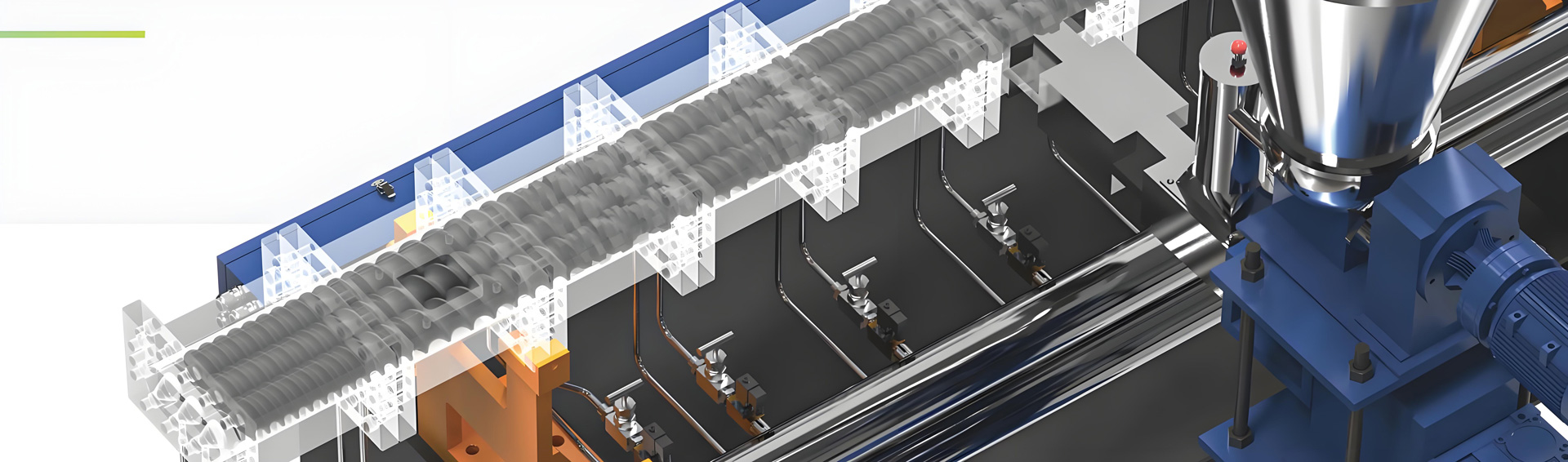
Producing fiber-grade color masterbatch is a dispersive compounding operation first and a coloring operation second. The goal of the screw is to convert pigment agglomerates supplied by the pigment maker, often tens of microns across, into primary particles of well under a micron, uniformly held apart by carrier, while keeping thermal history low enough that neither pigment nor carrier degrades. The co-rotating parallel twin-screw extruder is the standard platform because its modular screw lets the compounder place intense kneading exactly where the pigment needs it and gentle conveying everywhere else, and its self-cleaning action supports clean color changes.
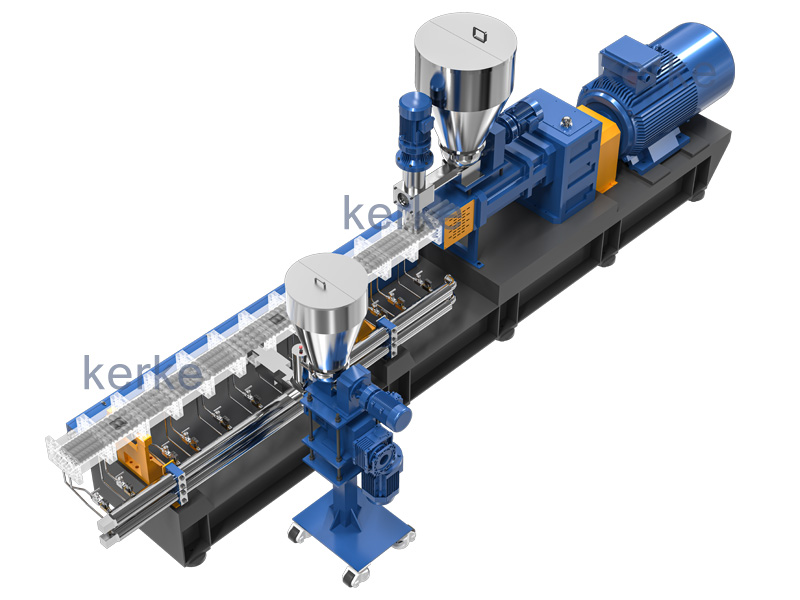
A representative screw layout runs from feed to die as follows. The carrier resin enters the main gravimetric feeder and is plasticized in the first zones with moderate conveying and a first kneading block that builds melt. The pigment, often pre-mixed with a portion of carrier or added via a side feeder, meets the melt and is subjected to one or two intense kneading zones with narrow, high-angle discs that generate the dispersive shear needed to shatter agglomerates. A subsequent wide-pitch mixing zone distributes the now-fine pigment uniformly. A vacuum venting zone removes volatiles and moisture that would otherwise form gel. The metering zone builds die pressure for strand pelletizing. The length-to-diameter ratio is typically 40 to 48 to give room for all these duties without crowding the shear zones.
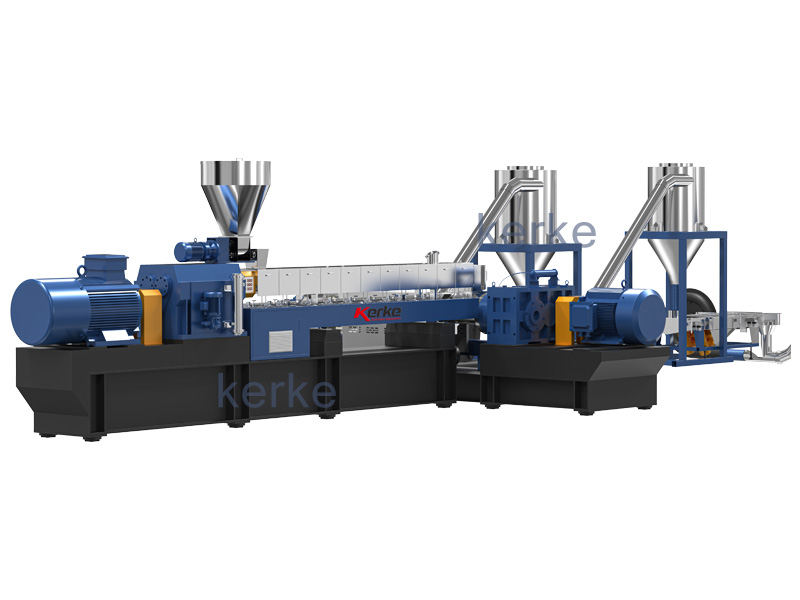
Temperature control is a balancing act. Enough heat is needed to melt the carrier and lower its viscosity so the kneading zones can disperse the pigment, but too much heat degrades temperature-sensitive organics and yellows whites. The profile is therefore set just high enough for flow and held steady with good barrel cooling, and the residence time is kept short by running at a healthy throughput. Kerke KTE-series machines, supplied by the Wanplas factory network, are optimized for this kind of dispersive work, with screw elements engineered for self-cleaning and barrel blocks that place the side feeder, vent, and liquid port at the optimal axial positions; the cutting and pelletizing system can be specified as water-cooled or air-cooled strand to protect the fragile, fully dispersed pellet.
Typical Compounding Parameter Set
| Process stage | Key setting | Purpose |
|---|---|---|
| Plasticizing | Moderate conveying plus one knead | Form homogeneous carrier melt |
| Dispersive mixing | Narrow high-angle kneading | Break pigment agglomerates |
| Distributive mixing | Wide-pitch mixing element | Uniform particle placement |
| Devolatilization | Vacuum vent | Remove moisture and volatiles |
| Pelletizing | Strand, water or air cooled | Protect dispersed pellet |
Feed arrangement matters for quality and housekeeping. Pigment dust is a nuisance and a contamination risk, so feeding it through a sealed side feeder or a pre-blended cage reduces both. Liquid additives such as wetting agents or antioxidants are best introduced by a liquid feeder at the mixing zone so they coat the pigment exactly when needed. Throughout the run, the operator watches motor load, melt pressure, and strand appearance; an unexplained rise in pressure or a roughening of the strand is an early warning of dispersion drift or screen loading that, if ignored, would ship as off-spec masterbatch.
Quality Control and Testing Protocol
A fiber-grade masterbatch is only as trustworthy as its quality protocol, and the protocol must cover dispersion, composition, and fastness. In-plant checks start with the filter pressure value on every batch, backed by a melt flow rate measurement to confirm the carrier grade and a moisture check because surface water drives gel and breakage. A microtomed cross section or a melt-film dispersion microscope gives a visual dispersion grade, and an automatic gel counter provides a repeatable number for soft particles. These four in-plant tests are fast enough to run on every lot and form the spine of the release decision.
Fastness testing is run per the end-use requirement rather than on every lot, usually on a qualification sample and after any pigment or carrier change. Light fastness follows ISO 105-B02, wash fastness ISO 105-C06, rub fastness ISO 105-X12, and sublimation by the relevant heat-stamp method, all cited here as plain text. The masterbatch maker should hold qualification dossiers for each color and fiber combination so a spinner can see evidence that the product meets the contract ratings before committing it to a fine denier line. This documentation is part of what justifies a higher cost tier for a fiber-grade masterbatch versus a commodity alternative.
Recommended Quality Control Tests
| Test | Reference method | Frequency | What it guards |
|---|---|---|---|
| Filter pressure value | Screen-pack rheometer, ASTM D3835 basis | Every batch | Spin pack blockage |
| Melt flow rate | ISO 1133 | Every batch | Carrier identity |
| Moisture content | Gravimetric oven or analyzer | Every batch | Gel and breakage |
| Light fastness | ISO 105-B02 | On qualification | Outdoor fading |
| Wash and rub fastness | ISO 105-C06, ISO 105-X12 | On qualification | End-use performance |
Beyond release testing, the masterbatch maker should run a periodic spin trial on the actual target fiber line, because the definitive proof of fiber grade is clean spinning with low breakage at the specified denier. Many disputes between masterbatch supplier and spinner are resolved only by such a trial, which exposes interactions between let-down ratio, spinneret geometry, and masterbatch that no bench test fully captures. Building the spin trial into the qualification, and repeating it after any formula change, protects both parties and keeps fine denier lines running.
Applications Across Fiber Types
Color masterbatch serves a wide set of fiber types, and the fastness and dispersion requirements shift with each. Polypropylene BCF carpet yarn is the largest outlet, where light fastness, rub fastness, and a very low filter pressure value keep continuous carpet lines running; the same PP chemistry appears in staple fiber for nonwoven, upholstery, and geotextile, where cost tier and consistent shade often outweigh extreme fastness. Polyethylene tape and monofilament for raffia, rope, and outdoor furniture need UV-stable pigments and a PE carrier. Polyester POY and DTY yarns for apparel demand the tightest dispersion because of fine denier and high spinning temperature, plus strong sublimation fastness for heat-set and transfer-printed fabrics.
Polyamide fibers for carpet and technical textiles need a PA carrier and pigments stable at the higher PA spinning temperature, with excellent light fastness for automotive and contract markets. Specialty fibers such as solution-dyed industrial yarns, aramid blends, and conductive or flame-retardant formulations add additive compatibility constraints but follow the same masterbatch logic: match the carrier, disperse hard, verify with the filter pressure value, and qualify fastness for the end use. Across all of these, the masterbatch maker who can document dispersion and fastness data wins the qualified-supplier status that locks in repeat orders.
Masterbatch Requirements by Fiber Type
| Fiber type | Carrier | Critical fastness | Dispersion demand |
|---|---|---|---|
| PP BCF carpet | PP | Light, rub | Low filter pressure value |
| PP nonwoven staple | PP | Wash, light | Medium |
| PET POY or DTY | PET or copolyester | Sublimation, wash | Very high |
| PA carpet or technical | PA 6 or PA 66 | Light, heat | High |
| PE tape or monofilament | PE | Light, weather | Medium |
The economic logic across these markets is consistent: the masterbatch is a small fraction of fiber cost but decides whether the fiber can be made at all and whether it passes its fastness contract. Paying a higher cost tier for a fiber-grade, low-filter-pressure-value, fastness-qualified masterbatch is almost always cheaper than the downtime, off-grade product, and claims that follow a poor one. This is the value proposition that the Wanplas network of specialized factories supports, with Kerke supplying the twin-screw compounding lines and the application know-how behind them.
Frequently Asked Questions
What is the difference between pigment and dye for textile fibers?
Pigments are insoluble particles dispersed in the polymer and are inherently wash-fast and light-fast, while dyes dissolve into the fiber and can migrate or sublime; masterbatch for melt-spun fibers uses pigments because they survive the spinneret and remain locked in the filament. The trade-off is that pigments demand excellent dispersion to avoid spinneret blockage.
Why does filament breakage happen in fine denier spinning?
A particle larger than the spinneret capillary, such as an undispersed pigment agglomerate, gel, or incompatible carrier speck, locally thins or blocks the filament so it snaps under draw tension; the root cause is almost always masterbatch dispersion quality and carrier match. Drying and screen-pack maintenance on the spinner’s side help, but the defect originates in the pellet.
What is the filter pressure value and why does it matter?
The filter pressure value is the rate of pressure rise when masterbatch melt is forced through a standardized screen pack; a high value signals agglomerates and gel that will block spinneret holes and cause broken filaments in fine denier yarn. It is the single most useful incoming-specification number for a fiber masterbatch.
Which fastness tests apply to fiber color masterbatch?
The core set is light fastness per ISO 105-B02, wash fastness per ISO 105-C06, rub or crocking fastness per ISO 105-X12, and sublimation fastness by heat-stamp methods, all referenced here as plain text without links. The exact ratings required depend on the end use, from automotive to apparel.
How do I match the masterbatch carrier to the fiber polymer?
Use the same polymer family: polypropylene carrier for PP fibers, polyester or copolyester carrier for PET fibers, polyamide carrier for PA fibers, so the carrier fully melts into the matrix and leaves no unmelted speck. Matching the melt flow index to the fiber grade is equally important.
Can the same masterbatch be used for PP and PET fibers?
No, because the carriers are incompatible; a PP-carrier masterbatch in PET spinning leaves unmelted particles that cause breakage and weak fastness, so a separate grade matched to each fiber polymer is required. Using one masterbatch across unrelated polymers is a common and costly mistake.
What pigment gives the best light fastness in outdoor fibers?
Inorganic pigments and high-performance organics such as phthalocyanine blue and green, quinacridone, and DPP reds deliver ratings of 7 to 8 on the blue wool scale, while many low-cost azo pigments fade quickly in sunlight. For outdoor or automotive fibers, the high-performance grade is the safe choice despite a higher cost tier.
What extruder is best for textile pigment masterbatch?
A co-rotating parallel twin-screw extruder with strong dispersive kneading and good vacuum devolatilization, such as the Kerke KTE series from the Wanplas factory network, produces the low-filter-pressure-value dispersion that fine denier spinning demands. Its modular screw lets the compounder place intense shear exactly where the pigment needs it.
Conclusion
Color masterbatch for textile fibers succeeds or fails on three linked properties: pigment chemistry that holds color under light, wash, rub, and heat; dispersion fine enough to pass a twenty-micron spinneret without blockage; and a carrier matched so completely to the fiber polymer that no second phase survives. Light, wash, rub, and sublimation fastness are each set by distinct choices, from pigment grade to additive stability, and they must be specified per end use rather than assumed. The filter pressure value is the quantitative gate that proves dispersion, and it is the number that predicts whether fine denier yarn will spin cleanly or break.
For masterbatch producers and integrated spinners, the path to fiber grade runs through dispersive twin-screw compounding with tight temperature control, vacuum devolatilization, and a disciplined quality protocol of filter pressure value, melt flow, moisture, and fastness testing. Kerke, a Wanplas factory, supplies the KTE-series co-rotating twin-screw extruders and the application know-how needed for this work, backed by the Wanplas network’s shared service standards including an annual free-parts allowance and on-site commissioning. Talk to the Kerke technical team to specify the screw configuration, side-feed, and pelletizing setup that will deliver a low-filter-pressure-value, fastness-qualified color masterbatch for your exact fiber type, from PP carpet to fine denier PET and PA yarns.