Heat resistant masterbatch for high-temperature plastics is the silent enabler behind every under-hood connector, LED housing and aerospace clip that must survive years of heat without losing strength or colour. As engineering polymers such as PPS, PEEK, PA46 and LCP replace metal in automotive, electrical and industrial parts, the ability to stabilize them against oxidative and thermal breakdown during both compounding and service life has become a core competency. This guide explains what a heat resistant masterbatch is, which high-temperature polymers need it, how antioxidant systems built around antioxidants 1010 and 168 work, what the heat-rating numbers such as HDT and RTI actually mean, and how a co-rotating twin-screw extruder compounds these demanding concentrates. Kerke, a Wanplas factory, is referenced throughout as a supplier of the twin-screw compounding equipment used to produce heat resistant masterbatches at temperature.
Understanding Heat Resistant Masterbatch for High-Temperature Plastics
A heat resistant masterbatch is a concentrated blend of thermal stabilizers, antioxidants and sometimes functional fillers, carried in a high-temperature polymer, that is let down into an engineering plastic to protect it from degradation caused by heat and oxygen. The threat is twofold. During processing, the polymer passes through the extruder and injection mold at melt temperatures that can reach 400 C, where unstabilized chains scission and crosslink. During service, the part sits at elevated temperature for years, slowly oxidizing until it becomes brittle or discoloured. A well-built heat resistant masterbatch interrupts both pathways.
The masterbatch format matters because stabilizers are used at low concentrations, often a fraction of a percent to a few percent, and must be distributed uniformly. Pre-compounding them into a carrier pellet lets a molder add a precise, repeatable dose without handling fine antioxidant powders that are dusty, prone to segregation and hard to disperse in a plain injection unit. The concentrate also lets the stabilizer supplier pre-react or pre-disperse difficult actives, such as liquid phosphites or high-load glass-fibre coupled packages, into a stable form.
Heat resistance is not a single property but a system. The carrier must survive the processing temperature, the antioxidants must cover both the radical-chain and hydroperoxide steps of oxidation, and any filler or flame-retardant co-additive must not consume the stabilizer. The compounding step ties it together: poor dispersion or local overheating during masterbatch production can burn off the stabilizer before the customer ever molds a part. This is why the production platform, a co-rotating parallel twin-screw extruder, is as important as the formula.
Why Heat Resistance Matters for Engineering Plastics
Engineering plastics earn their place by holding properties where commodity polyolefins would soften or melt. Under-hood automotive components see under-bonnet temperatures that can exceed 150 C near the engine and turbo, plus contact with hot oils and coolants. Electrical connectors and relay housings must keep dimensional stability through solder-reflow profiles and the lifetime heat of enclosed electronics. LED lighting places a lens or housing centimetres from a die that runs hot continuously. In each case, loss of strength or creep under load is a safety and warranty issue, not a cosmetic one.
Thermal degradation is insidious because it accelerates with temperature. The oxidation rate of a polymer roughly doubles for every 10 C of temperature rise, so a part rated for long life at 120 C may fail quickly at 160 C if the stabilizer system was not designed for that window. Colour stability tracks the same chemistry: phenolic antioxidants that have reacted turn the part yellow or pink, a visible signal that the protection is spent. A heat resistant masterbatch is therefore specified against the worst-case service temperature plus a margin, not the average.
There is also a processing-economy angle. High-temperature polymers are expensive, and regrind is reused to control cost. Each reprocessing cycle re-exposes the material to heat, so the stabilizer reserve must be sized for virgin plus several regrind passes. Compounds that skimp on stabilization show their weakness only after the second or third melt, when the molder is already in production. Specifying the masterbatch with regrind in mind protects both part quality and material cost across the life of a program.
The business case for heat resistance is rarely about the additive cost alone. A stabilized compound that survives one extra regrind cycle, or that passes a qualification the first time instead of after three reformulations, saves far more than the difference between a basic and a premium stabilizer system. Field failures are the real expense: a connector that cracks in service triggers a recall that dwarfs any material saving, and automotive or aerospace programs price warranty risk into the supplier selection from the start. For this reason, specifiers increasingly ask for aged-property data and a stabilizer certificate of analysis rather than a lowest-price quote, and they qualify the masterbatch on the finished part rather than on a datasheet. The compounder who can show consistent stabilizer content and a clean thermal history from the twin-screw line wins the program even at a higher unit price, because the downstream risk is lower.
High-Temperature Base Polymers: PPS, PEEK, PA46 and LCP
The polymers that most need heat resistant masterbatch share high melting points and demanding service temperatures. The four named in the title lead the field, supported by close cousins such as PPA, PEI and polyphenylsulfone. Each brings a different balance of temperature, chemical resistance and cost tier.
Polyphenylene Sulfide (PPS)
PPS is a semicrystalline aromatic sulfide with a melting point around 280 C and excellent chemical resistance, dimensional stability and flame behaviour, often used unfilled or glass-fibre reinforced in automotive and electrical parts. It is inherently flame retardant and rigid, but its continuous-use temperature and colour stability depend heavily on a sound stabilizer package. PPS is sensitive to oxidative crosslinking at high melt temperature, so the masterbatch carrier and antioxidant must tolerate its processing window.
Polyetheretherketone (PEEK)
PEEK is a high-performance semicrystalline thermoplastic with a melting point near 343 C and a continuous-use temperature around 250 C, combined with outstanding chemical resistance, wear behaviour and radiation tolerance. It is the premium choice for aerospace, oil and gas, medical and semiconductor parts. PEEK is processed at the top of the practical extrusion range, so its heat resistant masterbatch must survive without the stabilizer degrading before the polymer does. Relative cost sits at the Premium tier.
Polyamide 4,6 (PA46)
PA46 is an aliphatic polyamide with a higher crystallinity and melting point than PA66, around 295 C, giving a higher heat distortion temperature and superior fatigue and wear resistance at temperature. It is widely used in automotive under-hood modules, gears and electrical connectors where PA66 would creep. PA46 is more moisture reactive than PPS or PEEK, so its stabilization must also consider hydrolysis resistance, often pairing heat stabilizers with a hydrolysis-protection package.
Liquid Crystal Polymer (LCP)
LCP is a family of aromatic polyesters that form self-reinforcing ordered domains, giving very low melt viscosity, ultra-low warp, high stiffness and excellent heat and chemical resistance. Different LCP grades cover melt temperatures from roughly 280 C to above 330 C, with continuous-use ratings that reach the top of the engineering-plastics range. LCP is the material of choice for high-frequency connectors and miniaturized parts, but it is filled and additive-sensitive, demanding precise, low-shear dispersion in the masterbatch.
Supporting Polymers
Polyphthalamide, or PPA, bridges PA66 and the aromatics with strong heat and chemical resistance at a Medium to High cost tier. Polyetherimide, or PEI, is an amorphous high-heat amorphous polymer with good flame and dimensional behaviour for electrical and aircraft interiors. Polyphenylsulfone brings the highest continuous-use temperature among the sulfones with toughness. A heat resistant masterbatch platform is usually designed to cover this whole set, with carrier and stabilizer tuned per resin.
Heat Stabilizer and Antioxidant Systems
Thermal oxidation of a polymer is a radical chain reaction: heat and shear form radicals, oxygen adds to make peroxy radicals, peroxy radicals abstract hydrogen to form hydroperoxides, and hydroperoxides decompose into more radicals plus carbonyl and colour bodies. An effective stabilizer system attacks every step. The workhorse package pairs a primary phenolic antioxidant with a secondary phosphite, and that pairing is exactly why antioxidants 1010 and 168 appear so often together.
Antioxidant 1010
Antioxidant 1010 is a high-molecular-weight hindered phenolic antioxidant, specifically a pentaerythritol tetrakis ester, that acts as a chain-breaking donor of hydrogen to peroxy radicals. Its large molecule gives low volatility and good retention at high temperature, which is why it is preferred in engineering plastics processed above 300 C. It is the primary defence against chain scission and the yellowing that follows.
Antioxidant 168
Antioxidant 168 is a triaryl phosphite, a secondary antioxidant that decomposes hydroperoxides into stable alcohols before they can spawn new radicals. On its own it does little for colour, but paired with a phenolic it is strongly synergistic, allowing a lower total antioxidant loading for the same protection. Phosphites are also sensitive to hydrolysis, so the masterbatch and storage must stay dry, a point the compounding process must respect through venting and moisture control.
Synergy and Supporting Additives
Beyond 1010 and 168, a complete heat package may include a thioester secondary antioxidant for extra long-term heat aging, a metal deactivator to neutralise trace copper or iron that would catalyse oxidation, and an acid scavenger where halogen-free flame retardants generate acidic species during processing. For PA46 and other polyamides, a hydrolysis stabilizer such as a carbodiimide protects the chain from moisture at temperature. The masterbatch formulator balances these so they do not antagonise each other and so the total additive load stays processable.
Heat Rating Metrics: HDT, RTI and Continuous Service Temperature
Specifiers do not ask simply “is it heat resistant”; they ask for a number. Three metrics dominate. Heat deflection temperature, or HDT, is the temperature at which a standard test bar deflects by a set amount under a defined load, a short-term rigidity measure used to compare materials and set demolding and load limits. Vicat softening temperature marks the point where a needle penetrates the surface under load, a simpler softening indicator. Continuous service temperature, or CST, is the maker’s rated long-term use temperature, often backed by aged-property data.
The rating that carries the most weight in electrical and automotive qualification is Relative Thermal Index, or RTI, defined under UL 746B. RTI is the temperature at which a material retains a defined percentage of its key properties, mechanical or electrical, after long-term heat aging. An RTI of, for example, 200 C tells a connector designer that the part should keep its rated properties at 200 C for the intended life. Because RTI is earned through sustained aging tests, it is a far better guide to field life than HDT, and a heat resistant masterbatch exists largely to protect or raise the RTI of the base compound.
These numbers move with formulation. Adding a few percent of glass fibre raises HDT sharply by restricting chain mobility; the right antioxidant package preserves RTI by stopping oxidative embrittlement; a poorly chosen flame retardant can drop both. The masterbatch producer therefore quotes stabilizer performance against the rating the customer must hit, and the molder validates it on the actual compound, not on the neat resin.
Formulation Architecture of a Heat Resistant Masterbatch
As with any masterbatch, the architecture decides whether the stabilizer reaches the part intact. The components below are tuned for high-temperature duty.
Carrier Resin
The carrier must have a melting point at or above the matrix so it dissolves during molding yet survives compounding. A PEEK carrier serves PEEK, a PPS carrier serves PPS, and PA46 or LCP carriers serve those resins; sometimes a slightly higher-melting tie polymer is used to guarantee compatibility. Using the base polymer itself as carrier is common for premium grades because it adds no foreign phase.
Stabilizer Loading
Primary antioxidant loadings typically sit in the low single-digit percent range of the masterbatch, scaled so the let-down delivers a few tenths of a percent to roughly one percent in the final compound. Over-loading wastes cost and can bloom to the surface; under-loading leaves the part undefended. The synergy between 1010 and 168 lets the formulator hit the target at a lower combined dose than either alone.
Coupling and Filler Integration
Many heat resistant compounds are glass- or mineral-filled for stiffness, and the masterbatch may carry a coupling agent such as a silane or maleic-anhydride grafted polymer so the filler bonds to the matrix and does not act as a degradation site. Where the part also needs flame resistance, the halogen-free flame-retardant synergist is co-compounded so the acid-scavenger demand is met in the same pellet.
Lubrication and Processing Aid
High-temperature polymers are viscous. A small amount of a high-temperature lubricant such as a fluoropolymer or a specialised ester reduces screw torque and die pressure, protecting both the machine and the stabilizer from excessive shear heating. The level is tuned against flow and bleed.
Let-down calculation is where formulation meets the molding floor. The masterbatch is quoted at a stabilizer concentration in the concentrate, and the molder computes the addition rate that delivers the target concentration in the final compound; a small error in that arithmetic, or in the gravimetric feeder calibration, silently under-protects every part. Best practice is to validate the actual stabilizer level in the compounded pellet by extraction and analysis at the start of a program, then re-check it periodically, because screw wear or feeder drift on either the masterbatch line or the molding line shifts the real dose over time. A heat resistant masterbatch is therefore only as good as the measurement discipline around it, and the most reliable supply chains treat the stabilizer content as a controlled characteristic with statistical limits rather than a one-time specification.
Twin-Screw Compounding at High Temperature
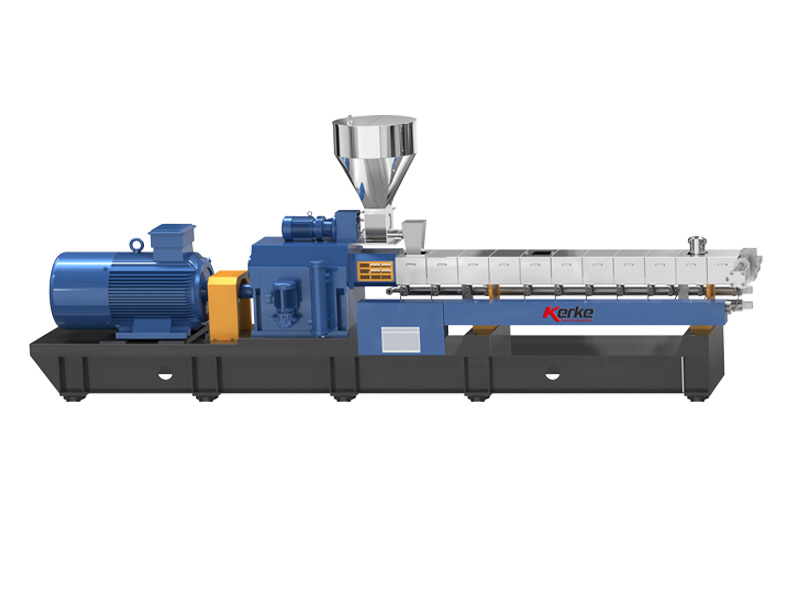
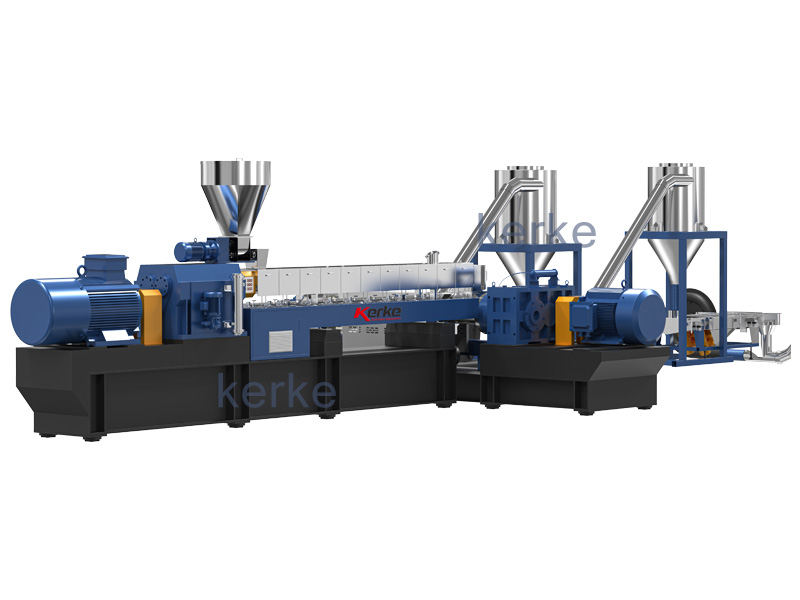
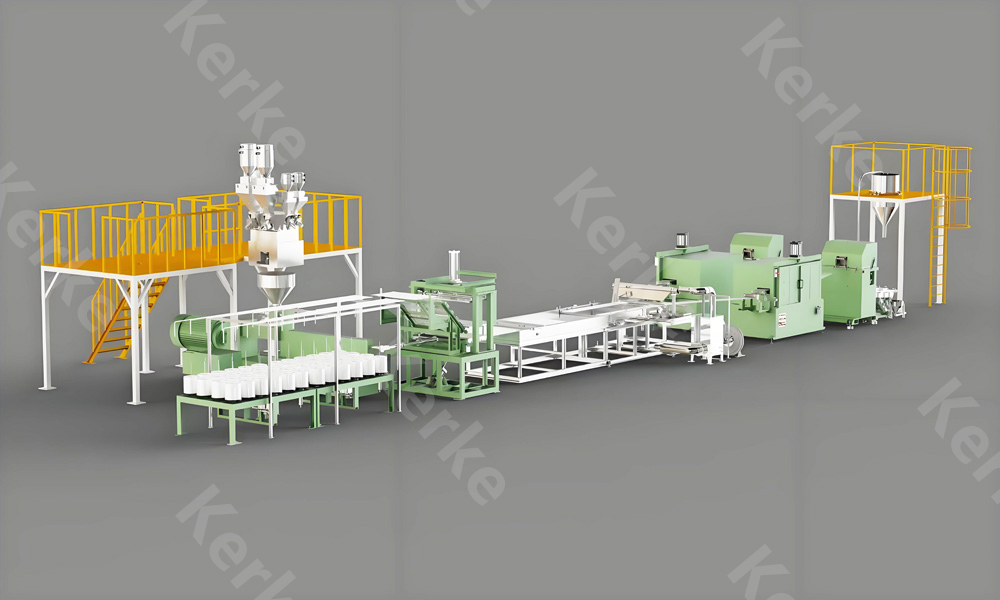
Compounding heat resistant masterbatch is a high-temperature, high-precision job. Kerke, a Wanplas factory, supplies the KTE series co-rotating parallel twin-screw extruders built for this, with an L/D configurable from 40 to 52 and options for wear- and corrosion-resistant barrel and screw materials plus a high-torque gearbox suited to stiff engineering melts.
Melting and Residence Time
At melt temperatures of 300 to 400 C the margin between useful processing and degradation is narrow. The screw must melt the carrier quickly and uniformly, then disperse the stabilizer and filler with minimal dwell so the antioxidant is not cooked before it leaves the die. A co-rotating twin-screw with modular kneading blocks gives the formulator control over both shear and residence time, and the long L/D provides the length to do it gently.
Liquid and Side Feeding
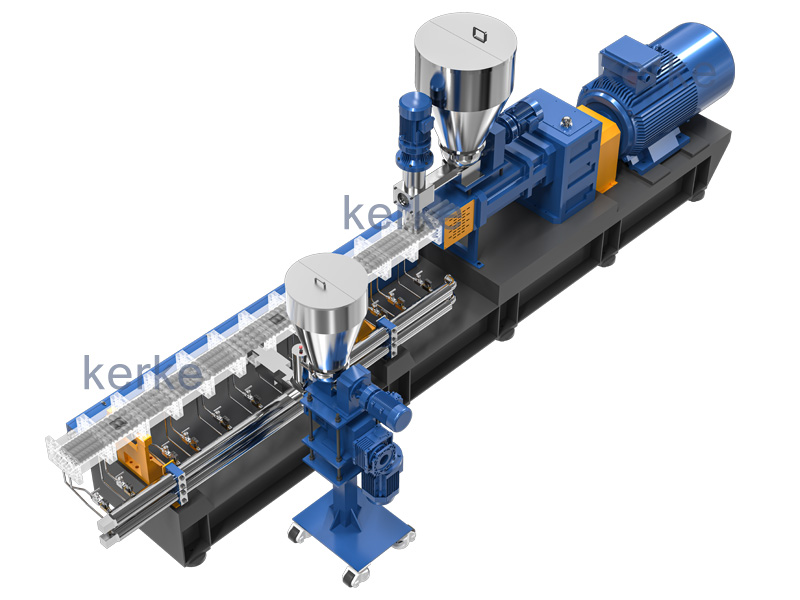
Liquid phosphite antioxidants such as 168 are best injected as a melt or solution through a liquid feeder mid-barrel, after the carrier is molten, so they wet the melt rather than degrading in the feed throat. Solid actives and fillers enter through a side feeder for the same reason. Kerke lines pair this with loss-in-weight feeders for accurate dosing and a crammer feeder for low-bulk-density powders.
Venting and Devolatilization
Moisture is the enemy of phosphites and of polyamides, so one or two vacuum vents strip surface and bound water and any volatiles from the stabilizer package. Effective venting is what keeps hydrolytically sensitive additives intact and prevents splay or porosity in the pellet. Kerke KTE machines are built with configurable venting sections for this purpose.
Pelletizing and Throughput
The homogenised high-temperature melt is cut by underwater or water-ring die-face pelletizing to give low-fines, free-flowing pellets that resist agglomeration at elevated ambient temperature. For very high-melting resins, the cutting system and cooling water temperature are selected to avoid stringing or sticking. Throughput on Kerke lines spans from the KTE-16B laboratory unit, ideal for stabilizer screening, up to the high-capacity KTE-135D for volume production, all backed by the Wanplas brand’s shared service commitments.
Performance and Cost Profile of High-Temp Polymers
The table below contrasts the main high-temperature polymers on the properties that drive masterbatch specification. Values are typical orders of magnitude for comparison and vary by grade and reinforcement; they are not a specification.
| Polymer | Melt Point, C | Typical HDT, C (filled) | Continuous Use, C | Key Strength | Relative Cost Tier |
|---|---|---|---|---|---|
| PPS | 280 | 240 to 270 | 200 to 220 | Chemical, flame, dimensional | High |
| PEEK | 343 | 300 plus | 250 | All-round premium heat | Premium |
| PA46 | 295 | 270 to 290 | 150 to 180 | Fatigue, wear at heat | High |
| LCP | 280 to 330 | 240 to 310 | 200 to 240 | Low warp, high freq | Very High |
| PPA | 310 | 280 to 300 | 180 to 200 | Stiffness, chemical | Medium to High |
| PEI | Amorphous, no sharp melt | 200 | 170 to 180 | Flame, dimensional | High |
The antioxidant system itself is specified in a second table, showing how the actives divide the stabilization work.
| Stabilizer Role | Example Active | Function | Typical Loading in Masterbatch |
|---|---|---|---|
| Primary antioxidant | Antioxidant 1010 | Chain-breaking radical donor | Low single-digit percent |
| Secondary antioxidant | Antioxidant 168 | Hydroperoxide decomposer | Low single-digit percent |
| Thioester | DLTDP type | Long-term heat aging | Minor percent |
| Metal deactivator | Chelating agent | Neutralises Cu, Fe catalysis | Minor percent |
| Acid scavenger | Calcium stearate type | Neutralises flame-retardant acid | Minor to low percent |
| Hydrolysis stabilizer | Carbodiimide | Protects PA at heat plus moisture | Minor percent |
Applications and Regulatory Compliance
Heat resistant masterbatches are qualified against the end-use standard of the part. In automotive, IATF 16949 quality systems and OEM-specific material specs govern the compound, and the heat rating that matters is often the RTI plus a hydrolysis requirement for PA46 under-hood parts. In electrical and electronic enclosures and connectors, UL 94 flame classification and UL 746B RTI are the gate, with RoHS substance restrictions and REACH registration applying across the European and many Asian supply chains. Aerospace and medical grades add their own traceability and biocompatibility or FAR flammability demands. For any grade that might contact food or water, FDA and EU 10/2011 screening may be required even in a technically non-food part.
The application table below links each sector to the polymer and stabilizer emphasis that fits.
| Application Sector | Preferred Polymer | Stabilizer Emphasis | Key Rating |
|---|---|---|---|
| Automotive under-hood | PA46, PPS, PPA | 1010 plus 168, hydrolysis | RTI, hydrolysis |
| E and E connectors | LCP, PPS, PEI | 1010 plus 168, metal deactivator | UL 94, RTI |
| LED and lighting | PPA, PC blends, PEI | Colour-stable phenolic | Long-term heat |
| Aerospace and semiconductor | PEEK, LCP | Maximum retention package | FAR, traceability |
| Industrial and gear | PA46, PPS | Wear plus heat | HDT, RTI |
Compliance is demonstrated through documentation: a declaration of conformity, REACH and RoHS screening, and aged-property data backing the claimed RTI. Because the stabilizer is the protective system, the masterbatch certificate of analysis should report antioxidant content and any restriction-relevant impurities, letting the molder build the part dossier with confidence. Kerke, as part of the Wanplas group, builds the extruders that produce these certified grades, and the same twin-screw know-how is shared across Wanplas’s Kerke, Polyretec and YuanSu factories for a coherent material-to-part supply chain.
How to Select and Specify a Heat Resistant Masterbatch
Specifying a heat resistant masterbatch starts from the polymer and the worst-case service temperature. Identify the base resin, then confirm the continuous-use and RTI target the part must keep. Choose a carrier matching the matrix, select a stabilizer system centered on antioxidants 1010 and 168 with the supporting additives the application demands, and set the loading so the let-down delivers the validated stabilizer concentration including margin for regrind. Confirm the regulatory path, then qualify the masterbatch on the actual compound by measuring retained properties after heat aging and, where relevant, hydrolysis cycles.
The common failure modes are predictable. Using a carrier with too low a melting point leaves an incompatible phase that clouds or weakens the part. Skipping the phosphite, or letting it hydrolyse through poor venting, removes the synergistic half of the protection and the part yellows early. Ignoring regrind over-estimates the stabilizer reserve. Over-loading bloom and plate-out foul the mold. A disciplined specification plus a controlled twin-screw compound avoids all of these.
Qualification should be staged from lab to line. Start with a screening run on a laboratory twin-screw extruder such as the Kerke KTE-16B to fix the carrier, stabilizer ratio and any filler coupling, measuring retained properties after heat aging at the target temperature. Move to a pilot run that includes the customer’s regrind protocol, then to a production validation that confirms lot-to-lot stability and mold behaviour such as plate-out and colour. Only after the part passes its end-use rating, RTI, flame class and any hydrolysis or chemical-resistance test, should the masterbatch be released for volume supply. This staged path catches the failure modes described above while they are still cheap to fix, and it gives the molder the documentation needed for IATF 16949, UL or aerospace traceability. The Wanplas group’s shared engineering support, available across its Kerke, Polyretec and YuanSu factories, helps compounders bridge from formulation to qualified production without rebuilding the line for every new grade.
On the equipment side, the buyer should seek a co-rotating twin-screw extruder with L/D of 40 to 52, a high-torque gearbox, wear- and corrosion-resistant barrel and screw options, liquid and side feeding, vacuum venting and a pelletizing system matched to the melt. Kerke’s KTE series meets this brief from the KTE-16B laboratory scale through the high-capacity KTE-135D, and the Wanplas brand supports its factories with shared service commitments including an annual free spare-parts package and on-site commissioning, which matters when qualifying a new high-temperature grade.
Frequently Asked Questions
What is a heat resistant masterbatch?
A heat resistant masterbatch is a concentrated blend of thermal stabilizers, antioxidants and sometimes functional fillers carried in a high-temperature polymer, added to engineering plastics to protect them from oxidative and thermal degradation during processing and end use.
Which polymers need heat resistant masterbatch?
Polymers with high continuous service temperatures such as PPS, PEEK, PA46, LCP, PPA, PEI and polyphenylsulfone benefit most, because they are processed at 300 C and above where unstabilized resin degrades quickly during extrusion and molding.
What do antioxidants 1010 and 168 do?
Antioxidant 1010 is a primary phenolic chain-breaker that intercepts peroxy radicals, while antioxidant 168 is a secondary phosphite that decomposes hydroperoxides; together they give a synergistic stabilization much stronger than either alone, allowing a lower total loading.
What does RTI mean for a heat resistant compound?
Relative Thermal Index, defined under UL 746B, is the temperature at which a material retains a defined percentage of its key properties over long-term heat aging, and it is the rating specifiers use for continuous-use electrical and automotive parts.
Why is compounding temperature control critical for high-temp masterbatch?
At melt temperatures of 300 to 400 C the margin between useful processing and degradation is narrow, so the extruder must give uniform melting, short residence time and effective venting while avoiding local overheating that would consume the stabilizer before the part is even molded.
Can the same masterbatch be used for PPS and PEEK?
Usually not directly, because the carrier must match the matrix melting point and compatibility; a PEEK-based carrier is needed for PEEK and a PPS-based carrier for PPS, though the antioxidant package can be similar across both resins.
Are heat resistant masterbatches compliant with RoHS and REACH?
Compliant grades are formulated from substances registered under REACH and screened against RoHS restricted lists, with documentation supplied for electrical, electronic and automotive supply chains, plus aged-property data backing the claimed RTI.
Does Kerke supply equipment for high-temperature masterbatch?
Yes. Kerke, a Wanplas factory, supplies KTE series co-rotating twin-screw extruders with high-torque gearboxes, wear- and corrosion-resistant barrel and screw options, vacuum venting and liquid feeding suited to PPS, PEEK, PA46 and LCP compounding from lab to production scale.
Conclusion
Heat resistant masterbatch for high-temperature plastics is a precise, system-level product: the right carrier, a stabilizer package centered on antioxidants 1010 and 168, and the supporting additives that the polymer and application demand, all dispersed without overheating. PPS, PEEK, PA46 and LCP set the bar with melt points above 280 C and continuous-use temperatures that reach 250 C, and only a controlled twin-screw compound can deliver the stabilizer to the part intact. The numbers that matter, HDT for short-term rigidity and RTI for long-term field life, are protected or lost by the quality of that masterbatch. Kerke, a Wanplas factory, provides the KTE series co-rotating parallel twin-screw extruders, with L/D 40 to 52, high-torque gearboxes, resistant barrel and screw options, liquid and side feeding, vacuum venting and matched pelletizing, to produce these demanding concentrates from laboratory development through to high-capacity supply. For any compounder or molder moving into high-temperature engineering plastics, specifying the masterbatch and the twin-screw platform together, validated against the RTI and regulatory path of the target part, is the route to parts that keep their strength, colour and safety through years of heat.