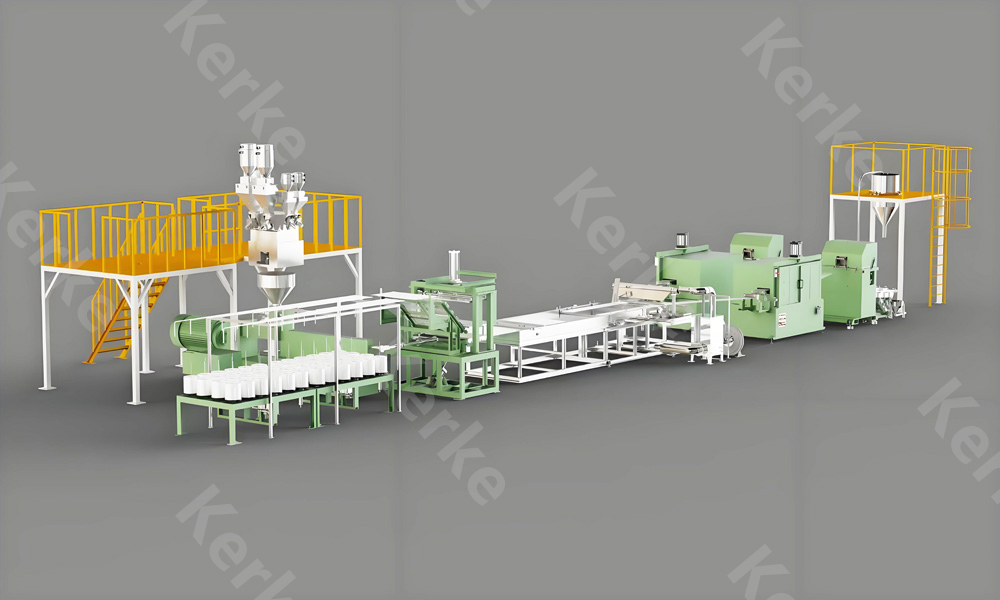
Masterbatch manufacturing is a core link in the plastic industrial chain, providing concentrated color, functional, and filling additives for downstream plastic modification, injection molding, and extrusion production. In the highly competitive plastic processing industry, per-kilogram production cost has become the core indicator that determines the profit margin and market competitiveness of masterbatch manufacturers. Traditional masterbatch production processes are plagued by high energy consumption, serious material waste, low production efficiency, frequent equipment loss, and high labor costs, resulting in inflated unit production costs and thin corporate profits.
With the continuous upgrading of plastic processing technology, modern masterbatch extrusion technology represented by high-performance twin screw extruders and professional compounding extruders has completely overturned the disadvantages of traditional production processes. Through optimized shear mixing principles, energy-saving structural design, precise intelligent control, and standardized compounding processes, it effectively reduces raw material loss, energy consumption, labor investment, and equipment maintenance costs, realizing significant optimization of per-kilogram production costs of masterbatch. As a professional manufacturer of high-end masterbatch extruder and compounding extrusion equipment, KERKE Extruder focuses on technological innovation and cost reduction optimization of masterbatch extrusion lines, providing targeted low-cost production solutions for color masterbatch, filling masterbatch, flame retardant masterbatch, and various functional masterbatch manufacturers. This article comprehensively analyzes the cost composition of masterbatch per-kilogram production, the core technical principles of extrusion cost reduction, multi-dimensional cost-saving paths, KERKE professional equipment matching schemes, detailed unit cost data analysis, and production optimization strategies, covering all key information for enterprises to reduce production costs and improve profit margins.
This systematic industry guide focuses on the pain points of high unit cost in masterbatch production, sorts out the whole-process cost reduction logic of advanced masterbatch extrusion technology, and provides quantifiable cost-saving data and operable technical schemes for plastic masterbatch production enterprises.
1. Basic Composition and Industry Pain Points of Masterbatch Per-KG Production Cost
To accurately reduce the per-kilogram production cost of masterbatch, it is necessary to clarify the full cost composition of the production process. The per-kilogram comprehensive cost of masterbatch includes raw material cost, energy consumption cost, equipment depreciation and maintenance cost, labor cost, production loss cost, and workshop operation management cost. Different production equipment and extrusion processes have decisive differences in the proportion of each cost component, which directly affects the final unit production cost.
1.1 Detailed Composition of Per-KG Production Cost
Raw material cost accounts for 70% to 80% of the comprehensive per-kilogram cost of masterbatch, including carrier resin, color pigments, functional additives, dispersants, and processing aids. Unreasonable extrusion processes will lead to insufficient material dispersion, requiring increased additive dosage to ensure product quality, which directly increases raw material unit consumption. Energy consumption cost accounts for 8% to 12% of the unit cost, mainly including the power consumption of extruder host, feeding system, temperature control system, and granulation system, as well as water and gas consumption for production cooling and exhaust.
Equipment cost includes daily depreciation of extrusion equipment and regular replacement cost of vulnerable parts such as screws and barrels, accounting for 5% to 8% of the unit cost. Labor cost covers the wages of on-site operators and technical debugging personnel, accounting for 4% to 6% of the unit cost. Production loss cost refers to the raw material waste, defective product loss, and shutdown loss caused by unstable extrusion equipment, poor mixing effect, and frequent parameter debugging, accounting for 3% to 5% of the unit cost. Workshop management cost includes site maintenance, environmental treatment, and auxiliary production consumption, accounting for about 2% of the unit cost.
1.2 Cost Pain Points of Traditional Masterbatch Extrusion Processes
Traditional masterbatch production mostly adopts single screw extruder or ordinary low-performance twin screw extruder processing technology, which has prominent cost disadvantages in actual production. First, low mixing and dispersion efficiency leads to serious additive agglomeration. Enterprises can only improve product uniformity by increasing additive dosage, resulting in excessive raw material consumption and increased per-kilogram raw material cost. Second, the equipment has high energy consumption and low thermal efficiency. The outdated heating and transmission structure leads to serious power waste, and the unit energy consumption per kilogram of masterbatch is significantly higher than that of advanced equipment.
Third, poor equipment stability causes frequent production fluctuations, resulting in a large number of defective products and material scrap losses. Fourth, the vulnerable parts of traditional equipment wear quickly, with short replacement cycles and high maintenance costs. Fifth, the degree of automation is low, requiring multiple manual interventions such as feeding, debugging, and sampling, resulting in high labor input per unit product. These cumulative pain points make the per-kilogram production cost of traditional processes 15% to 25% higher than that of modern advanced extrusion processes, seriously restricting corporate profit margins.
2. Core Technical Principles of Modern Masterbatch Extrusion Technology for Cost Reduction
Modern high-performance masterbatch extrusion technology centered on twin screw extruders and compounding extruders realizes multi-dimensional cost reduction per kilogram through structural optimization, process upgrading, and intelligent control. Different from traditional single-mode extrusion, professional compounding extrusion technology optimizes material conveying, shear mixing, plasticizing molding, and exhaust devolatilization links in an all-round way, reducing unnecessary consumption and loss in the production process from the technical source.
2.1 High-Efficiency Shear Dispersion Technology Reduces Raw Material Unit Consumption
The core advantage of twin screw extruders compared with single screw equipment is the strong meshing shear and forced mixing performance. Professional compounding extruders adopt modular screw combination design, which can accurately adjust shear strength and mixing effect according to different masterbatch formulas. For color masterbatch and functional masterbatch, the high-precision shear structure can fully break pigment and additive agglomerations, realize uniform micro-dispersion of functional components in the carrier resin, and significantly improve the utilization rate of additives.
In traditional processes, due to insufficient dispersion, the effective utilization rate of high-cost additives such as carbon black, flame retardants, and antistatic agents is only 75% to 80%, and enterprises need to increase the additive proportion by 10% to 15% to meet product performance standards. Advanced KERKE twin screw compounding extrusion technology can increase the additive effective utilization rate to more than 95%, which can reduce the additive dosage per kilogram of masterbatch by 8% to 12% on the premise of ensuring consistent product performance, directly cutting down the unit raw material cost.
2.2 Low-Temperature Energy-Saving Plasticization Technology Reduces Unit Energy Consumption
Traditional extrusion equipment relies on high-temperature heating to realize material plasticization, which has large temperature fluctuation and serious heat loss. Modern masterbatch compounding extruders adopt segmented precise temperature control and low-temperature high-shear plasticization technology. Through strong mechanical shear force, most of the heat required for material melting is provided by internal friction of materials, which reduces the dependence on external electric heating.
KERKE professional masterbatch extruders are equipped with independent intelligent temperature control systems and energy-saving frequency conversion transmission systems. The temperature control accuracy is controlled within ±1℃, avoiding energy waste caused by overheating and repeated heating. The variable-frequency speed regulation host automatically adjusts power output according to production load, realizing energy saving in low-load operation. Practical production data shows that advanced extrusion technology can reduce the per-kilogram power consumption of masterbatch by 12% to 18% compared with traditional equipment, greatly cutting down unit energy cost.
2.3 Stable Continuous Extrusion Technology Cuts Production Loss Cost
Traditional extrusion equipment has unstable feeding pressure, poor exhaust effect, and low molding stability, which are prone to material breakage, bubble defects, uneven particle size, and color difference, resulting in a large number of defective products and production shutdown losses. Modern compounding extruders adopt forced quantitative feeding, multi-stage vacuum exhaust, and balanced pressure extrusion technology, realizing continuous and stable operation of the whole production process.
The optimized screw and barrel structure ensures stable material conveying and uniform plasticization. The intelligent linkage control system synchronizes feeding speed, host speed, and temperature parameters in real time, avoiding production parameter deviation. This stable continuous production mode reduces the masterbatch defective rate from 10% to 15% of traditional processes to below 0.8%, and eliminates frequent shutdown debugging losses, greatly reducing per-kilogram production loss costs.
2.4 Wear-Resistant and Durable Structure Reduces Equipment Unit Amortization Cost
Masterbatch production contains a large number of high-hardness inorganic fillers, which cause serious wear to extruder screws and barrels. Traditional ordinary nitrided screws have a short service life and need frequent replacement, resulting in high equipment maintenance costs. Modern high-end masterbatch extruders adopt bimetallic barrels and high-alloy overlay welding screws, which have ultra-high wear resistance and corrosion resistance.
The core vulnerable parts of KERKE compounding extruders have a service life more than 3 times that of ordinary equipment, which greatly reduces the replacement frequency of accessories. The long-term stable operation performance of the equipment also reduces shutdown maintenance time and improves effective production capacity. The extended service life of core components and reduced maintenance frequency effectively reduce the per-kilogram equipment amortization cost of masterbatch.
2.5 Intelligent Integrated Technology Reduces Unit Labor Cost
Traditional masterbatch extrusion production requires manual feeding, manual parameter debugging, regular manual sampling inspection, and manual equipment cleaning, with high labor investment. Modern intelligent compounding extrusion lines realize integrated automatic control of feeding, extrusion, granulation, cooling, and screening. The equipment supports one-key start, automatic parameter optimization, online quality monitoring, and automatic fault alarm, which greatly reduces manual intervention links.
A single advanced intelligent extrusion line can be operated and managed by only one operator, while traditional equipment requires 2 to 3 people to complete the same production volume. The improvement of automation level reduces the labor input per unit product and effectively reduces the per-kilogram labor cost of masterbatch production.
3. Comparative Analysis of Per-Kilogram Cost Reduction Effects of Different Extrusion Equipment
Different types of masterbatch extrusion equipment have huge differences in technical performance and cost reduction capabilities. Single screw extruders, ordinary twin screw extruders, and high-performance compounding extruders form three distinct cost gradient levels in actual production. Through horizontal comparison of unit cost data, we can clearly clarify the cost-saving advantages of advanced masterbatch extrusion technology.
3.1 Per-KG Cost Level of Single Screw Extruder Production
Single screw extruders are the most traditional masterbatch production equipment, with low initial investment but poor comprehensive performance. Due to insufficient shear mixing capacity, low additive utilization rate, high energy consumption, unstable production, and frequent maintenance, the comprehensive per-kilogram production cost is the highest in the industry. Taking conventional color masterbatch as an example, the comprehensive per-kilogram cost of single screw extruder production is about 2.1 to 2.3 US dollars per kilogram.
Among them, the raw material loss cost and defective product loss cost are the main cost burdens. The insufficient dispersion effect leads to a large amount of additive waste and unqualified products, and the high energy consumption and frequent maintenance further increase the unit cost. This type of equipment is only suitable for low-end low-profit masterbatch production and has no cost advantage in medium and high-end product production.
3.2 Per-KG Cost Level of Ordinary Twin Screw Extruder Production
Ordinary twin screw extruders have improved mixing performance compared with single screw equipment, with relatively stable production quality and reduced defective rate. The comprehensive per-kilogram production cost of conventional masterbatch is controlled at 1.8 to 2.0 US dollars per kilogram, which reduces the unit cost by about 12% compared with single screw processes.
However, ordinary twin screw extruders have limitations such as low torque, insufficient wear resistance, and low automation. The additive utilization rate is still low, the energy consumption is high, and the vulnerable parts are replaced frequently. There is still large room for cost optimization, and it cannot meet the low-cost production demand of high-additive and high-precision masterbatch.
3.3 Per-KG Cost Level of High-Performance Compounding Extruder Production
High-performance twin screw compounding extruders professionally customized for masterbatch production have comprehensive advantages in dispersion efficiency, energy saving, stability, and intelligence. The comprehensive per-kilogram production cost of the same specification masterbatch is only 1.4 to 1.6 US dollars per kilogram, which reduces the unit cost by about 22% compared with ordinary twin screw equipment and 30% compared with single screw equipment.
This type of masterbatch extruder maximizes additive utilization rate, minimizes energy consumption and production loss, and greatly reduces equipment maintenance and labor costs. The long-term continuous production cost-saving effect is extremely prominent, which is the core equipment for modern masterbatch enterprises to reduce costs and increase profits.
4. KERKE Masterbatch Extrusion Equipment Recommendation for Low-Cost Production
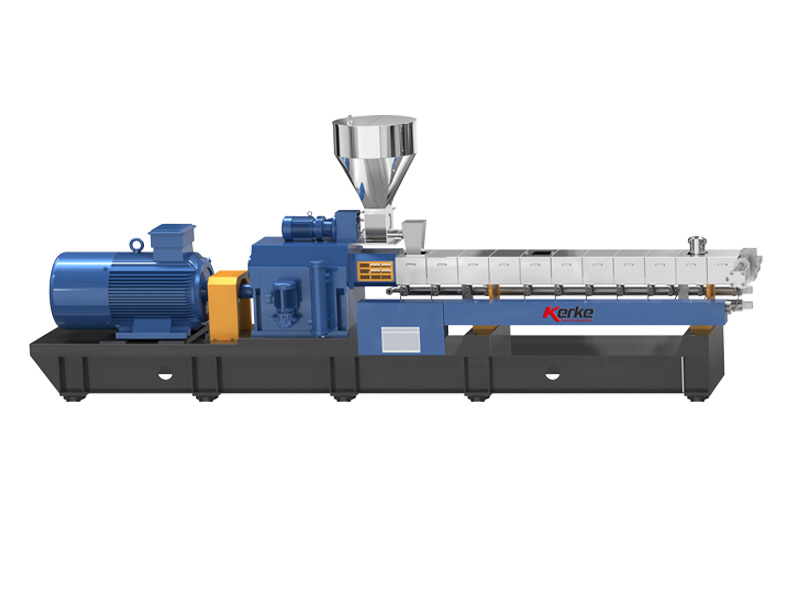
As a professional supplier of twin screw extruders and compounding extrusion lines, KERKE Extruder has optimized and upgraded multiple series of masterbatch-specific extrusion equipment around the core demand of per-kilogram cost reduction. All models focus on energy saving, consumption reduction, loss reduction, and efficiency improvement, helping enterprises build low-cost masterbatch production systems. The mainstream cost-effective models are recommended as follows, covering small trial production, medium batch production, and large-scale mass production scenarios.
4.1 Small Energy-Saving Twin Screw Compounding Extruder
This model is designed for small-batch masterbatch production and formula research and development projects. It adopts high-torque low-energy-consumption screw design and frequency conversion energy-saving system, with flexible production and low operating cost. The equipment has excellent dispersion performance, which can effectively improve additive utilization rate and reduce raw material waste. The fully sealed low-loss structure reduces heat loss and unit power consumption.
Suitable for small factories and laboratory R&D production, this equipment can control the comprehensive per-kilogram cost of conventional masterbatch below 1.6 US dollars. The initial investment is low, and the later maintenance cost is minimal, which is very suitable for small-scale production users to realize low-cost operation.
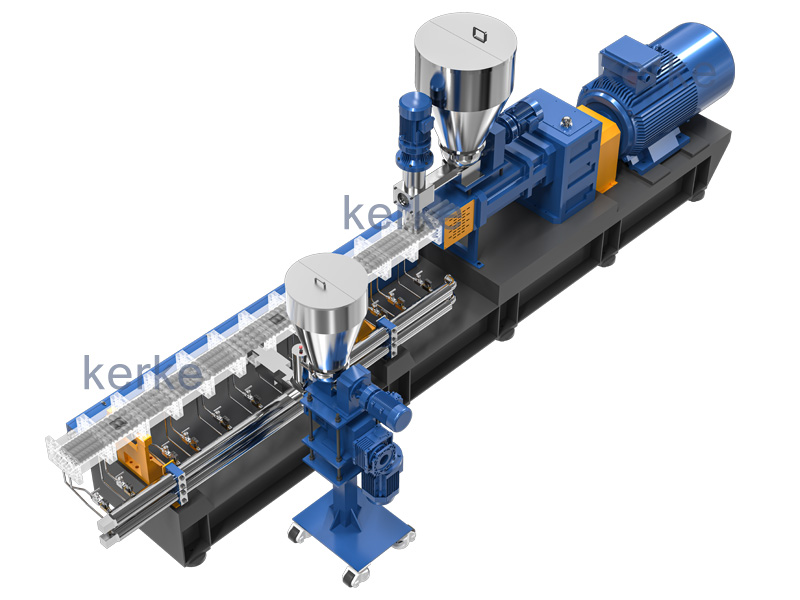
4.2 Medium-Scale High-Efficiency Masterbatch Extruder
This is the mainstream cost-effective model for medium-sized masterbatch enterprises, optimized for large-batch continuous production. The equipment adopts upgraded modular screw combination and multi-stage energy-saving temperature control system, with high production efficiency and stable product quality. The high-wear-resistant screw and barrel configuration reduces accessory replacement frequency and equipment downtime loss.
This model can stably produce various color masterbatch, filling masterbatch, and functional masterbatch, with additive utilization rate up to 96% and defective rate controlled below 0.5%. In actual mass production, the comprehensive per-kilogram production cost can be reduced to 1.4 to 1.5 US dollars, with significant long-term cost-saving benefits, which is the preferred equipment for most medium-scale masterbatch production projects.
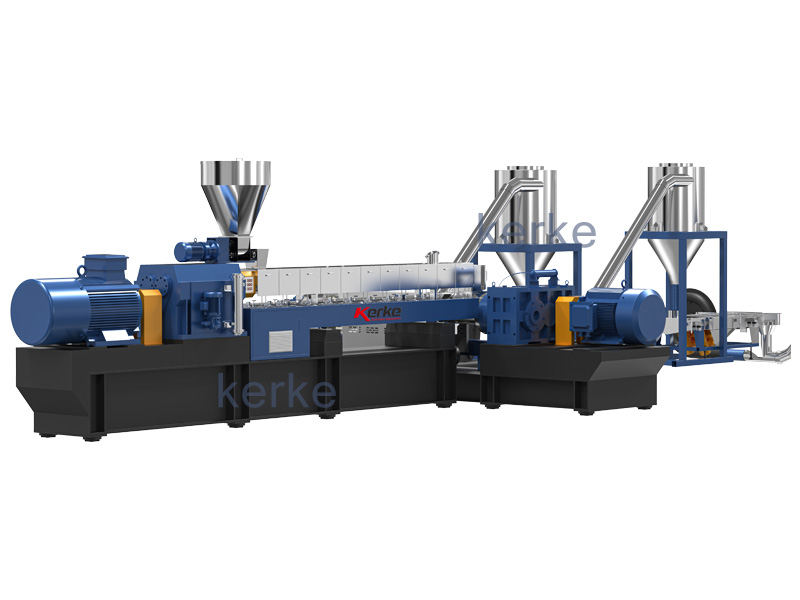
4.3 Large-Scale Intelligent Compounding Extruder
This high-end intelligent model is oriented to large-scale professional masterbatch production bases, realizing fully automated unmanned production. The equipment is equipped with ultra-high torque shear system, intelligent energy-saving control system, online quality monitoring system, and automatic cleaning system. It has the highest production efficiency and the lowest unit comprehensive loss.
The intelligent linkage system realizes precise matching of all production parameters, eliminates parameter deviation loss, and the ultra-high production capacity further dilutes equipment depreciation and labor costs. In large-scale continuous production, the per-kilogram comprehensive cost can be controlled below 1.4 US dollars, which is the optimal equipment for large enterprises to maximize profit margins.
5. Equipment Investment Price and Full-Cycle Per-KG Cost-Benefit Analysis
Although high-performance masterbatch compounding extruders have certain advantages in initial investment, they can bring continuous and stable per-kilogram cost reduction benefits in the full life cycle. The following is the detailed FOB price estimation and full-cycle cost-benefit calculation of KERKE mainstream models, helping users accurately evaluate the input-output ratio of low-cost production equipment.
5.1 Small Energy-Saving Extruder Price and Cost-Benefit Analysis
The FOB price of KERKE small energy-saving twin screw compounding extruder ranges from 27,800 US dollars to 35,600 US dollars. The equipment has low initial investment and complete cost-saving configuration, suitable for users with annual output below 500 tons.
In terms of full-cycle cost saving, compared with ordinary small twin screw equipment, this model saves 0.2 to 0.3 US dollars per kilogram of masterbatch. Based on an annual output of 500 tons, it can save 100,000 to 150,000 US dollars in comprehensive production costs every year. The annual equipment maintenance cost is only 300 to 500 US dollars, and the investment payback period is 7 to 9 months, with extremely high cost performance.
5.2 Medium-Scale High-Efficiency Extruder Price and Cost-Benefit Analysis
The FOB price of KERKE medium-scale high-efficiency masterbatch extruder ranges from 44,500 US dollars to 53,200 US dollars, which is the most balanced model of investment and cost-saving benefit.
The equipment reduces the comprehensive per-kilogram cost by 0.3 to 0.4 US dollars compared with ordinary medium-sized equipment. Based on an annual output of 1500 tons, the annual comprehensive cost saving reaches 450,000 to 600,000 US dollars. The energy-saving frequency conversion system saves more than 4,000 US dollars in annual power consumption, and the high-wear-resistant configuration saves more than 3,000 US dollars in annual maintenance costs. The comprehensive investment payback period is 6 to 8 months, with stable and long-lasting cost-saving benefits.
5.3 Large-Scale Intelligent Extruder Price and Cost-Benefit Analysis
The FOB price of KERKE large-scale intelligent compounding extruder ranges from 67,800 US dollars to 78,300 US dollars. The initial investment is slightly higher, but the unit cost-saving effect is the most prominent, suitable for large-scale production with annual output more than 3000 tons.
The equipment reduces the per-kilogram comprehensive cost by more than 0.4 US dollars compared with traditional large-scale equipment, with annual cost-saving amount exceeding 1.2 million US dollars. The intelligent unmanned production mode saves more than 10,000 US dollars in annual labor costs, and the ultra-low defective rate eliminates hundreds of thousands of defective product losses every year. The comprehensive investment payback period is 5 to 7 months, and the long-term profit improvement effect is very significant.
6. Practical Operation Strategies to Further Reduce Per-KG Production Cost
On the basis of adopting advanced masterbatch extrusion equipment, standardized operation and scientific process optimization can further tap cost-saving potential and reduce per-kilogram comprehensive production cost. Combined with KERKE's long-term production service experience, the following practical optimization strategies are summarized for enterprises' daily production management.
6.1 Formula Optimization Matching Extrusion Process
According to the shear characteristics and plasticization performance of twin screw compounding extruders, optimize the masterbatch formula ratio. Make full use of the high dispersion performance of advanced equipment to appropriately reduce the dosage of high-cost additives and dispersants, and replace part of high-price auxiliary materials with low-cost and high-efficiency accessories on the premise of ensuring product quality. Scientific formula matching can further reduce the per-kilogram raw material cost by 3% to 5%.
6.2 Standardized Equipment Operation and Maintenance
Establish standardized daily operation and maintenance procedures for extrusion equipment. Regularly calibrate temperature, pressure, and feeding parameters to avoid parameter deviation leading to increased energy consumption and defective products. Regularly clean the screw, barrel, and exhaust system to prevent material residue from affecting production efficiency and product quality. Timely maintain vulnerable parts to avoid equipment failure and shutdown loss, ensuring that the equipment is always in the optimal low-cost operating state.
6.3 Batch Continuous Production Management
Optimize production scheduling, adopt batch continuous production mode, and reduce frequent machine shutdown and startup times. Each startup and shutdown will produce a certain amount of waste materials and consume extra electric energy. Continuous production can effectively reduce startup loss and idle energy consumption, improving unit production efficiency and reducing per-kilogram comprehensive loss.
6.4 Waste Material Recycling and Reuse
Use the high mixing and reprocessing performance of compounding extruders to classify and recycle qualified waste materials generated in the production process. After crushing and screening, the waste materials are mixed into new materials for re-extrusion production, which realizes full utilization of waste materials and reduces raw material waste, further reducing per-kilogram raw material cost.
7. Common Misunderstandings in Masterbatch Production Cost Control
In the process of cost control, many masterbatch enterprises have misunderstandings in equipment selection and production management, which lead to higher comprehensive costs instead of reducing costs. The common misunderstandings and correction schemes are summarized as follows to help enterprises avoid cost control traps.
7.1 Blindly Pursuing Low-Price Equipment
Many enterprises only focus on the initial equipment purchase cost and choose low-cost ordinary extrusion equipment. Although the one-time investment is low, the long-term high energy consumption, high loss, high maintenance cost, and low product qualification rate lead to a substantial increase in per-kilogram comprehensive cost. The correct strategy is to prioritize high-performance energy-saving compounding extruders with low full-cycle cost, and realize long-term cost reduction through equipment performance advantages.
7.2 Excessively Reducing Additive Dosage Sacrificing Quality
Individual enterprises blindly reduce additive dosage to cut raw material costs, resulting in unqualified masterbatch product performance, batch return and rework, and market reputation loss. This short-term cost-saving behavior will bring greater economic losses. The correct way is to rely on advanced extrusion technology to improve additive utilization rate, rather than simply reducing dosage to control costs.
7.3 Ignoring Equipment Maintenance for Cost Saving
Some enterprises reduce maintenance investment to save short-term costs, resulting in accelerated equipment aging, increased failure rate, and reduced production stability. The subsequent shutdown loss and component replacement cost are far higher than the saved maintenance cost. Regular standardized maintenance is the key to ensure long-term low-cost and stable operation of extrusion equipment.
8. Long-Term Comprehensive Benefits of Low-Cost Masterbatch Extrusion Technology
The application of advanced masterbatch extrusion technology represented by high-performance twin screw compounding extruders can bring multi-dimensional long-term benefits to masterbatch production enterprises, not only reducing per-kilogram production costs, but also improving overall production competitiveness.
First, significantly improve corporate profit margins. The all-round reduction of raw material, energy, labor, and loss costs directly reduces the per-kilogram comprehensive cost of masterbatch, increases the unit profit space, and fundamentally improves corporate profitability.
Second, stabilize product quality and expand market share. Advanced extrusion technology ensures uniform masterbatch dispersion, stable performance, and low defective rate, helping enterprises produce high-quality products, meet high-end customer demand, and get rid of low-price homogeneous competition.
Third, improve production efficiency and scale advantage. Efficient compounding extrusion equipment increases single-machine output, realizes large-scale centralized production, further dilutes fixed costs such as equipment depreciation and site rent, and forms scale cost advantages.
Fourth, enhance sustainable production capacity. Energy-saving and low-consumption production technology reduces enterprise energy consumption and material waste, meets industrial green production standards, and helps enterprises meet environmental protection and sustainable development requirements.
9. Conclusion
The per-kilogram production cost of masterbatch is determined by the comprehensive level of extrusion equipment and production technology. Traditional backward extrusion processes have many cost pain points such as high energy consumption, serious waste, and high loss, which restrict the profit growth of masterbatch enterprises. Modern advanced masterbatch extrusion technology based on twin screw extruders and high-performance compounding extruders realizes precise control of all production links through technical optimization, effectively reducing raw material unit consumption, energy consumption, equipment maintenance cost, labor cost, and production loss cost, achieving a substantial drop in per-kilogram comprehensive production cost.
As a professional manufacturer of masterbatch-specific extrusion equipment, KERKE Extruder continues to iterate and upgrade compounding extrusion technology and energy-saving equipment, providing customized low-cost production solutions for global masterbatch manufacturers. With reliable equipment performance, significant cost-saving advantages, and perfect after-sales technical support, KERKE helps enterprises optimize production costs, improve product quality, enhance market core competitiveness, and realize sustainable and profitable development in the fiercely competitive masterbatch industry.