High additive content masterbatch has become a core raw material in the modern plastic modification, color matching, and functional plastic manufacturing industries. Unlike conventional low-filler masterbatch, high-additive masterbatch usually contains 50% to 85% of pigments, inorganic fillers, flame retardants, antistatic agents, tougheners, and other functional additives. These high-proportion solid powders face significant processing challenges such as poor dispersion, difficult melt blending, high material abrasion, and unstable extrusion molding during production. The selection of a professional masterbatch extruder directly determines the dispersion uniformity, finished product stability, production efficiency, and comprehensive production cost of high-additive masterbatch.
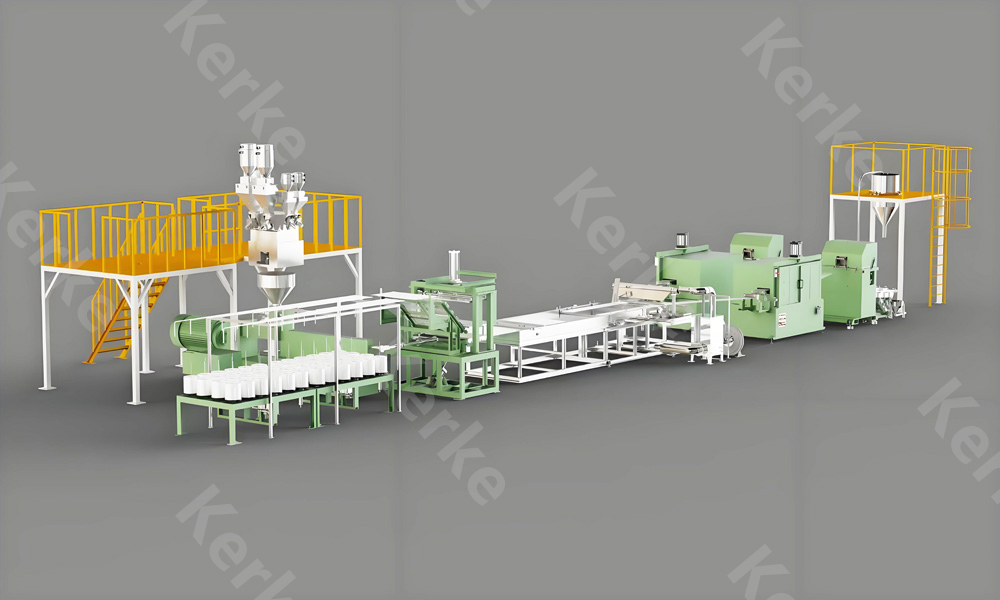
Ordinary single screw extruders cannot meet the processing requirements of high-filler masterbatch due to insufficient shearing, poor mixing performance, and low feeding capacity. Professional twin screw compounding extruders have become the mainstream equipment for high-additive masterbatch production by virtue of strong forced conveying, high-efficiency shear dispersion, and flexible process adjustment performance. As a professional manufacturer of high-performance twin screw extruders and compounding extrusion equipment, KERKE Extruder focuses on the R&D and manufacturing of masterbatch-specific extrusion lines, providing targeted equipment solutions for carbon black masterbatch, calcium carbonate masterbatch, talc masterbatch, flame retardant masterbatch, and other high-additive products. This article comprehensively elaborates on the processing characteristics of high-additive masterbatch, core extruder selection indicators, differences between mainstream extruder types, KERKE professional equipment recommendations, detailed price and operation cost analysis, and common selection mistakes, covering all key reference information for masterbatch factory equipment procurement and project investment.
This systematic selection guide fully sorts out the whole-process selection logic of high-additive masterbatch extruders, helping manufacturers accurately match compounding extruder equipment according to additive proportion, filler type, production capacity demand, and product quality standards, and effectively avoid quality defects and cost waste caused by mismatched equipment selection.
1. Processing Characteristics and Production Challenges of High Additive Content Masterbatch
High additive content masterbatch refers to concentrated functional masterbatch with additive filling ratio exceeding 50%, which is widely used in plastic coloration, material modification, flame retardant enhancement, anti-aging treatment, and functional filling modification. Common product types include high-concentration carbon black color masterbatch, high-calcium filling masterbatch, talc powder reinforced masterbatch, halogen-free flame retardant masterbatch, and antistatic functional masterbatch. Different from ordinary masterbatch with low filler content, high-additive masterbatch has unique physical processing characteristics, putting forward higher technical requirements for the structure, shear performance, wear resistance, and process adaptability of masterbatch extruders.
1.1 Core Processing Characteristics of High-Additive Masterbatch
First, high solid powder proportion and low melt fluidity. When the additive content exceeds 60%, the proportion of resin carrier is extremely low, resulting in poor overall material fluidity, difficult melt plasticization, and easy material bridging and material breakage in the extrusion process. Second, strong material abrasion. Inorganic fillers such as calcium carbonate, talc powder, and mica have high hardness, which will cause severe wear to the screw, barrel, and internal flow channel of the extruder during long-term high-load production. Third, strict dispersion requirements. High-concentration additives are prone to agglomeration. The equipment needs strong shear dispersion capacity to break powder agglomerates and realize uniform blending of powder and resin carrier.
Fourth, high moisture and impurity sensitivity. Most high-additive powders are easy to absorb moisture. Unremoved moisture will cause bubbles, silver lines, and surface defects in masterbatch particles, requiring the extruder to be equipped with efficient exhaust and devolatilization functions. Fifth, unstable material feeding. Ultra-high powder proportion leads to uneven feeding speed, easy overflow and material accumulation, requiring accurate quantitative feeding and stable conveying system matching.
1.2 Main Production Challenges for Extrusion Equipment
For extrusion equipment, the production of high-additive masterbatch mainly faces four major technical challenges. The first challenge is insufficient shear mixing capacity, which makes it impossible to break powder agglomerates, resulting in uneven color and inconsistent functional performance of finished masterbatch. The second challenge is poor equipment wear resistance, which leads to rapid wear of screw and barrel, short service life of vulnerable parts, and frequent shutdown maintenance.
The third challenge is unstable feeding and extrusion pressure, resulting in fluctuating output, uneven particle size, and low finished product qualification rate. The fourth challenge is insufficient exhaust devolatilization effect, leading to residual moisture and volatile impurities inside the masterbatch, which affects the mechanical properties and appearance quality of downstream plastic products. Only professional customized compounding extruders can solve the above industry pain points in a targeted manner.
2. Comparison of Mainstream Extruder Types for Masterbatch Production
At present, the mainstream extrusion equipment for masterbatch production in the market includes single screw extruders, conventional twin screw extruders, and high-torque compounding extruders. Different types of extruders have huge differences in shear performance, mixing capacity, wear resistance, and production adaptability, and their applicable additive concentration ranges and production scenarios are completely different. For high-additive masterbatch production with additive content higher than 50%, equipment selection must strictly distinguish equipment performance differences to avoid mismatched models.
2.1 Single Screw Extruder: Suitable Only for Low-Additive Masterbatch
Single screw extruders rely on single spiral propulsion for material conveying and plasticization, with simple structure and low equipment cost. This type of equipment has weak shear force and poor mixing and dispersion performance, which can only meet the production demand of conventional masterbatch with additive content below 30%. When used for high-additive masterbatch production, it is prone to insufficient plasticization, serious powder agglomeration, uneven masterbatch dispersion, and a large number of unqualified particles. In addition, single screw extruders have no forced feeding function, and high-powder materials are easy to block and break materials, resulting in extremely low production efficiency and serious material waste.
Although the initial investment of single screw extruder is low, the defective rate of high-additive masterbatch production is as high as 15% to 25%, and the long-term comprehensive production cost is far higher than that of professional compounding extruders. Therefore, single screw extruders are completely not recommended for high-additive masterbatch production projects.
2.2 Conventional Parallel Twin Screw Extruder: Basic Adaptation for Medium-Additive Products
Conventional parallel twin screw extruders adopt double-screw meshing rotating structure, with forced conveying and basic shear mixing functions. Compared with single screw equipment, it has significantly improved mixing performance and can adapt to masterbatch production with additive content of 30% to 50%. The equipment has stable feeding performance and certain exhaust capacity, which can meet the production needs of ordinary medium-concentration masterbatch.
However, conventional twin screw extruders have limited torque output and low wear resistance of screw and barrel. When facing high-additive masterbatch with content higher than 50% and high-hardness inorganic fillers, the shear force is insufficient to completely disperse powder agglomerates, and the screw and barrel are seriously worn, resulting in rapid attenuation of equipment performance, frequent replacement of vulnerable parts, and increased downtime loss. It can only be used for low-demand high-additive masterbatch trial production and cannot meet long-term stable mass production.
2.3 High-Torque Compounding Extruder: Professional Equipment for High-Additive Masterbatch
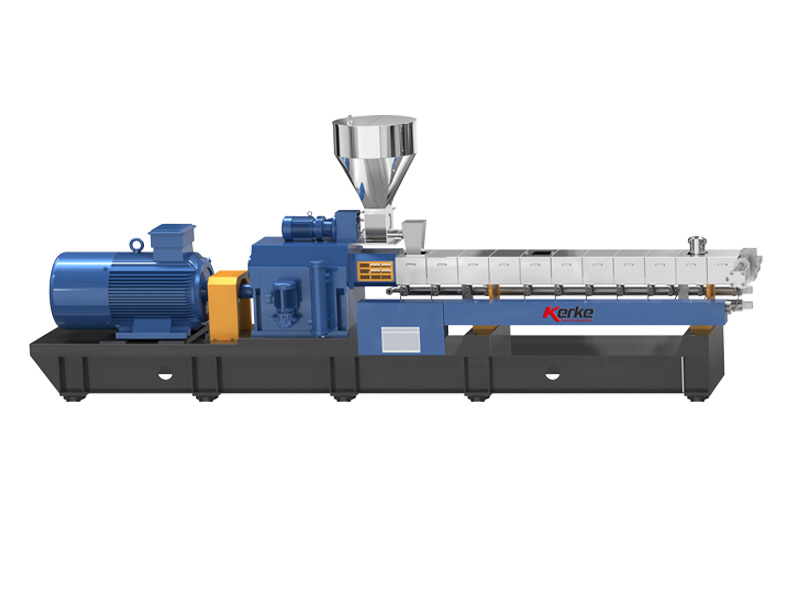
High-torque twin screw compounding extruder is a special upgraded equipment developed for high-additive and high-abrasive masterbatch production, and it is the most matching core equipment for high-concentration masterbatch processing at present. This type of masterbatch extruder is optimized in terms of screw structure, torque output, wear resistance configuration, feeding system, and exhaust system, with super strong shear dispersion capacity, high-precision stable conveying performance, and ultra-high wear resistance.
It can stably produce various high-additive masterbatch with additive content of 50% to 85%, realizing uniform powder dispersion, full melt plasticization, stable particle molding, and low equipment loss. All high-quality high-concentration masterbatch products in the industry are produced by high-torque compounding extruders, which is the standard configuration for large-scale and high-standard masterbatch production projects.
3. Core Selection Criteria for High-Additive Masterbatch Extruders
When purchasing extrusion equipment for high-additive masterbatch, manufacturers need to focus on eight core technical indicators, including equipment torque level, screw and barrel wear resistance, shear mixing system, feeding stability, exhaust devolatilization capacity, temperature control accuracy, production capacity matching, and intelligent control level. Comprehensive selection according to product formula and production scale can ensure equipment production efficiency and finished product quality.
3.1 Equipment Torque and Shear Capacity Matching
Torque is the core parameter that determines the shear mixing capacity of the compounding extruder. High-additive masterbatch has high powder content and poor melt fluidity, which requires high torque output of the equipment to provide strong shear force to break powder agglomerates and promote uniform blending of powder and resin. The higher the additive concentration and the harder the filler, the higher the torque demand of the equipment.
KERKE high-torque compounding extruders adopt high-precision hard tooth surface reduction gearboxes, with ultra-high torque density design. The screw can maintain stable high-shear operation under high-load powder filling conditions, effectively solving the agglomeration and uneven dispersion problems of high-concentration pigments and fillers. When selecting equipment, masterbatch with additive content above 60% must be equipped with high-torque models to avoid insufficient shear leading to unqualified product quality.
3.2 Screw and Barrel Wear Resistance Configuration
High-hardness inorganic fillers such as calcium carbonate, talc powder, and silica powder will cause severe abrasive wear to the screw and barrel during long-term extrusion. Ordinary nitrided screw and barrel will be worn and failed in a short time, resulting in reduced equipment precision and increased production defective rate. Therefore, wear resistance configuration is a key selection indicator for high-additive masterbatch extruders.
All KERKE masterbatch extruders are equipped with high-wear-resistant alloy screws and bimetallic barrels. The screw surface adopts high-hardness alloy overlay welding treatment, and the barrel inner wall is embedded with high-chromium alloy wear-resistant layer. The overall wear resistance is more than 3 times that of ordinary equipment, which can adapt to long-term high-abrasive high-additive masterbatch production, greatly extending the service life of vulnerable parts and reducing long-term maintenance costs.
3.3 Modular Screw Combination Design
Different types of high-additive masterbatch have different processing requirements. Color masterbatch needs moderate shear to ensure uniform color dispersion, flame retardant masterbatch needs low-temperature gentle extrusion to avoid additive decomposition, and high-filling masterbatch needs strong shear to improve filling uniformity. The modular screw combination structure can freely adjust the screw element combination according to different formulas, realizing personalized process matching.
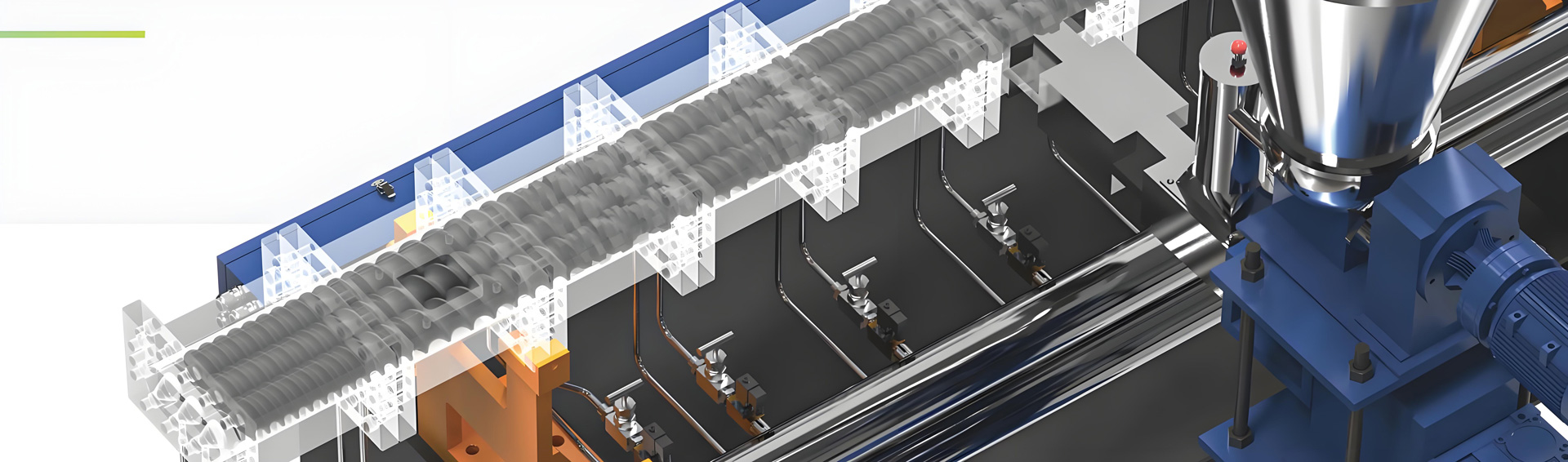
KERKE twin screw extruders adopt full modular screw design, equipped with various conveying elements, shearing elements, mixing elements, and kneading elements. Users can adjust the screw combination mode according to the additive type and concentration, accurately control the shear strength and mixing effect, avoid material degradation and additive failure caused by excessive shear, and ensure the stability of masterbatch functional performance.
3.4 Stable Quantitative Feeding System
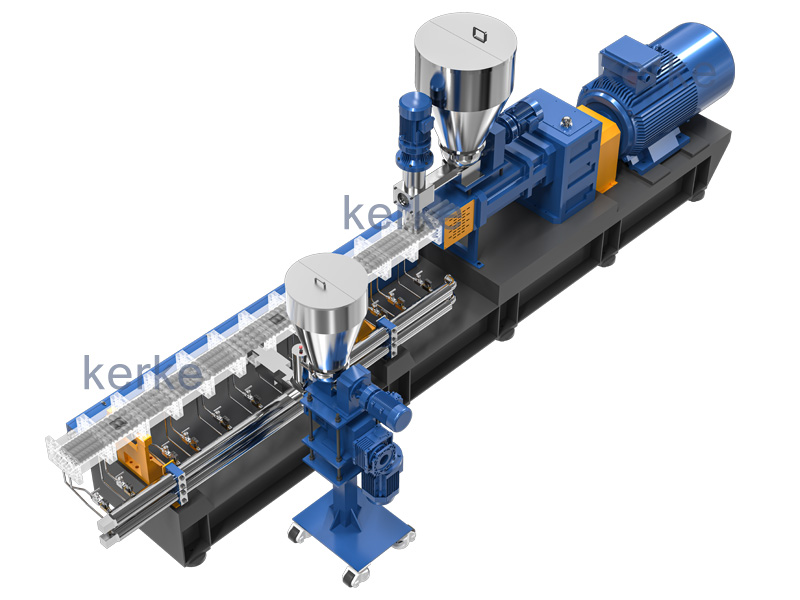
High-additive masterbatch materials are mostly powder-based mixtures, which are prone to bridging, uneven blanking, and feeding fluctuation, leading to unstable extrusion pressure and fluctuating particle quality. Professional high-additive extruders must be equipped with customized double-screw forced feeding system to realize continuous and uniform quantitative conveying of powder materials.
The supporting feeding system of KERKE compounding extruder adopts frequency conversion quantitative feeding technology, with anti-bridging stirring device inside the feeding bin, which can effectively solve the feeding instability problem of high-powder and low-fluidity materials. The feeding speed is synchronized with the host extrusion speed in real time, ensuring stable extrusion pressure and consistent particle size and density of finished masterbatch.
3.5 Multi-Stage Exhaust Devolatilization System
High-concentration powder additives are easy to absorb moisture, and volatile small molecules will be generated during extrusion heating. Residual moisture and volatile substances will cause bubbles, voids, and poor surface flatness of masterbatch particles, affecting downstream product quality. Therefore, high-additive masterbatch production requires multi-stage efficient exhaust and devolatilization configuration.
KERKE masterbatch extruders are equipped with multi-stage vacuum exhaust and atmospheric exhaust ports, which can discharge moisture, air, and volatile impurities in the material in sections during the extrusion process. The high-vacuum exhaust system ensures zero bubble and zero impurity of high-additive masterbatch particles, significantly improving the compactness and appearance quality of finished products.
3.6 High-Precision Constant Temperature Control System
Most functional additives in high-additive masterbatch are temperature-sensitive. Excessively high temperature will cause additive decomposition, failure, and color fading, while excessively low temperature will lead to insufficient material plasticization and poor dispersion effect. Precise segmented temperature control is the key to ensure masterbatch performance stability.
KERKE twin screw extruders adopt segmented independent intelligent temperature control system, with temperature control accuracy up to ±1℃. Each temperature zone can independently adjust heating and cooling parameters, realizing low-temperature high-efficiency plasticization of high-additive materials, effectively protecting the activity of functional additives, and avoiding product performance attenuation caused by temperature deviation.
3.7 Production Capacity and Model Size Matching
Equipment model specification needs to be matched with daily production demand. Small-scale trial production and small-batch customized orders are suitable for small and medium-sized extruder models, while large-scale mass production projects need to be equipped with large-diameter high-output compounding extruders. Blindly purchasing large-scale equipment will cause energy waste and idle loss, while undersized equipment will restrict production capacity expansion.
4. KERKE High-Additive Masterbatch Extruder Equipment Recommendation
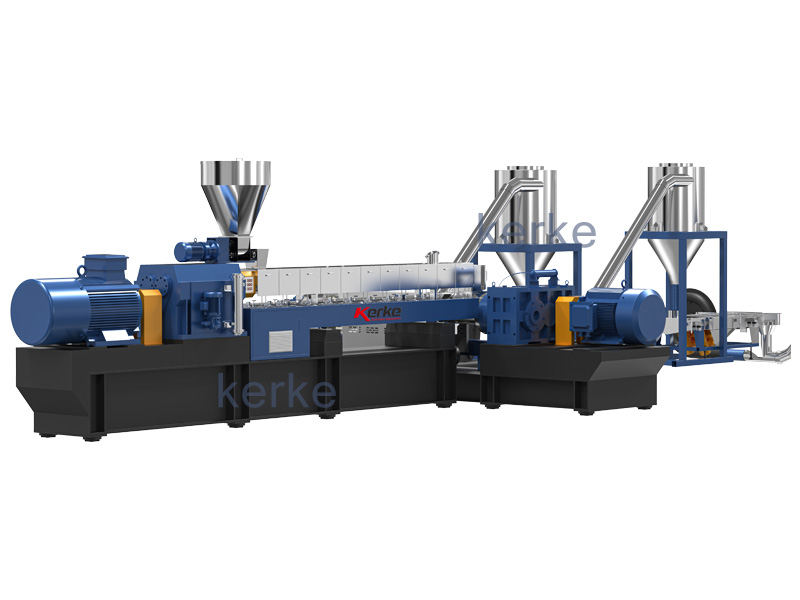
As a professional manufacturer of twin screw extruders and compounding extrusion lines, KERKE Extruder independently develops and produces a full range of masterbatch-specific compounding extruders, covering small trial production, medium batch production, and large-scale intelligent mass production. All equipment is optimized and upgraded for high-additive masterbatch processing characteristics, with super strong shear dispersion performance, high wear resistance, and stable operation. The mainstream models and applicable scenarios are recommended as follows, without any non-standard or disorderly generated models.
4.1 Small Batch Trial Production Twin Screw Compounding Extruder
This small model is specially designed for masterbatch formula research and development, small-batch trial production, and new product testing, suitable for laboratories, new factories, and enterprises with customized small-order production demands. The equipment adopts high-torque screw design and wear-resistant configuration, which can stably produce high-additive masterbatch with additive content of 50% to 70%. It has flexible parameter adjustment, small floor space, low trial production cost, and can quickly verify new masterbatch formulas and process parameters.
The equipment is equipped with a miniature quantitative feeding system and precise temperature control module, which can accurately simulate the production state of large-scale equipment, ensuring that the test data is consistent with industrial mass production data. It is the preferred test equipment for high-additive masterbatch formula optimization and process debugging.
4.2 Medium-Scale Standard Masterbatch Compounding Extruder
This standard model is the mainstream equipment for medium-sized masterbatch factories, widely used in batch production of various conventional high-additive masterbatch such as high-calcium filling masterbatch, ordinary color masterbatch, and general flame retardant masterbatch. The equipment has balanced torque, shear performance, and production capacity, supporting long-term 24-hour uninterrupted industrial production, with stable product quality and low failure rate.
Equipped with standard multi-stage exhaust system and anti-wear screw barrel configuration, this model can stably process masterbatch products with additive content of 50% to 80%. The modular screw structure supports free adjustment of different formula processes, with strong product adaptability and high cost performance, which is suitable for most medium-scale high-additive masterbatch production projects.
4.3 Large-Scale High-Output Intelligent Compounding Extruder
This high-end intelligent model is oriented to large-scale professional masterbatch production bases and high-standard functional masterbatch projects, specially used for mass production of high-concentration carbon black masterbatch, high-performance flame retardant masterbatch, and high-precision functional modified masterbatch with additive content up to 85%.
The equipment adopts upgraded ultra-high torque transmission system and enhanced wear-resistant alloy configuration, with stronger shear dispersion capacity and higher production efficiency. It is equipped with full intelligent linkage control system, automatic feeding, automatic temperature adjustment, online quality monitoring, and fault self-diagnosis functions, realizing unattended intelligent production. The finished masterbatch has uniform dispersion, stable performance, and ultra-low defective rate, meeting the high-quality supply standards of high-end plastic modification enterprises.
5. Equipment Price and Full-Cycle Operation Cost Analysis
The investment cost of high-additive masterbatch extrusion equipment includes initial equipment purchase cost and long-term operation and maintenance cost. The following is the detailed FOB price estimation and full-cycle economic benefit analysis of KERKE mainstream masterbatch extruder models, providing accurate investment and cost reference for project purchasers.
5.1 Small Batch Trial Production Extruder Price and Cost Analysis
The FOB price of KERKE small trial production twin screw compounding extruder ranges from 28,500 US dollars to 36,800 US dollars. This model has a low investment threshold and complete functional configuration, meeting all trial production and formula debugging demands of high-additive masterbatch.
In terms of operation cost, the equipment has low power consumption, with annual electricity consumption cost controlled within 2,800 US dollars. The wear-resistant parts have long service life, and the annual maintenance and replacement cost of vulnerable parts is only 300 to 500 US dollars. The equipment has flexible use and no idle loss, which is very suitable for R&D and trial production scenarios. The comprehensive investment payback period is 8 to 10 months, with low investment risk and high flexibility.
5.2 Medium-Scale Standard Production Extruder Price and Cost Analysis
The FOB price of KERKE medium-scale standard masterbatch compounding extruder ranges from 45,600 US dollars to 54,200 US dollars. This model is the most cost-effective mainstream model in the market, balancing production capacity, equipment performance, and investment cost.
In terms of daily operation cost, the equipment adopts energy-saving frequency conversion control technology, with annual electricity saving benefit of more than 4,200 US dollars compared with ordinary equipment. The high-wear-resistant configuration reduces the replacement frequency of screw and barrel, and the annual maintenance cost is controlled within 600 US dollars. The stable production performance reduces the product defective rate to below 0.8%, saving more than 6,500 US dollars of annual raw material waste and rework cost. The comprehensive investment payback period is 7 to 9 months, with excellent long-term economic benefits.
5.3 Large-Scale Intelligent Production Extruder Price and Cost Analysis
The FOB price of KERKE large-scale intelligent high-output compounding extruder ranges from 68,900 US dollars to 79,500 US dollars. Although the initial investment is relatively high, the equipment has ultra-high production efficiency and ultra-low failure rate, suitable for large-scale continuous production projects.
The intelligent automatic production function saves 2 professional operators annually, reducing labor cost expenditure by more than 12,000 US dollars every year. The enhanced wear-resistant configuration extends the service life of core components by more than 40%, and the annual comprehensive maintenance cost is less than 800 US dollars. The high-precision production capacity ensures stable high-quality output of high-additive masterbatch, greatly improving product market competitiveness and profit margin. The comprehensive investment payback period is 6 to 8 months, with long-term stable cost-saving advantages.
6. Common Extruder Selection Mistakes for High-Additive Masterbatch
In the actual equipment procurement process, many masterbatch manufacturers have selection deviations due to insufficient understanding of high-additive material processing characteristics, resulting in unqualified product quality, low production efficiency, and increased comprehensive costs. The common selection mistakes and correction schemes are summarized as follows.
6.1 Choosing Low-Cost Ordinary Twin Screw Extruders Blindly
Many new manufacturers blindly pursue low initial investment and purchase ordinary low-torque twin screw extruders to produce high-additive masterbatch. This kind of equipment has insufficient shear force and poor wear resistance, which leads to serious powder agglomeration, uneven masterbatch dispersion, and rapid wear of core components in production. The later maintenance cost and product loss cost far exceed the equipment price difference. The correct selection scheme is to prioritize high-torque wear-resistant professional compounding extruders for high-additive products to ensure long-term stable production.
6.2 Ignoring Feeding and Exhaust System Matching
Some manufacturers only pay attention to the screw and host performance and ignore the matching degree of the feeding system and exhaust system. Ordinary gravity feeding cannot solve the bridging and uneven feeding problems of high-powder materials, and insufficient exhaust leads to bubble defects in masterbatch. When selecting equipment, it is necessary to support professional forced feeding device and multi-stage vacuum exhaust system to fully adapt to high-additive material processing.
6.3 Unmatched Screw Process Configuration and Product Formula
Using fixed single-structure screws to produce different types of high-additive masterbatch will lead to poor product adaptability. For temperature-sensitive flame retardant masterbatch, high-shear screw will cause additive decomposition and failure; for high-filling masterbatch, low-shear screw will cause insufficient dispersion. The correct way is to select equipment with modular adjustable screw structure and customize the screw combination according to the actual formula.
6.4 Unreasonable Model Capacity Matching
Purchasing oversized equipment for small-batch production will cause long-term idle energy waste, while purchasing undersized equipment for large-scale production will restrict capacity expansion and lead to long-term overload operation and accelerated equipment aging. It is necessary to select equipment model reasonably according to the current production demand and future capacity planning to realize the optimal matching of production capacity and cost.
7. Post-Selection Commissioning and Production Optimization Suggestions
After completing the selection of high-additive masterbatch extruder, standardized equipment commissioning and process optimization are required to give full play to the equipment performance and ensure stable output of high-quality masterbatch products. KERKE summarizes professional production optimization suggestions for high-additive masterbatch extrusion.
7.1 Pre-Production Formula and Parameter Debugging
Before formal mass production, carry out small-scale trial production debugging according to the masterbatch additive proportion and filler type. Adjust the screw speed, feeding speed, and segmented temperature parameters to find the optimal process window. For high-hardness inorganic filler masterbatch, appropriately reduce the screw speed to reduce equipment wear; for temperature-sensitive functional masterbatch, adopt low-temperature high-shear process to ensure additive activity and dispersion effect.
7.2 Regular Equipment Maintenance and Parameter Calibration
Establish regular equipment maintenance files, regularly check the wear degree of screw and barrel, clean the exhaust system and feeding system, and avoid equipment performance attenuation caused by material residue and component wear. Regularly calibrate temperature control parameters and feeding accuracy to ensure long-term consistency of production process parameters and stable product quality.
7.3 Raw Material Pretreatment Optimization
Carry out drying and dehumidification pretreatment on high-additive powder materials before production to reduce material moisture and reduce the operation load of the equipment exhaust system. Uniformly mix the powder and resin carrier in advance to avoid local excessive powder concentration, which helps improve the dispersion uniformity of finished masterbatch and reduce equipment shear loss.
8. Long-Term Comprehensive Benefit Analysis of Correct Equipment Selection
Correct selection of professional high-additive masterbatch compounding extruders can bring multi-dimensional economic and competitive benefits for masterbatch production enterprises.
First, stabilize product quality and reduce defective loss. Professional twin screw extruders ensure uniform dispersion of high-concentration additives, stable masterbatch performance, and qualified product rate stable above 99.2%, completely eliminating batch scrap losses caused by equipment mismatch.
Second, reduce long-term operation costs. High wear-resistant configuration reduces the frequency of vulnerable parts replacement and equipment shutdown maintenance, and energy-saving frequency conversion technology reduces daily power consumption, effectively optimizing enterprise production cost structure.
Third, improve production efficiency and output value. High-torque high-efficiency extrusion performance increases single-machine output by 20% to 30% compared with ordinary equipment, helping enterprises expand production scale and increase market share.
Fourth, enrich product competitiveness. Professional equipment can produce high-standard high-additive masterbatch products, meet the high-end demand of downstream plastic modification, flame retardant reinforcement, and functional material manufacturing, and get rid of low-price homogeneous competition.
9. Conclusion
The production of high additive content masterbatch has extremely high requirements on the shear dispersion performance, wear resistance, feeding stability, and exhaust capacity of extrusion equipment. Ordinary single screw extruders and low-performance twin screw equipment cannot adapt to the processing demand of high-concentration masterbatch, and wrong equipment selection will bring huge quality risks and cost losses to enterprises. High-torque professional twin screw compounding extruders are the only reliable equipment for stable production of high-quality high-additive masterbatch.
As a professional global supplier of compounding extrusion equipment, KERKE Extruder provides a full range of targeted twin screw extruder and masterbatch extruder solutions for high-additive masterbatch production. With reliable equipment performance, personalized process customization, reasonable price positioning, and perfect after-sales technical support, KERKE helps masterbatch manufacturers accurately select equipment, optimize production processes, reduce comprehensive operating costs, and produce high-quality high-additive functional masterbatch products, continuously enhancing the core market competitiveness of enterprises.