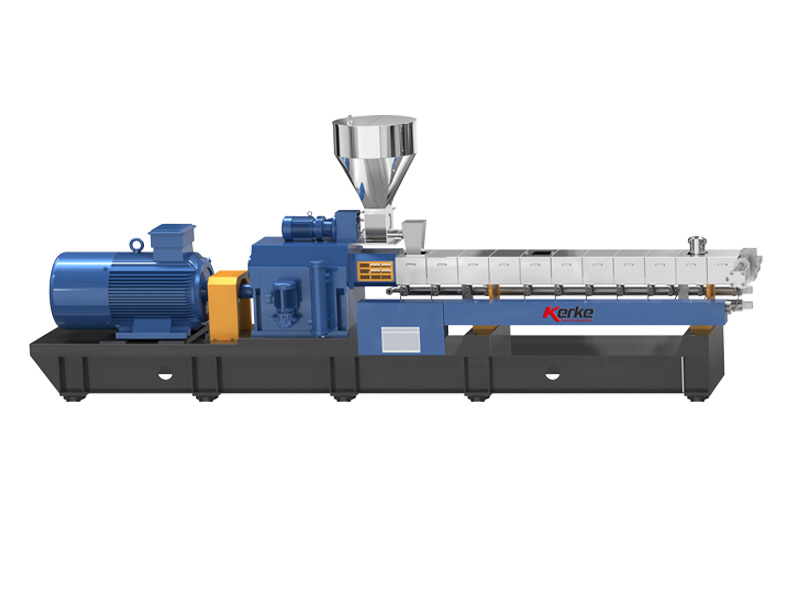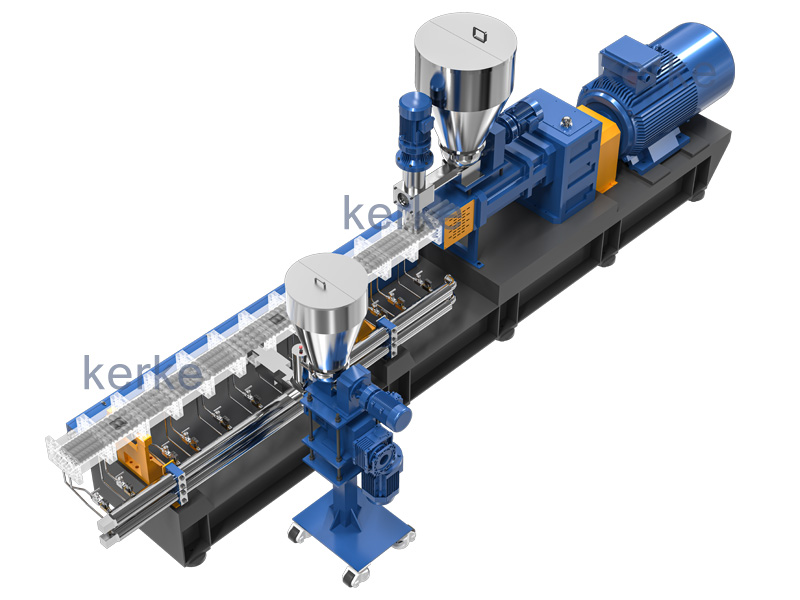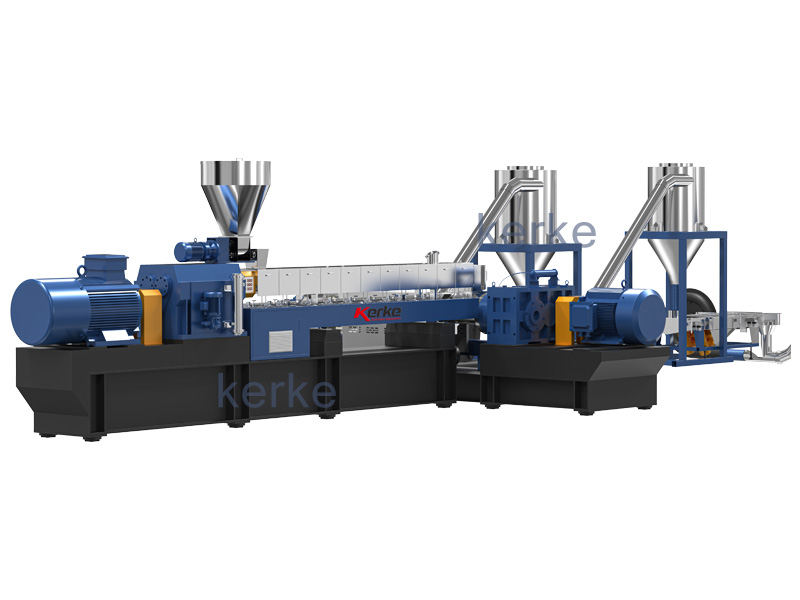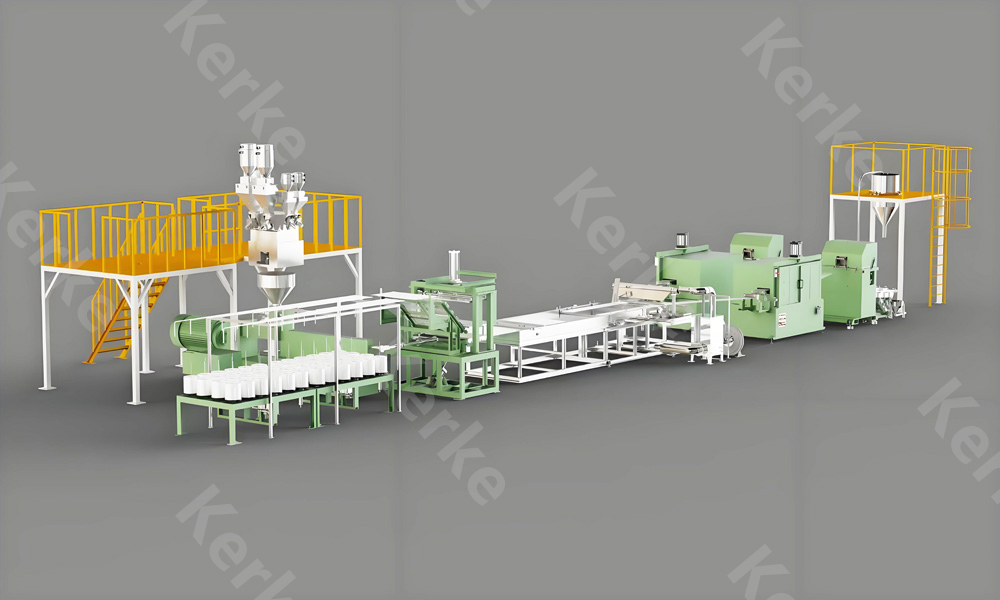
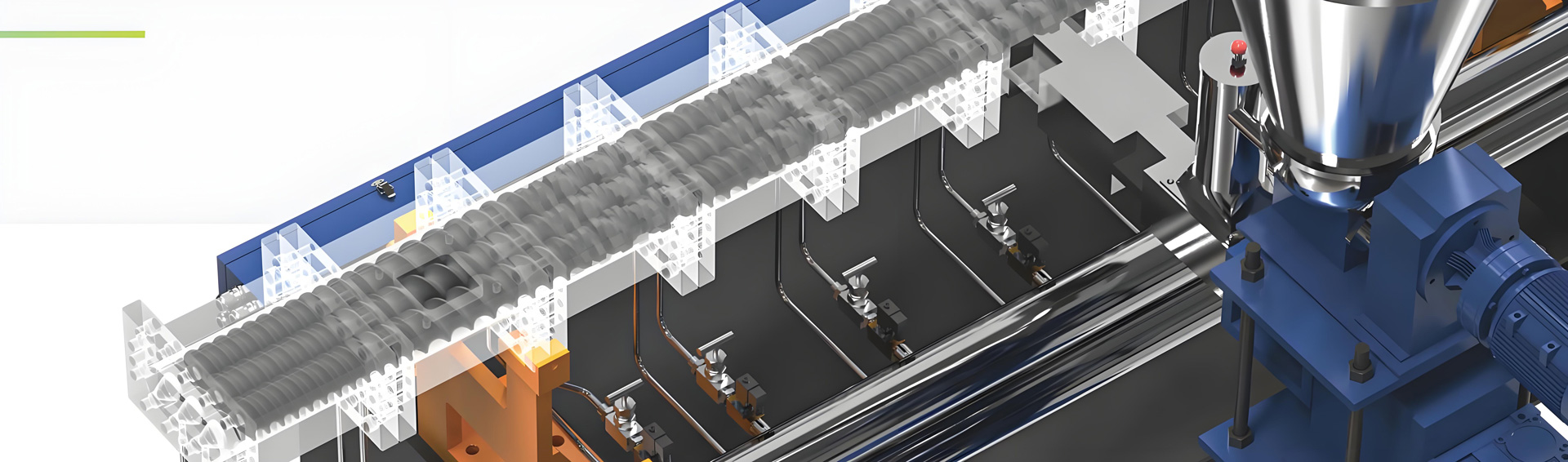
Masterbatch production highly relies on stable and continuous operation of professional extrusion equipment, including twin screw extruders, masterbatch extruders, and compounding extruders. These core processing devices determine the dispersion uniformity, particle quality, and production efficiency of color masterbatch, functional masterbatch, and filler masterbatch. Most manufacturing enterprises focus excessively on equipment price, configuration, and output parameters during procurement, while ignoring the importance of supporting after-sales service systems. In actual long-term production operation, high-quality after-sales service is the core guarantee to reduce equipment failure rate, control maintenance costs, extend equipment service life, and stabilize continuous production.
A complete masterbatch extrusion line is composed of precision mechanical structures, intelligent control systems, high-precision transmission components, and professional auxiliary supporting equipment. After long-term high-load operation, twin screw extruders and compounding extruders will inevitably face component wear, parameter drift, electrical aging, and process matching deviation problems. Without professional and standardized after-sales support, minor equipment faults will evolve into large-scale shutdown failures, resulting in massive material waste, delayed delivery cycles, and increased comprehensive production costs. Choosing a scientific and reliable after-sales service plan for masterbatch extruder equipment has become a key factor in the long-term profitable operation of masterbatch processing enterprises.
KERKE is a professional global manufacturer of high-performance twin screw extruders, masterbatch extruders, and compounding extruders, focusing on equipment R&D, customized production, technical training, and full-cycle after-sales service support. Different from ordinary equipment suppliers that only focus on product sales, KERKE builds a complete whole-life after-sales service system for masterbatch extrusion equipment, covering installation guidance, commissioning debugging, regular maintenance, fault repair, spare parts supply, technical upgrading, and remote after-sales support. This comprehensive guide systematically elaborates the core selection standards, key evaluation dimensions, common service pitfalls, cost-benefit analysis, and practical selection strategies for masterbatch extruder after-sales service, helping enterprises screen high-quality service resources and maximize equipment operation value.
1. Why Professional After-Sales Service Matters for Masterbatch Extruder Equipment
1.1 Unique Structural and Operational Attributes of Masterbatch Extrusion Equipment
Masterbatch extruders, twin screw extruders, and compounding extruders used for masterbatch production have higher precision and stricter process requirements than ordinary plastic granulation equipment. Masterbatch production requires ultra-uniform pigment and filler dispersion, stable melt plasticization, and consistent extrusion pressure, which puts forward higher standards for equipment operation accuracy and parameter stability. The core components such as screw elements, barrel lining, gearbox transmission system, and precision sensors of compounding extruders are vulnerable to wear and parameter deviation under long-term high-filler and high-shear working conditions.
This type of professional extrusion equipment cannot rely on ordinary mechanical maintenance for fault solving and daily maintenance. Unprofessional disassembly, debugging, and maintenance will easily damage the screw combination precision, sensor calibration accuracy, and gearbox matching performance, resulting in permanent equipment performance attenuation, unable to meet the high-precision production requirements of masterbatch products. Professional manufacturer after-sales service is the only way to ensure long-term precision operation of masterbatch extrusion equipment.
1.2 Loss Risks Caused by Inadequate After-Sales Support
Enterprises that choose low-cost or informal after-sales services will face multiple operational risks and invisible losses. First, untimely fault maintenance leads to long-term production shutdown. Once the twin screw extruder has torque overload, strand breakage, uneven plasticization, and electrical system faults, unprofessional maintenance teams cannot quickly locate and solve problems, resulting in days of shutdown loss and delayed customer orders.
Second, non-standard maintenance leads to repeated faults and accelerated equipment aging. Irregular screw cleaning, incorrect parameter debugging, and unqualified accessory replacement will damage the original precision of the masterbatch extruder, resulting in frequent recurrence of quality problems such as uneven masterbatch dispersion and color spots, increasing product rejection rate. Third, informal after-sales channels cannot provide original matching spare parts, and mismatched accessories will cause equipment operation jitter, increased wear, and shortened service life of core equipment.
Fourth, lack of professional technical upgrading and process optimization services makes it impossible for enterprises to adapt to new masterbatch formula production and market demand changes, resulting in backward production technology and reduced market competitiveness.
1.3 Value Advantages of Standardized Full-Cycle After-Sales Service
High-quality manufacturer after-sales service can bring multi-dimensional economic and operational value to masterbatch production enterprises. Standardized regular maintenance can reduce the equipment failure rate of twin screw extruders and compounding extruders by more than 85%, effectively avoiding shutdown losses caused by sudden faults. Professional parameter calibration and process optimization services can maintain the optimal production state of the masterbatch extruder, improve product qualification rate by 3% to 8%, and reduce raw material waste.
Original factory spare parts replacement and professional component maintenance can extend the service life of core equipment by 15% to 20%, reducing the frequency of large-scale equipment replacement and long-term investment costs. In addition, manufacturer exclusive technical training and new process guidance can help enterprises expand product categories, optimize production efficiency, and obtain continuous technical dividends in market competition.
2. Core Service Contents of Standard Masterbatch Extruder After-Sales System
Before selecting after-sales service providers and service packages, enterprises need to clarify the complete service content of standardized masterbatch extruder after-sales system, so as to avoid missing core service items and choosing incomplete service plans. A complete after-sales system for twin screw extruders, masterbatch extruders, and compounding extruders covers the whole life cycle of equipment from installation and commissioning, operational maintenance, fault repair, spare parts guarantee, technical support to equipment upgrading.
2.1 On-Site Installation and Commissioning Service
Professional after-sales service starts from equipment arrival and deployment. Regular manufacturers provide full on-site installation guidance and standardized commissioning services. Professional engineers complete equipment positioning calibration, pipeline connection, electrical debugging, no-load operation test, and material trial production commissioning according to masterbatch production characteristics. For masterbatch extruders and compounding extruders specially used for high-dispersion masterbatch production, engineers will conduct targeted process parameter debugging according to customer conventional production formulas to ensure that the equipment meets the production standards of color masterbatch, functional masterbatch, and filler masterbatch.
Informal after-sales teams often only complete simple equipment assembly without professional process commissioning, resulting in equipment operation from the factory with hidden quality risks, unable to exert the optimal production performance of masterbatch extrusion equipment.
2.2 Regular Inspection and Preventive Maintenance Service
Preventive maintenance is the most valuable core item of extrusion equipment after-sales service, which can eliminate potential faults in advance. Standard after-sales service includes regular quarterly and annual full-line inspection of twin screw extruders and masterbatch extrusion lines. The inspection contents cover screw wear detection, barrel internal condition inspection, gearbox oil quality detection, electrical sensor calibration, transmission system stability test, and process parameter matching verification.
For high-load masterbatch production equipment with long-term operation, the after-sales team will conduct targeted anti-wear maintenance, residual carbon cleaning, and parameter optimization to avoid torque overload, uneven plasticization, and strand instability faults caused by long-term operation. KERKE’s exclusive preventive maintenance service can effectively reduce the probability of sudden equipment shutdown and is very suitable for continuous batch production of masterbatch enterprises.
2.3 Rapid Fault Diagnosis and Repair Service
Timely fault response and efficient repair are the most concerned service items for production enterprises. Standard after-sales service systems include remote real-time fault diagnosis and on-site emergency repair dual mechanisms. For common faults such as parameter drift, minor electrical faults, and simple material jamming of masterbatch extruders, professional engineers can complete remote diagnosis and guidance repair within 1 to 2 hours.
For complex mechanical faults such as gearbox abnormality, screw wear, and electrical system failure of twin screw compounding extruders, the after-sales team provides on-site door-to-door repair service within the specified time limit to minimize production shutdown time. Regular manufacturers have standardized fault processing processes and complete fault databases, which can accurately locate problems and solve them one-time, avoiding repeated repairs.
2.4 Original Spare Parts Supply and Replacement Service
The precision matching of spare parts directly determines the operation stability of masterbatch extrusion equipment. Standard after-sales service provides long-term supply of original factory supporting spare parts, including screw elements, barrel liners, pelletizing blades, sensors, sealing parts, and gearbox accessories. All spare parts are produced according to the original equipment precision standards, with consistent size, material, and performance, ensuring no matching deviation after replacement.
Informal after-sales channels mostly provide generic low-cost accessories, which have problems such as poor wear resistance, low precision, and inconsistent size. After replacement, they will cause increased equipment vibration, unstable extrusion pressure, uneven masterbatch dispersion, and accelerated component wear, bringing long-term hidden dangers to production.
2.5 Professional Technical Training and Process Guidance
Excellent after-sales service is not limited to equipment maintenance, but also includes continuous technical empowerment. Standard after-sales systems provide free operator and maintenance personnel training, covering equipment standard startup and shutdown procedures, daily maintenance methods, conventional fault judgment and solution, and parameter adjustment skills for different masterbatch formulas.
At the same time, professional manufacturers provide regular new process and new formula technical guidance, helping enterprises optimize existing masterbatch production processes, improve product dispersion quality, and develop new functional masterbatch products. This technical service can effectively improve the comprehensive production capacity and market competitiveness of enterprises.
2.6 Equipment Upgrading and Technical Iteration Service
With the continuous upgrading of masterbatch production technology and market demand, old equipment may gradually fail to meet new production standards. High-quality after-sales service includes equipment partial upgrading and technical iteration services, such as screw combination optimization, intelligent control system upgrading, high-precision sensor replacement, and energy-saving transformation of twin screw extruders.
This service can help enterprises upgrade equipment performance at a low cost, adapt to new formula production and high-standard product requirements, and avoid the huge investment loss caused by direct elimination of old equipment, effectively extending the economic service life of extrusion equipment.
3. Key Evaluation Dimensions for Selecting Masterbatch Extruder After-Sales Service
In the face of various after-sales service providers and service packages in the market, enterprises need to conduct comprehensive evaluation from multiple dimensions to screen out reliable and cost-effective after-sales solutions. The core evaluation indicators include service response speed, professional technical capability, service coverage cycle, spare parts guarantee capability, service cost performance, and brand after-sales reputation.
3.1 Service Response Speed and Emergency Processing Capability
For masterbatch enterprises with continuous production, the response speed of after-sales service directly determines the loss size of equipment shutdown. When evaluating after-sales services, enterprises must focus on the remote response time and on-site emergency repair cycle of the service team. Excellent after-sales providers can realize remote fault diagnosis response within 1 hour and solve 80% of conventional minor faults through remote guidance.
For complex faults requiring on-site processing, professional manufacturers have regional service outlets, which can arrange engineers to arrive at the site within 24 to 48 hours. Some small-scale informal after-sales teams have no fixed service outlets and professional engineer teams, with slow response speed and indefinite processing cycle, which will lead to long-term shutdown of masterbatch extrusion lines and huge economic losses.
3.2 Professional Technical Team and Industry Experience
Masterbatch extruders, twin screw extruders, and compounding extruders are professional precision processing equipment, and their maintenance and debugging work have strong industry particularity. Ordinary mechanical maintenance personnel do not understand the masterbatch production process and equipment parameter matching logic, and cannot complete professional fault repair and process optimization.
High-quality after-sales teams are composed of professional engineers with long-term extrusion equipment industry experience, who are familiar with the structural characteristics of masterbatch extrusion lines, common fault mechanisms, and process parameter matching standards of different masterbatch formulas. They can not only solve equipment mechanical faults, but also optimize production parameters for enterprises to improve product quality and production efficiency. When selecting after-sales service, enterprises must verify the team's industry experience and professional technical level, rather than blindly choosing low-price general maintenance services.
3.3 Service Cycle Coverage and Long-Term Stability
Masterbatch extrusion equipment has a service life of more than 10 years, and enterprises need long-term stable after-sales support rather than short-term temporary services. Regular brand manufacturers provide whole-life cycle after-sales service guarantee, including free warranty service within the warranty period and paid preferential service after the warranty period, with stable service system and sustainable technical support.
Some small trading companies and informal service teams have unstable operation status and no long-term service guarantee capability. Once the team is dissolved or the company closes, enterprises will face the dilemma of no after-sales support and no spare parts supply, resulting in equipment paralysis that cannot be repaired. Therefore, long-term service stability is one of the core indicators for selecting after-sales service.
3.4 Original Spare Parts Supply Capability and Inventory Guarantee
Spare parts supply capability is an important hard indicator of after-sales service level. Professional manufacturers have complete spare parts warehouses and standardized inventory management systems, with sufficient stock of conventional vulnerable parts of masterbatch extruders and twin screw compounding extruders, which can realize rapid replacement and supply without delaying production.
At the same time, regular manufacturers strictly control the quality of spare parts, all of which are original factory customized accessories matching the equipment, ensuring the precision and stability of equipment operation. Informal service providers have no stable spare parts supply channels, often adopt generic accessories or refurbished parts, with uneven quality, which will cause secondary damage to the equipment and increase long-term maintenance costs.
3.5 Service Transparency and Standardized Charging Mechanism
High-quality after-sales service has transparent service items, standardized service processes, and clear charging standards. Regular manufacturers will formulate detailed service quotation lists according to maintenance projects, accessory types, and service cycles, with no hidden charges and arbitrary pricing behaviors. Enterprises can clearly understand the service content and cost composition, which is convenient for later operation cost budgeting and management.
Many informal after-sales teams have opaque charging standards, often arbitrarily increase service fees and accessory prices in the process of maintenance, resulting in excessive maintenance costs for enterprises. Some will deliberately exaggerate equipment faults to induce enterprises to replace unnecessary accessories, bringing additional economic losses.
3.6 Brand After-Sales Reputation and User Word-of-Mouth
Brand reputation and real user word-of-mouth are the most intuitive reflection of after-sales service quality. When selecting after-sales service providers, enterprises can refer to the service evaluation and operation feedback of peer masterbatch enterprises, focusing on understanding the provider's fault processing efficiency, service attitude, spare parts quality, and long-term service stability.
Professional brands with good market reputation have standardized service systems and perfect after-sales mechanisms, and will take the initiative to optimize service processes according to user needs. KERKE has accumulated a large number of positive user evaluations in the global masterbatch extrusion equipment market by virtue of efficient response, professional technology, and transparent service, becoming a reliable after-sales service provider for masterbatch production enterprises.
4. Common After-Sales Service Pitfalls to Avoid
In the process of selecting after-sales service for masterbatch extruder equipment, many enterprises are prone to fall into low-price temptation and informal service traps, resulting in increased comprehensive costs and equipment performance loss. This chapter sorts out the most common after-sales pitfalls in the industry and corresponding avoidance strategies.
4.1 Blind Pursuit of Low-Price After-Sales Services
Many enterprises take low price as the primary selection standard for after-sales service, ignoring the difference in service professionalism and spare parts quality. The low-price after-sales service of informal teams seems to save short-term maintenance costs, but it will bring huge hidden losses. Unprofessional maintenance leads to repeated equipment faults, increased product rejection rate, accelerated component wear, and shortened equipment service life, and the comprehensive hidden loss is far higher than the saved service cost.
Enterprises should take cost performance and service quality as the core selection standards, and rationally view the service price difference. High-quality standardized after-sales service can effectively control long-term comprehensive operating costs and create stable production benefits.
4.2 Confusing General Mechanical Maintenance with Professional Extrusion Equipment After-Sales
Some enterprises choose ordinary mechanical maintenance teams to maintain masterbatch extruders and twin screw compounding extruders, mistakenly believing that general mechanical maintenance can meet equipment operation needs. In fact, masterbatch extrusion equipment involves professional plastic extrusion technology, material shearing principle, and precision parameter matching, which is completely different from ordinary mechanical equipment maintenance.
General maintenance personnel cannot accurately calibrate extrusion parameters, optimize screw shear matching, and solve process-related equipment faults, which will easily lead to equipment performance degradation and unqualified masterbatch product quality. Enterprises must choose professional after-sales teams focusing on extrusion equipment industry rather than general maintenance teams.
4.3 Ignoring Preventive Maintenance and Only Solving Faults Passively
Most enterprises only carry out maintenance when equipment faults occur, ignoring the importance of daily preventive maintenance after-sales service. Passive fault repair can only solve existing problems, but cannot eliminate potential hidden dangers. Lack of regular inspection and maintenance will lead to continuous accumulation of equipment wear and parameter drift, resulting in frequent sudden faults in the peak production period, seriously affecting production progress.
Enterprises should take the initiative to purchase standardized preventive maintenance after-sales packages, regularly inspect and optimize equipment performance, eliminate hidden dangers in advance, and realize stable and low-fault operation of masterbatch extrusion lines.
4.4 Accepting Non-Original Generic Spare Parts Replacement
To reduce service costs, some informal after-sales teams replace original factory accessories with low-cost generic accessories, without informing the enterprise of the difference in accessory performance. After the replacement of non-original accessories, the matching precision of twin screw extruders and masterbatch extruders decreases, resulting in unstable extrusion pressure, uneven material plasticization, and increased equipment vibration, which not only affects product quality but also accelerates the wear of surrounding core components.
Enterprises must clearly require after-sales service providers to use original factory matching spare parts, and check the accessory model and quality after replacement to ensure consistent equipment performance.
5. KERKE Professional After-Sales Service System for Masterbatch Extrusion Equipment
As a professional manufacturer of twin screw extruders, masterbatch extruders, and compounding extruders, KERKE builds a full-life-cycle, one-stop after-sales service system tailored for masterbatch production characteristics, solving various after-sales pain points such as slow response, unprofessional maintenance, and unstable spare parts supply in the industry. KERKE after-sales service covers all models of masterbatch extrusion lines, providing customized service schemes for small-batch test production, medium-scale mass production, and large-scale high-output production scenarios.
5.1 Full-Cycle Warranty and Flexible Service Modes
All KERKE masterbatch extruders, twin screw compounding extruders, and full-set extrusion lines enjoy a one-year full-machine free warranty service and lifelong preferential maintenance service. During the warranty period, all equipment quality problems and non-human damage faults are repaired free of charge, including free replacement of faulty accessories and free on-site debugging services. After the warranty period, enterprises can choose monthly, quarterly, and annual customized maintenance packages according to production scale and equipment operating conditions, with flexible service modes and transparent charging standards.
5.2 Efficient Dual Response Mechanism of Remote and On-Site Service
KERKE builds a global after-sales service network and realizes 24-hour online remote technical support. Professional extrusion equipment engineers provide real-time fault diagnosis, parameter guidance, and operation technical consultation all year round, solving 90% of conventional equipment operation problems remotely. For complex mechanical and electrical faults that require on-site processing, KERKE has regional service outlets, which can quickly arrange professional engineers to arrive at the site for emergency repair, greatly shortening the equipment shutdown cycle.
5.3 Original Spare Parts Global Inventory Guarantee
KERKE has large-scale spare parts warehouses, stocking all conventional vulnerable parts and core accessories of masterbatch extruders and twin screw compounding extruders. All spare parts are produced in strict accordance with the original equipment precision standards, with stable performance and perfect matching. The global unified spare parts supply system ensures that users can obtain original factory accessories in a timely manner, avoiding production delay and equipment performance loss caused by mismatched accessories.
5.4 Exclusive Technical Upgrading and Process Optimization Service
Different from conventional after-sales maintenance services, KERKE provides free regular process optimization and equipment performance upgrading suggestions for users. According to the latest masterbatch production technology and market product demand, the after-sales team optimizes equipment screw combination, temperature parameters, and control programs for users, helping enterprises improve masterbatch dispersion quality, increase production capacity, and reduce energy consumption. For old equipment users, targeted partial upgrading schemes are provided to maximize the service value of old equipment.
5.5 Free Long-Term Technical Training Support
KERKE provides lifelong free technical training services for all users, including pre-job training for new employees, regular skill improvement training, and new process formula training. The training content is tailored to the actual production of masterbatch enterprises, covering equipment standardized operation, daily maintenance skills, common fault judgment and solution, and high-dispersion masterbatch production process optimization, helping enterprises build professional operation and maintenance teams.
6. After-Sales Service Cost and Comprehensive Benefit Analysis
Enterprises need to balance after-sales service investment and production benefits, clarify the cost composition of different after-sales service schemes, and select the most cost-effective service mode according to their own production scale and equipment status. This chapter provides detailed after-sales service price estimation and comprehensive benefit accounting for masterbatch extruder equipment.
6.1 Market Price Range of Conventional After-Sales Services
The cost of after-sales service for masterbatch extrusion lines is affected by equipment model, production scale, service cycle, and service content. The market price of quarterly regular preventive maintenance service for medium-sized masterbatch twin screw extruder production lines is 350 US dollars to 550 US dollars per time, covering full-line inspection, parameter calibration, equipment cleaning, and minor fault repair.
The annual full-cycle after-sales service package including regular maintenance, emergency repair priority, and spare parts discount has a market price of 1200 US dollars to 1800 US dollars per year. The on-site emergency repair service fee for complex faults is 200 US dollars to 400 US dollars per time, excluding special large-scale accessory replacement costs. The service price of informal general maintenance teams is 30% to 50% lower than that of professional brand services, but there are huge hidden quality risks.
6.2 KERKE After-Sales Service Price Advantage
Compared with the market average price, KERKE after-sales service has obvious cost performance advantages. For users who purchase KERKE masterbatch extruders and compounding extruders, the free warranty service covers all core maintenance items in the early stage of equipment operation, with zero after-sales maintenance cost within one year. After the warranty period, KERKE provides exclusive preferential service packages for old users, with the annual package price 15% to 20% lower than the market average, and includes more technical training and process optimization services than ordinary service packages.
At the same time, KERKE old users enjoy a long-term 10% to 15% discount on original spare parts purchase, effectively reducing the daily vulnerable parts replacement cost of enterprises.
6.3 Hidden Loss Cost of Inferior After-Sales Service
Enterprises that choose low-cost inferior after-sales services will produce huge invisible losses every year. Unprofessional maintenance leads to an average increase of 4% to 7% in product rejection rate, resulting in a large amount of raw material waste. Repeated equipment faults lead to 5% to 10% reduction in annual effective production time, affecting output and order delivery.
Non-original accessory replacement and irregular maintenance accelerate equipment wear, reducing the service life of twin screw extruders and masterbatch extruders by more than 15%, making enterprises face advanced equipment replacement investment. The comprehensive annual hidden loss caused by inferior after-sales service far exceeds the saved service cost, resulting in serious cost inversion.
6.4 Investment Payback and Long-Term Benefit Analysis
Enterprises purchasing professional brand standardized after-sales service can recover the service investment cost within 3 to 5 months through reduced material waste, reduced shutdown losses, and improved production efficiency. In the long run, high-quality after-sales service can maintain the long-term stable operation of masterbatch extrusion equipment, maximize equipment output and product qualification rate, and extend equipment service life, bringing continuous stable economic benefits to enterprises.
The standardized after-sales service system of KERKE can help enterprises reduce comprehensive production and maintenance costs by 8% to 12% every year, effectively improving the overall profit margin of masterbatch production business.
7. Step-by-Step Guide to Selecting Suitable After-Sales Service Solutions
Combined with the above evaluation standards, cost analysis, and pitfall avoidance strategies, this chapter summarizes a set of practical step-by-step selection methods, helping enterprises quickly screen and match the most suitable after-sales service scheme according to their own equipment status and production scale.
7.1 Confirm Equipment Model and Production Demand Attributes
First, clarify the equipment type, model, service life, and daily production attributes. For new masterbatch extruders and twin screw compounding extruders within the warranty period, give priority to enjoying the manufacturer's free warranty service, and make full use of free installation debugging, technical training, and fault repair services. For old equipment with more than 3 years of service life and increased wear probability, it is necessary to purchase regular preventive maintenance after-sales packages to strengthen equipment performance monitoring and maintenance.
For high-output continuous production enterprises with high equipment operation frequency, choose full-cycle all-inclusive after-sales service packages to ensure 24-hour emergency response capability. For small-batch intermittent production enterprises, flexible single maintenance and quarterly inspection services can be selected to control service costs.
7.2 Verify Service Provider Qualification and Professional Capability
Screen service providers with formal manufacturer qualification and professional extrusion equipment after-sales experience, eliminate general mechanical maintenance teams and unqualified small workshops. Focus on verifying the provider's after-sales team scale, engineer industry experience, spare parts warehouse scale, and service network coverage, ensuring that the provider has long-term stable service capability.
7.3 Compare Service Content, Charging Standards and Cost Performance
Collect multiple service schemes for horizontal comparison, sort out the service items included in each package, charging standards, and preferential policies, and avoid overpaying for redundant services or missing core maintenance items. Prioritize service schemes including preventive inspection, remote technical support, original spare parts guarantee, and technical training, and select the optimal cost-performance scheme combining service quality and price.
7.4 Sign Standard Service Agreements to Clarify Rights and Obligations
After determining the service provider and service scheme, sign a formal after-sales service agreement, clearly stipulating service response time, service cycle, maintenance content, spare parts quality standards, charging items, and after-sales liability clauses. Standardize service cooperation procedures, avoid oral agreements and ambiguous terms, and effectively protect the legitimate rights and interests of enterprises.
8. Daily After-Sales Cooperation and Maintenance Management Suggestions
After selecting a high-quality after-sales service provider, standardized daily cooperation and internal equipment management can further amplify the value of after-sales service and ensure long-term stable operation of masterbatch extrusion equipment. Enterprises need to establish a perfect equipment operation and maintenance management system to cooperate with professional after-sales services.
Establish complete equipment operation records, record daily operation parameters, fault conditions, and maintenance records of twin screw extruders and masterbatch extruders, providing accurate data support for after-sales engineers' inspection and optimization. Arrange special personnel to be responsible for docking with after-sales teams, timely feeding back equipment abnormal conditions, and cooperating with regular maintenance and fault repair work.
Organize operators to participate in after-sales technical training regularly, improve the team's independent operation and daily maintenance capabilities, reduce the probability of human-induced equipment faults, and form a management mode combining daily self-maintenance and professional manufacturer after-sales maintenance.
9. Conclusion
The selection of after-sales service for masterbatch extruder equipment is a key link related to the long-term operational benefits of masterbatch production enterprises. High-quality professional after-sales service can effectively reduce the failure rate of twin screw extruders, masterbatch extruders, and compounding extruders, stabilize product quality, control comprehensive production costs, and extend equipment service life. Blind pursuit of low-price informal services will bring continuous hidden losses such as repeated faults, unqualified products, and accelerated equipment aging.
As a professional global manufacturer of masterbatch extrusion equipment, KERKE relies on a complete full-cycle after-sales service system, professional technical team, efficient response mechanism, and original spare parts guarantee to provide reliable after-sales support for global users. Scientific selection of matching after-sales service schemes and standardized daily equipment management can maximize the operation value of masterbatch extrusion equipment, help enterprises maintain stable production advantages in the competitive market, and create long-term and stable economic benefits.