Masterbatch production relies entirely on high-precision extrusion equipment to achieve uniform pigment dispersion, stable resin plasticization, and consistent particle molding. A complete masterbatch extrusion line centered on twin screw extruders, compounding extruders, and professional masterbatch extruders is the core equipment for manufacturing color masterbatch, functional masterbatch, filler masterbatch, and modified plastic masterbatch products. The installation and commissioning process of a new masterbatch extrusion line directly determines subsequent production stability, product qualification rate, equipment service life, and long-term operating costs. Unstandardized installation and incomplete commissioning are the main causes of common production faults such as uneven color dispersion, particle unevenness, equipment vibration, high torque alarm, and frequent shutdowns in later mass production.
Many plastic processing enterprises and masterbatch manufacturers often ignore standardized installation and commissioning specifications when purchasing new extrusion lines, blindly starting mass production after simple equipment assembly, resulting in long-term unstable product quality, low production efficiency, and increased equipment failure rates. Professional and standardized full-process installation and scientific commissioning can maximize the performance of twin screw extruders, masterbatch extruders, and compounding extruders, eliminate potential equipment faults in advance, and lay a solid foundation for long-term high-efficiency and low-fault production.
KERKE is a professional global manufacturer of high-performance masterbatch extrusion equipment, focusing on the R&D, customized manufacturing, on-site installation guidance, and one-stop commissioning services of twin screw extruders, compounding extruders, and full-set masterbatch production lines. KERKE masterbatch extrusion lines are specially optimized for the high dispersion and high uniformity production requirements of masterbatch products, with stable mechanical structure, intelligent control system, and wide material adaptability. This comprehensive guide systematically sorts out the full-step installation process, standardized commissioning procedures, fault debugging solutions, acceptance standards, and project cost analysis of new masterbatch extrusion lines, covering all key links from pre-installation preparation to formal production handover, providing professional operational guidance for enterprise equipment deployment.
1. Overview of Masterbatch Extrusion Line Composition and Working Characteristics
1.1 Core Equipment Composition of Masterbatch Production Line
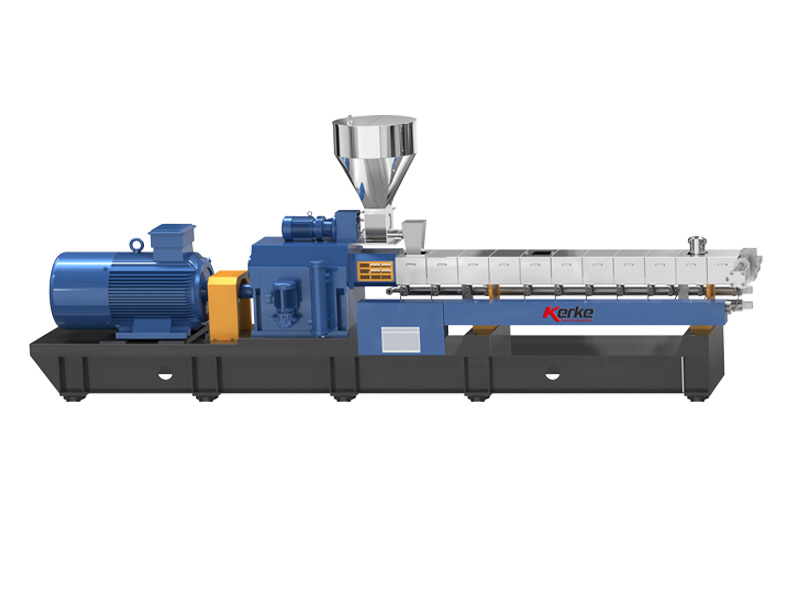
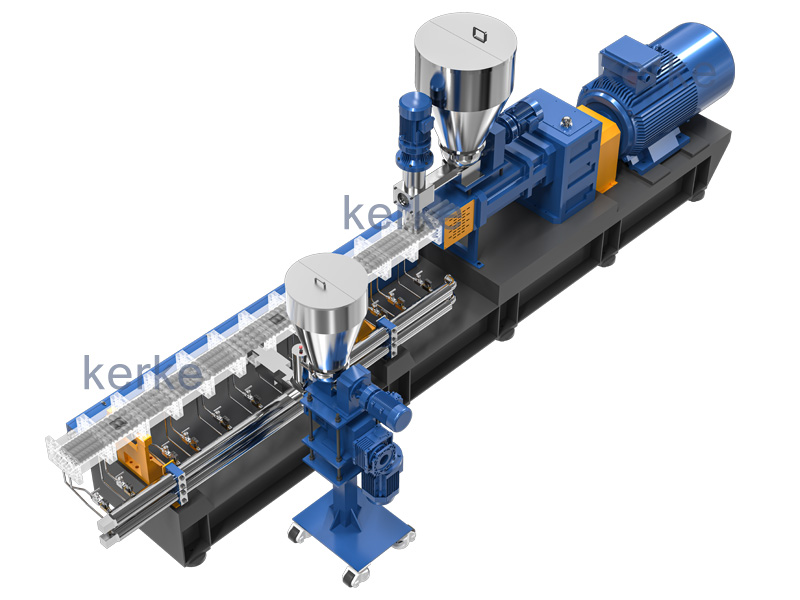
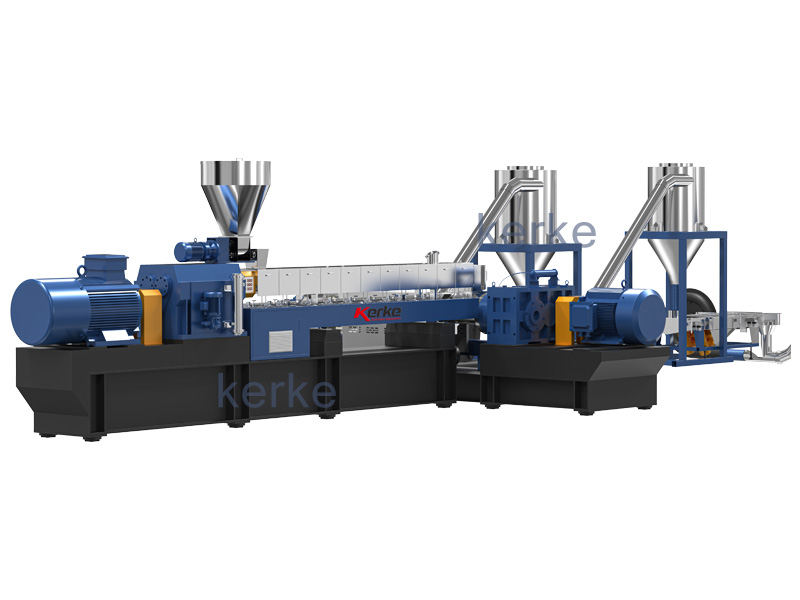
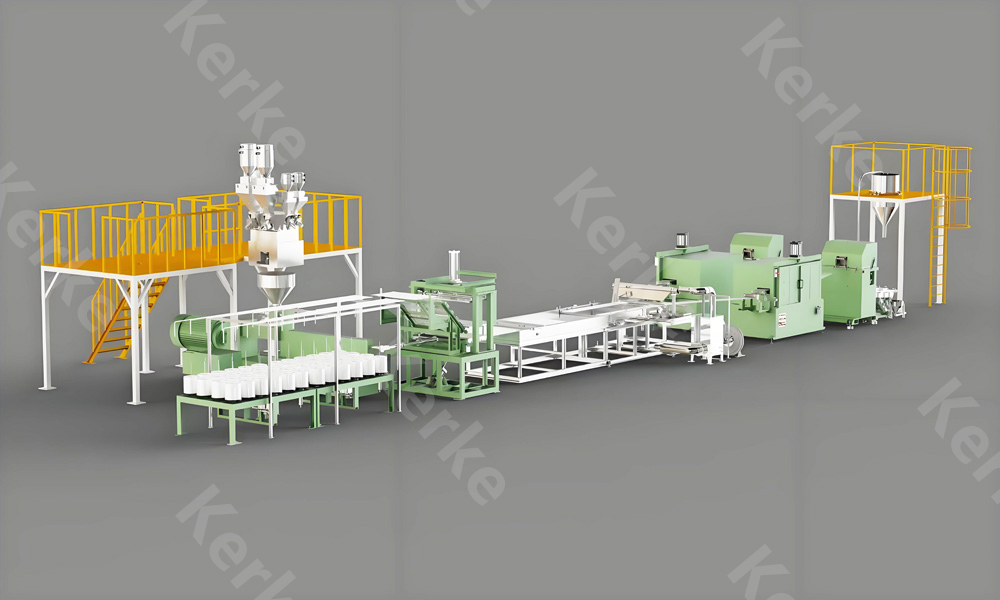
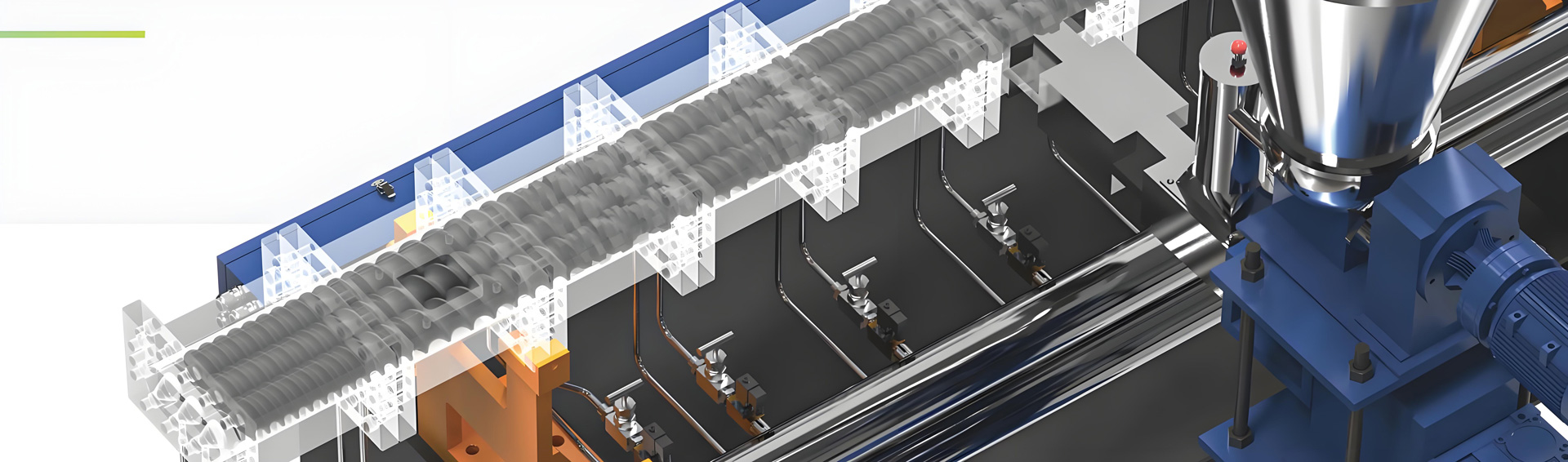
A complete industrial-grade masterbatch extrusion line is a fully automated integrated production system with complete upstream and downstream supporting equipment, mainly composed of core host equipment and auxiliary supporting systems. The core host adopts KERKE professional masterbatch extruder, twin screw compounding extruder, which undertakes the core processes of material mixing, shearing, plasticization, and extrusion molding. Different from ordinary single screw extruders, twin screw compounding extruders have stronger shearing and dispersion capabilities, which can fully disperse high-concentration pigments, fillers, and functional additives in resin substrates, meeting the high uniformity production requirements of masterbatch products.
The supporting auxiliary equipment includes automatic batching and mixing system, vacuum feeding system, water cooling and air cooling system, strand pelletizing system, vibration screening system, finished product drying and packaging system, and intelligent electrical control system. All equipment modules are matched and linked to realize automatic continuous production from raw material feeding to finished masterbatch packaging. Each equipment link has strict installation and debugging standards, and the coordination accuracy between systems directly affects the overall production performance of the extrusion line.
1.2 Special Production Requirements for Masterbatch Extrusion Equipment
Masterbatch production has stricter technical requirements than ordinary plastic granulation production, putting forward higher standards for equipment installation and commissioning. First, masterbatch requires ultra-high dispersion uniformity of pigments and fillers, which demands precise debugging of screw rotating speed, shearing gap, and melt pressure of twin screw extruders to avoid color spots and uneven dispersion. Second, masterbatch products have high requirements for particle consistency, requiring stable equipment operation, uniform extrusion discharge, and matching pelletizing speed.
Third, functional masterbatch such as flame retardant, anti-static, and weather-resistant masterbatch has sensitive formula characteristics, requiring accurate temperature control and parameter calibration of the compounding extruder to prevent additive decomposition and performance attenuation. Therefore, the installation and commissioning of masterbatch extrusion lines cannot adopt ordinary plastic granulation equipment standards, and must follow professional customized specifications for masterbatch production.
1.3 Importance of Standard Installation and Commissioning
Standardized installation ensures the stable mechanical structure and accurate operation benchmark of the masterbatch extruder, twin screw extruder, and compounding extruder, avoiding equipment vibration, component deviation, and transmission jitter caused by uneven installation. Scientific and comprehensive commissioning can verify the matching performance of each equipment module, optimize production parameters, eliminate potential faults such as material jamming, uneven plasticization, and unstable discharge, and ensure that the equipment reaches the optimal production state.
Enterprises that strictly implement standardized installation and commissioning can increase the product qualification rate of masterbatch production by more than 5%, reduce equipment failure rate by 80%, extend the service life of core equipment by 15% to 20%, and effectively reduce long-term production and maintenance costs, bringing stable economic benefits to enterprises.
2. Pre-Installation Preparation Work and Site Standard Requirements
Adequate pre-installation preparation is the premise of smooth equipment installation and qualified commissioning. Before the arrival of KERKE masterbatch extrusion line equipment, enterprises need to complete site transformation, power matching, facility layout, and tool preparation in accordance with official equipment specifications, avoiding installation delays and unqualified installation quality caused by inadequate preparation.
2.1 Workshop Site and Foundation Construction Standards
The masterbatch extrusion line covers a continuous production area, and the workshop site needs to meet strict load-bearing, flatness, and space requirements. The ground bearing capacity of the equipment installation area must reach more than 3 tons per square meter to bear the long-term operating weight of the twin screw compounding extruder and auxiliary equipment, avoiding ground settlement and equipment tilt. The ground flatness error of the installation foundation shall not exceed 3mm per square meter, ensuring the horizontal installation benchmark of the host equipment.
In terms of space layout, a maintenance channel of more than 1.5 meters shall be reserved around the extrusion line to facilitate subsequent equipment overhaul, component replacement, and daily cleaning. The height of the workshop shall not be less than 4.5 meters to meet the installation and maintenance requirements of upper feeding, pelletizing, and cooling systems. The workshop needs to be equipped with good ventilation and dust removal facilities to adapt to the dust pollution generated by masterbatch filler processing and ensure a clean production environment.
2.2 Power, Water and Gas Supporting Configuration
The power configuration must match the total power of the full masterbatch extrusion line. KERKE conventional masterbatch twin screw extruder production lines have a total supporting power of 120KW to 380KW, requiring stable three-phase industrial power supply with voltage fluctuation controlled within ±5%. Independent power distribution cabinets and leakage protection devices need to be configured to avoid equipment parameter deviation and electrical faults caused by voltage instability.
In terms of water supply, the cooling system needs to be equipped with circulating cooling water equipment, with stable water pressure and clean water quality, to meet the cooling and shaping requirements of the extruder barrel, die, and strand. The gas supply system needs to provide stable compressed air for the pneumatic feeding and adjusting components of the equipment, with air pressure stabilized at 0.6MPa to 0.8MPa, and equipped with oil-water filtration devices to ensure clean gas source.
2.3 Equipment Inspection and Tool Preparation Before Arrival
After the equipment arrives at the factory, the staff shall check the equipment packaging, accessories, spare parts, and technical documents one by one in accordance with the packing list. Focus on inspecting the screw, barrel, gearbox, electrical control cabinet, and precision accessories of the masterbatch extruder and compounding extruder to confirm no transportation damage, missing parts, and component deformation. Sort and store spare parts, tools, and wearing parts uniformly to avoid loss and confusion.
Prepare professional installation tools including level gauges, torque wrenches, vernier calipers, lifting equipment, and cleaning tools in advance, and arrange professional installation and operation personnel to receive pre-job technical training to ensure that the installation personnel are familiar with the equipment structure and installation specifications.
2.4 Pre-Installation Safety Preparation
Isolate the equipment installation area, set up safety warning signs, and prohibit irrelevant personnel from entering the construction area. Check the safety performance of lifting equipment and electrical tools to eliminate construction safety hidden dangers. Formulate targeted installation safety operation specifications to standardize the operation behavior of construction personnel and ensure zero safety accidents during the installation process.
3. Full Process Standard Installation Steps of Masterbatch Extrusion Line
The installation of the masterbatch extrusion line follows the principle of "host first, auxiliary later, overall positioning, and fine calibration". The whole process is divided into host installation, auxiliary equipment assembly, pipeline connection, electrical system wiring, and overall fixed calibration. Each link has strict standardized operation requirements to ensure installation accuracy and structural stability.
3.1 Host Equipment Positioning and Installation
The twin screw extruder and masterbatch compounding extruder are the core hosts of the production line, and their installation accuracy determines the overall operation stability of the equipment. First, use professional lifting equipment to stably lift the host equipment and place it on the pre-built foundation, initially adjust the horizontal position and front-rear spacing of the equipment. Use a high-precision level gauge to calibrate the horizontal degree of the host fuselage, adjust the foundation bolts to ensure that the horizontal error of the fuselage is controlled within 0.5mm per meter, avoiding equipment tilt and running vibration caused by unlevel installation.
After the horizontal calibration is completed, lock the foundation bolts to fix the host equipment firmly. Check the connection tightness of the gearbox, motor, and fuselage to ensure that all connecting parts are closely fitted without looseness. For the screw and barrel assembly, conduct dust-free protection installation to avoid dust and impurities entering the barrel, ensuring the cleanliness of the core shearing components.
3.2 Auxiliary Equipment Sequential Installation
After the host installation is fixed, install the upstream and downstream auxiliary equipment in sequence according to the production process flow. First, install the automatic batching and mixing unit and vacuum feeding system, calibrate the horizontal position and feeding height of the equipment, ensure the seamless connection between the feeding system and the extruder hopper, and avoid material leakage and feeding instability.
Then install the die head, strand cooling water tank, traction device, pelletizing machine, vibration screening machine, and finished product conveying equipment. Ensure that the center lines of all equipment are on the same horizontal straight line, calibrate the height difference and spacing of each equipment interface, ensure smooth material transmission, and eliminate material accumulation and strand breakage caused by inconsistent equipment alignment.
3.3 Pipeline System Connection and Installation
Complete the laying and connection of cooling water pipeline, vacuum pipeline, compressed air pipeline, and material conveying pipeline. All pipelines are arranged neatly and fixed firmly to avoid looseness and falling off during equipment operation. The cooling water pipeline adopts a sealed connection to prevent water leakage, and the internal pipeline is cleaned to ensure no impurities blockage.
The vacuum pipeline is strictly sealed and tested for air tightness to ensure stable vacuum adsorption effect and avoid unstable feeding caused by air leakage. The material conveying pipeline is polished smoothly inside to prevent residual material adhesion and blockage, ensuring smooth and uniform material conveying.
3.4 Electrical Control System Wiring Installation
Arrange professional electricians to complete the wiring of the electrical control cabinet, host motor, heating system, sensor, and auxiliary equipment. All wiring is carried out in accordance with national electrical safety specifications, with standardized wire arrangement, firm wiring, and complete grounding protection. Distinguish power lines, control lines, and signal lines to avoid signal interference and electrical short circuit faults.
Install and calibrate temperature sensors, pressure sensors, speed sensors, and torque sensors to ensure accurate sensor installation position and sensitive data collection. After wiring is completed, conduct a comprehensive inspection of the electrical circuit to eliminate hidden dangers such as wrong wiring and virtual connection, and lay a foundation for subsequent electrical commissioning.
3.5 Overall Equipment Calibration and Fixation
After all equipment and pipelines are installed, conduct a comprehensive overall calibration of the production line. Recheck the horizontal degree, parallelism, and center line alignment of the host and auxiliary equipment, fine-tune unqualified parts, and lock all fixing bolts uniformly. Conduct overall vibration detection of the equipment to ensure no abnormal structural looseness and vibration hidden dangers.
4. Systematic Commissioning Process of New Masterbatch Extrusion Line
Installation completion only realizes equipment assembly, and systematic and standardized commissioning is the key to activate equipment performance and meet production standards. The commissioning of the masterbatch extrusion line is divided into no-load commissioning, low-load trial commissioning, material trial production commissioning, and parameter optimization commissioning, which are carried out step by step to ensure stable equipment operation and qualified product quality.
4.1 Pre-Commissioning Comprehensive Inspection
Before formal commissioning, conduct a full-line comprehensive inspection. Check whether all mechanical connecting parts are fastened, whether the pipeline connection is sealed and unblocked, whether the electrical circuit is normal, and whether the sensor is installed correctly. Manually rotate the screw and transmission parts of the twin screw extruder to confirm flexible operation without jamming and abnormal resistance.
Check the lubricating oil level and oil quality of the gearbox and transmission bearings, ensure sufficient and qualified lubricating oil, and avoid transmission abrasion during operation. Check the cooling system and air supply system to ensure normal water circulation and stable air pressure.
4.2 No-Load Debugging and Operation Inspection
Power on the equipment for no-load commissioning without adding raw materials. Start the equipment at low speed, run the twin screw extruder, masterbatch extruder, and all auxiliary equipment in no-load state, and continuously observe the equipment operation status. Check whether the motor speed, transmission operation, and electrical control response are normal, whether there is abnormal noise, vibration, and heating of mechanical parts.
Verify the sensitivity and accuracy of the temperature control system, pressure monitoring system, and torque monitoring system, confirm that all data display is normal and the control function is effective. The no-load operation time shall not be less than 2 hours. After confirming that all links operate stably without abnormalities, proceed to the next step of load commissioning.
4.3 Low-Load Material Trial Commissioning
Select conventional universal raw materials for low-load trial production commissioning, avoid high-filler and high-difficulty formula materials in the initial stage, and reduce equipment load risk. Set conventional standard process parameters, start automatic feeding at low speed, and carry out low-load extrusion production. Observe the material plasticization state, extrusion discharge uniformity, and strand stability of the compounding extruder in real time.
Adjust the feeding speed, screw rotating speed, and temperature parameters of each section appropriately to ensure full material plasticization and stable strand discharge. Check the operation coordination of traction, pelletizing, and screening equipment to ensure smooth transmission and molding of the whole process. Low-load commissioning lasts for 4 to 6 hours to verify the overall matching performance of the production line.
4.4 Formal Load Commissioning and Parameter Optimization
On the basis of stable low-load operation, gradually increase the feeding amount and equipment operating speed to carry out full-load formal commissioning. According to the production characteristics of different masterbatch products (color masterbatch, functional masterbatch, filler masterbatch), optimize targeted process parameters, calibrate the optimal temperature interval, screw shear parameters, melt pressure, and traction speed.
Focus on detecting the dispersion uniformity of masterbatch pigments and fillers, particle size consistency, and surface smoothness of finished products. Adjust the screw combination shear strength and formula auxiliary ratio according to the product quality status to eliminate quality defects such as color spots, uneven particles, and rough surfaces. Complete the parameter solidification of different product specifications and form a standardized production parameter database.
4.5 Continuous Operation Stability Commissioning
After the product quality reaches the standard, carry out 24-hour continuous full-load operation commissioning to verify the long-term stability of the equipment. Continuously monitor equipment torque, temperature, pressure, power consumption, and product qualification rate, record operation data, and eliminate intermittent faults and unstable factors in long-term operation. After 24 hours of stable operation without abnormalities and stable qualified product rate, the equipment commissioning is basically completed.
5. Key Commissioning Technical Points for Masterbatch Extrusion Core Equipment
5.1 Twin Screw Compounding Extruder Parameter Debugging
The twin screw compounding extruder is the core equipment determining masterbatch dispersion quality. During commissioning, the screw rotating speed and shear strength must be accurately matched according to different masterbatch formulas. For high-concentration color masterbatch, appropriately increase the screw shear frequency and extend the plasticization time to ensure full pigment dispersion and avoid color agglomeration. For filler masterbatch with high calcium carbonate and talc content, appropriately reduce excessive shear to prevent material overheating decomposition and equipment overload torque alarm.
Calibrate the temperature gradient of each barrel section of the extruder to form a reasonable temperature rise curve from feeding to melting and extrusion, ensuring gradual plasticization of materials, uniform melt viscosity, and stable extrusion pressure. Avoid local overheating leading to material carbonization and local low temperature leading to incomplete plasticization.
5.2 Masterbatch Extruder Die and Strand Debugging
The die gap and temperature uniformity directly affect the strand molding effect of masterbatch. During commissioning, calibrate the die heating uniformity to ensure consistent temperature of each discharge hole, avoid inconsistent strand thickness caused by uneven die temperature. Fine-tune the die gap to ensure uniform discharge of each strand, consistent thickness, and smooth surface.
Debug the matching relationship between strand water tank cooling temperature and traction speed to ensure that the strands are fully cooled and shaped without bending, deformation, and adhesion. Adjust the water tank water level and cooling water flow to form a stable cooling environment and improve strand molding quality.
5.3 Pelletizing and Finishing System Debugging
Debug the pelletizing knife speed and strand traction speed to ensure synchronous operation of the two, realizing uniform length of masterbatch particles and flat incision without burrs. Adjust the gap between the pelletizing knife and the roller to avoid particle crushing and oversized or undersized particles. Debug the vibration screening machine to screen out unqualified particles, powder, and impurities, ensuring uniform particle size of finished masterbatch products.
6. Common Installation and Commissioning Faults and Solutions
6.1 Unstable Equipment Operation and Vibration
Equipment vibration and jitter after installation and commissioning are mostly caused by unlevel ground installation, loose fixing bolts, and inconsistent equipment center line alignment. The solution is to re-calibrate the equipment horizontal level, lock all fixing bolts tightly, adjust the center line of upstream and downstream equipment to be consistent, and eliminate structural vibration hidden dangers. Long-term vibration will lead to loose equipment parts and unstable operation parameters, which must be completely eliminated in the commissioning stage.
6.2 Uneven Masterbatch Dispersion and Color Spots
Uneven pigment dispersion and color spot defects are common commissioning quality problems, caused by unreasonable screw shear parameters, insufficient plasticization temperature, and uneven material mixing. The solution is to optimize the screw combination structure, appropriately increase the shear section, adjust the plasticization temperature parameters, extend the material mixing and plasticization time, and improve the mixing uniformity of the front-end batching system to ensure uniform mixing of raw materials and auxiliary materials.
6.3 Strand Breakage and Unstable Discharge
Frequent strand breakage and intermittent discharge instability are caused by unstable feeding speed, mismatched traction speed, and unreasonable melt pressure. During commissioning, stabilize the automatic feeding speed, calibrate the synchronous matching of extruder discharge speed and traction speed, adjust the melt pressure parameters, and clean the die blockage to ensure continuous and uniform discharge of strands.
6.4 High Torque and Overload Alarm During Operation
High torque alarm of twin screw extruders during commissioning is mainly due to low plasticization temperature, excessive feeding volume, and excessive material viscosity. The solution is to appropriately increase the barrel plasticization temperature, reduce the instantaneous feeding amount, adopt graded feeding and speed increase, optimize the material formula fluidity, and eliminate equipment overload faults.
7. Project Price and Comprehensive Operation Cost Analysis
7.1 KERKE Masterbatch Extrusion Line Price Estimation
KERKE provides full-set customized masterbatch extrusion lines based on different production capacities and configuration standards, including twin screw extruders, masterbatch extruders, and compounding extruders supporting systems. The FOB price of small-capacity laboratory and small-batch masterbatch extrusion lines is 32,000 US dollars to 48,000 US dollars, suitable for formula research and development and small-scale production. The FOB price of medium-capacity conventional industrial masterbatch production lines is 72,000 US dollars to 105,000 US dollars, which is the mainstream cost-effective configuration for mass production of color masterbatch and functional masterbatch.
The FOB price of large high-output full-automatic masterbatch extrusion production lines is 140,000 US dollars to 190,000 US dollars, suitable for large-scale factory standardized intensive production. All equipment prices include factory pre-commissioning, professional on-site installation guidance, full-process commissioning services, technical training, and one-year full-machine warranty, with transparent pricing and no hidden costs.
7.2 Installation and Commissioning Project Cost
The on-site installation and commissioning service cost of a new masterbatch extrusion line is included in the equipment quotation for conventional standard models, and enterprises do not need to pay additional service fees. For special customized models and overseas on-site commissioning projects, the comprehensive service cost is 2,800 US dollars to 5,500 US dollars, including engineer travel, on-site debugging, and technical guidance costs. The workshop foundation transformation and supporting facility construction cost is about 3,000 US dollars to 6,000 US dollars according to the site conditions.
7.3 Daily Operation and Maintenance Cost Analysis
The masterbatch extrusion line installed and debugged in accordance with KERKE standard specifications has extremely low daily operating costs. The monthly equipment maintenance cost including lubricating oil replacement, cleaning, and vulnerable parts inspection is 90 US dollars to 180 US dollars. The annual replacement cost of core vulnerable parts such as screw accessories and pelletizing blades is 500 US dollars to 900 US dollars. Standardized installation and commissioning reduce equipment failure rate by more than 80%, saving a lot of fault maintenance and shutdown loss costs for enterprises every year.
7.4 Investment Benefit and Payback Cycle
After standardized installation and commissioning, the masterbatch extrusion line has stable operation and high product qualification rate, which can increase the effective output by 8% to 12% every year and reduce raw material waste by 4% to 6%. The comprehensive investment payback cycle of the whole equipment project is 7 to 10 months faster than that of equipment with non-standard installation and commissioning. Long-term stable production can continuously improve enterprise production efficiency and product market competitiveness, with significant economic benefits.
8. Final Acceptance Standard and Formal Production Handover Specification
8.1 Equipment Operation Acceptance Standards
After the completion of installation and commissioning, the equipment needs to meet strict acceptance standards: the whole line operates stably without abnormal vibration, noise, and frequent alarms; the temperature control accuracy, pressure control accuracy, and speed control accuracy of the twin screw extruder and masterbatch extruder meet industrial standards; the equipment continuous operation failure rate is lower than 0.5%; all electrical control and safety protection functions are sensitive and effective.
8.2 Product Quality Acceptance Standards
The finished masterbatch products produced by commissioning need to meet high-quality standards: uniform pigment and filler dispersion without color spots and agglomeration; consistent particle size, smooth surface, no powder and debris; stable physical and chemical properties, meeting the production matching requirements of downstream plastic products. The product qualification rate is stable above 99.5% to complete quality acceptance.
8.3 Technical Handover and Operation Training
After the acceptance is qualified, complete the formal project handover, including equipment technical documents, parameter files, operation manuals, and maintenance specifications. KERKE professional engineers provide one-on-one systematic training for enterprise operators and maintenance personnel, covering equipment standard operation, parameter adjustment, daily maintenance, and common fault troubleshooting, ensuring that the enterprise team can independently complete subsequent production operation and equipment maintenance.
9. Daily Maintenance and Operation Precautions After Handover
After the new masterbatch extrusion line is put into formal production, standardized daily maintenance and operation management must be implemented to maintain the optimal commissioning state of the equipment and ensure long-term stable operation. Operators must start and stop the machine in accordance with standardized procedures, strictly prohibit arbitrary adjustment of core process parameters, and avoid equipment parameter disorder and quality fluctuation.
Carry out daily cleaning of the extruder screw, barrel, and die to prevent material carbonization and adhesion; conduct regular calibration of sensors and control systems to ensure accurate data monitoring; implement regular lubrication and overhaul of transmission components to reduce equipment wear. Establish complete equipment operation and maintenance records to realize traceable equipment management.
10. Conclusion
The installation and commissioning of a new masterbatch extrusion line are systematic and professional engineering work, which runs through the whole process from site preparation, equipment assembly, systematic debugging to acceptance handover. Standardized installation ensures the structural stability and operation benchmark accuracy of twin screw extruders, masterbatch extruders, and compounding extruders; scientific commissioning optimizes production parameters, eliminates potential faults, and guarantees masterbatch product quality and production efficiency.
As a professional manufacturer of masterbatch extrusion equipment, KERKE adheres to strict installation and commissioning specifications, provides one-stop full-process services for enterprise equipment deployment, and relies on high-quality equipment performance and professional technical guidance to help masterbatch production enterprises achieve stable, efficient, and low-cost standardized production, creating long-term and stable economic value for users.