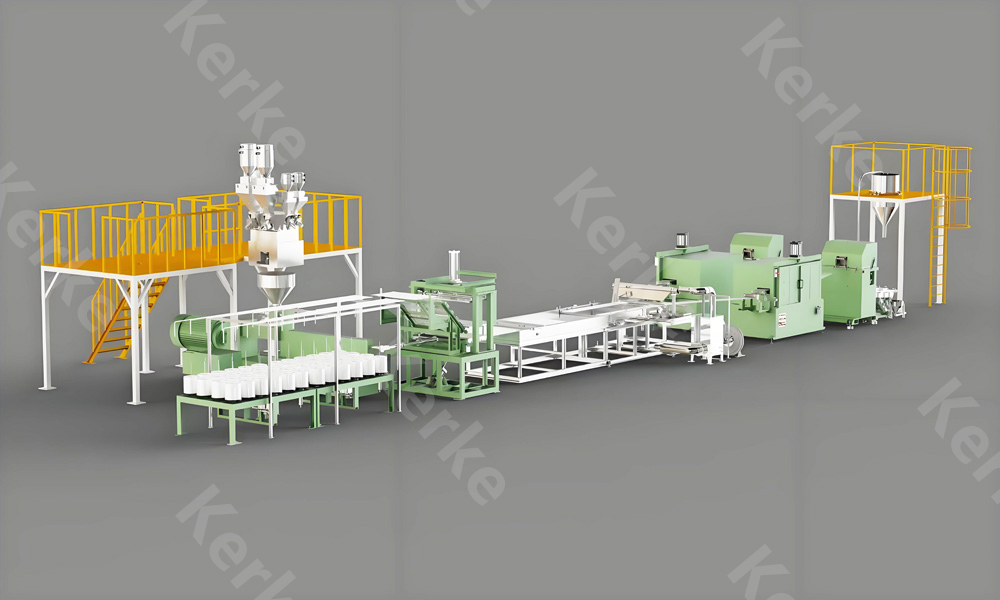
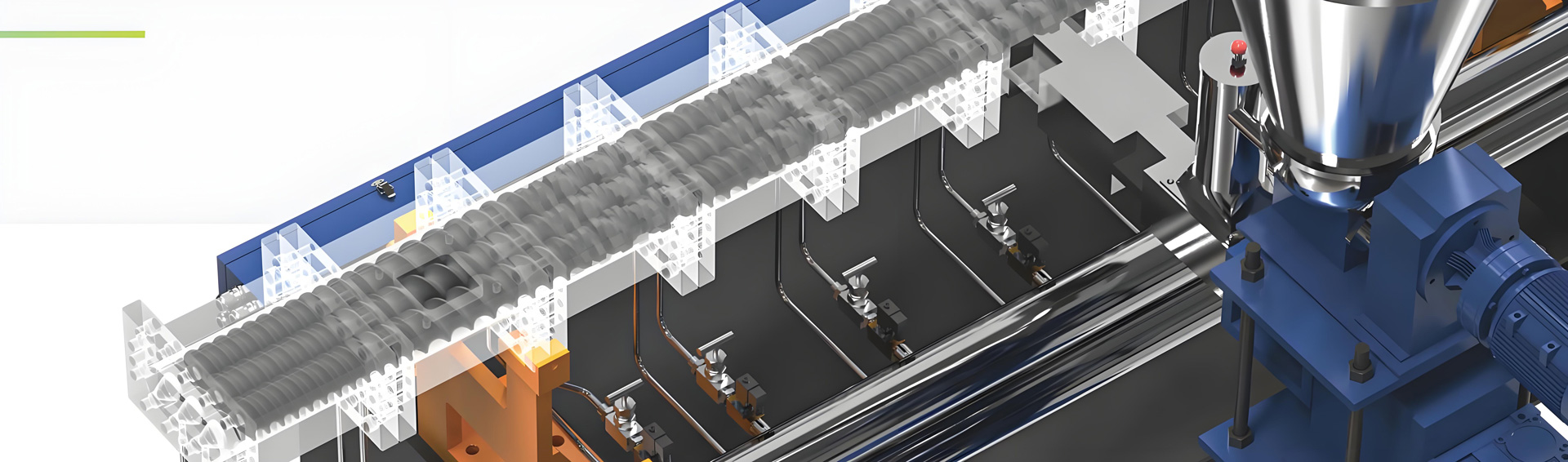
The global plastic industry is undergoing a comprehensive green transformation driven by strict environmental regulations, carbon neutrality policies and growing consumer demand for sustainable packaging and industrial materials. Biodegradable plastic masterbatch has become one of the fastest-growing functional plastic materials, widely applied in food packaging, agricultural mulch films, disposable daily necessities, medical supplies and eco-friendly industrial products. Unlike traditional plastic masterbatches, biodegradable masterbatches take eco-friendly polymers such as PLA, PBAT, PHBV and PCL as carrier materials, matched with biodegradable pigments, natural additives and environment-friendly modifiers, which can be completely decomposed into carbon dioxide, water and biomass by microorganisms in natural environments without causing plastic pollution.
The production of high-quality biodegradable plastic masterbatch puts forward extremely strict requirements on processing equipment. Traditional ordinary extrusion equipment is prone to thermal degradation of biodegradable carriers, additive failure, uneven dispersion and reduced biodegradation performance during production, resulting in unqualified product quality and failure to meet international environmental protection standards. As the core production equipment, professional masterbatch extruders, twin screw extruders and compounding extruders determine the dispersion uniformity, molecular stability, biodegradation performance and batch consistency of finished biodegradable masterbatches. Choosing a suitable extrusion device is the key premise for manufacturers to achieve stable production of high-standard biodegradable masterbatches and seize the green material market.
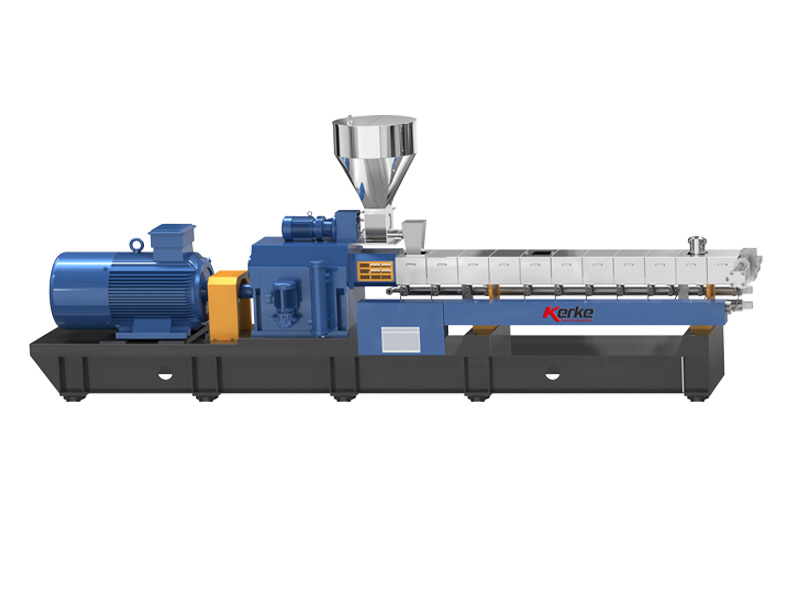
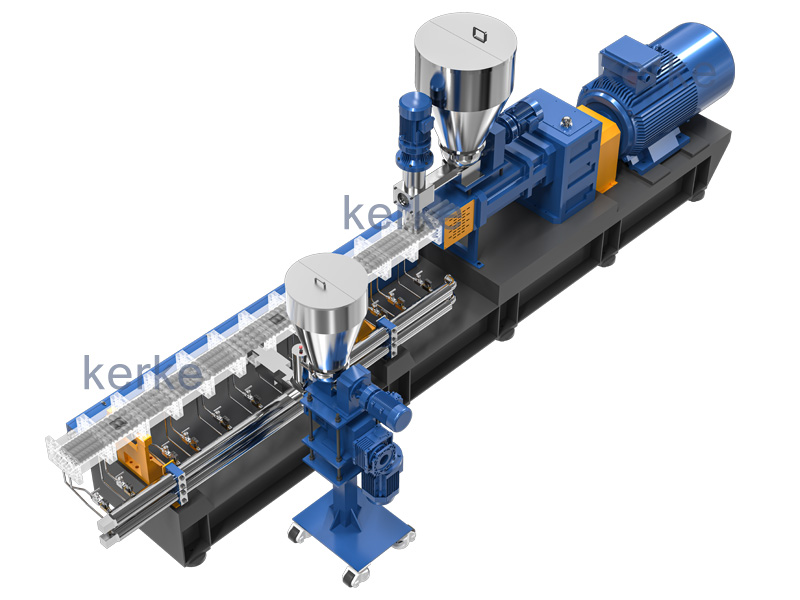
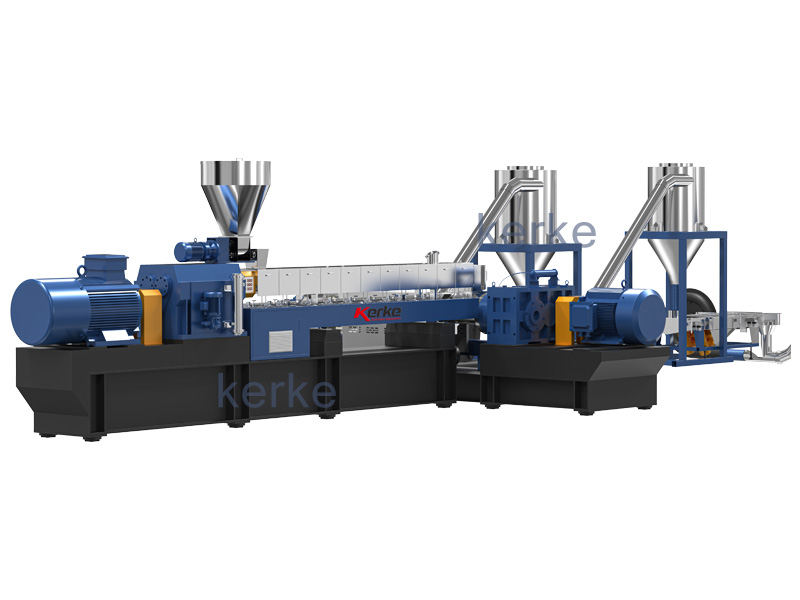
As a professional global manufacturer of high-performance twin screw compounding extruders and masterbatch extruders, Kerke has more than 20 years of technical accumulation in biodegradable material processing, with mature equipment solutions for PLA, PBAT, PHBV and full-series biodegradable masterbatch production. This article systematically elaborates the unique production characteristics of biodegradable plastic masterbatch, core equipment selection indicators, key parameter requirements, equipment type matching rules, common selection mistakes, and detailed equipment price and project cost-benefit analysis, providing comprehensive and professional selection guidance for biodegradable masterbatch production enterprises.
1. Unique Production Characteristics of Biodegradable Plastic Masterbatch
Biodegradable plastic masterbatch has completely different processing characteristics compared with conventional PE, PP and ABS plastic masterbatches. Its carrier materials are temperature-sensitive and shear-sensitive, with poor thermal stability and easy molecular chain fracture. The functional additives are mostly natural eco-friendly materials, which are prone to failure and degradation under excessive shear and high temperature. These unique material properties determine that ordinary extrusion equipment cannot meet production requirements, and professional customized compounding and masterbatch extrusion equipment must be selected.
1.1 Strict Thermal Sensitivity of Biodegradable Carrier Resins
Common biodegradable carrier materials including PLA, PBAT and PHBV have narrow processing temperature windows and extremely poor high-temperature stability. PLA material will undergo molecular hydrolysis and chain scission when the temperature exceeds 200℃, resulting in reduced molecular weight, decreased material toughness and incomplete biodegradation. PBAT is sensitive to long-term high-temperature shear, which is easy to cause thermal aging and yellowing of masterbatch products. PHBV has stricter temperature control requirements, and temperature fluctuation exceeding ±2℃ will lead to material degradation and loss of biodegradable activity.
Traditional single screw extruders and ordinary low-end twin screw extruders have large temperature fluctuation and excessive shear heat generation, which will seriously damage the molecular structure of biodegradable carriers in the production process, resulting in unqualified product biodegradation rate and failure to meet green product certification standards. Professional Kerke masterbatch extruders adopt precise constant-temperature control and low-shear processing design to perfectly adapt to the thermal sensitivity of biodegradable materials.
1.2 Special Dispersion Requirements for Eco-Friendly Additives
Biodegradable masterbatches use natural plant pigments, biodegradable tougheners, nucleating agents and non-toxic processing aids instead of traditional chemical additives. These eco-friendly additives have large particle activity differences and poor fusion with biodegradable carriers, putting forward higher requirements on the shear dispersion capacity of extrusion equipment. Insufficient dispersion will lead to uneven color of finished masterbatches, poor functional consistency and reduced mechanical properties of downstream products.
Different from the high-shear design of traditional masterbatch extruders, biodegradable masterbatch production requires moderate and uniform shear force, which can fully disperse additives without destroying the activity of eco-friendly components. Kerke twin screw compounding extruders adopt modular screw shear optimization design, which realizes ultra-fine and uniform dispersion of biodegradable additives while protecting the stability of material molecular structure.
1.3 Zero Pollution & Green Production Standards
As a green environmental protection material, biodegradable masterbatch has strict zero impurity and zero pollution requirements in the whole production process. Any residual traditional plastic impurities, metal impurities and degraded carbonized materials will affect the biodegradation performance of products and lead to unqualified environmental protection certification. The equipment must have efficient impurity filtration and sealed production functions to avoid secondary pollution in the processing process.
1.4 Batch Consistency Requirements for Degradation Performance
The market and industrial standards require consistent biodegradation cycle and performance of different batches of masterbatches. Unstable extrusion process parameters will lead to differences in molecular structure and additive dispersion of finished products, resulting in inconsistent degradation speed of downstream plastic products. This requires the selected masterbatch extruder to have high process stability and parameter locking function to ensure batch product consistency.
2. Core Selection Criteria for Biodegradable Masterbatch Extruders
When choosing a masterbatch extruder and compounding extruder for biodegradable plastic masterbatch production, manufacturers need to comprehensively evaluate multiple core indicators including temperature control precision, screw shear performance, impurity filtration capacity, equipment stability, automation level and material adaptability. Combined with their own production scale, product type and budget, they can select the most matching twin screw extruder equipment to avoid selection errors affecting product quality and production benefits.
2.1 Ultra-High Precision Zoned Temperature Control System
Temperature control precision is the primary selection indicator for biodegradable masterbatch extrusion equipment. Qualified production equipment must achieve multi-stage independent zoning temperature control, with temperature control accuracy within ±1℃, to adapt to the narrow processing temperature window of PLA, PBAT and other biodegradable materials. Ordinary extruders with single-point temperature control and large fluctuation will cause material thermal degradation and must be eliminated.
Kerke professional twin screw extruders and masterbatch extruders are equipped with 6 to 12 independent temperature control zones according to different models, covering feeding, plasticization, kneading, exhaust and extrusion sections. Each zone adopts independent heating and circulating water cooling dual regulation, which can accurately match the optimal processing temperature of different biodegradable materials. The equipment can effectively avoid thermal decomposition and molecular chain damage of biodegradable carriers, ensuring that the finished masterbatch maintains 100% biodegradation activity.
2.2 Optimized Modular Screw Shear Structure
The screw structure directly determines the dispersion effect and material protection performance of biodegradable masterbatches. The ideal screw configuration for biodegradable material processing is low-shear, high-dispersion and gradual kneading structure, which can fully mix pigments and functional additives without excessive shear damage to material molecules. Traditional high-shear screw for ordinary color masterbatch production is not suitable for biodegradable materials and will cause material performance attenuation.
Kerke compounding extruders adopt customized modular screw combination for biodegradable masterbatch production, including special low-resistance conveying elements, gentle kneading blocks and pressure stabilizing elements. The multi-stage gradual shear design realizes uniform dispersion of additives at low temperature and low shear, completely solving the problems of insufficient dispersion and material degradation. According to different masterbatch formulas such as color masterbatch, toughened masterbatch and foaming masterbatch, Kerke can provide personalized screw combination schemes to meet differentiated production needs.
2.3 High-Precision Melt Filtration & Sealed Production Structure
To meet the zero-pollution production standard of biodegradable masterbatches, the selected masterbatch extruder must be equipped with multi-stage precision filtration system and fully sealed production structure. The filtration system needs to filter micro-impurities, carbonized particles and raw material agglomerates in the melt to ensure high purity of finished products. The sealed structure prevents external dust, moisture and foreign impurities from entering the production link to avoid secondary pollution of eco-friendly materials.
Kerke twin screw extruders are equipped with automatic multi-layer high-precision filter screen changing system, which can filter micro-impurities above 5μm in real time. The fully sealed melt conveying and production cabin design avoids external pollution, ensuring that the impurity content of biodegradable masterbatches is far lower than the industry standard, and the products meet global green environmental protection certification requirements.
2.4 Negative Pressure Vacuum Exhaust System
Biodegradable materials are highly hygroscopic, and trace moisture will cause molecular hydrolysis and product performance degradation during extrusion. In addition, eco-friendly additives will produce trace volatile gases in the processing process. Therefore, professional biodegradable masterbatch extruders must be equipped with high-negative-pressure vacuum exhaust devices to completely remove moisture and volatile substances in the melt.
Kerke masterbatch extruders are equipped with high-power negative pressure vacuum exhaust systems, which can maintain stable high vacuum degree in the barrel, effectively remove material moisture and volatile components, eliminate product bubble defects and molecular hydrolysis problems, and ensure the stability and high quality of biodegradable masterbatch products.
2.5 Intelligent Parameter Locking & Stable Operation Performance
Batch consistency is the key quality index of biodegradable masterbatches. The selected compounding extruder must have intelligent parameter locking and stable operation performance to avoid quality fluctuation caused by parameter deviation and equipment vibration. The equipment needs to realize stable matching of feeding volume, screw speed and melt pressure to ensure consistent processing state of each batch of materials.
Kerke extrusion equipment adopts full PLC intelligent linkage control system, which can one-key lock production parameters of different biodegradable masterbatch formulas. The servo constant-speed feeding and constant-pressure extrusion technology ensures stable equipment operation, zero fluctuation of production parameters, and consistent degradation performance and color dispersion of batch products, meeting the standardized mass production needs of environmental protection masterbatches.
2.6 Professional Material Adaptability & Customization
Different types of biodegradable masterbatches (color masterbatch, toughening masterbatch, foaming masterbatch, weather-resistant masterbatch) have different processing requirements for equipment. The ideal extruder needs to have strong adaptability and support personalized configuration customization. For example, foaming masterbatch requires precise pressure control, and food-grade biodegradable masterbatch requires food-grade anti-pollution configuration.
Kerke provides personalized equipment configuration services for different biodegradable masterbatch types, covering food-grade material configuration, foaming pressure stabilization configuration, high-fill modification configuration and other customized schemes, which can fully meet the differentiated production needs of various biodegradable eco-friendly masterbatches.
3. Extruder Type Matching for Different Biodegradable Masterbatch Types
There are obvious differences in processing technology and equipment requirements for different types of biodegradable plastic masterbatches. Manufacturers need to select matched twin screw extruder and masterbatch extruder models according to their main product directions to avoid equipment mismatch leading to low production efficiency and unqualified product quality. The following is the professional matching scheme summarized by Kerke for mainstream biodegradable masterbatch types.
3.1 Biodegradable Color Masterbatch Extruder Matching
Biodegradable color masterbatch takes PLA, PBAT and other biodegradable resins as carriers, matched with natural plant pigments and eco-friendly colorants. The core production requirements are uniform pigment dispersion, no color difference between batches, and no damage to material biodegradability. It is necessary to select low-shear high-dispersion twin screw compounding extruders, equipped with fine filtration system and precise temperature control system.
Kerke conventional medium-sized twin screw extruders are the most suitable equipment for mass production of biodegradable color masterbatches. The optimized screw shear structure ensures uniform dispersion of natural pigments, avoids color deviation caused by excessive shear, and stably produces high-color-consistency eco-friendly color masterbatches that meet international environmental protection standards.
3.2 Biodegradable Toughening & Modification Masterbatch Extruder Matching
Toughening and modification masterbatches are used to improve the brittleness and poor mechanical properties of pure biodegradable materials, containing toughening agents, compatibilizers and modified additives. The production requires moderate shear to ensure full fusion of modified components and carriers, while protecting the activity of toughening additives. It is suitable to select Kerke high-torque twin screw compounding extruders with optimized kneading structure.
The high-torque stable extrusion design ensures sufficient material kneading and mixing, significantly improves the modification effect of masterbatches, and effectively improves the toughness and processing performance of downstream biodegradable products.
3.3 Biodegradable Foaming Masterbatch Extruder Matching
Biodegradable foaming masterbatches contain eco-friendly foaming agents and nucleating agents, which are extremely sensitive to temperature and pressure. Excess temperature will cause foaming agent failure in advance, and unstable pressure will lead to uneven foaming cell structure of finished products. Special foaming-grade masterbatch extruders with precise pressure control and constant-temperature processing are required.
Kerke foaming special twin screw extruders are equipped with independent pressure stabilization system and ultra-precise temperature control module, which can stably control the processing state of foaming masterbatches, ensure the activity of foaming agents and uniform nucleation effect, and produce high-quality biodegradable foaming masterbatches for lightweight packaging and cushioning materials.
3.4 Food-Grade Biodegradable Masterbatch Extruder Matching
Food-grade biodegradable masterbatches used for food packaging and disposable tableware require zero pollution and zero precipitation of products. The equipment needs to be equipped with food-grade wear-resistant barrel and screw materials, fully sealed dust-free production structure and multi-stage high-precision filtration system.
Kerke food-grade customized masterbatch extruders fully meet FDA and EU food contact material standards, with no heavy metal precipitation and no secondary pollution in the production process, which is the preferred equipment for food-grade eco-friendly masterbatch production.
4. Common Extruder Selection Mistakes & Avoidance Strategies
Many biodegradable masterbatch manufacturers often have selection errors in equipment procurement, resulting in low product qualification rate, high production cost and short equipment service life. Summarizing common selection mistakes and formulating avoidance strategies can help enterprises select cost-effective and fully compliant extrusion equipment.
4.1 Blind Selection of High-Shear Ordinary Masterbatch Extruders
Many buyers mistakenly believe that the higher the shear force of the extruder, the better the dispersion effect, and blindly select high-shear equipment for traditional chemical masterbatches. In fact, excessive high shear will cause molecular chain fracture and additive activity failure of biodegradable materials, resulting in reduced product biodegradation rate, yellowing and poor toughness, making products unable to pass environmental protection certification.
Avoidance Strategy: Take low-shear uniform dispersion as the core standard, select Kerke biodegradable special screw optimized compounding extruders, balance dispersion effect and material molecular stability, and ensure both product quality and degradation performance.
4.2 Ignoring Temperature Control Precision Requirements
Some manufacturers pay attention to equipment output and price but ignore temperature control precision, purchasing ordinary extruders with large temperature fluctuation. The narrow processing temperature window of biodegradable materials makes slight temperature deviation lead to large-area material degradation, resulting in high defective rate and serious raw material waste.
Avoidance Strategy: Prioritize equipment with multi-stage independent temperature control and ±1℃ high-precision constant temperature function, take Kerke high-precision temperature control twin screw extruders as the preferred choice, and fundamentally solve the thermal degradation problem of biodegradable materials.
4.3 Neglecting Filtration & Sealed Production Configuration
Some low-cost extruders are not equipped with high-precision filtration and sealed production structure, resulting in easy impurity mixing and product pollution in the production process. The finished biodegradable masterbatches have excessive impurities, which affect the degradation uniformity and safety performance, and cannot enter the high-end market.
Avoidance Strategy: Take high-precision filtration and fully sealed production as the standard configuration, do not purchase simplified low-cost equipment, and ensure the high purity and environmental safety of eco-friendly masterbatch products.
4.4 Unmatched Equipment Production Capacity & Actual Demand
Blindly purchasing large-output equipment leads to idle equipment and high operating costs for small-batch customized production; purchasing small equipment for large-scale mass production leads to insufficient output and inability to meet order demand. Unmatched capacity will seriously affect enterprise production benefits.
Avoidance Strategy: Select equipment model according to actual production batch and order demand. Kerke provides complete series of equipment from small experimental models to large high-output models, realizing precise matching of production capacity and demand.
5. Kerke Biodegradable Masterbatch Extruder Product Advantages
As a professional supplier of twin screw extruders, masterbatch extruders and compounding extruders for biodegradable material processing, Kerke’s full-series equipment is professionally optimized for the pain points of temperature sensitivity, shear sensitivity and easy pollution of biodegradable masterbatches, with significant technical advantages compared with ordinary extrusion equipment on the market.
5.1 Professional Biodegradable Material Processing Technology
Kerke has long-term technical research and development accumulation in PLA, PBAT, PHBV and other biodegradable material extrusion processing, mastering mature low-temperature low-degradation extrusion technology. The equipment can accurately adapt to the processing characteristics of different biodegradable carriers, effectively avoid material thermal degradation and molecular damage, and ensure that the finished masterbatch maintains 100% original biodegradation performance. Compared with ordinary extruders, the product biodegradation qualification rate is increased by more than 20%.
5.2 Modular Flexible Screw Combination Design
Kerke twin screw compounding extruders adopt fully modular screw design, which can freely combine and adjust screw elements according to different biodegradable masterbatch formulas and processing requirements. It can switch production of color masterbatch, toughening masterbatch, foaming masterbatch and other different products in a short time, with strong production flexibility, meeting the multi-variety and small-batch customized production needs of the green masterbatch market.
5.3 High-Stability Intelligent Production System
The full intelligent PLC control system realizes one-key parameter setting and locking, automatic operation of the whole production process, and real-time monitoring of temperature, pressure, speed and other core parameters. The equipment can automatically correct parameter deviation, ensure long-term stable operation, and realize zero fluctuation of batch product quality. The built-in formula database stores mature production parameters of various biodegradable masterbatches, helping customers quickly launch new product production.
5.4 Energy-Saving & Low-Consumption Operation Performance
Kerke extrusion equipment adopts full servo energy-saving drive and optimized fluid mechanics design, which reduces unit energy consumption by 18% to 25% compared with traditional extruders. The low-wear mechanical structure reduces the replacement frequency of vulnerable parts, greatly reducing long-term operation and maintenance costs for enterprises, with significant energy-saving and cost-reducing benefits.
5.5 Full-Range Customized Configuration Services
According to customer product positioning and market certification requirements, Kerke provides personalized customized configurations including food-grade anti-pollution configuration, high-precision foaming configuration, high-fill modification configuration and dust-free production configuration, helping customers produce high-standard biodegradable masterbatches that meet international environmental protection and safety certification standards.
6. Equipment Price & Full-Cycle Project Cost-Benefit Analysis
Equipment procurement and operation cost is an important factor for enterprises to select extruders. The following is a detailed price quotation of Kerke biodegradable masterbatch special extruders and full-cycle cost-benefit analysis, helping enterprises accurately evaluate investment value and select cost-effective equipment.
6.1 Kerke Biodegradable Masterbatch Extruder Price Range
Kerke provides serialized twin screw extruders and masterbatch extruders covering experimental research and development, small-batch production and large-scale mass production, with transparent and standardized pricing. The FOB price of small experimental twin screw extruders for biodegradable masterbatch formula research and development and laboratory trial production is 28,000 US dollars to 36,000 US dollars, with flexible operation and low investment cost, suitable for new enterprises and product research and development institutions.
The standard medium-sized compounding extruders, the mainstream model for mass production of biodegradable masterbatches, are priced at 45,000 US dollars to 58,000 US dollars. This model is equipped with full standard configurations including high-precision temperature control, modular screw, multi-stage filtration and vacuum exhaust, fully meeting the mass production needs of various eco-friendly masterbatches.
The large high-output twin screw extruders for large-scale green material factories are priced at 62,000 US dollars to 75,000 US dollars, with higher production efficiency and stable continuous operation performance, suitable for large-batch standardized production. Various personalized customized configurations are priced at 2,500 US dollars to 5,000 US dollars, which can be selected according to product certification and production needs.
6.2 Operational Cost Reduction After Equipment Upgrading
Using ordinary mismatched extruders for biodegradable masterbatch production has a defective rate of 8% to 15%, resulting in a large amount of raw material waste and order loss. After upgrading to Kerke professional biodegradable special extruders, the product qualification rate is stabilized above 99.2%, and a single medium-sized production line can reduce annual raw material waste and defective product losses by 36,000 to 52,000 US dollars.
In terms of energy consumption, the equipment’s servo energy-saving system reduces annual electricity cost by 4,800 to 6,500 US dollars compared with ordinary equipment. The optimized low-wear structure reduces the replacement frequency of vulnerable parts, cutting annual maintenance cost by 3,200 to 4,500 US dollars. The intelligent automatic production reduces manual operation posts, saving annual labor cost by 12,000 to 18,000 US dollars.
6.3 Profit Improvement & Investment Payback Cycle
High-quality biodegradable masterbatches produced by Kerke equipment have complete biodegradation performance, stable quality and international certification qualification, with a 12% to 20% market premium compared with unqualified ordinary products. Enterprises can successfully enter high-end green packaging and export markets, increasing annual order profit by 40,000 to 70,000 US dollars for a single production line.
The comprehensive investment payback period of equipment procurement and upgrading is only 2 to 3 months. Kerke equipment has a service life of more than 15 years, which can bring long-term stable cost-saving and profit-increasing benefits for enterprises, and help enterprises continuously expand the market share of biodegradable green masterbatches.
7. Kerke Brand Service & Technical Support Advantages
Kerke is a high-tech enterprise focusing on the research and development, production and sales of twin screw compounding extruders and masterbatch extruders, with 20 years of professional experience in biodegradable material processing equipment. The company has served more than 3,000 customers in 70+ countries and regions worldwide, with mature project experience in green masterbatch production lines.
Kerke provides one-stop full-cycle services including pre-sales professional selection guidance, personalized process scheme customization, on-site installation and commissioning, production technical training and after-sales long-term maintenance. Professional engineers formulate targeted equipment selection and process optimization schemes according to customers’ masterbatch types, production scale and market certification requirements, ensuring that customers purchase the most suitable equipment and quickly realize mass production of high-standard biodegradable masterbatches.
All Kerke equipment enjoys a two-year full-machine free warranty and 24-hour remote technical support. For production process debugging, equipment operation maintenance and product quality optimization problems encountered by customers, the technical team provides timely professional solutions to ensure long-term stable and efficient operation of the production line.
8. Conclusion
The booming biodegradable plastic masterbatch market puts forward higher professional requirements for extrusion production equipment. Different from traditional plastic masterbatch production, biodegradable eco-friendly masterbatch processing requires extruders with high-precision temperature control, low-shear uniform dispersion, high-purity filtration and stable intelligent production performance. Blindly selecting ordinary masterbatch extruders and compounding extruders will lead to product quality defects, increased production costs and blocked market expansion.
Scientific selection of professional Kerke twin screw extruders and customized masterbatch extruders according to product types and production needs is the core key to achieve high-quality, low-cost and standardized production of biodegradable masterbatches. Relying on professional biodegradable material processing technology, flexible modular design, stable intelligent system and perfect after-sales service, Kerke provides reliable green extrusion equipment solutions for global environmental protection material manufacturers, helping enterprises seize the dividend of the green plastic industry and realize sustainable business development.