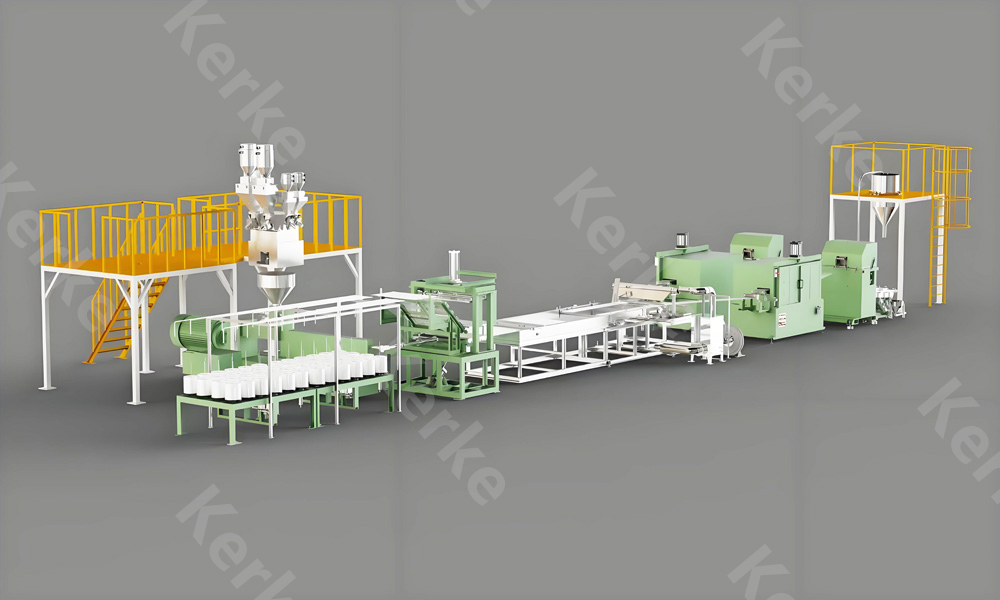
Masterbatch manufacturing is a core segment of the modern plastic processing industry, responsible for producing concentrated color, functional, and modified masterbatches that determine the appearance, mechanical performance, weather resistance, and batch consistency of downstream plastic products. In commercial masterbatch production, manufacturing stability stands as the most critical indicator for factory profitability, product qualification rate, and market credibility. Unstable production conditions often lead to inconsistent color dispersion, uneven additive distribution, fluctuating melt viscosity, frequent product defects, and large batch-to-batch performance differences, resulting in high scrap rates, wasted raw materials, and lost customer orders.
Traditional single screw extruders and simple mixing equipment struggle to maintain stable processing conditions during complex masterbatch compounding, especially for high-fill masterbatches, functional modified masterbatches, and biodegradable masterbatches with sensitive material properties. In contrast, professional twin screw extruder equipment, also widely recognized as a high-precision compounding extruder and masterbatch extruder, has become the mainstream solution for stable and standardized masterbatch production worldwide. With its unique meshing screw structure, precise process control, and uniform shear mixing performance, the twin screw extruder fundamentally solves various instability pain points in masterbatch manufacturing.
As a professional manufacturer of high-performance twin screw extruders, compounding extruders, and dedicated masterbatch extruders, Kerke has decades of technical experience in masterbatch compounding and extrusion stabilization. Kerke extrusion equipment is professionally optimized for the whole-process stability control of color masterbatch, functional masterbatch, and modified masterbatch production, helping global manufacturers achieve consistent product quality, stable continuous production, and reduced operational costs. This article comprehensively analyzes the root causes of instability in traditional masterbatch production, explains the core working principles of twin screw extruders for stabilizing production, sorts out key structural and technological advantages, summarizes practical application schemes, and provides detailed equipment price and cost-benefit analysis to deliver full-dimensional technical guidance for stable masterbatch manufacturing.
1. Common Instability Problems in Traditional Masterbatch Manufacturing
To fully understand the stabilizing advantages of twin screw extruder equipment, it is necessary to clarify the common instability defects and their negative impacts in traditional masterbatch production. Most small and medium-sized masterbatch factories rely on outdated single screw extruders or low-precision compounding equipment, which cannot achieve precise control of shear force, temperature, pressure, and material residence time, leading to multiple unstable production problems that restrict product quality and production efficiency.
1.1 Uneven Pigment and Additive Dispersion
Uneven dispersion is the most frequent instability issue in masterbatch production. Traditional extrusion equipment provides single and insufficient shear mixing force, which cannot fully break pigment agglomerates and high-fill additive particles. A large number of fine particle clusters remain in the melt, resulting in inconsistent color density, speckle defects, and uneven functional distribution in finished masterbatches. In downstream plastic molding, this defect causes local color difference, inconsistent weather resistance, and unstable mechanical modification effect, making products fail uniform quality standards.
In addition, traditional equipment has unstable mixing intensity for different formula materials. For masterbatches containing ultra-fine powder additives and high-concentration colorants, insufficient mixing leads to component stratification, while excessive shear for low-fill formulas causes additive failure and material degradation, further exacerbating dispersion instability.
1.2 Batch-to-Batch Performance Fluctuation
Batch consistency is the core evaluation standard for industrial-grade masterbatches. Traditional masterbatch extruders lack precise parameter locking and intelligent adjustment functions. Slight fluctuations in feeding volume, screw speed, and processing temperature will lead to differences in melt plasticization degree and component mixing state between different production batches. The final finished products show obvious differences in color shade, melt flow rate, tensile performance, and weather resistance.
For downstream manufacturers with large-scale continuous molding production, unstable batch performance of masterbatches will cause large-area product quality fluctuations, increase debugging frequency, and seriously affect production continuity and product qualification rate, bringing huge hidden dangers to enterprise production and operation.
1.3 Melt Plasticization Instability and Defect Generation
Plasticization stability directly determines the surface finish, compactness, and usability of masterbatch particles. Traditional extrusion equipment has uneven barrel temperature distribution and unstable melt pressure, resulting in incomplete plasticization of local materials or excessive thermal degradation. Incomplete plasticization leads to rough particle surface, internal pores, and poor dispersion performance of masterbatches; excessive thermal degradation causes material yellowing, molecular chain fracture, and reduced functional activity of additives.
Moreover, unstable melt pressure will cause uneven discharging speed, resulting in inconsistent particle size and irregular particle shape of finished masterbatches, affecting feeding uniformity and molding stability of downstream production lines.
1.4 Unstable Material Residence Time and Thermal History
Different masterbatch formulas have different tolerance ranges for high-temperature residence time. Traditional single screw extruders have disordered material flow paths and uneven residence time distribution. Some materials stay in the high-temperature barrel for too long and undergo thermal aging and degradation, while some materials are discharged without sufficient plasticization and mixing. Disordered thermal history makes the internal molecular structure and additive activity of masterbatches inconsistent, resulting in long-term hidden quality dangers such as delayed color fading and reduced modification performance.
1.5 Low Production Continuity and High Failure Rate
Outdated extrusion equipment has poor operational stability, prone to material jamming, screen blockage, temperature runaway, and discharging interruption during continuous production. Frequent equipment shutdown and restart will disrupt the stable production state, produce a large number of transitional defective products, reduce production line operation efficiency, and increase manual debugging and maintenance costs. This kind of operational instability is one of the important reasons for the high comprehensive production cost of small and medium-sized masterbatch factories.
2. Core Working Principle of Twin Screw Extruder for Stabilizing Masterbatch Production
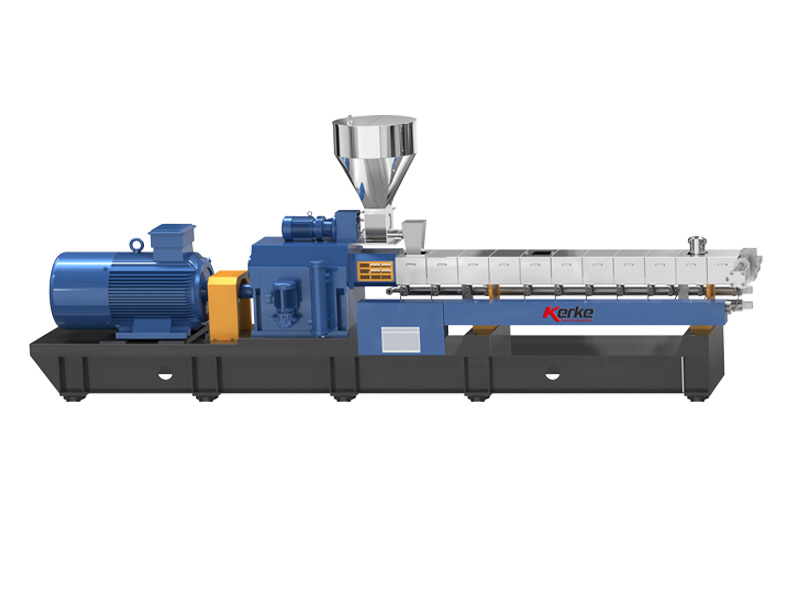
A professional twin screw extruder, as a high-precision compounding extruder and dedicated masterbatch extruder, fundamentally solves various instability problems in traditional production through its unique meshing double-screw structure, multi-stage graded processing logic, and precise closed-loop process control system. Different from the single conveying and simple mixing mode of single screw equipment, the twin screw extruder realizes continuous, uniform, and controllable plasticization, shearing, mixing, and extrusion of materials, ensuring full-process stability of masterbatch production.
2.1 Meshing Twin-Screw Self-Cleaning and Uniform Conveying Principle
The twin screw extruder adopts a co-rotating meshing double-screw design. The two screws rotate synchronously at a constant speed, and the screw elements mesh with each other closely without dead angles. During material operation, the screw surfaces and barrel inner wall continuously scrape and clean each other, completely avoiding material residue and long-term high-temperature retention. This self-cleaning function prevents residual degraded materials from mixing into new batches, ensuring consistent material thermal history for each batch of masterbatches and eliminating batch quality fluctuation caused by residual materials.
At the same time, the double-screw meshing structure forms a stable material thrust and flow field, realizing quantitative and uniform material conveying. The material conveying speed and residence time are highly controllable, completely solving the problems of uneven feeding and disordered residence time of traditional equipment, and laying a foundation for stable plasticization and mixing.
2.2 Modular Gradient Shearing and Uniform Mixing Mechanism
The core advantage of the twin screw extruder in masterbatch stabilization lies in its modular gradient shearing system. Different from the single shear force of traditional equipment, the twin screw extruder is equipped with diversified screw elements including conveying elements, gentle kneading blocks, medium shearing blocks, and pressure stabilizing elements according to processing requirements. The materials pass through multiple graded processing sections to realize gradual plasticization, dispersion, homogenization and extrusion.
In the low-shear pre-mixing section, the equipment gently mixes carriers, pigments and additives to avoid additive damage; in the medium-shear refining section, it fully breaks pigment agglomerates and realizes microscopic uniform dispersion; in the homogenization stabilizing section, it balances melt viscosity and internal stress to ensure consistent material performance. This gradient processing mode realizes precise matching of shear force and material characteristics, avoiding insufficient dispersion or excessive degradation, and greatly improving mixing stability.
2.3 Zoned Precise Temperature and Pressure Closed-Loop Control
Temperature and pressure stability are the key to consistent masterbatch plasticization performance. Professional twin screw compounding extruders adopt independent multi-stage zoned temperature control technology. Each processing section of the barrel is equipped with independent heating and circulating water cooling devices, with temperature control accuracy within ±1℃. The equipment can accurately adjust the optimal processing temperature according to different masterbatch formulas, avoid local overheating or under-plasticization, and ensure consistent molecular structure and additive activity of materials.
Equipped with a high-precision melt pressure real-time monitoring and automatic adjustment system, the twin screw extruder dynamically balances extrusion pressure according to material flow changes, maintains stable discharging pressure and uniform discharging speed, ensures consistent particle size, compactness and surface quality of finished masterbatches, and eliminates particle defect instability.
2.4 Stable Vacuum Exhaust and Impurity Filtration System
Moisture and volatile impurities in materials are important hidden dangers of masterbatch performance instability. The twin screw masterbatch extruder is equipped with a high-negative-pressure vacuum exhaust device, which can completely remove material moisture, residual air and additive volatile components in the extrusion process, avoid pore defects, bubble particles and molecular hydrolysis caused by moisture, and stabilize the internal compactness and mechanical properties of masterbatches.
Matching with an automatic high-precision filtration system, the equipment can filter micro-impurities, carbonized particles and undispersed agglomerates in the melt in real time, ensuring high purity and uniform texture of finished masterbatches, and avoiding quality fluctuation caused by impurity mixing.
3. Key Advantages of Kerke Twin Screw Extruder for Masterbatch Production Stability
As a professional supplier of twin screw extruders, compounding extruders and masterbatch extruders, Kerke optimizes the core structure, control system and processing technology of equipment targeting the stability pain points of masterbatch production. Compared with ordinary twin screw equipment on the market, Kerke equipment has more prominent advantages in batch consistency, dispersion stability, operational stability and long-term production reliability, fully adapting to the stable production needs of various color masterbatches, functional masterbatches and high-fill modified masterbatches.
3.1 Customized Modular Screw Stabilization Design
Kerke twin screw extruders adopt fully modular screw combination design, which can freely match different screw element combinations according to masterbatch formula characteristics. For high-color-concentration color masterbatches, high-dispersion low-damage screw configuration is adopted to ensure uniform pigment dispersion without additive degradation; for high-fill functional masterbatches, high-torque stable kneading elements are matched to improve mixing uniformity and material fluidity; for temperature-sensitive biodegradable masterbatches, low-shear gradual processing screw schemes are customized to avoid thermal degradation.
This personalized screw matching mode realizes targeted stable processing of different masterbatch products, completely solving the problem that universal equipment cannot adapt to multi-formula stable production, and ensuring consistent product quality of different formulas and different batches.
3.2 High-Precision Intelligent Parameter Locking System
Kerke compounding extruders are equipped with full PLC intelligent linkage control system, supporting one-key locking of production parameters such as feeding speed, screw speed, zoned temperature and melt pressure. After debugging the optimal process parameters for a specific masterbatch formula, the system can permanently lock the parameters to avoid quality fluctuation caused by manual operation errors and parameter drift.
The built-in formula database stores mature stable process parameters of hundreds of masterbatch products. When switching production batches, the system can automatically call matching parameters to realize rapid batch switching and zero-difference production, ensuring long-term stable batch consistency of products and greatly reducing the defective rate caused by parameter adjustment errors.
3.3 High-Stability Mechanical Operation Structure
The equipment adopts high-rigidity integrated frame and high-precision transmission system, with stable operation and low vibration during long-term high-load continuous production. The optimized bearing and gear transmission structure reduces operational wear and vibration deviation, ensures synchronous and stable screw operation, and avoids mixing instability caused by equipment vibration.
The optimized barrel cooling and heating balance structure realizes rapid temperature response and stable temperature maintenance. Even in long-term uninterrupted production, the temperature fluctuation of each processing zone is controlled within an ultra-small range, ensuring consistent material plasticization state and realizing 24-hour stable continuous production.
3.4 Low-Wear and Long-Term Stable Operation Performance
Kerke twin screw extruder barrels and screws are made of high-hardness anti-wear alloy materials, with strong corrosion resistance and wear resistance. Long-term production will not produce screw wear, gap increase and mixing performance attenuation, ensuring that the equipment maintains consistent mixing and extrusion accuracy in the whole service cycle. It avoids the gradual deterioration of production stability caused by equipment aging and wear of ordinary low-end equipment.
3.5 Full-Link Defect Prevention and Stabilization Configuration
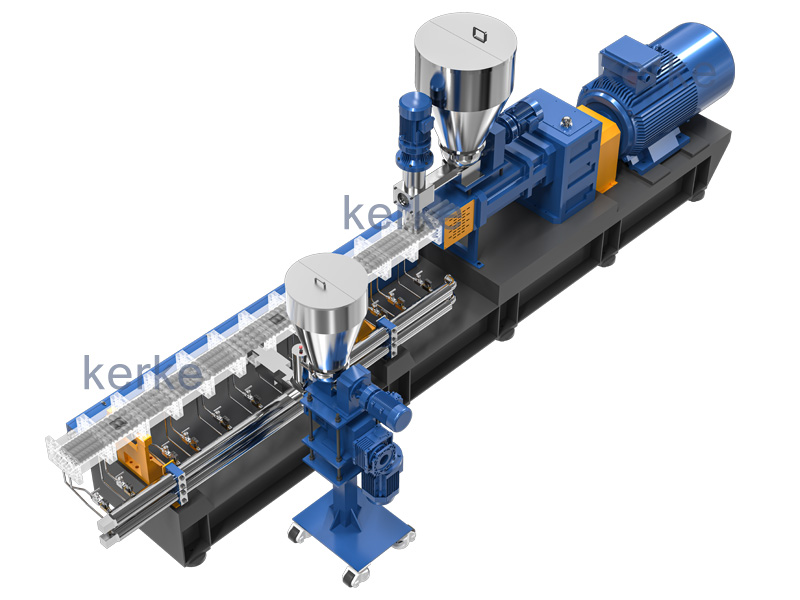
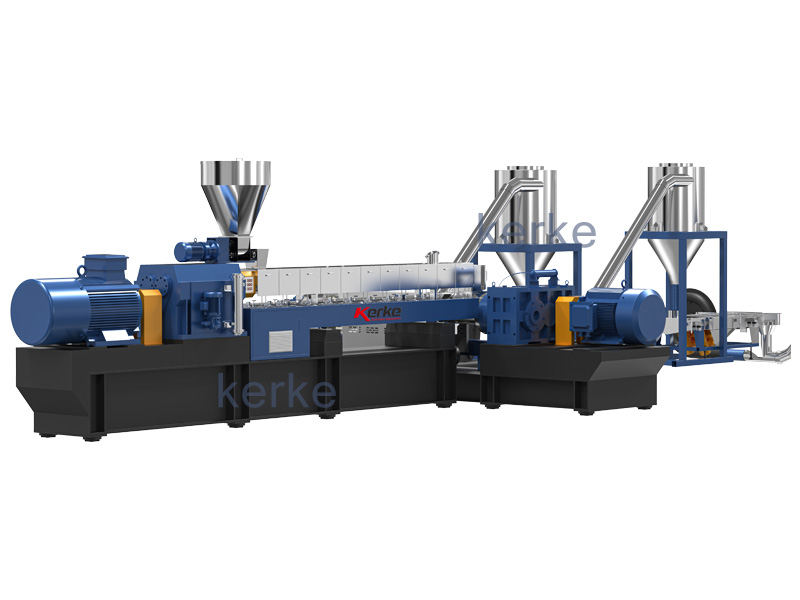
The complete machine is equipped with supporting stable production configurations such as constant-speed servo feeding system, automatic pressure stabilization device and continuous screen changing system. The servo feeding system realizes uniform and quantitative feeding to avoid material stratification and uneven mixing caused by unstable feeding; the pressure stabilization device balances melt extrusion pressure to ensure uniform particle molding; the automatic screen changing system realizes non-stop screen replacement, avoiding production interruption and transitional defective products caused by shutdown screen changing, and maximizing production continuity and stability.
4. Practical Stabilization Effects of Twin Screw Extruders on Different Masterbatch Types
Different types of masterbatches have different stability requirements in the production process. Kerke twin screw extruders and masterbatch extruders can achieve targeted stability improvement for color masterbatches, functional modified masterbatches, high-fill masterbatches and biodegradable masterbatches, solving personalized instability problems of various products.
4.1 Color Masterbatch Stability Improvement
Color masterbatches have extremely high requirements for color dispersion uniformity and batch color consistency. Traditional equipment is prone to color difference, speckles and uneven tinting strength. Kerke twin screw compounding extruders adopt graded low-shear high-dispersion processing technology to fully disperse nano-scale and micron-scale colorant particles, eliminate pigment agglomeration, and ensure uniform color distribution of masterbatches.
Through precise parameter locking and stable thermal history control, the equipment ensures zero color difference between different batches of color masterbatches, stable tinting strength, and no color fading deviation, meeting the high-standard color consistency requirements of high-end plastic products and printing and packaging materials.
4.2 Functional Modified Masterbatch Stability Improvement
Weather-resistant, flame-retardant, toughening and anti-aging functional masterbatches rely on the stable activity of functional additives to exert their performance. Excessive shear and high temperature of traditional equipment easily lead to additive failure and unstable modification effect. Kerke twin screw extruders adopt optimized gradient shear and constant-temperature processing technology to fully mix functional additives and carrier resins while protecting additive activity.
The stable extrusion process ensures consistent functional content and uniform distribution in each batch of masterbatches, making the mechanical properties, weather resistance and flame retardant performance of downstream modified plastic products stable and reliable, avoiding performance fluctuation and unqualified products caused by unstable masterbatch quality.
4.3 High-Fill Masterbatch Stability Improvement
High-fill masterbatches with high content of talc powder, calcium carbonate and other inorganic fillers are prone to poor fusion, component stratification and unstable fluidity. The high-torque stable mixing performance of Kerke twin screw extruders realizes full wetting and uniform fusion of inorganic fillers and organic carriers, improves the compatibility of high-fill systems, and eliminates filler precipitation and stratification defects.
The stable melt pressure and plasticization state ensure consistent melt flow rate and particle compactness of high-fill masterbatches, stable downstream molding processing performance, and no batch fluctuation of product dimensional accuracy and mechanical properties.
4.4 Biodegradable Masterbatch Stability Improvement
Biodegradable masterbatches made of PLA and PBAT carriers are temperature-sensitive and shear-sensitive, and traditional equipment is prone to material degradation and unstable biodegradation performance. Kerke special twin screw extruders for biodegradable materials adopt low-temperature stable extrusion process and low-shear uniform mixing design, which ensures full mixing of materials without damaging the molecular structure of biodegradable carriers and additive activity.
The equipment realizes stable control of material thermal history, ensures consistent biodegradation rate and environmental protection performance of each batch of masterbatches, and meets the stable production requirements of high-standard green environmental protection masterbatches.
5. Common Production Stability Problems and Twin Screw Extruder Solutions
In actual masterbatch production, manufacturers often encounter various unstable quality problems. The following summarizes typical production instability phenomena, root causes, and targeted solving schemes based on Kerke twin screw extruder equipment and processes, helping enterprises quickly eliminate quality fluctuations and stabilize production.
5.1 Masterbatch Color Difference and Speckle Defects
The main causes include insufficient shear dispersion of equipment, unstable feeding uniformity, and fluctuating processing temperature. Traditional single screw equipment cannot break fine pigment agglomerates, and temperature fluctuation leads to inconsistent pigment fusion degree. The twin screw extruder solves this problem through modular high-dispersion screw configuration, servo uniform feeding system and constant-temperature zoned control, realizing ultra-fine uniform dispersion of pigments and eliminating color difference and speckle defects.
5.2 Batch Melt Flow Rate Fluctuation
Unstable melt flow rate is caused by inconsistent material plasticization degree and residual moisture volatility. Twin screw compounding extruders adopt high-precision temperature control and high-negative-pressure vacuum exhaust technology to ensure consistent plasticization state of each batch of materials and completely remove moisture and volatile components, stabilizing masterbatch melt flow performance and eliminating batch flow rate fluctuation.
5.3 Masterbatch Particle Inhomogeneity and Pore Defects
Unstable extrusion pressure and incomplete exhaust are the main inducing factors. Kerke twin screw extruders are equipped with real-time pressure self-adjustment system and multi-stage vacuum exhaust device to stabilize melt extrusion pressure, eliminate internal pores of particles, ensure uniform particle size and compact texture, and improve masterbatch appearance and internal quality stability.
5.4 Functional Additive Activity Instability
Excessive shear and overheating processing lead to additive failure and activity fluctuation. The gradient shear design of twin screw extruders balances mixing effect and material protection, avoids excessive shear damage to additives, and matches precise constant-temperature processing to ensure stable additive activity and consistent functional performance of finished masterbatches.
6. Equipment Price and Full-Cycle Cost-Benefit Analysis
Upgrading to professional twin screw extruders and masterbatch extruders is a cost-effective investment for masterbatch manufacturing enterprises to stabilize production, reduce defective rates and improve profit margins. The following is a detailed price quotation of Kerke core equipment and full-cycle cost-benefit analysis, providing accurate investment reference for manufacturers.
6.1 Kerke Twin Screw Extruder Price Range for Masterbatch Production
Kerke provides serialized compounding extruders and masterbatch extruders covering experimental research and development, small-batch production and large-scale mass production, with standardized and transparent pricing. The FOB price of small experimental twin screw extruders for formula debugging and small-batch trial production is 29,000 US dollars to 38,000 US dollars, with flexible operation and low investment threshold, suitable for new factories and product R&D departments.
The standard medium-sized twin screw masterbatch extruders, the mainstream model for industrial mass production, are priced at 46,000 US dollars to 59,000 US dollars. This model is fully equipped with modular screw, zoned precise temperature control, vacuum exhaust, automatic filtration and intelligent parameter locking systems, completely meeting the stable production needs of various conventional and high-end masterbatches.
The large high-output twin screw compounding extruders for large-scale standardized production lines are priced at 63,000 US dollars to 76,000 US dollars, supporting 24-hour uninterrupted stable operation, with higher production efficiency and batch consistency, suitable for large factories with large order volume and high-quality standard requirements. Customized functional configurations for special masterbatches are priced at 2,800 US dollars to 5,200 US dollars, which can be selected according to production demands.
6.2 Production Cost Reduction Brought by Stable Production
Traditional single screw production lines have a comprehensive defective rate of 7% to 13% due to unstable production, resulting in a large amount of raw material waste and product scrapping. After upgrading to Kerke twin screw extruders, the masterbatch product defective rate is stably reduced to below 0.9%. A single medium-sized production line can reduce annual raw material waste and defective product losses by 38,000 to 55,000 US dollars.
In terms of labor cost, the intelligent stable production mode reduces manual debugging, quality inspection and rework workload, saving 3 to 4 manual operation posts per production line, with annual labor cost saving of 13,000 to 19,000 US dollars. In terms of maintenance cost, the low-wear and high-stability equipment structure reduces failure frequency and vulnerable part replacement frequency, cutting annual equipment maintenance cost by 3,500 to 4,800 US dollars.
In terms of energy consumption, Kerke servo energy-saving twin screw extruders reduce unit production energy consumption by 19% to 23% compared with traditional equipment, saving annual electricity cost of 4,200 to 6,000 US dollars for continuous production.
6.3 Quality Improvement Profit and Investment Payback Cycle
Masterbatches produced by high-stability twin screw extruders have stable batch performance, uniform dispersion and reliable quality, which can meet the procurement standards of high-end downstream manufacturers and international export orders. High-consistency stable masterbatches have a 11% to 19% market premium compared with unstable ordinary products, effectively improving enterprise profit margins.
Stable product quality avoids order returns, customer complaints and brand reputation losses caused by quality fluctuations, helping enterprises stabilize long-term customer resources and expand market share. The comprehensive investment payback period of equipment upgrading is only 2.5 to 3.5 months. Kerke equipment has a service life of more than 15 years, which can bring long-term stable cost-saving and profit-increasing benefits for masterbatch manufacturing enterprises.
7. Kerke Brand Technical Support and Service Advantages
Kerke has focused on the R&D and manufacturing of twin screw compounding extruders and masterbatch extruders for many years, focusing on solving the stability pain points of masterbatch compounding production. The company has rich practical experience in stable production line construction for various color masterbatches, functional masterbatches and biodegradable masterbatches, serving thousands of plastic processing enterprises worldwide.
Kerke provides one-stop full-cycle services including pre-sales production scheme customization, equipment selection guidance, personalized screw configuration matching, on-site installation and commissioning, production process debugging and technical training. Professional engineers formulate targeted stable production process parameters according to customers’ masterbatch types, formula systems and production scale, helping customers quickly realize zero-fluctuation batch production.
All Kerke twin screw extruder equipment enjoys a two-year full-machine free warranty and 24-hour remote technical support. For production stability problems and process optimization demands encountered by customers in long-term operation, the technical team provides timely professional solutions to ensure long-term stable and efficient operation of the production line and continuous improvement of product qualification rate.
8. Conclusion
Production stability is the core competitiveness of masterbatch manufacturing enterprises, determining product quality consistency, production cost control and market development space. Traditional single screw extrusion equipment is limited by structural defects and backward control technology, and cannot solve the fundamental instability problems such as uneven dispersion, batch fluctuation and defective rate fluctuation in masterbatch production.
As high-performance compounding extruders and dedicated masterbatch extruders, twin screw extruders rely on unique meshing screw structure, modular gradient shear technology, precise intelligent control system and full-link defect prevention configuration to comprehensively improve the production stability of various masterbatch products. Kerke professional twin screw extruder equipment further optimizes the stable production performance aiming at the personalized processing characteristics of different masterbatches, helping enterprises achieve standardized, high-efficiency and low-defect masterbatch production.
For modern masterbatch manufacturing enterprises pursuing high-quality development, replacing traditional unstable equipment with Kerke twin screw extruders is an effective way to reduce comprehensive costs, stabilize product quality, enhance market competitiveness and realize sustainable operational development.