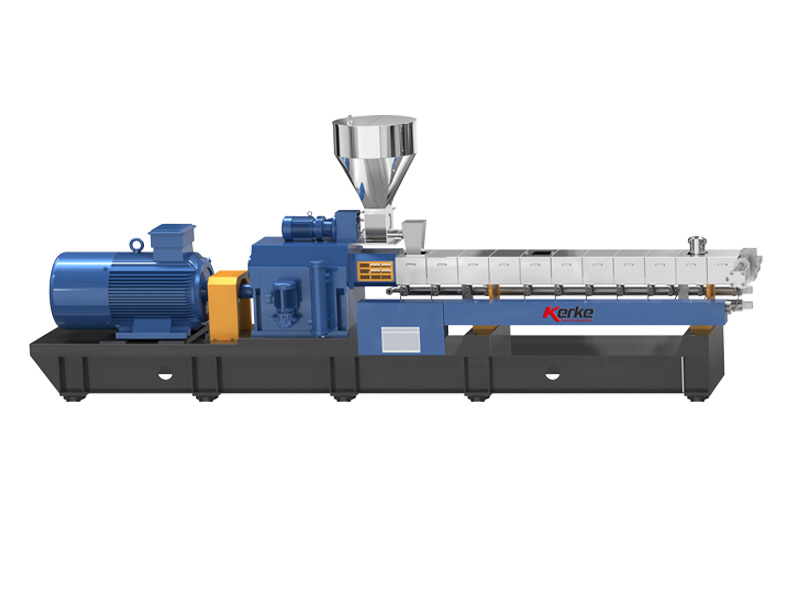
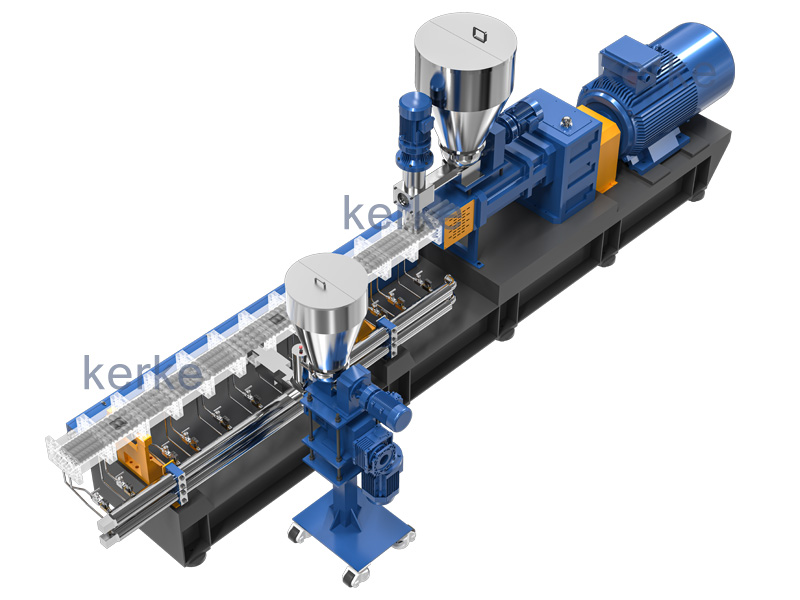
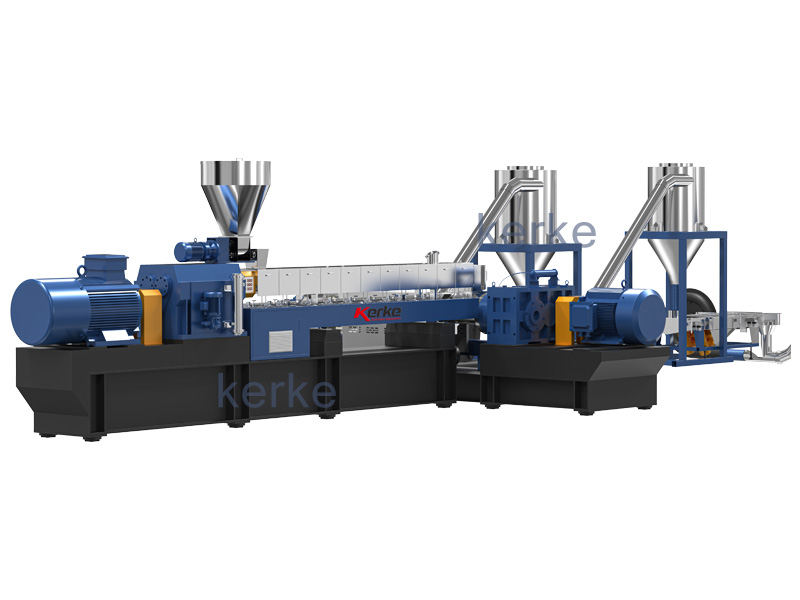
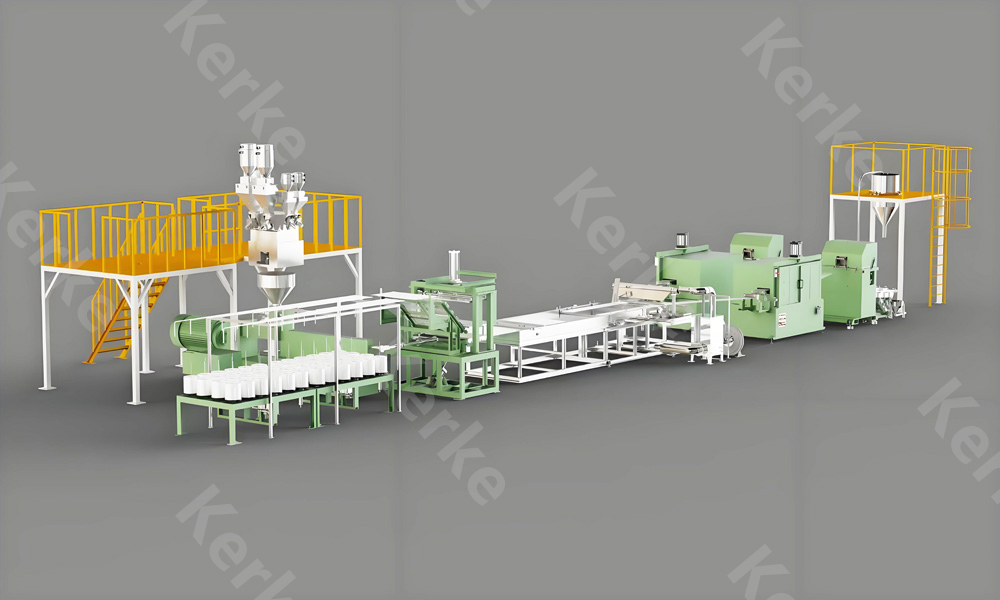
Masterbatch extrusion compounding is a core production process in the plastic coloring and functional modification industry, which determines the dispersion uniformity, pellet quality, production output and comprehensive production cost of color masterbatch, functional masterbatch and filler masterbatch products. Twin screw extruders, also widely known as masterbatch extruders and compounding extruders, are the mainstream core equipment for modern masterbatch production, relying on powerful shear mixing, material plasticization and homogenization capabilities to complete high-precision masterbatch compounding processing. Among all adjustable operational parameters of Kerke twin screw compounding extruders, screw speed is the most flexible and influential core parameter that directly affects material residence time, shear intensity, melt plasticization degree, pigment dispersion effect and unit hourly output.
Unreasonable screw speed setting is the primary cause of low production efficiency, poor masterbatch quality, high energy consumption and frequent equipment failure in most masterbatch factories. Excessively low screw speed leads to insufficient material shear dispersion, low hourly output, prolonged production cycles and increased unit labor costs. Excessively high screw speed causes excessive shear heat generation, pigment decomposition, carrier resin degradation, unstable melt pressure and serious pellet defects, which greatly reduces masterbatch qualification rate and increases raw material waste. This article systematically elaborates the working principle of screw speed in masterbatch compounding, classified speed optimization strategies for different masterbatch types, step-by-step speed debugging methods, parameter matching rules, common speed-related faults and solutions, as well as comprehensive cost and price benefit analysis based on Kerke professional twin screw extruders. It provides comprehensive and actionable technical guidance for masterbatch manufacturers to maximize extrusion efficiency and product quality.
1. Basic Principle: Why Screw Speed Dominates Masterbatch Extrusion Efficiency
1.1 Core Working Mechanism of Kerke Twin Screw Extruder for Masterbatch Compounding
Kerke co-rotating twin screw extruders are professionally optimized for masterbatch compounding and polymer modification production, featuring modular screw combination design, high-precision barrel structure and intelligent variable-speed drive system. Different from ordinary single screw extruders, Kerke masterbatch extruders rely on two intermeshing co-rotating screws to form a continuous material conveying, shearing, kneading, homogenizing and extrusion molding cycle. The screw rotation speed directly controls the material forward conveying speed and the number of shear kneading times per unit time in the barrel cavity.
In the masterbatch compounding process, pigment particles, functional additives, filler powders and carrier resins need to undergo multiple shear peeling and dispersion to eliminate particle agglomeration and achieve uniform mixing effect. Kerke compounding extruders adopt optimized screw element combinations including conveying elements, kneading blocks and reverse elements. The change of screw speed will directly adjust the matching relationship between shear force and material residence time, which fundamentally determines the final dispersion quality and production efficiency of masterbatch products. Reasonable speed matching can give full play to the high-efficiency mixing advantages of Kerke twin screw equipment, while unreasonable speed setting will completely offset the equipment’s structural performance advantages.
1.2 Dual Influence of Screw Speed on Production Efficiency and Product Quality
Screw speed presents a typical dynamic balance relationship between production efficiency and product quality in masterbatch extrusion production. In terms of production efficiency, the increase of screw speed improves the material conveying capacity per unit time of the extruder, effectively increasing hourly output and shortening the production cycle of batch orders. For large-batch conventional color masterbatch production, appropriate speed increase can significantly improve equipment utilization and reduce fixed production costs per unit product.
In terms of product quality, excessive screw speed will shorten the residence time of materials in the barrel, resulting in insufficient plasticization of carrier resin and incomplete dispersion of pigment agglomerates. Meanwhile, ultra-high speed rotation will generate excessive frictional shear heat, leading to thermal decomposition of heat-sensitive pigments and additives, causing masterbatch color deviation, color fading and spot defects. Too low screw speed will lead to prolonged material residence time, excessive thermal aging of materials, increased melt viscosity fluctuation, and reduced production efficiency, failing to meet factory mass production needs. Only precise speed optimization can realize the dual improvement of high output and high-quality masterbatch production.
1.3 Defects Caused by Improper Speed Setting in Traditional Masterbatch Production
Most traditional masterbatch production factories adopt empirical fixed-speed operation, resulting in widespread production defects and cost waste. Long-term low-speed operation leads to low equipment output, requiring more equipment and labor to complete order tasks, increasing factory site occupation and labor costs. Insufficient shear dispersion causes poor masterbatch tinting strength, unstable color difference of finished products, and high defective rate, which affects downstream customer product quality and causes order loss.
Blind high-speed operation leads to frequent material burning, particle unevenness, rough pellet surface and poor fluidity of masterbatch products. Excessive shear wear also accelerates the abrasion of Kerke extruder screw and barrel vulnerable parts, shortening equipment service life and increasing daily maintenance and replacement costs. In addition, mismatched screw speed and feeding speed will cause material accumulation in the barrel, unstable melt pressure, frequent equipment jamming and shutdown failures, seriously disrupting continuous production rhythm and bringing huge invisible economic losses to enterprises.
2. Key Influencing Factors of Masterbatch Extrusion Screw Speed Optimization
2.1 Masterbatch Product Type and Material Formula Characteristics
Different types of masterbatches have completely different adaptability to screw speed, which is the primary basis for speed parameter optimization. Conventional general color masterbatches with high carrier resin content and low pigment filling have strong thermal stability and wide speed adjustment range, which can adapt to medium and high-speed extrusion to pursue high production efficiency. High-filler masterbatches such as calcium carbonate masterbatch, talc masterbatch and titanium dioxide masterbatch contain a large number of inorganic powder fillers, which have poor lubricity and high wear resistance. Excessively high speed will aggravate equipment wear and cause uneven filler dispersion, so medium and low stable speed operation is required.
Heat-sensitive masterbatches such as fluorescent masterbatch, weather-resistant functional masterbatch and PVC color masterbatch are extremely sensitive to shear heat and residence time. High-speed operation will easily cause material decomposition and performance attenuation, so low-speed precise shear speed matching must be adopted. Low-viscosity carrier masterbatches have fast melt fluidity and short natural residence time, which need appropriately increased screw speed to avoid material overflow and insufficient mixing. Kerke twin screw extruders support personalized speed parameter storage for different masterbatch formulas, realizing one-key speed switching for different products and greatly improving debugging efficiency.
2.2 Extruder Model and Screw Structural Configuration
Kerke provides multiple series of twin screw compounding extruder models for masterbatch production, including small experimental models, medium conventional production models and large high-output industrial models, with different screw diameter, length-diameter ratio and screw element configuration, forming different speed operation ranges. Small-sized Kerke masterbatch extruders with small screw diameter and low torque are suitable for low and medium speed operation, mainly used for small-batch customized masterbatch and experimental formula verification. Medium-sized standard compounding extruders are the mainstream models for factory mass production, with moderate speed range and balanced efficiency and quality.
Large high-torque twin screw extruders are equipped with reinforced screw structures and high-power drive systems, supporting stable high-speed operation and meeting high-output production demands of large factories. In addition, the screw length-diameter ratio also affects speed optimization logic. Extruders with large length-diameter ratio have long material residence paths, which can appropriately increase screw speed to improve output; extruders with small length-diameter ratio have short residence time, and excessively high speed will easily cause insufficient plasticization, requiring strictly controlled speed range.
2.3 Feeding Speed and Melt Pressure Matching Relationship
Screw speed must be matched with quantitative feeding speed in real time to ensure stable material filling rate in the barrel, which is the core premise of efficient masterbatch extrusion. When the feeding speed is fixed, excessively low screw speed will lead to excessive material accumulation in the barrel, increased melt pressure, serious shear heat generation and even material burning. Excessively high screw speed will cause insufficient material filling, unstable melt pressure, uneven shear force, and poor masterbatch dispersion uniformity.
Kerke masterbatch extruders are equipped with intelligent linkage control systems, which can realize synchronous matching of screw speed and feeding speed. In the speed optimization process, operators need to adjust the speed ratio according to material bulk density and feeding volume. For high-bulk-density powder formulas, appropriately increase the speed difference to ensure full material dispersion; for low-bulk-density fluffy materials, reduce the speed matching difference to avoid material empty conveying. Stable speed-feeding matching can effectively stabilize melt pressure fluctuation within ±0.05MPa, ensuring consistent batch quality of masterbatch products.
2.4 Barrel Temperature and Cooling System Operating State
Barrel zoning temperature and circulating cooling system directly restrict the upper limit of screw speed. High-speed screw operation will generate a large amount of frictional shear heat inside the barrel. If the barrel temperature is set too high or the cooling water circulation is insufficient, the superposition of shear heat and heating temperature will cause material overheating decomposition. For high-speed extrusion production, the barrel temperature needs to be appropriately reduced, and the cooling water flow rate needs to be increased to balance shear heat generation.
For low-speed extrusion of heat-sensitive masterbatches, the barrel temperature can be appropriately increased to assist resin plasticization and make up for the insufficient shear plasticization caused by low speed. Kerke twin screw extruders adopt multi-stage independent zoning temperature control and circulating water cooling systems, with precise temperature control accuracy of ±1℃, which provides a stable temperature foundation for flexible screw speed optimization and avoids quality defects caused by temperature-speed mismatch.
3. Classified Screw Speed Optimization Strategies for Different Masterbatch Types
3.1 General Color Masterbatch: High-Efficiency Medium-High Speed Optimization Scheme
General PE, PP, ABS color masterbatches have stable material properties, low filler content and strong thermal stability, which are most suitable for medium-high speed efficient extrusion production. Taking the mainstream Kerke medium-sized twin screw compounding extruder as an example, the optimal screw speed range for conventional color masterbatch production is 350r/min to 450r/min. Under this speed range, the screw can provide sufficient shear force to fully disperse pigment particles, eliminate agglomeration spots, and ensure high tinting strength and uniform color difference of masterbatch products.
Matching with this speed, the feeding speed can be increased synchronously to improve hourly output by 20% to 30% compared with traditional low-speed operation. The medium-high speed operation will not cause material thermal decomposition, and can effectively shorten material residence time, avoid pigment aging and fading, and improve the surface smoothness and gloss of masterbatch pellets. In actual production, for dark color masterbatches with high pigment concentration, the speed can be appropriately reduced by 30 to 50r/min to ensure sufficient dispersion time; for light color low-concentration masterbatches, the upper limit speed can be adopted to maximize production efficiency.
3.2 High-Filler Masterbatch: Stable Medium-Low Speed Optimization Scheme
Inorganic high-filler masterbatches such as calcium carbonate masterbatch, talc masterbatch and titanium dioxide masterbatch contain 50% to 80% of inorganic powder fillers, which have high hardness and poor dispersion fluidity. High-speed operation will cause severe wear of screw and barrel, and lead to uneven filler dispersion and powder agglomeration. The optimal screw speed range for high-filler masterbatch production on Kerke compounding extruders is 200r/min to 300r/min.
The medium-low stable speed can ensure that the filler and carrier resin are fully kneaded and compounded under stable shear force, avoiding powder separation and precipitation defects. Although the single machine hourly output is slightly lower than that of color masterbatch, it effectively reduces the defective rate caused by dispersion failure and the replacement frequency of worn screw accessories. By optimizing the speed stability and matching with appropriate kneading block screw elements, the production qualification rate of high-filler masterbatch can be stabilized above 99.2%, and the comprehensive production cost is significantly reduced compared with blind high-speed production.
3.3 Heat-Sensitive Functional Masterbatch: Precise Low Speed Optimization Scheme
Heat-sensitive functional masterbatches including fluorescent masterbatch, anti-ultraviolet masterbatch, flame retardant masterbatch and PVC functional masterbatch are sensitive to shear heat and high temperature. Excessive speed and shear heat will damage the functional structure of additives, resulting in reduced product functionality, color fading and pellet carbonization. The optimal screw speed range for heat-sensitive masterbatch production is 120r/min to 200r/min.
Low-speed operation extends the material residence time appropriately, ensures full plasticization under low shear and low temperature conditions, and completely retains the functional activity of heat-sensitive additives. In the low-speed optimization process, it is necessary to cooperate with low-temperature zoning temperature setting and enhanced cooling circulation to avoid material overheating. Although the production efficiency of low-speed operation is relatively low, it effectively avoids functional failure and defective product waste of high-value functional masterbatches, and maximizes the qualified product yield of high-margin products, which is more in line with the cost-benefit logic of functional masterbatch production.
3.4 High-Viscosity Special Masterbatch: Variable Speed Gradient Optimization Scheme
Engineering plastic masterbatches such as PA, PC and PET have high carrier viscosity and difficult plasticization. Fixed single-speed operation is prone to uneven plasticization and unstable extrusion. Kerke twin screw extruders support variable gradient speed adjustment, which adopts low-speed feeding and high-speed homogenization segmented speed strategy. The feeding and preliminary plasticization section adopts 250r/min low speed to avoid material accumulation and incomplete melting; the intermediate kneading and homogenization section increases the speed to 380r/min to strengthen shear dispersion; the final extrusion molding section reduces the speed appropriately to stabilize melt pressure.
The gradient variable speed optimization scheme solves the contradiction between difficult plasticization of high-viscosity materials and insufficient high-speed dispersion, realizing stable extrusion production of special engineering masterbatches. This personalized speed adjustment mode is one of the core advantages of Kerke intelligent compounding extruders, which can meet the customized production needs of various special masterbatch products and expand the product processing range of factories.
4. Step-by-Step Screw Speed Debugging and Optimization Operation Process
4.1 Pre-Production Speed Parameter Confirmation and Preparation
Before starting masterbatch extrusion production, operators need to complete parameter preparation and equipment state inspection to lay a foundation for accurate speed optimization. First, confirm the masterbatch product formula type, carrier material and filler content, and call the pre-stored standard speed parameter template of the corresponding product in the Kerke extruder PLC intelligent control system. Second, check the screw wear state, barrel cleanliness and feeding system stability to ensure no foreign matter blockage and abnormal mechanical resistance, avoiding speed deviation caused by mechanical failure.
Third, complete the barrel zoning temperature preheating and constant temperature treatment, confirm that the temperature of each zone reaches the standard value and stabilizes for more than 20 minutes, ensuring uniform material plasticization environment. Fourth, debug the feeding system speed initially, reserve a reasonable speed matching range for subsequent screw speed fine-tuning, and record the initial speed and feeding parameter values to facilitate comparative optimization and data tracking.
4.2 Initial Low-Speed Trial Extrusion and State Observation
Start the equipment for low-speed trial extrusion with 50% of the standard optimal speed to avoid material burning and equipment jamming caused by rapid high-speed startup. During the trial extrusion process, observe the material plasticization state, pellet appearance and melt pressure change in real time. If the pellets have rough surface, color spots and poor dispersion, it indicates insufficient shear force, and the screw speed needs to be increased gradually. If the pellets have yellowing, carbonization and bubble defects, it indicates excessive shear heat generation, and the speed needs to be reduced appropriately.
Record the pellet quality state and pressure fluctuation data under the initial trial speed, clarify the speed adjustment direction, and avoid blind large-scale speed adjustment leading to repeated trial production and raw material waste. The low-speed trial extrusion stage can effectively eliminate potential equipment and parameter risks, and provide accurate data support for formal speed optimization.
4.3 Gradual Fine-Tuning to Optimal Speed Range
On the basis of stable trial extrusion, carry out gradual fine-tuning of screw speed with the adjustment interval of 20 to 30r/min each time. After each speed adjustment, keep the equipment running stably for 5 to 10 minutes to ensure stable material conveying and shear state, then sample and detect pellet quality, dispersion uniformity and output data. Continuously optimize the speed until the masterbatch products have smooth surface, uniform color, no agglomeration spots and stable dimensional consistency, and the equipment melt pressure fluctuation is within the standard range.
In the fine-tuning process, balance the relationship between output efficiency and product quality. On the premise of ensuring 100% qualified product quality, appropriately push the speed to the upper limit of the optimal range to maximize unit output. For mass production formulas, fix the optimal speed parameters and save them to the system formula library to realize one-key calling in subsequent production and avoid repeated debugging.
4.4 Synchronous Matching Adjustment of Auxiliary Parameters
After determining the optimal screw speed, synchronously adjust the matching auxiliary parameters to form a complete parameter system. First, adjust the feeding speed synchronously to ensure stable material filling rate and avoid material accumulation or empty conveying. Second, fine-tune the barrel zoning temperature, appropriately reduce the temperature of the shear section according to the shear heat generated by high-speed operation, and supplement the plasticization temperature of low-speed operation sections. Third, adjust the cooling water flow rate and vacuum exhaust system parameters to eliminate bubbles and thermal deformation defects caused by speed changes.
Fourth, adjust the pelletizing machine speed and traction speed to match the extrusion output speed, ensuring uniform pellet length and neat appearance. The synchronous matching of all parameters ensures that the screw speed optimization can give full play to the efficiency improvement effect and avoid single parameter adjustment leading to unbalanced production state.
4.5 Stable Production Verification and Parameter Locking
After completing all parameter adjustments, carry out 1 to 2 hours of continuous stable production verification, continuously sample and test masterbatch tinting strength, color difference, dispersion grade and physical properties. Confirm that the product quality is stable and qualified, the equipment operates without abnormal noise, pressure fluctuation and temperature over-limit alarm, and the hourly output reaches the optimal standard. After the verification is passed, lock the optimized screw speed and matching auxiliary parameters in the system to prevent accidental parameter modification by novice operators.
Record the optimized parameter data, production output and product qualification rate in the production log, form standardized production process documents, and provide standardized operation basis for subsequent batch production of the same formula, realizing standardized and efficient production management.
5. Common Speed Mismatch Faults, Causes and Optimization Solutions
5.1 Low Masterbatch Dispersion and Insufficient Tinting Strength
This fault is mainly manifested in uneven masterbatch color, obvious pigment particles, poor tinting effect after mixing with base material, and low product qualification rate. The core cause is that the screw speed is too low, resulting in insufficient shear kneading times, incomplete peeling and dispersion of pigment and filler agglomerates, and poor material homogenization effect. In addition, the mismatch between low speed and excessive feeding volume will also lead to short-term material accumulation and insufficient shear action.
The optimization solution is to appropriately increase the screw speed according to the product formula, adjust to the medium speed range matching the formula characteristics, and synchronously calibrate the feeding speed to ensure stable material filling rate. For high-filler and high-concentration pigment formulas, increase the speed by 30 to 50r/min on the basis of the original speed to strengthen shear dispersion, and cooperate with appropriate temperature adjustment to improve resin plasticization effect, so as to comprehensively improve masterbatch dispersion uniformity and tinting strength.
5.2 Masterbatch Pellet Yellowing, Carbonization and Thermal Decomposition
Pellet yellowing, black spots and material burning are typical defects caused by excessive screw speed. Ultra-high speed operation generates a large amount of frictional shear heat, which makes the local temperature in the barrel far exceed the material heat resistance temperature, leading to thermal decomposition and aging of carrier resin and heat-sensitive additives. This fault is more likely to occur in heat-sensitive masterbatch and low-temperature resistant material formulas, and will seriously affect product performance and appearance quality.
The solution is to immediately reduce the screw speed to the formula-adaptable low and medium speed range, appropriately reduce the temperature of the shear and kneading sections of the barrel, and increase the cooling water circulation flow rate to eliminate excessive shear heat. After speed adjustment, clean the residual carbonized materials in the barrel, and carry out trial extrusion production again until the pellet appearance and performance return to normal. For formulas prone to thermal decomposition, set the upper limit speed protection in the equipment system to avoid excessive speed operation.
5.3 Unstable Extrusion Output and Fluctuating Pellet Size
Unstable hourly output and uneven pellet length and size are mainly caused by frequent screw speed fluctuation and asynchronous speed-feeding matching. Unreasonable speed setting will cause periodic material accumulation and empty conveying in the barrel, resulting in unstable melt pressure and fluctuating extrusion volume. Too fast speed adjustment speed and unsmooth speed transition will also lead to unstable equipment operation state and inconsistent product molding.
The optimization method is to adopt gradual speed adjustment mode, avoid sudden speed increase or decrease, and lock the optimal stable speed after debugging. Calibrate the linkage ratio between screw speed and feeding speed to realize synchronous speed change and stable material conveying. Regularly check the screw drive system and motor operating state to eliminate mechanical speed fluctuation faults, ensure long-term stable operation of the equipment, and stabilize pellet size and production output consistency.
5.4 Severe Screw and Barrel Wear and Short Service Life
Long-term blind high-speed operation, especially high-speed production of high-filler masterbatches, will cause severe abrasive wear of screw elements and barrel inner wall. Excessive speed increases the friction times between hard fillers and mechanical accessories, accelerating the wear and aging of vulnerable parts, increasing equipment maintenance costs, and even affecting equipment operation accuracy and service life.
The solution is to classify and limit the speed according to the masterbatch formula, strictly adopt medium and low stable speed operation for high-filler abrasive materials, and avoid pursuing high output at the cost of equipment wear. Regularly detect the screw wear degree, replace worn accessories in time, and match the screw element combination suitable for high-filler production. Reasonable speed control can extend the service life of screw and barrel by more than 25%, greatly reducing long-term equipment maintenance costs.
6. Equipment Price and Full-Cycle Cost-Benefit Analysis of Speed Optimization
6.1 Kerke Masterbatch Extruder Standard Price Range
Kerke provides serialized twin screw compounding extruders specially designed for masterbatch production, with stable performance and professional speed regulation system, covering small, medium and large production models to meet different factory scale demands. The FOB price of small experimental Kerke twin screw masterbatch extruders suitable for formula research and development and small-batch production ranges from 28,000 US dollars to 36,000 US dollars. The standard medium-sized compounding extruders, the mainstream model for mass production of color masterbatch and functional masterbatch, are priced at 45,000 US dollars to 58,000 US dollars.
The large high-torque twin screw extruders for high-output industrial masterbatch production have a price range of 62,000 US dollars to 75,000 US dollars. All standard models are equipped with intelligent variable-frequency speed regulation systems, PLC parameter locking and formula storage functions, supporting precise screw speed optimization and stable long-term operation. Optional customized configurations such as high-precision vacuum exhaust system and intelligent online quality detection module are priced at 2,500 US dollars to 5,000 US dollars, which can be selected according to production needs.
6.2 Operating Cost Changes Brought by Scientific Speed Optimization
Scientific screw speed optimization can significantly reduce the comprehensive operating cost of masterbatch production, covering energy consumption cost, raw material cost and maintenance cost. In terms of power consumption cost, unreasonable high-speed operation increases invalid power consumption and shear heat loss. After standardized speed optimization, the actual hourly power consumption of Kerke extruders is reduced by 18% to 25%. Calculated based on 16-hour daily production and 300-day annual working hours, a single medium-sized extruder can save 5,000 to 7,000 US dollars in annual electricity costs.
In terms of raw material cost, optimized speed parameters stabilize the product qualification rate above 99.2%, reducing the defective rate from the traditional 5% to 8% to less than 0.8%. It saves 20 to 40 tons of masterbatch raw materials annually for a single production line, reducing raw material waste cost by 35,000 to 65,000 US dollars. In terms of maintenance cost, reasonable speed operation reduces screw and barrel wear, extending the replacement cycle of vulnerable parts. The annual equipment maintenance cost is reduced from 3,200 US dollars to less than 2,000 US dollars, bringing continuous cost-saving benefits.
6.3 Production Efficiency Improvement and Profit Growth Analysis
Blind low-speed operation leads to low equipment output and low profit per unit equipment. Scientific speed optimization balances efficiency and quality, realizing maximum output under qualified product quality. After speed parameter optimization, the hourly output of conventional color masterbatch production is increased by 20% to 30%, and the annual output of a single medium-sized production line is increased by 80 to 120 tons. Based on the average profit margin of masterbatch products, it can increase annual profit income by 40,000 to 80,000 US dollars for enterprises.
At the same time, stable product quality improves customer satisfaction and order repurchase rate, reducing after-sales compensation and order loss losses caused by quality problems. The standardized speed parameter system realizes rapid product switching and formula debugging, shortening trial production time and improving equipment operation rate. The comprehensive investment payback period of relying on speed optimization to improve efficiency and reduce costs is only 2 to 3 months, with extremely high cost performance and long-term economic benefits.
7. Long-Term Speed Operation Management and Standardized Production Specifications
7.1 Establish Product Classification Speed Parameter Library
Masterbatch production factories should establish a complete classification speed parameter library based on Kerke extruder equipment characteristics and product formulas. Classify and store optimal speed parameters for general color masterbatch, high-filler masterbatch, heat-sensitive functional masterbatch and special engineering masterbatch respectively. Each formula corresponds to fixed optimal speed range, feeding matching ratio and auxiliary parameter standards.
Unified parameter standards avoid random debugging by different operators, realize standardized production of different batches of products, and ensure stable product quality consistency. Regularly update and optimize the parameter library according to raw material batch changes and production process upgrades, continuously improve production efficiency and product quality, and form standardized enterprise production process specifications.
7.2 Daily Speed Operation Inspection and Data Monitoring
Arrange special personnel to conduct daily inspection and monitoring of screw speed operating parameters. Check whether the actual operating speed is consistent with the standard optimal speed, whether there is abnormal speed fluctuation and parameter drift every shift. Use the equipment’s built-in data recording system to track speed changes, output data and product quality data in real time, form daily production data reports, and find out abnormal speed operation problems in time.
For long-term continuous production equipment, conduct weekly speed parameter calibration to eliminate speed errors caused by mechanical wear and system drift, ensuring long-term accurate and stable speed operation. Standard daily monitoring management can effectively avoid quality and efficiency losses caused by subtle speed parameter changes.
7.3 Operator Professional Speed Debugging Training
Regularly carry out professional technical training for production operators, focusing on the speed optimization principle of different masterbatch formulas, standard debugging steps and fault judgment methods. Enable operators to clearly master the speed adjustment logic, not only rely on fixed parameters, but also flexibly fine-tune speed according to raw material changes, environmental temperature and equipment operating state.
Kerke provides free professional technical training for cooperative customers, including in-depth explanation of twin screw extruder speed matching technology, on-site debugging demonstration and fault handling guidance, helping enterprise technical teams master independent optimization capabilities, maximize equipment production efficiency, and give full play to the performance advantages of Kerke compounding extruders, masterbatch extruders and twin screw extruders.
8. Kerke Brand Technical Advantages and After-Sales Support
As a professional manufacturer of twin screw compounding extruders, Kerke has long been committed to the research and development and upgrading of masterbatch extrusion equipment, focusing on solving the pain points of low efficiency, unstable quality and high energy consumption in masterbatch production. All Kerke twin screw extruders adopt high-precision variable-frequency speed regulation systems, with stable speed regulation accuracy, no fluctuation in long-term operation, and support micro-adjustment of 1r/min precision, providing accurate parameter basis for fine speed optimization.
The professional modular screw design of Kerke equipment matches the speed optimization logic of different masterbatch products, realizing perfect coordination of shear force, residence time and extrusion speed. The intelligent PLC control system pre-stores a large number of mature masterbatch production speed formulas, which can quickly adapt to different production needs and reduce the threshold of operator debugging. Compared with ordinary extruder equipment on the market, Kerke masterbatch extruders have more flexible speed adjustment range, higher operation stability and better production adaptability.
In terms of after-sales service, Kerke provides one-stop full-cycle technical support for customers. In the pre-sales stage, professional engineers formulate personalized equipment selection and speed parameter optimization schemes according to customer product types, production scale and budget. In the after-sales stage, provide free on-site installation and commissioning, operator technical training and production process guidance to help customers quickly master speed optimization skills and realize efficient production.
All Kerke equipment enjoys a two-year full-machine free warranty and lifelong low-cost maintenance services, with 24-hour remote technical support. For any speed parameter debugging problems and production abnormal faults encountered by customers in the production process, the technical team can respond quickly to provide professional solutions, ensuring long-term stable and efficient operation of the equipment and continuous improvement of enterprise production benefits.
9. Conclusion
Screw speed is the core adjustable parameter that determines the production efficiency and product quality of masterbatch extrusion compounding production. Blind fixed-speed operation and empirical debugging will lead to low equipment efficiency, high defective rate, serious energy waste and increased equipment loss, restricting the profit growth and standardized development of masterbatch manufacturing enterprises. Scientific and classified screw speed optimization can perfectly balance the dual goals of high production efficiency and high masterbatch quality, and is the most effective low-cost and high-efficiency production improvement measure for masterbatch factories.
Kerke twin screw extruders, professional compounding extruders and masterbatch extruders are professionally optimized for masterbatch production characteristics, with precise speed regulation performance, flexible parameter adjustment functions and stable mechanical structure, providing reliable equipment support for speed optimization production. By formulating classified speed optimization schemes according to different masterbatch formulas, standardizing debugging operation processes, establishing long-term parameter management mechanisms and matching professional technical operation standards, enterprises can significantly improve production output, stabilize product quality, reduce comprehensive production costs and enhance market core competitiveness.
For modern masterbatch manufacturing enterprises pursuing refined production, efficient output and low-cost operation, mastering scientific screw speed optimization technology and giving full play to the performance advantages of Kerke masterbatch extrusion equipment is an important way to realize standardized production, profit improvement and sustainable industrial development.