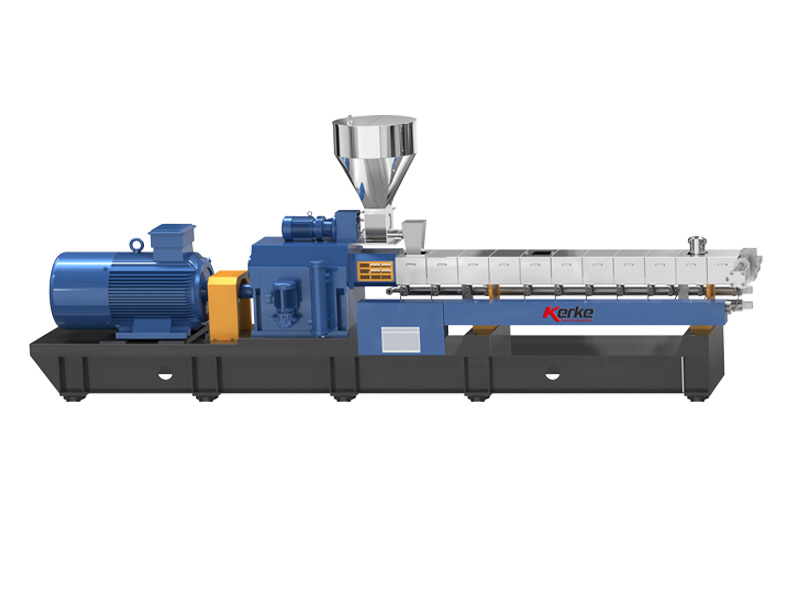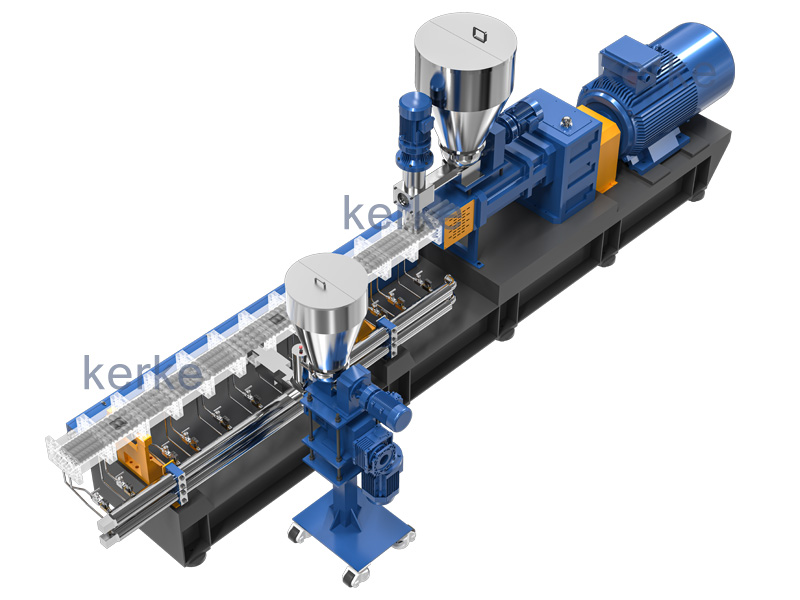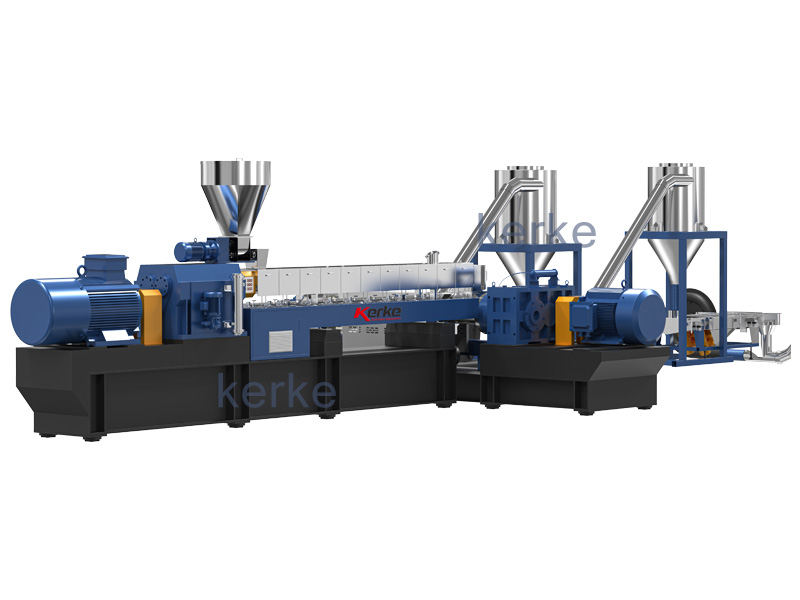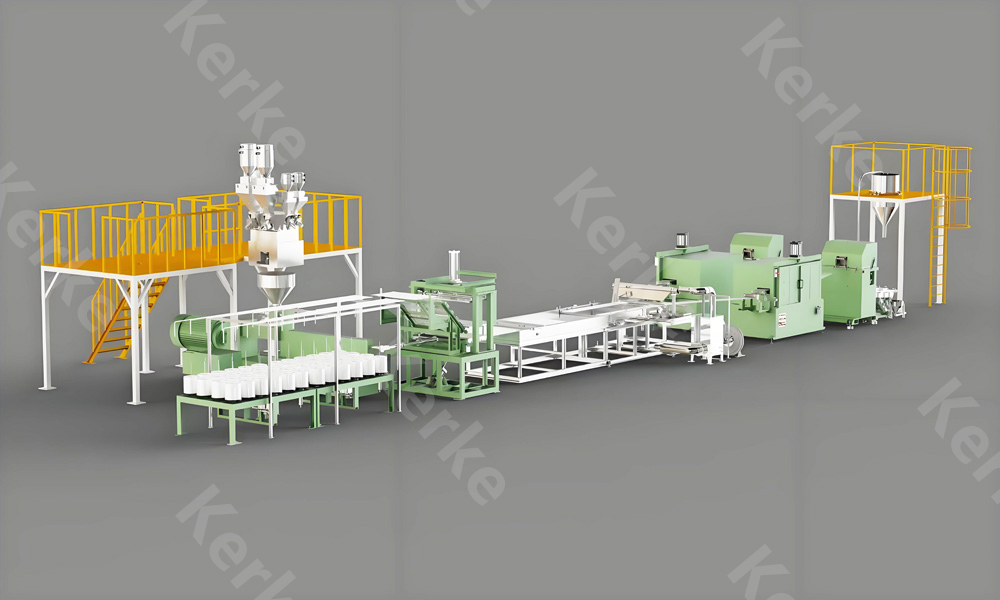
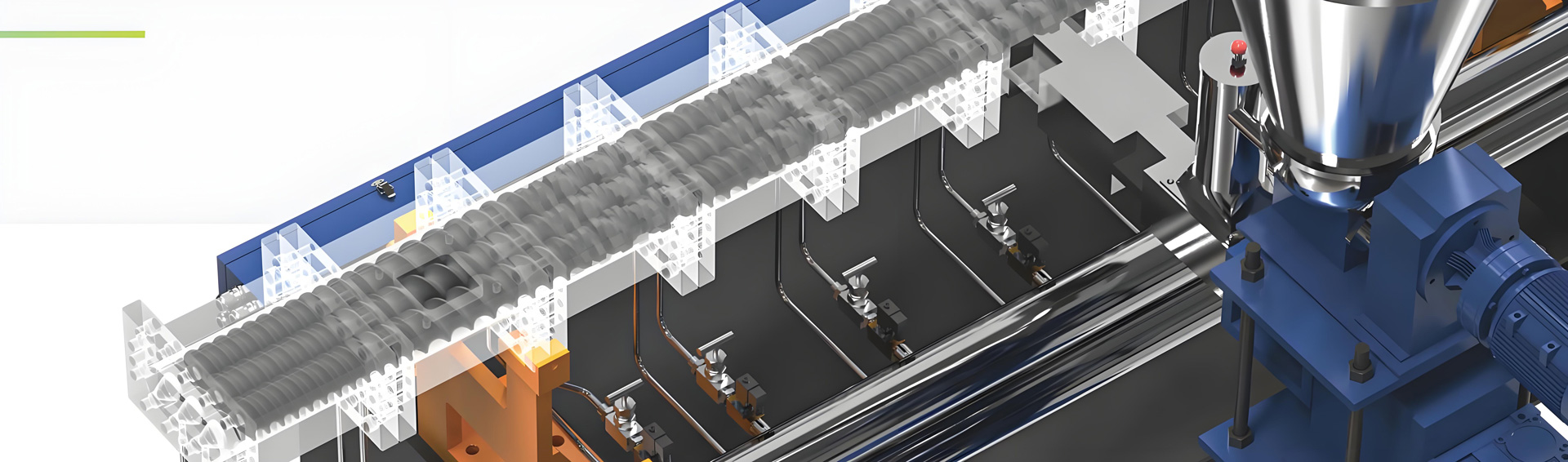
Thermal degradation represents one of the most critical challenges in plastic extrusion, affecting material properties, product quality, and processing efficiency. Twin screw extruders engineered for superior thermal management enable manufacturers to minimize thermal degradation while maintaining production efficiency and product consistency. This comprehensive analysis examines the mechanisms of thermal degradation, advanced thermal management technologies, and operational strategies that enable twin screw extruders to preserve material integrity, with detailed focus on Kerke extruder solutions and cost considerations.
Understanding Thermal Degradation in Extrusion
Mechanisms of Polymer Degradation
Polymer degradation during extrusion occurs through multiple mechanisms including thermal degradation, oxidative degradation, hydrolytic degradation, and mechanical degradation. These mechanisms often occur simultaneously, with synergistic effects that accelerate material breakdown. Understanding these degradation mechanisms enables development of effective strategies for material preservation during processing.
Thermal degradation involves molecular chain scission caused by elevated temperatures exceeding polymer stability limits. This degradation typically follows Arrhenius kinetics, with degradation rate approximately doubling for every 10°C increase in temperature. Polymers begin thermal degradation at specific temperatures, with polyethylene starting around 300°C, polypropylene around 280°C, and PVC as low as 140°C. Twin screw extruders must process materials below these degradation thresholds while maintaining adequate melt fluidity for processing.
Oxidative degradation results from reaction with oxygen at elevated temperatures, forming peroxides and hydroperoxides that initiate chain scission. This degradation mechanism becomes particularly significant for polymers exposed to oxygen during processing, especially at temperatures above 200°C. Kerke twin screw extruders minimize oxidative degradation through nitrogen blanketing systems that displace oxygen from the melt and minimize exposure time to elevated temperatures.
Hydrolytic degradation occurs in susceptible polymers including polyesters (PET, PBT) and polycarbonates when exposed to moisture at elevated temperatures. Even trace amounts of moisture (0.01-0.02%) can cause significant molecular weight reduction in these materials. Kerke extruders prevent hydrolytic degradation through effective devolatilization systems that remove moisture before it can react with the polymer.
Effects of Thermal Degradation
Molecular weight reduction represents the primary effect of thermal degradation, directly impacting mechanical properties and processing characteristics. Polymer molecular weight typically decreases by 10-30% during standard extrusion operations, with greater reduction in poorly controlled processes. This molecular weight reduction reduces tensile strength, impact resistance, and melt viscosity, affecting product performance and processing stability.
Color changes occur when thermal degradation produces chromophores in the polymer matrix. Color shifts from yellowing to browning indicate degradation severity, with even subtle color changes indicating significant molecular damage. Kerke twin screw extruders minimize color degradation through precise temperature control and short residence times, maintaining color within 2-3 delta E units for most materials.
Volatile degradation products formation occurs as thermal degradation produces low-molecular-weight compounds including monomers, oligomers, and small molecules. These volatiles can create voids, bubbles, and surface defects in extruded products, particularly in sheet, film, and profile applications. Kerke extruders incorporate effective venting systems that remove volatiles before they affect product quality.
Odor development represents another consequence of thermal degradation, particularly problematic for food packaging and consumer applications. Degradation products can create unpleasant odors that persist in finished products, affecting product acceptability. Kerke extruder designs minimize odor formation through low-temperature processing and effective volatile removal.
Temperature Exposure Factors
Residence time represents a critical factor in thermal degradation, with longer exposure increasing degradation extent. Typical residence times in twin screw extruders range from 30 seconds to 5 minutes, with degradation increasing approximately linearly with residence time above the degradation threshold temperature. Kerke extruders optimize residence time through screw design that provides adequate mixing while minimizing unnecessary exposure to elevated temperatures.
Temperature gradient across the barrel creates regions of varying degradation rates. Hot spots within the melt can cause localized degradation even when average temperatures remain within acceptable limits. Kerke barrel designs with uniform heating and effective mixing eliminate temperature gradients, ensuring uniform thermal history throughout the material.
Shear heating contributes significantly to temperature rise, particularly in high-viscosity materials and high-shear processing zones. Shear-generated heat can increase melt temperature by 10-30°C above barrel set temperatures, potentially pushing materials into degradation zones. Kerke screw designs minimize excessive shear heating while maintaining adequate mixing and dispersion.
Thermal Management Technologies
Advanced Temperature Control Systems
Multi-zone barrel heating provides precise temperature control along the extruder length, enabling optimization of temperature profiles for specific materials and processing requirements. Kerke twin screw extruders feature 8-12 independent temperature zones, each with individual PID controllers maintaining temperatures within ±1°C of setpoint. This precise control prevents temperature excursions that could trigger degradation.
Electric heating elements with rapid response times enable quick temperature adjustments while maintaining stability. Kerke utilizes cartridge heaters with 50-100 W/inch² power density, providing sufficient heating capacity for most polymers while maintaining rapid response for temperature control. This responsive heating prevents temperature overshoot during startups and processing changes.
Cooling systems integrated with heating zones enable removal of excess heat generated by shear heating and exothermic reactions. Kerke barrel cooling systems use water or oil circulation through channels surrounding heating elements, removing 1-3 kW of heat per zone depending on operating conditions. This heat removal capability prevents thermal runaway during high-shear processing.
Modular Barrel Design
Nitrided steel barrels provide excellent wear resistance and thermal conductivity, enabling efficient heat transfer and uniform temperature distribution. Kerke barrels feature nitrided steel with hardness HRC 60-65 and thermal conductivity of 45-50 W/m-K, providing excellent temperature control and wear resistance. This construction enables long service life while maintaining thermal performance.
Bimetallic barrel liners offer enhanced wear resistance and thermal properties for demanding applications. Kerke provides bimetallic barrels with tungsten carbide or nickel-based alloy liners for abrasive or corrosive materials. These liners provide 3-5 times the service life of standard nitrided barrels while maintaining thermal conductivity adequate for precise temperature control.
Vented barrel sections facilitate removal of volatiles and moisture that could contribute to degradation. Kerke provides vented barrel sections with atmospheric or vacuum venting capabilities, removing degradation products and moisture before they can affect material quality. Vent ports positioned strategically maximize volatile removal while maintaining material flow.
Screw Configuration Optimization
Conveying section design establishes residence time and heat input during material feeding and initial melting. Kerke conveying elements feature optimized flight depths and pitches that provide adequate residence time for melting while minimizing unnecessary exposure to elevated temperatures. This optimization reduces overall thermal exposure while maintaining processing efficiency.
Melting zone configuration balances efficient melting with thermal stress minimization. Kerke melting sections use progressive compression with increasing shear intensity, melting materials gradually to prevent thermal shock. This gradual melting reduces peak temperature requirements while ensuring complete melting before mixing zones.
Mixing zone design achieves adequate dispersion with minimal additional temperature increase. Kerke mixing sections use optimized kneading block configurations that provide sufficient shear for dispersion while limiting shear heating. These configurations achieve target dispersion quality with temperature increases of only 5-10°C above melting zone temperatures.
Material-Specific Degradation Prevention
Polyolefin Processing
Polyethylene and polypropylene processing requires careful temperature control to prevent degradation while maintaining adequate melt fluidity. Polyethylene begins thermal degradation around 300°C, while polypropylene starts degrading around 280°C. Kerke twin screw extruders process polyolefins at 180-240°C, maintaining safety margins of 60-80°C below degradation thresholds while providing adequate processing characteristics.
Polypropylene presents particular challenges due to its stereoisomer sensitivity to thermal degradation. Isotactic PP can undergo chain scission and stereoisomer formation at elevated temperatures, affecting crystallinity and mechanical properties. Kerke extruders process PP at 200-230°C with residence times under 3 minutes, maintaining molecular weight within 90-95% of starting values.
High-density polyethylene (HDPE) typically requires higher processing temperatures (200-240°C) compared to LDPE (160-190°C) due to higher melting points. Kerke extruders accommodate these different processing requirements through configurable temperature profiles and screw geometries optimized for each material type.
Engineering Plastics Processing
Engineering plastics including polyamide, polycarbonate, and polyester require careful thermal management due to relatively low degradation thresholds and sensitivity to moisture. Polyamide begins degrading around 260°C, polycarbonate around 290°C, and PET/PBT around 280°C. Kerke extruders process these materials at 220-270°C with appropriate safety margins, minimizing degradation while maintaining processing efficiency.
Polyamide processing requires strict moisture control due to hydrolytic degradation sensitivity. Even trace moisture (0.01-0.02%) can cause molecular weight reduction and property loss. Kerke extruders incorporate effective venting systems and optional nitrogen blanketing that remove moisture and prevent hydrolytic degradation, maintaining molecular weight within 95-100% of starting values.
Polycarbonate presents thermal degradation challenges due to its relatively low glass transition temperature (150°C) and degradation onset around 290°C. This narrow processing window requires precise temperature control and short residence times. Kerke extruders process PC at 260-280°C with residence times under 2 minutes, maintaining color and molecular quality.
PVC Processing
Polyvinyl chloride represents one of the most thermally sensitive common polymers, beginning dehydrochlorination at temperatures as low as 140°C. This degradation releases HCl gas, accelerating further degradation in autocatalytic reaction. Kerke twin screw extruders process PVC at 160-190°C with residence times under 2 minutes, minimizing degradation while achieving adequate processing characteristics.
PVC formulations typically include heat stabilizers that scavenge HCl and prevent autocatalytic degradation. Kerke extruders ensure uniform distribution of these stabilizers through optimized mixing sections, enabling effective protection throughout the material volume. This uniform stabilizer distribution extends processing windows and product service life.
Temperature profile optimization becomes critical for PVC processing to minimize residence time at elevated temperatures. Kerke PVC screw configurations minimize melting time and maintain temperatures just above processing requirements, reducing thermal exposure. This optimization enables PVC processing with molecular weight retention above 95% in most applications.
Kerke Twin Screw Extruder Features
Temperature Control Systems
PID temperature controllers with auto-tuning capabilities maintain precise barrel temperatures. Kerke extruders feature advanced PID controllers that automatically tune based on process characteristics, maintaining temperatures within ±1°C of setpoint even during load changes. This precision prevents temperature excursions that could trigger degradation.
Rapid heating and cooling response enables quick temperature adjustments during startups and processing changes. Kerke heating systems achieve heating rates of 5-10°C per minute, while cooling systems remove excess heat at 3-7°C per minute. This responsive control minimizes time spent in transition temperatures where degradation risks increase.
Temperature monitoring with multiple sensors per zone ensures accurate temperature assessment and control. Kerke provides 2-3 temperature sensors per zone positioned at different depths and circumferential locations, detecting temperature gradients and enabling corrective action before material degradation occurs.
Nitrogen Blanketing Systems
Oxygen displacement prevents oxidative degradation during processing, particularly important for susceptible polymers and extended residence times. Kerke nitrogen blanketing systems maintain oxygen levels below 0.5% in the melt, reducing oxidative degradation by 70-90% compared to unblanketed processing.
Nitrogen injection points strategically positioned maximize oxygen displacement efficiency. Kerke provides nitrogen injection at material feeding points, after venting zones, and at melt discharge points, ensuring complete oxygen removal throughout the processing length. This comprehensive blanketing provides maximum protection against oxidative degradation.
Gas flow control maintains appropriate nitrogen consumption while ensuring oxygen removal. Kerke systems automatically adjust nitrogen flow based on processing conditions, consuming 0.5-2.0 cubic meters per hour depending on machine size and material. This optimized consumption provides effective protection while minimizing operating costs.
Advanced Devolatilization
Vacuum venting removes high-boiling volatiles that can contribute to degradation product formation. Kerke vacuum venting systems achieve 0.1-0.3 bar absolute pressure, effectively removing moisture, residual monomers, and degradation products. This volatile removal reduces defect formation and prevents secondary degradation reactions.
Vent port design maximizes volatile removal while maintaining material flow. Kerke vent ports feature large openings (30-50mm diameter depending on machine size) with extended dwell sections that provide adequate time for volatile separation. This design achieves volatile removal efficiencies of 80-95% for most applications.
Vent port positioning optimizes removal of different volatiles at appropriate processing stages. Kerke provides vent ports after melting zones for moisture removal and after mixing zones for degradation product removal. This staged venting addresses different volatile types at optimal processing conditions.
Operational Strategies for Degradation Minimization
Startup and Shutdown Procedures
Gradual temperature ramping during startup prevents thermal shock and reduces degradation risks. Kerke recommended startup procedures increase temperatures at 3-5°C per minute from ambient to processing temperatures, allowing uniform heating throughout the barrel. This gradual ramping prevents hot spots and material overheating during startup.
Purge material selection prevents contamination and degradation during startups. Kerke recommends using purge materials compatible with both the production material and the previous material, typically using low-melt-index polyethylene for general purging. Appropriate purge materials remove previous material while minimizing degradation risks.
Shutdown cooling procedures prevent degradation during cooling. Kerke recommends shutting off heating and maintaining material flow until barrel temperatures drop below material melting points, then purging with clean material. This procedure prevents material degradation from extended residence at elevated temperatures during cooling.
Material Handling and Preparation
Drying systems remove moisture that can cause hydrolytic degradation in susceptible polymers. Kerke recommends desiccant dryers maintaining material moisture below 0.01% for polyesters and polycarbonates. Proper drying prevents hydrolytic degradation that can cause significant molecular weight reduction during processing.
Material storage conditions prevent pre-processing degradation and contamination. Kerke recommends storing materials at controlled temperatures (15-25°C) and humidity (below 50% RH) in sealed containers. These conditions prevent moisture absorption and thermal aging that could affect processing stability.
Material inspection before processing identifies potential degradation sources before they affect production. Kerke recommends visual inspection for color changes, moisture testing, and melt flow index measurement before loading materials. This inspection prevents processing of already degraded materials that could affect final product quality.
Process Monitoring and Control
Melt pressure monitoring provides insight into viscosity changes that may indicate degradation. Kerke extruders include pressure sensors at multiple barrel locations that monitor melt pressure during operation. Sudden pressure drops can indicate molecular weight reduction from degradation, enabling corrective action before significant material damage occurs.
Melt temperature measurement using shielded thermocouples provides accurate assessment of actual material temperatures. Kerke provides melt thermocouples at discharge and intermediate locations, measuring actual melt temperatures that may differ from barrel set temperatures due to shear heating. This monitoring enables optimization of processing conditions to prevent overheating.
In-line rheology assessment provides continuous evaluation of molecular weight during processing. Kerke offers optional in-line rheometers that measure melt viscosity at multiple shear rates, detecting viscosity changes that may indicate degradation. Real-time rheology monitoring enables immediate process adjustments to prevent ongoing degradation.
Cost Analysis and Economic Considerations
Equipment Investment for Thermal Management
Standard Kerke twin screw extruders include basic temperature control systems providing adequate thermal management for most applications. Standard models such as KTE-50B cost $45,000-60,000 and include 8-zone temperature control with PID controllers and standard heating/cooling systems. These systems provide sufficient thermal control for typical polyolefin and engineering plastic processing.
Enhanced thermal management options including nitrogen blanketing, advanced devolatilization, and in-line monitoring add $15,000-40,000 to equipment costs depending on configuration. These enhanced features provide additional protection for sensitive materials and high-value applications, reducing material waste and improving product quality.
Complete systems with comprehensive thermal management including dryers, nitrogen generators, and quality monitoring may total $100,000-200,000 depending on production capacity. These complete systems provide maximum protection against degradation while enabling monitoring and documentation of thermal history for quality assurance.
Operating Cost Considerations
Nitrogen consumption represents an operating cost for blanketed processing, typically $0.05-0.15 per kg of material depending on machine size and blanketing requirements. This cost provides substantial benefits through reduced degradation, improved product quality, and extended material usability that typically outweigh the nitrogen expense.
Energy consumption for heating and cooling varies by material and processing conditions. Kerke extruders consume 0.4-0.6 kWh per kg of output, corresponding to $0.04-0.06 per kg at $0.10 per kWh energy costs. Effective thermal management through optimized processing conditions can reduce energy consumption by 10-20% compared to unoptimized processes.
Material waste reduction provides significant economic benefits through improved yields. Degradation prevention increases usable material yield from 96-98% to 99-99.5%, saving $0.02-0.08 per kg on typical $2-4 per kg materials. For high-value materials costing $10-20 per kg, this yield improvement saves $0.10-0.40 per kg.
Return on Investment Analysis
Material cost savings from reduced degradation typically provide ROI within 18-36 months. Reduction in scrap from 4% to 0.5% saves $0.07-0.14 per kg for typical materials. At 1000 kg/hour production, 6000 hours/year, this saves $420,000-840,000 annually, providing rapid return on enhanced thermal management investment.
Product quality improvements enable premium pricing of 5-15% for degradation-sensitive applications. Products with consistent color, mechanical properties, and appearance command premium prices in demanding markets. This premium pricing provides additional revenue enhancement that supports thermal management investment.
Customer satisfaction improvements reduce complaints and returns while enhancing market reputation. Degradation-related defects cause customer complaints and returns that damage market position. Effective thermal management reduces these issues by 70-90%, protecting customer relationships and market reputation.
Advanced Degradation Prevention Technologies
Reactive Extrusion with Stabilization
In-situ stabilization during extrusion enables incorporation of stabilizers that protect against degradation during processing and end-use. Kerke extruders support reactive extrusion with precise additive feeding systems that add stabilizers at optimal processing stages. This in-situ stabilization provides immediate protection while ensuring uniform stabilizer distribution.
Antioxidant injection systems enable incorporation of antioxidants at optimal locations along the extruder. Kerke provides liquid injection systems for antioxidant addition downstream of melting zones, protecting material during remaining processing while ensuring complete distribution. This approach maximizes antioxidant effectiveness while minimizing thermal exposure.
Nucleating agent incorporation during extrusion improves thermal stability and crystallization behavior. Kerke extruders incorporate nucleating agents through side feeding systems that add these additives after melting, ensuring effective dispersion without thermal degradation. This in-situ nucleating improves product quality and processing characteristics.
Low-Temperature Processing Technologies
Specialized screw geometries enable processing at reduced temperatures while maintaining adequate melt fluidity. Kerke offers low-temperature screw configurations with enhanced shear mixing that provide adequate dispersion at temperatures 10-20°C lower than standard processing. This reduced temperature processing extends material life and reduces degradation risks.
Processing aid incorporation enables lower temperature processing for difficult materials. Kerke provides additive packages that include processing aids that reduce melt viscosity, enabling lower temperature processing while maintaining flow characteristics. This approach reduces thermal stress on susceptible materials.
Reactive compatibilization enables blending of materials with different processing temperatures, allowing lower overall processing temperatures. Kerke extruders incorporate compatibilizers during processing that enable blending at reduced temperatures, protecting temperature-sensitive components while achieving uniform blends.
Advanced Monitoring and Control
Real-time degradation detection using optical and spectroscopic methods enables immediate detection of degradation onset. Kerke is developing optical monitoring systems that detect color changes and fluorescence indicating degradation, enabling immediate process adjustment before significant damage occurs.
Artificial intelligence algorithms predict degradation based on processing parameters and material characteristics. Kerke is developing AI systems that forecast degradation based on temperature, residence time, and material data, enabling proactive adjustment to prevent degradation before it occurs.
Adaptive control systems automatically adjust processing parameters to prevent predicted degradation. Kerke is developing control systems that modify temperature profiles, screw speed, and throughput based on degradation prediction algorithms, maintaining optimal processing conditions while preventing material damage.
Applications and Case Studies
Medical Plastics Processing
Medical plastics require exceptional purity and consistency with minimal degradation to meet regulatory requirements. Kerke twin screw extruders achieve molecular weight retention above 98% for medical-grade materials, meeting stringent medical device regulations while maintaining product quality.
Medical-grade polypropylene for syringes and containers requires consistent color and minimal degradation products. Kerke processes medical PP at 200-220°C with nitrogen blanketing, achieving color variations within 1-2 delta E units and molecular weight retention above 99%. This consistent quality meets medical device requirements for critical applications.
Medical-grade polycarbonate for transparent medical devices requires exceptional clarity and thermal stability. Kerke processes medical PC at 260-280°C with enhanced devolatilization, achieving haze below 0.5% and molecular weight retention above 98%. This clarity and stability meet stringent medical device requirements.
Food Packaging Materials
Food packaging materials require minimal degradation products that could affect food safety and quality. Kerke twin screw extruders minimize volatile formation and maintain material integrity for food contact applications, meeting FDA and EU regulations for food contact materials.
Polyethylene for food packaging films requires minimal odor and taste transfer. Kerke processes PE films at 180-200°C with nitrogen blanketing and venting, achieving odor levels below detection thresholds and maintaining molecular weight within 95-100% of starting values. This quality ensures no taste or odor transfer to food products.
Polypropylene for food containers requires consistent appearance and mechanical properties. Kerke processes PP containers at 200-230°C with optimized thermal profiles, achieving color variations within 2 delta E units and impact strength retention above 95%. This consistent quality meets food packaging requirements for appearance and performance.
High-Temperature Engineering Plastics
High-temperature engineering plastics including polyetheretherketone (PEEK) and polyphenylene sulfide (PPS) require careful thermal management despite high processing temperatures. Kerke twin screw extruders process these materials at 320-380°C with specialized thermal management, achieving acceptable degradation levels despite demanding conditions.
PEEK processing at 340-360°C requires exceptional temperature control due to the narrow processing window between melting and degradation. Kerke processes PEEK with temperature control within ±1°C and residence times under 2 minutes, achieving molecular weight retention above 95% and color within 3 delta E units of target values.
PPS processing at 320-340°C requires degradation prevention due to potential discoloration and molecular weight reduction. Kerke processes PPS with nitrogen blanketing and optimized temperature profiles, achieving color retention within 2 delta E units and maintaining molecular weight above 90% of starting values.
Future Trends in Degradation Prevention
Smart Thermal Management Systems
Artificial intelligence-driven thermal control optimizes temperature profiles based on real-time material condition and degradation prediction. Kerke is developing AI systems that adjust temperature zones, screw speed, and throughput based on in-line sensing of material condition, achieving optimal thermal management while maximizing processing efficiency.
Predictive degradation algorithms forecast degradation onset based on processing history and material characteristics. Kerke is developing predictive models that identify degradation risks before they occur, enabling proactive adjustment to prevent material damage. These algorithms will reduce degradation incidents by 70-90% compared to reactive approaches.
Adaptive control systems automatically implement optimal processing conditions for each material batch. Kerke is developing systems that analyze incoming material characteristics and automatically adjust processing parameters to minimize degradation while maintaining production efficiency. This adaptive control will reduce operator dependency and optimize processing for each material lot.
Energy-Efficient Degradation Prevention
Energy-efficient heating systems reduce energy consumption while maintaining precise temperature control. Kerke is developing induction heating and advanced insulation systems that reduce energy consumption by 20-30% while maintaining temperature precision within ±1°C. These energy savings will reduce operating costs while maintaining effective degradation prevention.
Heat recovery systems capture excess heat from processing and reuse for preheating materials or facility heating. Kerke is developing heat recovery systems that capture 30-50% of waste heat, reducing energy consumption and operating costs. These systems improve sustainability while maintaining effective thermal management.
Low-energy processing technologies enable adequate mixing and melting at reduced temperature and energy input. Kerke is developing screw geometries and mixing elements that achieve equivalent processing at 10-20°C lower temperatures, reducing energy consumption and thermal stress on materials.
Conclusion
Thermal degradation represents a significant challenge in plastic extrusion, affecting material properties, product quality, and processing economics. Twin screw extruders engineered for superior thermal management, particularly Kerke’s advanced systems, enable manufacturers to minimize thermal degradation while maintaining production efficiency and product consistency.
The investment in advanced thermal management technologies delivers substantial returns through reduced material waste, improved product quality, and enhanced market competitiveness. Reduction in scrap from 4% to 0.5% saves significant material costs, while quality improvements enable premium pricing in demanding markets. These benefits provide rapid return on investment while positioning manufacturers for long-term success.
As material requirements continue to evolve and quality standards increase, the importance of superior thermal management will only grow. Kerke’s commitment to thermal management innovation and equipment quality ensures that customers benefit from the latest advances in degradation prevention while maintaining reliable, consistent production. Contact Kerke today to discover how twin screw extruder solutions can minimize thermal degradation in your production operations.